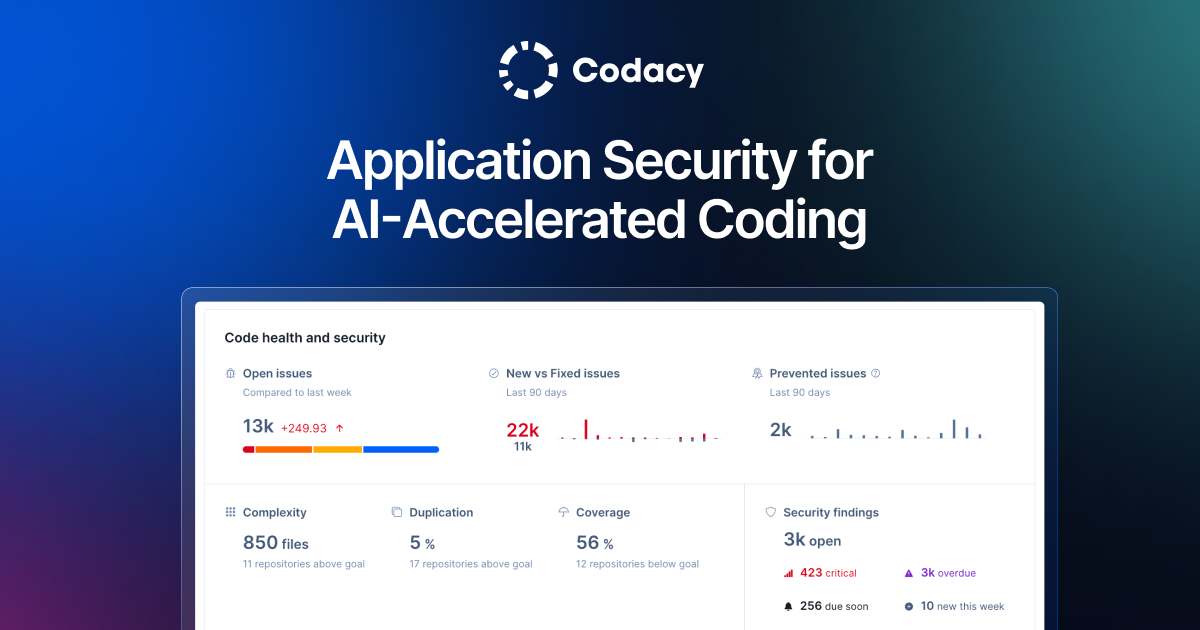
Codacy combines static analysis, SAST, SCA, secret scanning, IaC checks and test coverage in one platform, and has repositioned around AI-assisted engineering — detecting AI policy violations and unapproved model calls, with Codacy Guardrails embedding checks inside agentic workflows.
codacy.com8 viewsAdded October 21, 202510K visitors
Code review had a comfortable assumption behind it for twenty years: a person wrote the code, so a person understood it, and review was a second opinion on something already reasoned through.
Agentic coding breaks that. When an agent writes nine files in four minutes, nobody has reasoned through them — and the developer approving the pull request is reading code for the first time, at volume, under the same time pressure as before.
That makes automated review the primary control rather than a supplement, which is a genuine shift in what a tool like this is for. Codacy has repositioned around exactly that, and the interesting question is whether the repositioning is substantive or a change of wording.
What Does Codacy Enforce?
Five security scan types in one platform: SAST, SCA for dependencies, secret scanning, infrastructure-as-code checks and DAST, alongside classic code quality analysis.
It has repositioned around AI-written code — detecting AI policy violations and unapproved model calls, which is a genuinely new category of check.
Codacy Guardrails embeds checks inside agentic workflows, so problems are caught as an agent works rather than after it has committed.
It integrates where the code is: GitHub, GitLab, Bitbucket, VS Code, IntelliJ and Cursor, plus GitHub Copilot, Claude and Gemini.
Audit-ready for SOC 2 and ISO 27001, with SBOM generation, a self-hosted option and a free tier for open source.
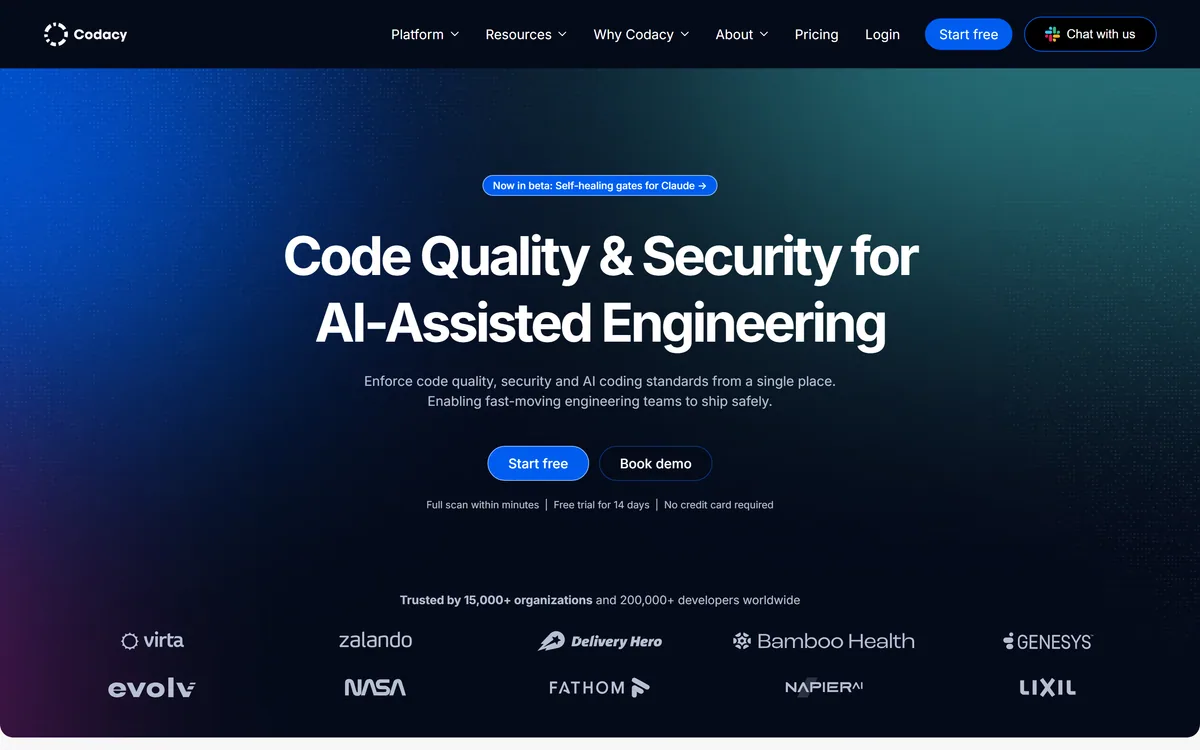
Codacy's homepage, captured 9 September 2026. The positioning has moved to AI-assisted engineering rather than general code quality.
Why Does AI-Written Code Need Different Checks?
Codacy's newer capabilities — AI policy violation detection, unapproved model call identification, and Codacy Guardrails for agentic workflows — address problems that did not exist three years ago.
Unapproved model calls is the clearest example and the most immediately valuable. A developer or an agent adding a call to an external language model API introduces a data flow nobody reviewed: customer information may now leave your infrastructure, and the first time anyone notices is usually an audit. Detecting those calls in the codebase is a genuinely new class of check, and an obvious one in hindsight.
AI policy violations covers the organisational rules a company has now written and has no way to enforce — which models are permitted, what data may reach them, whether generated code needs marking. Policies without enforcement are documents, and most AI policies are currently documents.
Guardrails is the architecturally interesting piece. Embedding checks inside the agentic workflow means a problem is caught while the agent works rather than after it commits, and correcting an agent mid-task is far cheaper than reviewing and reverting.
The scepticism worth holding is that all of this is only as good as the policy you configure. A tool that enforces rules cannot invent them, and an organisation without a considered AI policy will get an enforcement engine with nothing to enforce.
This is why the pairing matters. A generator such as GitHub Copilot raises the volume of code entering review, and volume is precisely what a human reviewer handles worst.
When an agent writes nine files in four minutes, nobody reasoned through them. Review stops being a second opinion and becomes the first one.
Five Scan Types Beats Four Tools
Codacy covers SAST, SCA with insecure dependency detection, secret scanning, infrastructure-as-code security and DAST, alongside code quality, duplication, complexity and test coverage.
Consolidation matters here more than in most categories, for a reason that is about people rather than software. Each separate scanner has its own dashboard, its own findings format and its own noise profile — and developers respond to four sources of alerts by ignoring three of them.
One platform with one findings list, integrated into the pull request, is the difference between checks that change behaviour and checks that generate reports nobody reads.
Secret scanning deserves particular mention in the agentic context. Agents write configuration and test files, and a hardcoded credential in generated code is exactly the sort of thing that passes a quick human read. Catching it before merge is worth the whole subscription on the day it happens.
Where It Sits Determines Whether It Works
Codacy integrates with GitHub, GitLab and Bitbucket for version control, VS Code, IntelliJ and Cursor for editors, and GitHub Copilot, Claude and Gemini among AI tools, plus Jira, Slack, Docker, JFrog and Amazon ECR.
The editor integrations are the ones that change outcomes. A finding surfaced in CI after a push is a task; the same finding surfaced in the editor as the code is written is a correction. The cost of fixing a problem rises steeply with how long it has existed, and the editor is the cheapest possible point.
Including Cursor in that list is notable and current — it acknowledges that a meaningful share of developers now work in an AI-first editor rather than a traditional one, and a quality tool that does not run there is invisible to them.
The AI tool integrations imply something more interesting: checks that run against what Copilot, Claude or Gemini produce as they produce it, which is the Guardrails idea applied at the assistant level rather than the agent level.
The question to test is signal quality in the editor specifically. Inline warnings that are frequently wrong get disabled within a week, and once disabled they never come back.
Placement is the same lesson runtime tools like Sentry Seer learned from the other end: a finding that arrives where the work is happening gets fixed, and one that arrives in a weekly digest does not.
Test the editor integration first, since that is where findings are cheapest to act on.
Measure the false positive rate before rolling out — noisy inline warnings get switched off permanently.
Confirm coverage for your actual languages, which the site does not enumerate.
Check how findings appear in the pull request, because that is where the enforcement happens.
Configure your AI policy before enabling policy checks, or there is nothing to enforce.
Compliance Is The Quiet Selling Point
Codacy states it is audit-ready for SOC 2 and ISO 27001 and generates SBOMs, with a self-hosted option available.
That combination addresses a problem most engineering teams meet for the first time during their first serious enterprise sale or funding round. A customer's security questionnaire asks how you ensure code quality, how you detect vulnerable dependencies, and how you know what is in your software — and the honest answer is frequently that nobody has documented it.
SBOM generation is the concrete part. A software bill of materials lists every component in your application, and it has moved from good practice to a procurement requirement in several sectors and a regulatory one in some jurisdictions. Generating it automatically from what is actually in your dependency tree beats maintaining a spreadsheet that is wrong within a month.
Audit-ready is a softer phrase and worth reading carefully: it means the tool produces evidence an audit would accept, not that using it makes you compliant. Compliance is a set of practices; this supports them.
The self-hosted option matters for the same buyers who need self-hosting anywhere — organisations where source code cannot reach a third-party cloud regardless of the vendor's own certifications.
Security-specific scanners such as Snyk Code go deeper on individual vulnerability classes. The trade you are making here is depth in one dimension against a single report covering five.
Trialling It Without Creating Alert Fatigue
The failure mode for any code analysis tool is not missing problems — it is finding so many that the team stops looking. A trial should be designed to avoid creating that on day one.
The bar is step three. A tool that produces four hundred findings on your existing codebase will be ignored, whatever those findings say.
Start with one active repository rather than your whole organisation. Enabling everything at once produces a wall of findings and a team that resents the tool.
Run it first in report-only mode against your main branch, and read the volume before deciding what to enforce.
Tune before you enforce: pick the small set of rules you would actually block a merge for, and turn the rest to advisory.
Test the editor integration on a real feature branch, and count how many inline warnings you would have acted on versus dismissed.
Enable secret scanning and dependency checks first, since those catch the highest-consequence problems with the lowest false positive rates.
Only then enable AI policy checks — and write the policy before you enable them, because the tool cannot invent your rules.
Trials, Tiers And The Open Source Exception
There is a 14-day free trial, a free tier for open source projects, and paid plans; amounts are not disclosed on the pages we read. A self-hosted option exists alongside the cloud platform.
Free for open source is a familiar and sound arrangement in developer tooling: it costs the vendor little, builds credibility where developers actually look, and converts when those developers reach a company that will pay.
In this category commercial pricing normally scales with contributors or repositories rather than with lines of code, so cost tracks team size. Self-hosting is usually licensed separately, and typically at a higher tier.
The company is headquartered in Lisbon, Portugal, which is worth noting for European buyers with data residency preferences, though hosting location is a separate question from company location and should be confirmed.
We do not publish amounts. Establish which languages your tier covers and whether the AI-specific checks are included at your level, since a newer capability is often gated to higher plans.
Key features of Codacy
Static analysis covering violations, complexity, duplication and unused code
SAST and DAST security scanning in one platform
Software composition analysis with insecure dependency detection
Secret scanning to catch hardcoded credentials before merge
Infrastructure-as-code security checks
AI policy violation detection and unapproved model call identification
Audit-ready for SOC 2 and ISO 27001; generates SBOMs
Deployment
Cloud platform with a self-hosted option
Headquarters
Lisbon, Portugal
Pricing model
14-day free trial; free tier for open source; paid plans with amounts not disclosed
Which Teams Need Codacy
Bring it in when
A meaningful share of your code is now written by agents, which makes automated review your primary control.
You want one findings list rather than four dashboards your developers have learned to ignore.
You have written an AI usage policy and have no way to enforce it, which is most companies that have written one.
Security questionnaires and SBOM requests have started arriving from enterprise customers.
Your developers work in Cursor or another AI-first editor, where many quality tools do not run.
Hold off when
You have no AI policy to enforce, in which case configure that first — the tool cannot invent your rules.
Your team already ignores existing static analysis findings, since more checks will not fix a cultural problem.
You need production error debugging rather than pre-merge analysis, which is a different category.
Your languages are unusual, since coverage is not enumerated on the pages we read.
You would enable everything at once, which produces a wall of findings and a team that resents the tool.
Other Code Quality And Security Tools
Compare on when in the lifecycle a tool catches a problem — editor, pull request, CI or production.
Snyk Code — security-first analysis with particularly strong dependency coverage
Sentry Seer — catches what static analysis cannot — failures that only appear in production
Zencoder — builds review into the coding agent itself rather than checking afterwards
Functionize — testing rather than analysis, for the other half of the quality question
GitHub Copilot — one of the AI tools whose output Codacy is designed to check
Confirming Codacy's Coverage
Last checked . Read from codacy.com, including the footer, with the screenshot above captured in the same session.
Positioning read from the site as code quality and security for AI-assisted engineering, enforcing quality, security and AI coding standards from a single place
Quality analysis confirmed as covering violations, complex code, error-prone code, unused code, duplication and unit test coverage
Security scanning confirmed as SAST, SCA with insecure dependency detection, secret scanning, infrastructure-as-code security, SQL injection detection and DAST
AI-specific features confirmed as AI policy violation detection, unapproved model call identification, Codacy Guardrails for agentic workflows and AI auto-fix
Version control integrations confirmed as GitHub, GitLab and Bitbucket
Editor integrations confirmed as VS Code, IntelliJ and Cursor
AI tool integrations confirmed as GitHub Copilot, Claude and Gemini
Other integrations confirmed including Jira, Slack, Docker, JFrog and Amazon ECR
Compliance stated as audit-ready for SOC 2 and ISO 27001, with SBOM generation
Deployment confirmed as cloud with a self-hosted option available
Pricing structure confirmed as a 14-day free trial with a free tier for open source projects
Headquarters given on the site as Lisbon, Portugal; footer confirmed to carry platform features, resources, comparisons, pricing, careers, legal and contact links
What we could not confirm: the number and list of supported programming languages are not enumerated on the pages we read, which is the first specification most buyers need; no false positive rate or accuracy data is published for any scan type; no pricing amounts or per-tier feature gating are disclosed, so whether AI-specific checks are included at lower tiers is unknown; the self-hosted licensing terms are not described; and we did not run the platform, so nothing here reflects tested finding quality.
Editor's Verdict
4.2/5
Codacy scores well because it identified the consequence of agentic coding that most teams have not addressed: when a large share of code is written by an agent, the review layer stops being hygiene and becomes the primary control. Combining static analysis with SAST, SCA, secret scanning and IaC in one platform is genuinely more useful than four tools, and Guardrails embedding checks inside agentic workflows is the right architecture — catching a problem before it lands beats finding it afterwards. It loses ground because language coverage is not enumerated where a buyer would look, and because more automated checks mean more findings, which is how teams learn to ignore them. AInexfinder Editor Score: 4.2/5.
Codacy pricing
AInexfinder does not list plan prices or billing details. For current pricing, plans, and trials, visit the official Codacy website.
Vendor pricing, credits, and billing policies change over time. Always confirm on the official site before you buy.
Frequently asked questions
What is Codacy?
Codacy is a code quality and security platform that combines static analysis, SAST, DAST, dependency scanning, secret scanning and infrastructure-as-code checks in one place. It has repositioned around AI-assisted engineering, adding AI policy violation detection, unapproved model call identification and Codacy Guardrails for agentic workflows.
Why does AI-generated code need different checks?
Because the assumption underneath code review has changed. Review used to be a second opinion on code a person had reasoned through; when an agent writes nine files in four minutes, the reviewer is reading it for the first time. Automated review stops being hygiene and becomes the primary control.
What is unapproved model call detection?
It finds calls to external language model APIs in your codebase that nobody sanctioned. That matters because such a call introduces a data flow no one reviewed — customer information may now be leaving your infrastructure — and the first time most organisations notice is during an audit. It is a genuinely new class of check.
What does Codacy Guardrails do?
It embeds security checks inside agentic coding workflows, so a problem is caught while the agent is working rather than after it has committed. Correcting an agent mid-task is considerably cheaper than reviewing and reverting, which is why the placement matters more than the checks themselves.
Is Codacy free?
There is a 14-day free trial and a free tier for open source projects, with paid plans above; amounts are not disclosed on the pages we read. Commercial pricing in this category usually scales with contributors or repositories. Confirm whether the AI-specific checks are included at your tier, since newer capabilities are often gated to higher plans.
Which programming languages does Codacy support?
The number and list are not enumerated on the pages we read, which is a real gap since it is the first thing most buyers need to know. Ask directly and confirm coverage for your actual stack — a quality platform that handles your main language well but your service language poorly will only be half adopted.
Will Codacy create too many alerts?
It can, and that is the failure mode to design against. Start with one repository in report-only mode, read the volume before enforcing anything, and enable secret scanning and dependency checks first — they catch the highest-consequence problems with the lowest false positive rates. A tool producing four hundred findings on day one gets ignored.
Does Codacy help with SOC 2 or ISO 27001?
It states it is audit-ready for both and generates SBOMs. Read audit-ready carefully: it means the tool produces evidence an audit would accept, not that using it makes you compliant. Compliance is a set of practices; this supports and evidences them, particularly around code quality and knowing what is in your software.
Can Codacy run on our own infrastructure?
Yes, a self-hosted option is available alongside the cloud platform. That matters for organisations where source code cannot reach a third-party cloud regardless of the vendor's certifications. Licensing terms for self-hosting are not described on the pages we read, so ask about those separately from cloud pricing.
How does Codacy compare with Snyk?
Snyk is security-first with particularly strong dependency coverage. Codacy spans a wider set — quality analysis alongside SAST, SCA, secrets, IaC and DAST — and has moved further into AI-specific checks such as unapproved model calls and agentic guardrails. If security depth is the priority, Snyk; if consolidating scanners and governing AI-written code is, Codacy.
Daniel reviews AI tools the slow way — by actually using them on real projects. His reviews cover what works, what breaks, and who each tool is genuinely a good fit for.
Daniel and the AInexfinder editorial team research Codacy using public product information, listing evidence, and (when available) hands-on checks. Scores reflect listing completeness and transparency — not paid placement.
Listings may include affiliate or sponsored placements, which are labeled when present. Editorial scores and cons are not sold. See our affiliate disclosure and review methodology.
CodeScene measures code with CodeHealth, a validated metric predicting defects and delivery performance. It states the average enterprise codebase scores 5.15 out of 10 while AI needs 9.5 to work reliably, and offers an MCP server, automated reviews and IDE feedback. Operated by CodeScene AB.
cubic reviews pull requests in GitHub and your IDE, enforces rules written in plain English, and learns from senior engineers' PR comment history. It runs thousands of agents nightly to scan an entire codebase for bugs, pulls context from Linear, JIRA, Notion and Confluence, and is free for public repositories.
Sourcery is an AI code-review tool that reviews every pull request in minutes, catching bugs, edge cases and security issues with one-click fixes, plus codebase security scanning, with a strong stance on keeping your code private.
Snyk Code is a static application security testing tool built for developers, using DeepCode AI to find vulnerabilities in the IDE in real time and Snyk Agent Fix to propose pre-validated fixes, including coverage for AI-generated code.
Korbit AI is an automated code-review tool that reviews pull requests inside GitHub, GitLab and Bitbucket, flagging bugs, security and design issues with fix explanations, writing PR descriptions and summaries, and generating team insights, without training on your code.