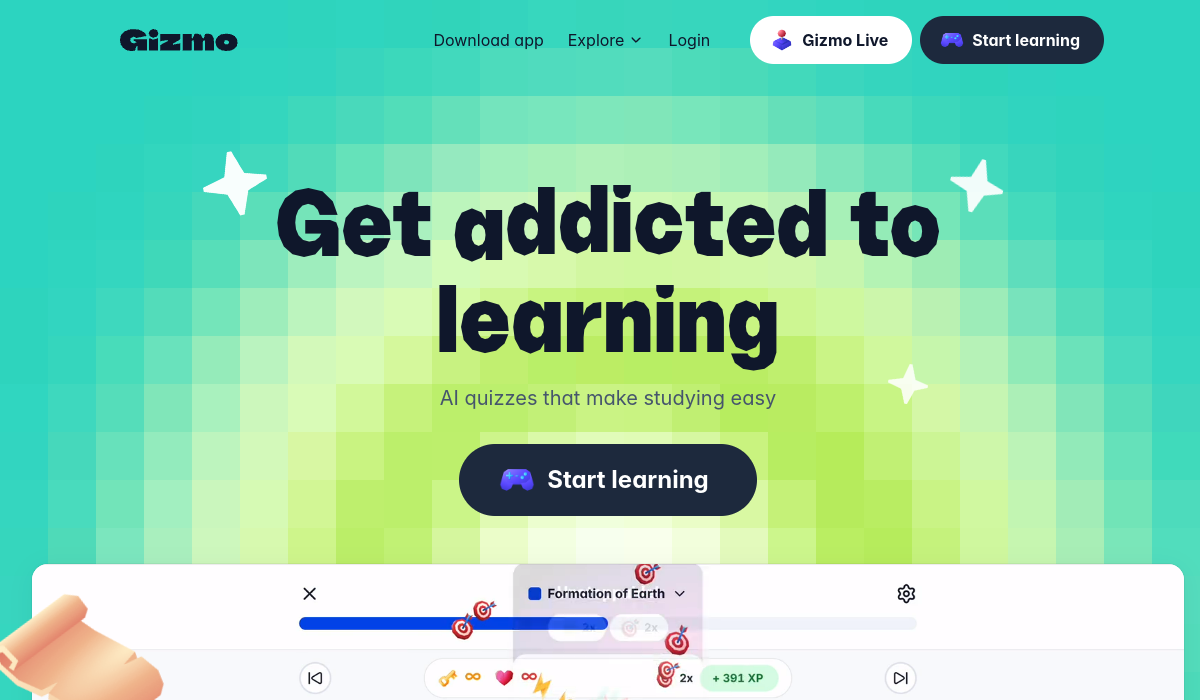
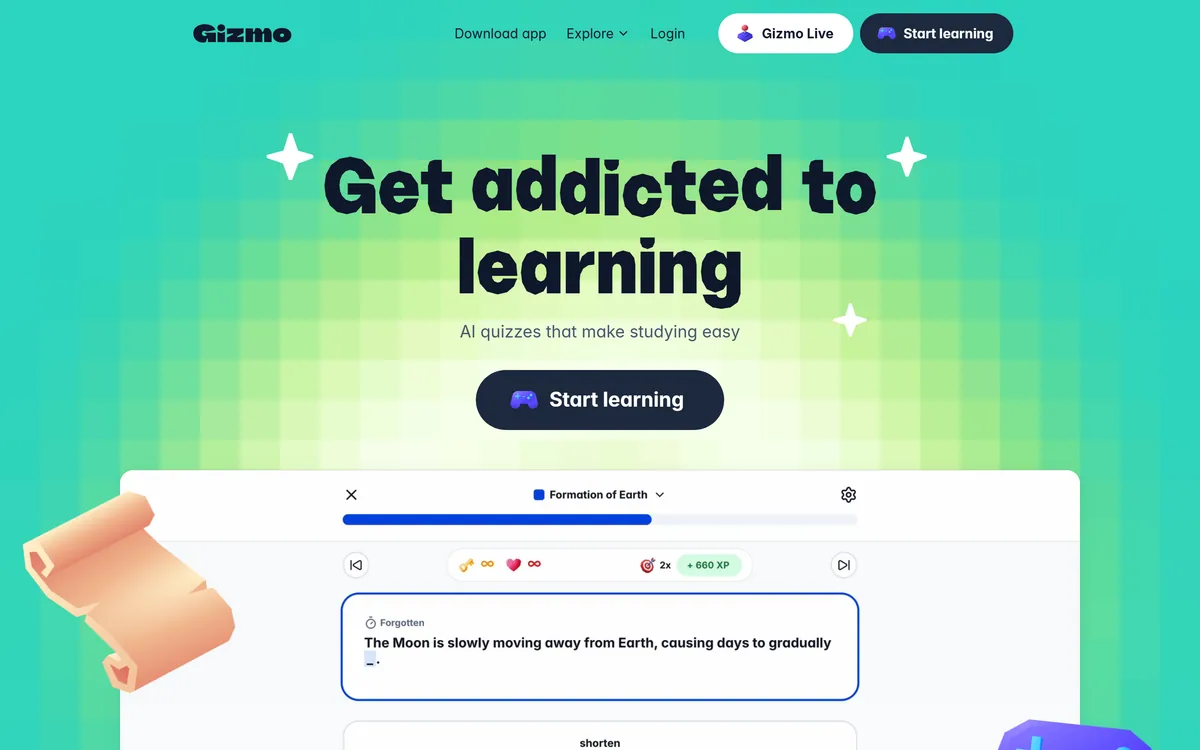
Gizmo is a mobile-first study app that turns your notes, PDFs, slides and YouTube videos into AI-generated quizzes and flashcards, built around active recall so revision becomes a habit rather than a chore.
Most students revise by rereading, which feels productive and barely works. Gizmo is built around the opposite habit, active recall, and tries to make it something you actually keep doing.
It is a mobile-first study app that turns your own material, notes, PDFs, slides and YouTube videos, into AI-generated quizzes and flashcards, then gets you testing yourself on them. That recall-first design puts it alongside a spaced-repetition tool like RemNote, rather than the answer-on-demand apps it is often lumped in with.
This review covers how Gizmo builds quizzes from your material, who it genuinely helps, how its free and paid tiers work, and why its grade-boosting testimonials deserve a sceptical read.
Gizmo leans on quizzing and recall rather than handing over answers.
Gizmo, The Snapshot
Gizmo is a quiz-first study app: it turns your material into AI quizzes and flashcards rather than handing you answers.
It ingests your sources: notes, PDFs, slides and YouTube videos become study cards and tests.
It is built on active recall: testing yourself instead of rereading, which is the point, not a shortcut.
Treat the grade claims with caution: the testimonials promise big results; your mileage depends on the work you put in.
Gizmo Study App Facts
What it is
A quiz-first AI study app
Platform
Mobile-first, with a web Explore section
Ingests
Notes, PDFs, slides and YouTube videos
Produces
AI quizzes and flashcards
Method
Active recall and self-testing
Approach
Study aid, not an answer-solver
Pricing
Freemium with an implied paid tier
Audience
School, college and university students
A Quiz-First App That Makes Revision A Habit
Gizmo's framing is 'get addicted to learning', and under the gamified language is a sound idea: the best way to remember something is to test yourself on it, repeatedly. The app is built to make that quizzing frictionless enough that you keep coming back.
That quiz-first stance is the important distinction. Gizmo is not pitched as a place to get your homework answered; it is a place to drill what you are learning. That makes it a study aid in the honest sense, one that still requires you to do the learning.
The gamified presentation, streaks, likes, a social feel, is aimed at the real problem with revision, which is not understanding but consistency. Making a dull habit slightly moreish is a legitimate design goal.
The best way to remember something is to test yourself on it, repeatedly. Gizmo's job is to make that quizzing frictionless enough that you keep coming back.
How Does Gizmo Build Quizzes From Your Material?
The workflow is about converting whatever you already have into something you can be tested on.
Turning Notes, PDFs And Videos Into Cards
You feed Gizmo your sources, class notes, a PDF, a slide deck, a YouTube lecture, and it generates flashcards and quizzes from them. That ingestion is the practical hook: you study from your own syllabus, not a generic question bank.
The breadth of inputs matters, because the material students actually have is messy and mixed. A broader study platform like StudyFetch covers a similar ingest-and-study loop; Gizmo's angle is keeping it tight, mobile and quiz-led.
Testing Yourself Instead Of Rereading
Once your material is in, the app has you answer questions rather than re-read, which is the mechanism that actually moves things into memory. Repetition over days is where the retention comes from.
This is learning done the right way around, and it pairs naturally with a guided-learning tool like Khanmigo for the explanation side: understand a concept there, then drill it in Gizmo until it sticks.
Who Gizmo Helps, And Who It Does Not
Gizmo helps students who have the material but struggle to revise consistently, GCSE, A-level, AP and university learners who need the habit as much as the content. For them, the quiz-first loop is genuinely useful.
It also suits visual and on-the-go learners who prefer short phone sessions to long desk ones, and anyone who learns better by being tested than by re-reading, which is most people, whether they know it or not.
It helps less if you want deep conceptual explanation, which is a tutor's job, not a quiz app's, or if you are hunting for quick answers to hand in, which is simply not what Gizmo is built to do. And like any study tool, it rewards the student who shows up regularly far more than the one who opens it the night before an exam and hopes.
How Gizmo Handles Its Free And Paid Tiers
Gizmo is freemium, free to download and start, with a paid tier for heavier use; one of its own testimonials calls it 'basically free', which suggests a generous free allowance. We do not publish prices, which change; check the app.
For a student, the value test is simple and personal: does it get you revising more often than you otherwise would? A study tool that sits unused is worthless at any price, and one that builds the habit is cheap at most.
Because the free tier is usable, there is little reason not to try it before paying, and the paid tier is only worth it once the habit has actually formed.
A Simple Way To Try Gizmo Properly
A study app only proves itself over a couple of weeks of real use, not a single session, so test it against your actual revision.
Download the app and load a real source you need to learn, a set of notes or a lecture PDF.
Let it generate flashcards and a quiz, then check the questions actually match your syllabus.
Do a short session daily for a week rather than one long cram.
Notice whether the quizzing habit sticks, which is the thing Gizmo is really selling.
Add a YouTube lecture or slide deck to test the breadth of inputs.
Pass/fail: Gizmo is worth it if you revise more consistently and recall more in a self-test.
Judge it on your own retention, not on the app's grade-boost testimonials.
Will Gizmo Suit How You Revise?
Students Who Get The Most From Gizmo
Students who have the material but revise inconsistently
People who learn better by self-testing than rereading
On-the-go learners who prefer short phone sessions
Anyone who wants to study from their own notes and PDFs
Learners who respond to a gamified, habit-building loop
When Gizmo Will Not Help You
Students needing deep conceptual explanation
Anyone looking for quick answers to hand in
Learners who will not study regularly whatever the app
People who want a desktop-first experience
Those expecting a guaranteed grade boost
Key features of Gizmo
AI quiz generation from your material
Flashcard maker from notes and PDFs
YouTube and slide summarisation to cards
Active-recall study loop
Gamified, habit-building design
Mobile-first with a web Explore section
Study from your own syllabus
Freemium access to start
Pros & cons
Pros
5
Recall-first design that actually aids memory
Studies from your own notes, PDFs and videos
Gamification targets the real problem of consistency
A study aid, not an answer-solver
Generous free tier to start
Cons
5
Not for deep conceptual explanation
Grade-boost testimonials are unverifiable
Mobile-first may not suit desktop users
Only as good as the habit you build
Thin detail on the paid tier
Best For
Inconsistent revisers
Self-testing learners
On-the-go students
People studying their own notes
Those who respond to gamification
Gizmo Compared With Other Study Apps
The useful comparison is with other recall-first study tools and broader platforms.
Last checked . Read from gizmo.ai during this check, with the screenshot above captured at the same time.
A mobile-first study app built around quizzes and flashcards
Ingestion of notes, PDFs, slides and YouTube videos
An active-recall, self-testing approach
A quiz-first design rather than an answer-solver
A gamified presentation aimed at study consistency
A freemium model with an implied paid tier
Heavy reliance on student grade-outcome testimonials
A web Explore section alongside the app
No plan prices reproduced here, in line with this site's pricing policy
Gizmo's page leans on unverifiable grade-boost testimonials; we report them as marketing, not evidence. Its value is the revision habit it builds, which depends on your own effort.
Study And Revision Tools To Compare
A spaced-repetition app, a broad study platform and a guided tutor to weigh alongside Gizmo.
Gizmo earns 3.7 for getting the fundamentals right: it is a quiz-first study app built on active recall, ingests your own notes, PDFs and videos, and uses gamification to fix the real problem with revision, consistency, rather than handing out answers. Its grade-boost testimonials are unverifiable marketing, and it will not explain concepts the way a tutor does, but as a habit-builder it is a sound, honest study aid. AInexfinder Editor Score: 3.7/5.
Gizmo pricing
AInexfinder does not list plan prices or billing details. For current pricing, plans, and trials, visit the official Gizmo website.
Vendor pricing, credits, and billing policies change over time. Always confirm on the official site before you buy.
Frequently asked questions
What is Gizmo?
Gizmo is a mobile-first study app that turns your own material, notes, PDFs, slides and YouTube videos, into AI-generated quizzes and flashcards. It is built around active recall, so you study by testing yourself rather than rereading, with a gamified design to keep the habit going.
Is Gizmo an answer-solver for homework?
No. Gizmo is a quiz-first study aid, not a tool for getting homework answered. It generates questions and flashcards from your material so you can drill and remember it, which is a legitimate, learning-focused use rather than a shortcut around the work.
What can Gizmo turn into flashcards?
It ingests a range of real student material, including class notes, PDFs, slide decks and YouTube videos, and generates flashcards and quizzes from them. Studying from your own syllabus, rather than a generic question bank, is one of its main practical advantages.
Does Gizmo actually improve grades?
Its site leans heavily on student testimonials claiming big grade jumps, which are unverifiable and should be read as marketing. What Gizmo genuinely offers is a recall-based revision habit; how much that helps your grades depends on the effort you put in.
Is Gizmo free?
Gizmo is freemium: free to download and start, with a paid tier for heavier use. One of its own testimonials calls it 'basically free', suggesting a generous free allowance. We do not publish prices, which change; check the app before paying.
How is Gizmo different from a tutor app?
A tutor app focuses on explaining concepts; Gizmo focuses on drilling what you already understand through quizzes and recall. Many students use both: a guided tutor to grasp an idea, then Gizmo to test and retain it until it sticks.
What is active recall and why does Gizmo use it?
Active recall is the practice of retrieving information from memory by testing yourself, rather than passively rereading, and it is one of the most evidence-backed study techniques. Gizmo is built around it because self-testing is far more effective for retention than review.
Is Gizmo only on mobile?
It is mobile-first, which suits short, frequent study sessions on a phone, and also has a web Explore section. If you strongly prefer studying on a desktop, the mobile-led experience may feel limiting, so weigh that against how you actually revise.
Who should not use Gizmo?
Students who need deep conceptual teaching rather than drilling, anyone hoping for quick answers to submit, and learners who simply will not revise regularly whatever the app. Gizmo rewards consistent self-testing; without that, no study app delivers much.
How should I test whether Gizmo works for me?
Load a real source you need to learn, generate flashcards and a quiz, and do a short daily session for a week rather than one cram. Judge it on whether the habit sticks and your recall improves in a self-test, not on the app's testimonials.
Daniel reviews AI tools the slow way — by actually using them on real projects. His reviews cover what works, what breaks, and who each tool is genuinely a good fit for.
Daniel and the AInexfinder editorial team research Gizmo using public product information, listing evidence, and (when available) hands-on checks. Scores reflect listing completeness and transparency — not paid placement.
Listings may include affiliate or sponsored placements, which are labeled when present. Editorial scores and cons are not sold. See our affiliate disclosure and review methodology.
LUCA is a K-12 reading intervention platform that analyses student reading at the phoneme level rather than the word level, identifying skill gaps in real time. It reports a 17.4 words-per-minute average fluency gain and 763,000+ grapheme-phoneme mappings, delivered through SoundScout, StoryGen and Assessment Intelligence.
Question AI is a homework-helper app that scans a question and returns step-by-step answers across school subjects, plus AI writing, search, translation and summarizing. Its study uses are legitimate; using it to hand in answers or graded work crosses academic-integrity lines, which we weigh honestly.
RemNote combines outlining, handwriting, PDF annotation and spaced-repetition flashcards in one document, generating cards, quizzes and summaries from PDFs, slides, lecture transcripts and video, with an exam scheduler that works backwards from a date you set.
StudyFetch turns course material — PDFs, slides, lecture recordings, YouTube videos, photographed notes — into flashcards, quizzes, summaries and an AI tutor called Spark.E that answers only from your uploaded content.
ThetaWise is a STEM study tool covering maths, science and engineering with step-by-step solutions, a Tutor Mode that guides through hints, generated animated video lessons, practice quizzes, flashcards and Desmos graphing, stating 765,781 students.
Wolfram|Alpha is a computational knowledge engine that computes verified, expert-level answers across maths, science, data and everyday topics using Wolfram's algorithms and curated knowledgebase, with step-by-step solutions, Pro features and an API.