Elicit is an AI research assistant for scientific literature. It searches across more than 125 million papers, screens and extracts data at systematic-review scale, and produces research reports where every claim carries a sentence-level citation back to its source.
elicit.com8 viewsAdded January 17, 202650K visitors
The citation on every sentence is not a nicety here. It is the entire reason the tool is usable.
Research Methodology Terms Used Here
Five terms that make the difference between understanding this tool and misreading its claims.
Systematic review
Answering a research question by finding and appraising all relevant evidence against a protocol declared in advance. The highest standard of evidence synthesis.
Recall
The share of genuinely relevant papers a search actually found. In systematic review this is the metric that matters, because a miss can change the conclusion.
Screening
Deciding which retrieved records are relevant, first from titles and abstracts and then from full text. Conventionally done independently by two reviewers.
Data extraction
Pulling specified variables out of each included study into a structured table — sample sizes, outcomes, effect sizes and study characteristics.
Publication bias
The tendency for studies with positive results to be published more often, which distorts any synthesis based only on published literature.
What Elicit Is Built To Do
Elicit is an AI research assistant that searches, screens, summarises and extracts data from academic papers, designed around systematic review methodology rather than around general question answering.
Coverage is more than 125 million papers, with the vendor stating it can analyse up to 1,000 relevant papers and process up to 20,000 data points in one piece of work.
Every generated claim carries a sentence-level citation to the source material — the single most important design decision in a research tool.
It publishes benchmark numbers against 994 Cochrane reviews: 95% search recall, 97% abstract screening, 99% full-text screening and 96% extraction, with data extraction accuracy stated at 99.4%.
The vendor states more than 5 million researchers use it, across pharmaceuticals, academia, medical devices, policy and industry.
Coverage, Accuracy And Scale
Category
AI research assistant for scientific literature and systematic review
Corpus
More than 125 million academic papers
Named features
Research Reports, Systematic Literature Review, Library, Alerts, Research Agent
Analysis scale
Vendor states up to 1,000 relevant papers analysed and up to 20,000 data points processed
Citation approach
Sentence-level citations from source material on every AI-generated claim
Pharmaceuticals, academia, medical devices and technology, policy and government, consumer goods, industrials, software and technology
Charging model
Tiered access with a free entry point and paid plans, plus institutional arrangements; no prices published here
Why Systematic Review Is The Right Problem To Attack
Elicit is not built to answer questions. It is built around a specific and enormously expensive research method, and understanding that method explains the whole product.
A systematic review is the process of answering a research question by finding and assessing all the relevant evidence, according to a protocol declared in advance. It underpins clinical guidelines, drug approvals and policy decisions, and it is the highest form of evidence synthesis there is.
It is also brutal to conduct. A team designs a search, runs it across databases, and retrieves several thousand records. Two reviewers independently screen every title and abstract. The survivors are read in full, again independently. Data is extracted from each included study into a structured table. Disagreements are resolved by a third reviewer.
That process routinely takes twelve to twenty-four months and consumes hundreds of hours of skilled time — most of it spent reading abstracts of papers that turn out to be irrelevant.
Faster tools like Consensus answer a question; this one builds a defensible search. It is exactly the shape of work that should be automated: high-volume, rule-governed, exhausting, and where the human contribution to each individual decision is genuinely small even though the aggregate matters enormously.
That Elicit organises itself around this rather than around a chat interface is the strongest signal about who built it and for whom.
Screening four thousand abstracts by hand is not research. It is the tax you pay before the research, and it is the right thing to automate.
The Cochrane Benchmark Is An Unusually Serious Claim
Most AI tools publish accuracy figures that cannot be checked. This one is different in a way worth explaining.
Cochrane reviews are the gold standard of evidence synthesis in medicine. They are conducted to a published protocol, by trained reviewers, with documented inclusion and exclusion decisions for every record considered.
That makes them a genuine benchmark rather than a marketing exercise. If you can obtain 994 completed Cochrane reviews, you have 994 cases where humans already decided, transparently, which papers were relevant and what data they contained. You can run a system against the same starting point and compare.
The stated results — 95% search recall, 97% abstract screening, 99% full-text screening, 96% extraction — describe agreement with expert human reviewers on tasks where the correct answer was independently established.
The figure that matters most is search recall at 95%, because in systematic review a miss is the defining failure. Missing 5% of relevant literature is not a small error — a review that omits a relevant trial can reach the wrong conclusion, and that conclusion may inform treatment.
So the honest reading is that 95% is genuinely impressive for automation and is not sufficient on its own for a review that will be published or submitted. Which is precisely why it is used to accelerate the process rather than replace the second reviewer.
Sentence-Level Citation Is The Feature That Makes It Usable
If you take one thing from this listing, take this: the citation architecture is more important than the corpus size.
General assistants like Perplexity cite the open web; academic work needs more. Language models fabricate references. This is not an occasional bug but a well-documented characteristic — plausible author names, plausible journals, plausible years, describing papers that do not exist. It is the single reason general chat models are dangerous for literature work, and it has already produced retractions and court sanctions in other fields.
A researcher who cannot instantly verify a claim has to check every reference by hand, which eliminates the time saving that motivated using the tool in the first place.
Grounding every generated sentence in a specific passage of a specific retrieved paper changes that entirely. The claim is traceable, and the check takes a click rather than a search.
It also changes the failure mode in a useful direction. A grounded system that cannot find support tends to say less rather than inventing more — which is the correct behaviour for research and the opposite of what a general assistant does.
The corollary is that you must still read the cited papers before relying on them. A citation proves the source exists and was retrieved; it does not prove the summary characterised its findings correctly, and characterisation is where the remaining errors live.
Run a review question you have already completed manually and compare what it retrieves.
Look specifically at what it missed — recall is the metric that matters, not what it found.
Click through a dozen citations and confirm each paper says what the summary claims.
Test a question where the literature is contested, and see whether it reflects the disagreement.
Keep it as a first-pass screener alongside a human reviewer before trusting it unsupervised.
How Access Is Sold
This site does not publish plan prices. Elicit's structure is tiered, and the shape is worth knowing because it differs by who you are.
There is a free entry point with paid tiers above it, and separate institutional arrangements for universities, pharmaceutical companies and government bodies.
The meter in research tools of this kind is usually work volume rather than seats — how many papers a run can analyse, how many extractions or reports you can perform, and whether the heavier systematic review workflows are available at your level. Screening 1,000 papers is a materially different unit of consumption from asking a question.
For individual academics the practical question is whether your institution already has an arrangement, since library-negotiated access is common for research tools and much cheaper than an individual subscription.
For commercial research teams the comparison worth running is against the fully loaded cost of the analyst hours currently spent screening. A systematic review consuming several hundred hours of skilled time makes the arithmetic unusually clear.
One thing to confirm regardless of tier: what happens to your uploaded documents and your queries, particularly if you are working on unpublished research or commercially sensitive questions.
What It Cannot Do, Stated Plainly
Being specific here matters more than usual, because the accuracy figures invite over-trust.
It cannot assess study quality the way a methodologist does. Risk of bias assessment — was randomisation adequate, was blinding maintained, was the outcome measure appropriate — requires domain judgement about how a study was actually conducted. Extraction finds what a paper reports; it does not evaluate whether the paper should be believed.
It sees published literature only. Publication bias is one of the most serious distortions in evidence synthesis: studies with negative results are systematically less likely to be published. A perfect search of published papers still inherits that bias, and grey literature and unpublished trial data sit largely outside any corpus.
Cross-checking against Semantic Scholar is a cheap sanity test. Coverage is not universal. 125 million papers is enormous and it is not everything — non-English literature, older material, some regional journals and paywalled content vary in how well they are represented.
The synthesis is still yours. Deciding what a body of evidence means, where studies conflict and why, and what should follow from it, is the actual intellectual work. Elicit gets you to the point where that work can begin, much faster.
For anything that will be published, submitted to a regulator, or used to inform clinical practice, treat this as a powerful assistant to a properly conducted review and not as the review itself.
Does not perform risk-of-bias or methodological quality assessment
Inherits publication bias, since unpublished negative results are not there to find
Coverage varies for non-English, older and paywalled literature
A citation proves a source exists, not that it was characterised correctly
Interpretation and synthesis remain the researcher's work entirely
Key features of Elicit
Search across more than 125 million academic papers
Automated abstract and full-text screening
Structured data extraction into tables across many studies
Research Reports built on systematic review methodology
Sentence-level citations on every generated claim
Library for organising and reusing sources
Alerts for new research on tracked questions
Research Agent environment for high-stakes work
Analysis of up to 1,000 papers in a single piece of work
Pros & cons
Pros
6
Built around systematic review methodology rather than around a chat box
Sentence-level citation grounding directly addresses the fabricated-reference problem
Benchmarking against 994 completed Cochrane reviews is a genuinely checkable standard
Attacks screening and extraction, which is where review hours actually go
Extraction across thousands of data points is work no researcher enjoys doing by hand
Alerts turn a one-off review into ongoing surveillance of a question
Cons
6
95% search recall means roughly one relevant paper in twenty is missed
Performs no risk-of-bias or methodological quality assessment
Inherits publication bias, since unpublished negative results cannot be found
Coverage is weaker for non-English, older and paywalled literature
A citation confirms a source exists, not that the summary characterised it correctly
Overkill and slower than ordinary search if you only need a handful of papers
Best For
Researchers conducting systematic and scoping reviews
Pharmaceutical and medical device evidence teams
Policy analysts synthesising research for government
PhD students running literature reviews at scale
Any team needing structured data extracted across hundreds of studies
Elicit Beside Other Research Assistants
These differ sharply in rigour and in what they are actually for, despite looking similar.
You conduct systematic or scoping reviews as part of your work
Screening and extraction consume hundreds of hours you would rather spend elsewhere
You need every claim traceable to a source you can open and check
You work in evidence-heavy sectors like pharma, medical devices or policy
You need structured data extracted across a large body of studies
Read The Papers Yourself If
You need three or four papers on a topic, where ordinary search is faster
Your field's literature sits largely outside indexed English-language journals
You would submit its output as a review without a human second reviewer
You need methodological quality appraisal, which it does not perform
Your question is about the open web rather than academic literature
Other Tools For Literature Work
Most serious research uses several of these — one for discovery, one for synthesis, one for checking how a paper has been received.
Consensus — faster evidence answers when you do not need review-scale rigour
Scite — shows whether later papers support or contrast a finding
Semantic Scholar — free discovery and a useful cross-check on coverage
Scholarcy — summarising individual papers you have already selected
Cypris — the same discipline applied to patents and commercial R&D
Elicit's Published Claims, Checked
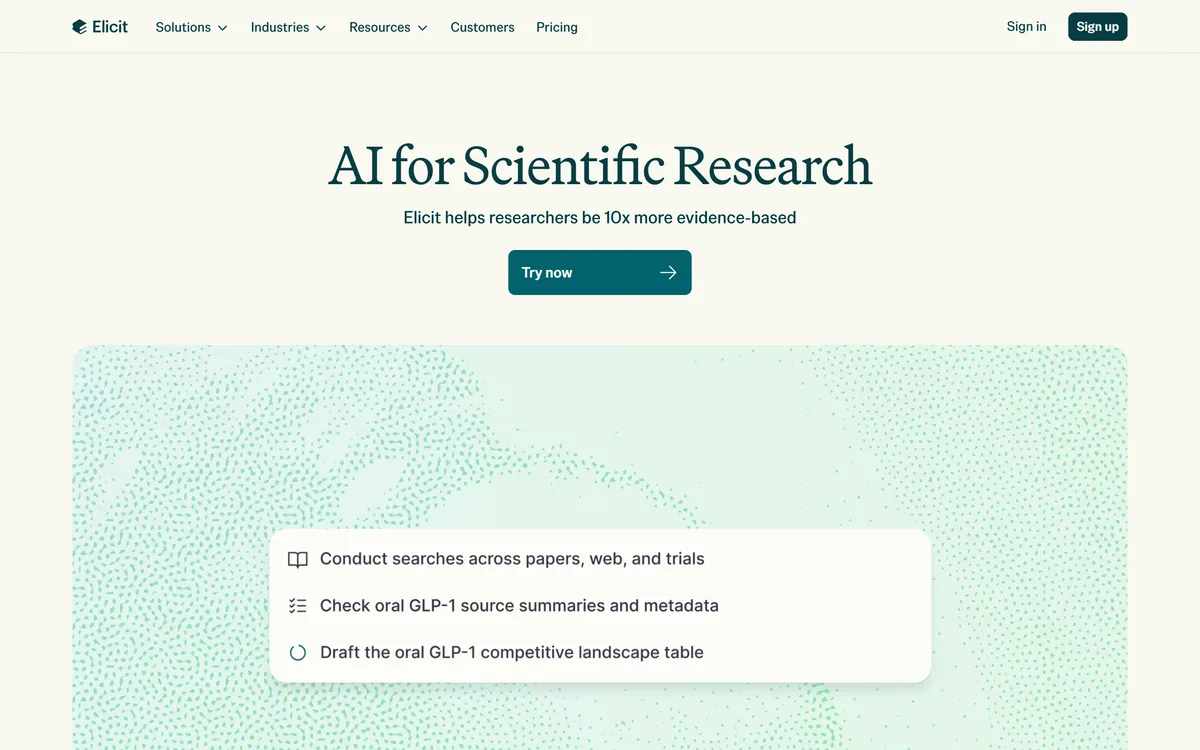
Last checked . Read from elicit.com during this check, with the screenshot above captured at the same time.
Corpus stated as more than 125 million academic papers
Named features confirmed on site: Research Reports, Systematic Literature Review, Library, Alerts and Research Agent
Analysis scale stated as up to 1,000 relevant papers and up to 20,000 data points
Sentence-level citations stated as accompanying all AI-generated claims
Benchmark stated across 994 Cochrane reviews with 95% search recall, 97% abstract screening, 99% full-text screening and 96% extraction
Data extraction accuracy stated at 99.4%
User base stated as more than 5 million researchers
Sectors listed including pharmaceuticals, academia, medical devices and technology, policy and government, consumer goods, industrials and software
Research Reports described as inspired by systematic review methodology
Tiered access referenced on site with pricing pages linked; no plan prices published here, in line with this site's pricing policy
All accuracy and scale figures are the vendor's own, benchmarked against Cochrane reviews but not independently audited. Search recall of 95% means roughly one relevant paper in twenty is missed, which is not acceptable on its own for a review intended for publication or regulatory submission — this accelerates a properly conducted review rather than replacing the second reviewer. It also cannot assess study quality, and inherits publication bias from the literature it searches.
Editor's Verdict
4.6/5
Elicit has an AInexfinder Editor Score of 4.6/5.
Elicit pricing
AInexfinder does not list plan prices or billing details. For current pricing, plans, and trials, visit the official Elicit website.
Vendor pricing, credits, and billing policies change over time. Always confirm on the official site before you buy.
Frequently asked questions
What is Elicit used for?
Searching, screening, summarising and extracting data from academic papers, organised around systematic review methodology. It is built for the high-volume screening and extraction work that dominates a literature review rather than for answering one-off questions.
How accurate is Elicit?
The vendor benchmarks against 994 Cochrane reviews, reporting 95% search recall, 97% abstract screening, 99% full-text screening and 96% extraction, with 99.4% data extraction accuracy. Those are vendor-published figures against a genuinely checkable standard.
Can Elicit do a systematic review on its own?
No, and its own recall figure explains why. Missing roughly one relevant paper in twenty is not acceptable for a review intended for publication or regulatory submission, where an omitted trial can change the conclusion. Use it to accelerate the process alongside a human reviewer.
Does Elicit make up citations?
Its architecture is designed to prevent that — every generated claim is grounded in a sentence from a retrieved paper. That is the key difference from general chat models, which fabricate plausible references. You should still read the cited papers, because grounding proves the source exists rather than that it was summarised correctly.
How many papers does Elicit cover?
More than 125 million, with the ability to analyse up to 1,000 relevant papers and process up to 20,000 data points in a single piece of work. Coverage is weaker for non-English, older and paywalled material, as it is for every index.
Is Elicit free for students?
There is a free entry point with paid tiers above it, and institutional arrangements exist for universities. Check whether your library already has access before paying individually — that is common for research tools and usually much cheaper.
Elicit vs Consensus — which should I use?
Consensus is built for quick, cited answers to a research question. Elicit is built for review-scale work — screening hundreds of papers and extracting structured data. If you need an answer, use Consensus. If you need a defensible search, use Elicit.
Daniel reviews AI tools the slow way — by actually using them on real projects. His reviews cover what works, what breaks, and who each tool is genuinely a good fit for.
Daniel and the AInexfinder editorial team research Elicit using public product information, listing evidence, and (when available) hands-on checks. Scores reflect listing completeness and transparency — not paid placement.
Listings may include affiliate or sponsored placements, which are labeled when present. Editorial scores and cons are not sold. See our affiliate disclosure and review methodology.
AnswerThis is an AI research assistant for literature reviews that searches a large database of papers and trials, checks citations and claims against their sources, supports PRISMA- and Cochrane-style systematic reviews, and helps draft, revise and collaborate on research writing.
Gemini Notebook is Google's research and thinking tool, grounded in sources you upload rather than the open web. Renamed from NotebookLM on 16 July 2026, it now also runs code in a secure cloud environment and syncs notebooks with the Gemini app.
Consensus is an AI-powered academic search engine that searches and analyses hundreds of millions of peer-reviewed research papers, with a Deep Search that automates literature review, a Medical mode for clinical sources, and natural-language filters, used across university libraries.
LUCA is a K-12 reading intervention platform that analyses student reading at the phoneme level rather than the word level, identifying skill gaps in real time. It reports a 17.4 words-per-minute average fluency gain and 763,000+ grapheme-phoneme mappings, delivered through SoundScout, StoryGen and Assessment Intelligence.