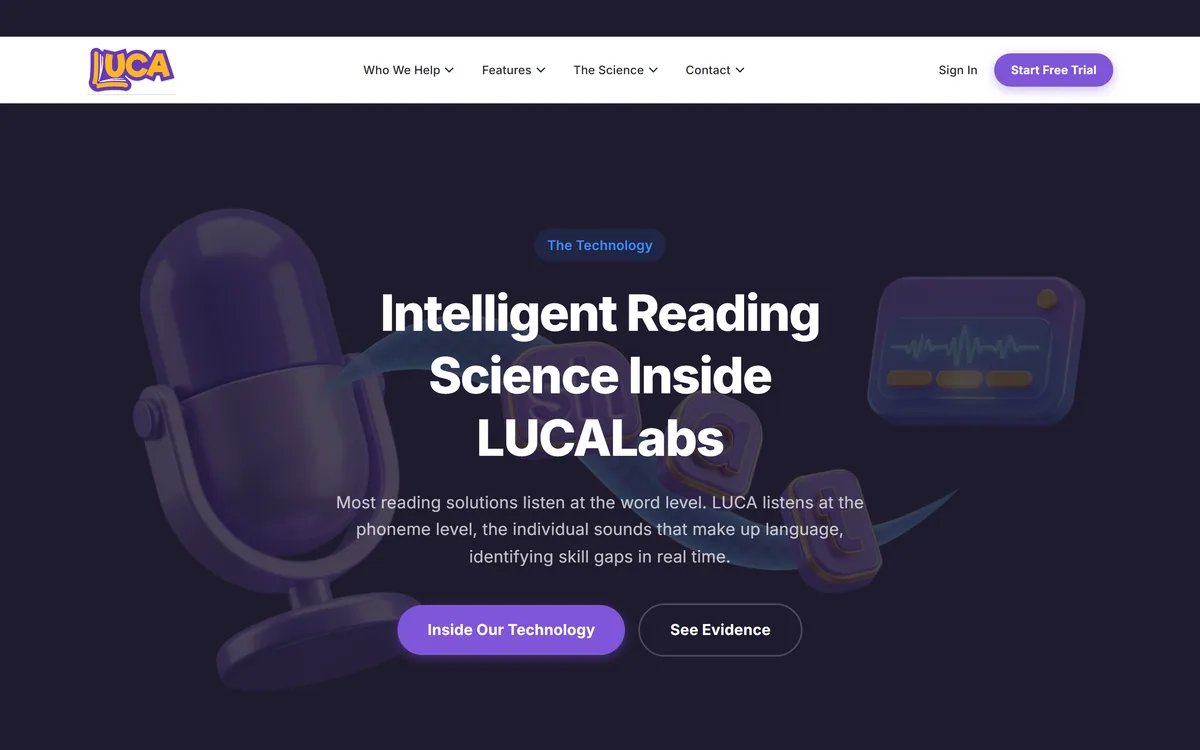
LUCA is a K-12 reading intervention platform that analyses student reading at the phoneme level rather than the word level, identifying skill gaps in real time. It reports a 17.4 words-per-minute average fluency gain and 763,000+ grapheme-phoneme mappings, delivered through SoundScout, StoryGen and Assessment Intelligence.
A child who cannot read a word is usually not failing at that word. They are failing at one specific relationship between letters and sounds, and that relationship appears in dozens of other words they will also miss.
Finding which one is the entire skill of a reading specialist. It requires listening carefully to a child read aloud, repeatedly, and hearing the pattern in the errors rather than the errors themselves.
LUCA's proposition is to do that listening automatically, at the level of individual sounds — and its framing is that there are nowhere near enough specialists to do it any other way.
LUCA: Reading Taught At The Phoneme Level
Listens at the phoneme level — the individual sounds inside a word — rather than judging whether the whole word was correct.
763,000+ grapheme-phoneme mappings behind LUCADictionary, which is what makes that granularity possible.
+17.4 words per minute average fluency improvement stated, with 85% and 88% figures from a Spring 2026 pilot.
Three components: SoundScout, StoryGen and Assessment Intelligence.
Framed around scarcity — the site cites 211 struggling readers for every trained reading specialist.
LUCA's homepage, captured 9 September 2026, showing the phoneme-level reading science positioning.
Why Does Phoneme-Level Listening Matter?
LUCA states that most reading solutions listen at the word level, while it listens at the phoneme level — the individual sounds that make up language — identifying skill gaps in real time.
That distinction is the whole product, and it maps onto how reading instruction actually works.
Word-level assessment produces a list: these forty words were wrong. It is a record of symptoms and it does not tell a teacher what to do next, because forty wrong words might reflect one underlying gap or fifteen.
Phoneme-level assessment produces a diagnosis. If a child consistently misses a particular vowel team or consonant blend, that is one teachable thing, and teaching it fixes every word containing it.
This is why the granularity is not a technical detail. It is the difference between telling a teacher that a child is behind and telling them precisely which skill to teach on Monday — and with a stated ratio of 211 struggling readers per trained specialist, that difference decides whether intervention happens at all.
Word-level assessment tells a teacher a child is behind. Phoneme-level assessment tells them which skill to teach on Monday.
Reading The Pilot Numbers Carefully
LUCA publishes four figures: +17.4 words per minute average fluency improvement across grade levels, 85% of students reaching high-confidence reading thresholds in a Spring 2026 pilot, 88% seeing gains in their first week, and 763,000+ grapheme-phoneme mappings.
Two of these are labelled as coming from a pilot, and that labelling is worth crediting — a great deal of education technology reports outcomes without saying where they came from.
Pilot data has known limits, and none of them imply anything is wrong. Pilots are usually small, run in schools that volunteered, supported by staff who are engaged because it is new, and measured against a baseline the vendor chose.
The 88% seeing gains in their first week is the figure to treat most carefully. Very early gains in fluency measures often reflect familiarity with the assessment format rather than reading improvement, which is a well-documented effect.
The fluency figure is the more meaningful one, because words per minute is a standard, comparable measure. What is missing is the comparison — 17.4 against what a matched group achieved over the same period is the number that would settle it, and the site does not provide it.
SoundScout, StoryGen And Assessment
The product is described as delivering reading-specialist-level support through SoundScout, StoryGen and Assessment Intelligence, with a mastery overview shown in the interface.
The three names map onto the three things a reading intervention has to do, which is a coherent structure rather than a feature list.
SoundScout is the listening layer — analysing a child reading aloud and locating gaps at sound level. This is the technically hardest part, because children's speech is genuinely difficult for speech recognition, with high variability, developing articulation and enormous accent variation.
StoryGen is the practice layer, and generation matters here for a specific reason. Once you know a child misses a particular sound correspondence, you need text that practises it heavily — and no fixed library contains a passage targeting every possible gap.
Assessment Intelligence closes the loop by tracking mastery, which is what turns a set of activities into an intervention. Without it a teacher has a tool; with it they have a record showing whether the gap actually closed.
Ask for the comparison group behind any fluency gain figure.
Treat first-week gains cautiously — familiarity with a test format is not reading.
Check how the system handles your students' accents and dialects.
Verify that generated practice text is age-appropriate before it reaches children.
Confirm what happens to voice recordings of children, in writing.
Speech Recognition On Children's Voices
The hardest technical problem here is not mentioned prominently on the site and deserves to be, because it determines whether anything else works.
Speech recognition is substantially harder on children than adults. Voices are higher and more variable, articulation is still developing, and the very sounds a struggling reader produces imprecisely are the ones the system must judge.
There is a circularity to be careful about. A system trying to detect whether a child produced a phoneme correctly must distinguish a genuine decoding error from unclear articulation, a speech difference, or a regional accent — and those can look identical in audio.
The consequence of getting it wrong runs in both directions. A child flagged as having a decoding gap they do not have gets practice they do not need; a child whose accent is misread as an error is being told their speech is wrong, which is a serious thing to do to a young reader.
This is the question to ask any vendor in this space: what speech data the system was trained on, how it handles regional and dialect variation, and whether it distinguishes articulation differences from reading errors. It is the same class of question that decides fairness in any consumer analysis product, including Derm AI.
The Scarcity Argument And What It Justifies
LUCA frames the problem starkly: 211 struggling readers for every trained reading specialist, 66% of US students not reading proficiently, and third-grade struggling readers four times more likely to drop out.
The framing is emotionally effective and the underlying scarcity is real. There are nowhere near enough specialists, and children who need intervention overwhelmingly do not receive it.
What follows from scarcity is the important argument, and it is a comparative one. The relevant question is not whether LUCA is as good as a trained specialist — nothing software does is — but whether it is better than the nothing most children currently get.
That is a much easier bar and a legitimate one. An intervention that is 60% as effective as a specialist, available to a child who was never going to see a specialist, is a substantial gain.
The risk to watch is displacement rather than supplement. If a district reads the scarcity argument as a reason to fund software instead of specialists, the tool has made things worse for the children who most needed a person — which is a policy failure rather than a product one, but the framing makes it easier.
The pattern holds across education technology generally. Practice platforms like Coddy and immersion tools such as Language Reactor succeed by supplying volume that no teacher has hours to provide, and fail wherever the missing ingredient was judgement rather than repetition.
Reading intervention sits awkwardly across that line, because diagnosis is judgement and practice is volume. A tool doing both has to be evaluated twice — once on whether it identifies the right gap, and once on whether the practice it then generates actually closes it.
Introducing LUCA To A Classroom
Education technology usually fails at implementation rather than capability: bought at district level, deployed without training, and quietly unused by half-term.
This sequence tests the specific claims against your own students before anything scales.
Ask for the comparison group and methodology behind the published gain figures.
Pilot with students whose reading profiles a specialist has already assessed.
Compare what the system identifies against what the specialist found.
Check performance specifically on students with strong regional accents or dialects.
Settle voice recording retention, consent and deletion in writing before children use it.
Confirm it supplements specialist time rather than being counted as a replacement.
Reading Intervention Terms
The vocabulary LUCA uses, and what each term means in practice.
undefined
undefined
undefined
undefined
undefined
undefined
LUCA: Evidence And Products
Product type
K-12 reading intervention platform
Positioning
The intelligent reading specialist for K-12 students
Core method
Phoneme-level listening rather than word-level assessment
211 struggling readers per trained reading specialist stated
66% of US students stated as not reading proficiently
SoundScout, StoryGen and Assessment Intelligence named as the delivery components
Described as trusted by schools and backed by leading research institutions
An origin story described as a father's mission, with the product named after his son
What we could not confirm: the comparison group and methodology behind the fluency and pilot figures, which the site references but does not detail on the pages we read; which research institutions are involved and what they published; pricing and licensing for schools; how the system handles regional accents, dialects and speech differences, which is the central fairness question; what happens to voice recordings of children, including retention, consent and deletion; and whether the cited national statistics carry a source. Nothing here is educational advice.
Is LUCA Right For Your Students?
Bring LUCA in when
You have far more struggling readers than specialist hours to assess them.
You need to know which skill to teach rather than which children are behind.
Practice text targeted to a specific sound gap is not something your library provides.
You want mastery tracked so you can see whether a gap actually closed.
The alternative for these children is currently no intervention at all.
A specialist is needed when
A child has a suspected speech or language disorder needing clinical assessment.
Your students' accents or dialects differ from what the system was trained on.
Adoption would be used to justify reducing specialist staffing.
You cannot resolve voice recording consent and retention for minors.
Comprehension rather than decoding is the actual difficulty.
Editor's Verdict
4.0/5
Most reading apps listen for whether a word was right. LUCA's claim is that it listens to the sounds inside the word, which is a genuinely different measurement and the one that matches how reading difficulty actually presents — a child does not fail at 'through', they fail at a specific grapheme-phoneme correspondence that shows up in forty words. Publishing pilot figures with the term pilot attached is more honest than most education technology manages. The score reflects that the evidence is early-stage and self-reported, which is normal at this point and still needs saying plainly. AInexfinder Editor Score: 4.0/5.
LUCA pricing
AInexfinder does not list plan prices or billing details. For current pricing, plans, and trials, visit the official LUCA website.
Vendor pricing, credits, and billing policies change over time. Always confirm on the official site before you buy.
Frequently asked questions
What is LUCA?
LUCA is a K-12 reading intervention platform that listens to students read at the phoneme level rather than the word level, identifying skill gaps in real time. It delivers through SoundScout, StoryGen and Assessment Intelligence, and reports a 17.4 words-per-minute average fluency gain.
Why does phoneme-level listening matter?
Because word-level assessment produces a list of symptoms — these forty words were wrong — which could reflect one underlying gap or fifteen. Phoneme-level assessment produces a diagnosis: this specific vowel team is missing, and teaching it fixes every word containing it.
How should I read the pilot figures?
As encouraging early evidence, which is what they are labelled as. Pilots are usually small, run in volunteering schools, supported by engaged staff, and measured against a vendor-chosen baseline. None of that implies anything is wrong; it means the numbers are not yet outcomes.
Which figure is the weakest?
88% seeing gains in their first week. Very early improvements in fluency measures frequently reflect familiarity with the assessment format rather than reading improvement, which is a well-documented effect and one to ask about directly.
What would make the fluency number convincing?
A comparison group. 17.4 words per minute is a standard, comparable measure, but the meaningful figure is 17.4 against what a matched group achieved over the same period — and the site does not provide it on the pages we read.
Why is speech recognition on children hard?
Voices are higher and more variable, articulation is still developing, and the sounds a struggling reader produces imprecisely are exactly the ones the system must judge. Distinguishing a decoding error from unclear articulation or an accent is genuinely difficult.
What is the risk if it gets that wrong?
It runs both ways. A child flagged with a gap they do not have receives practice they do not need. A child whose accent is misread as an error is being told their speech is wrong, which is a serious thing to do to a young reader.
What is StoryGen for?
Generating practice text targeted at a specific gap. Once you know a child misses a particular sound correspondence, you need passages that practise it heavily — and no fixed library contains text targeting every possible gap, which is why generation earns its place here.
Should software replace reading specialists?
No, and the framing makes that easy to get wrong. The right comparison is not against a specialist but against the nothing most children currently receive. If a district reads the scarcity argument as a reason to fund software instead of staff, the children who most needed a person lose.
What should a school settle before deploying it?
Voice recording retention, consent and deletion for minors, in writing. Then pilot with students a specialist has already assessed and compare what the system finds against what the specialist found — including for students with strong regional accents.
Daniel reviews AI tools the slow way — by actually using them on real projects. His reviews cover what works, what breaks, and who each tool is genuinely a good fit for.
Daniel and the AInexfinder editorial team research LUCA using public product information, listing evidence, and (when available) hands-on checks. Scores reflect listing completeness and transparency — not paid placement.
Listings may include affiliate or sponsored placements, which are labeled when present. Editorial scores and cons are not sold. See our affiliate disclosure and review methodology.
Question AI is a homework-helper app that scans a question and returns step-by-step answers across school subjects, plus AI writing, search, translation and summarizing. Its study uses are legitimate; using it to hand in answers or graded work crosses academic-integrity lines, which we weigh honestly.
Gizmo is a mobile-first study app that turns your notes, PDFs, slides and YouTube videos into AI-generated quizzes and flashcards, built around active recall so revision becomes a habit rather than a chore.
RemNote combines outlining, handwriting, PDF annotation and spaced-repetition flashcards in one document, generating cards, quizzes and summaries from PDFs, slides, lecture transcripts and video, with an exam scheduler that works backwards from a date you set.
StudyFetch turns course material — PDFs, slides, lecture recordings, YouTube videos, photographed notes — into flashcards, quizzes, summaries and an AI tutor called Spark.E that answers only from your uploaded content.
ThetaWise is a STEM study tool covering maths, science and engineering with step-by-step solutions, a Tutor Mode that guides through hints, generated animated video lessons, practice quizzes, flashcards and Desmos graphing, stating 765,781 students.
Wolfram|Alpha is a computational knowledge engine that computes verified, expert-level answers across maths, science, data and everyday topics using Wolfram's algorithms and curated knowledgebase, with step-by-step solutions, Pro features and an API.