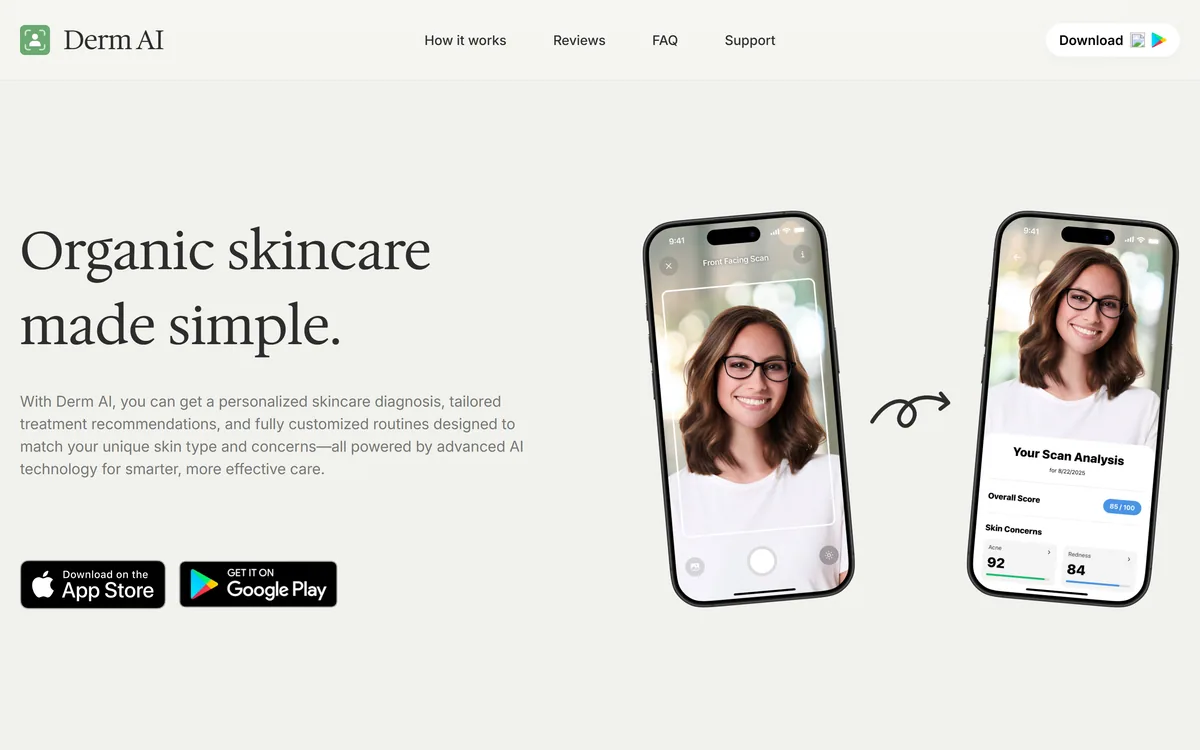
Derm AI analyses a photo of your face to produce personalised skincare recommendations and routines, shows ingredient breakdowns for any product, suggests cleaner alternatives, and tracks progress with graphs. Operated by DermAI LLC, with an FAQ addressing whether it replaces a dermatologist.
Skincare is an unusually badly served consumer category. Labels list ingredients in a naming system almost nobody can read, claims are regulated loosely, and the feedback loop between using something and seeing a result runs for weeks.
That combination makes people cycle products constantly, which is the one behaviour guaranteed to prevent anything from working. Nothing has time to help before it is replaced.
Derm AI addresses both halves: making the ingredient list legible, and making the routine something you stick to long enough to judge.
Derm AI: Skin Analysis From A Photo
Photo in, routine out — take a picture, receive recommendations across skincare categories, track progress in graphs.
Ingredient breakdowns for any product, plus suggested cleaner alternatives.
A routine manager with frequency settings, notes per product and morning or evening grouping.
The site's own FAQ asks whether it replaces a dermatologist, which is the right question to put on the page.
DermAI LLC, contactable at a published address, with the app positioned around organic skincare.
Derm AI's homepage, captured 9 September 2026, showing the photo-based skin analysis flow.
How Much Can A Photo Tell You About Skin?
Derm AI's flow is to upload a clear photo of your face through a secure camera interface, receive personalised routine suggestions and curated product options per category, then track improvements through progress graphs.
Some things genuinely are visible in a photograph. Surface texture, visible redness, obvious oiliness or flaking, and change over time in the same lighting are all legible signals, and change over time is the strongest of them.
Other things are not, and the gap matters. Depth is invisible, and the difference between something superficial and something that needs attention is frequently a matter of depth rather than appearance.
Lighting and camera dominate everything. The same skin photographed in bathroom light and daylight looks like two different conditions, which is why consistency of photography matters more than resolution for anything tracked over time.
Skin tone is the most important limitation to raise. Dermatological image analysis has a documented history of performing unevenly across skin tones, largely because reference datasets have historically over-represented lighter skin — and consumer apps rarely state what theirs was built on.
The same skin photographed in bathroom light and daylight looks like two different conditions. Consistency of photography matters more than resolution.
Why This Is Not A Diagnosis
Derm AI's own FAQ includes the questions does this replace seeing a dermatologist, how accurate is the skin analysis, and what conditions it can recognise. Putting those on the page is the right instinct.
The distinction that matters is between describing and diagnosing. An app can reasonably say this area appears drier than the surrounding skin; it cannot say what that is, and the second is the medical act.
The risk runs in both directions and the more serious one is reassurance. Something concerning that an app treats as ordinary dryness produces delay, and delay is where most preventable harm in skin conditions occurs.
The other direction is anxiety. Flagging normal variation as a concern generates worry and unnecessary appointments, which has its own cost.
The sensible rule is simple and worth stating plainly: anything new, changing, bleeding, or that has worried you for more than a few weeks goes to a clinician regardless of what any app said. Wellbeing apps such as Clarity face the same boundary and it is drawn in the same place.
Ingredients, Alternatives And Who Benefits
The app shows ingredient breakdowns for any product, explaining what is inside and how it may affect your skin, and suggests cleaner and safer alternatives where something does not fit.
The breakdown half is straightforwardly good. Ingredient lists use INCI naming, which is standardised, unpronounceable and effectively designed to be unread by consumers — so translating it is real value with no modelling risk attached.
It is also how you find the actual cause of a problem. Someone reacting to a product is usually reacting to one ingredient in it, and identifying that is far more useful than switching brands and hoping.
The alternatives half deserves more scepticism, for two reasons. Clean and safe are marketing terms rather than regulatory ones, and natural origin has no relationship to whether something irritates your skin — plenty of botanical extracts are common sensitisers.
The second reason is commercial. Any free app recommending products has a revenue model somewhere, and whether suggestions are ranked by suitability or by affiliate relationship changes what a recommendation means. The site's own FAQ asks whether recommendations are unbiased, which is again the right question to raise.
Photograph in the same light at the same time of day, always.
Use ingredient breakdowns to find the specific cause, not just to switch brands.
Treat clean and safe as marketing words, not safety classifications.
Give any routine at least eight weeks before judging it.
See a clinician about anything new, changing or persistent, whatever the app says.
Tracking Progress Over Months
The routine manager lets you build morning, evening and concern-specific routines, adjust how often products are used, move them between routines and add notes on how each ingredient behaves.
This is the most quietly useful feature, because the binding constraint in skincare is almost never product selection. It is consistency for long enough that anything could work.
Skin turnover means most changes take weeks, and many active ingredients get worse before they get better. Someone judging a product after ten days is measuring the adjustment period and concluding it failed.
Notes per product matter more than they look. Skincare problems are usually solved by elimination, and elimination requires a record — which nobody keeps in their head accurately across three months and six products.
Progress graphs help with the same problem from the other side. Skin changes too slowly to perceive day to day, so the impression you have of whether something is working is unreliable, and a photographic record taken consistently is a better witness than memory.
What The App Does Not Tell You
There are gaps here that a buyer should know about, none of which are unusual for the category.
How the analysis was validated is the biggest. Accuracy is raised in the FAQ, but the answer that would matter — tested against what, on how many people, across which skin tones — is the kind of detail consumer skincare apps rarely publish.
What happens to your photographs is the second. Face photographs are biometric-adjacent personal data, and where they are processed, how long they are held and whether they contribute to training are questions the marketing page does not settle.
How recommendations are ranked is the third, as above. The FAQ asks the question; a buyer should read the answer rather than assume it.
None of this makes the app not worth trying. It means treating the organisational features as the product and the analysis as a prompt to look more carefully — the same posture that works for consumer health tools generally, including sleep products like SleepQ that measure something real and still cannot interpret it for you.
It is worth noting how differently the clinician-facing side of this field behaves. Products built for practitioners, such as Nabla Copilot, operate under regulatory frameworks and professional accountability that consumer apps sit entirely outside — which is not a criticism of either, but it does explain why the two publish such different levels of detail.
Using A Skincare App Sensibly
The way people waste money on skincare is buying five things at once, none of which can then be evaluated because they all changed together.
This sequence makes the app's tracking features do the work they are good at.
Photograph in the same light, at the same time of day, from the same angle.
Change one product at a time, so a reaction has a single possible cause.
Read the ingredient breakdown before buying, not after reacting.
Record notes on anything that stings, flakes or breaks out, on the day.
Give each change eight weeks before deciding, since actives worsen before improving.
Take anything new, changing or persistent to a clinician, independent of the app.
Derm AI: App And Operator
Operating company
DermAI LLC
Product type
Skincare analysis and routine app
Positioning
Organic skincare made simple
Analysis
Photo of the face through a secure camera interface
Output
Personalised routine suggestions and curated product options by category
Routine manager
Morning, evening and concern-specific routines with frequency settings and notes
Ingredients
Breakdowns for any product, with cleaner alternatives suggested
Tracking
Progress graphs over time
FAQ topics
Data safety, whether it replaces a dermatologist, accuracy, recognised conditions, cost, bias in recommendations, skin tone and gender coverage
DreamSync — a structured programme rather than tracking
Nabla Copilot — the clinician-facing side of healthcare AI
Insight Timer — habit and consistency in a different wellbeing area
Derm AI: What DermAI LLC Publishes
Last checked . Read from derm-ai.app in a browser session on the date above, with the screenshot captured alongside.
Positioned as organic skincare made simple
Three-step flow described: take a photo, view recommendations, see progress
A secure, easy-to-use camera interface stated for photo upload
Personalised routine suggestions and curated product options by category stated
Progress tracking through easy-to-read graphs stated
A routine manager described, with frequency adjustment, movement between routines and personal notes
Ingredient breakdowns for any product stated, with cleaner and safer alternatives suggested
FAQ questions listed covering data safety, whether it replaces a dermatologist, accuracy, recognised conditions, cost, recommendation bias, and skin tone and gender coverage
What we could not confirm: the answers to the site's own FAQ questions, which we saw listed but did not expand — including accuracy, whether it replaces a dermatologist, recommendation bias and skin tone coverage; how the analysis was validated, against what and on whom; where facial photographs are processed and how long they are retained; whether images contribute to model training; pricing and what is free; and the company's location. This page is not medical advice and nothing here should be used in place of a clinician.
Editor's Verdict
3.6/5
The strongest part of Derm AI is the least algorithmic one. Ingredient breakdowns and routine tracking address the two genuine problems in skincare — that product labels are deliberately opaque, and that people abandon routines before anything could work — and neither depends on a model reading your face correctly. The photo analysis is harder to trust: skin conditions vary enormously by skin tone, lighting and camera, and consumer apps rarely publish how their analysis was validated or on whom. Useful as an organising tool, and not a substitute for a clinician on anything that concerns you. AInexfinder Editor Score: 3.6/5.
Derm AI pricing
AInexfinder does not list plan prices or billing details. For current pricing, plans, and trials, visit the official Derm AI website.
Vendor pricing, credits, and billing policies change over time. Always confirm on the official site before you buy.
Frequently asked questions
What is Derm AI?
Derm AI is a skincare app from DermAI LLC that analyses a photo of your face to suggest personalised routines and products, breaks down the ingredients in any product, suggests cleaner alternatives, and tracks progress with graphs over time.
Can a photo really analyse skin?
Partly. Surface texture, visible redness, oiliness and change over time in consistent lighting are legible signals. Depth is not — and the difference between something superficial and something needing attention is frequently a matter of depth rather than appearance.
Does it replace seeing a dermatologist?
No, and the site's own FAQ raises the question. An app can describe — this area appears drier than the surrounding skin — but it cannot say what that is, and naming it is the medical act. Anything new, changing, bleeding or persistent goes to a clinician.
What is the main risk of relying on it?
Reassurance. Something concerning treated as ordinary dryness produces delay, and delay is where most preventable harm in skin conditions occurs. The opposite risk — flagging normal variation and causing worry — is real but less serious.
Does it work equally well on all skin tones?
That is exactly the question to ask, and the site lists it in its FAQ without our having read the answer. Dermatological image analysis has a documented history of performing unevenly across skin tones, largely because reference datasets over-represented lighter skin.
Are ingredient breakdowns useful?
The most useful feature in the app. Ingredient lists use INCI naming, which is standardised, unpronounceable and effectively unread by consumers. Translating it carries no modelling risk and is how you find the one ingredient you actually react to.
Should I trust cleaner and safer recommendations?
With scepticism. Clean and safe are marketing terms, not regulatory ones, and natural origin has no relationship to whether something irritates your skin — plenty of botanical extracts are common sensitisers. The site's FAQ also raises whether recommendations are unbiased.
How long should I give a product?
At least eight weeks. Skin turnover means most changes take weeks, and many active ingredients make things worse before better — so judging at ten days is measuring the adjustment period and concluding failure. Constant cycling is the behaviour that guarantees nothing works.
How should I photograph for tracking?
Same light, same time of day, same angle, every time. Consistency matters far more than resolution, because the comparison is the point. The same skin in bathroom light and daylight looks like two different conditions.
What happens to my face photos?
The pages we read do not describe processing location, retention or training use, and facial photographs are biometric-adjacent personal data. Read the privacy policy before uploading — that is worth doing for any app that asks for pictures of your face.
Daniel reviews AI tools the slow way — by actually using them on real projects. His reviews cover what works, what breaks, and who each tool is genuinely a good fit for.
Daniel and the AInexfinder editorial team research Derm AI using public product information, listing evidence, and (when available) hands-on checks. Scores reflect listing completeness and transparency — not paid placement.
Listings may include affiliate or sponsored placements, which are labeled when present. Editorial scores and cons are not sold. See our affiliate disclosure and review methodology.
RecipeScan is an Apple-only cooking app that builds a pantry from photos, suggests recipes against what you already have, and coordinates three dishes onto one timeline. It adds grocery lists, budget tracking, calorie estimates and a hands-free cooking mode.
RelaxFrens is a personalised meditation and sleep app that builds a plan around your goals, schedule and daily mood check-ins. Its companion, Fren, guides breathing exercises and conversations, and the app uses streaks, badges, nature sounds and adjustable voices and session lengths.
Aura is a personalised mental-wellness and sleep app bundling meditation, sleep tracks, hypnosis, CBT-style content, coaching, breathwork and more, with AI-driven recommendations and live coach and therapist sessions, offered as a freemium subscription and framed here as a wellbeing aid, not medical care.
moonbird is a tactile, screen-free handheld breathing coach that expands and contracts in your palm to pace your breath, reads your pulse and HRV, and pairs with an app whose Aura AI coach personalises the rhythm, aimed at calm and sleep as a wellbeing tool.
Youper is an AI emotional-health assistant built around conversational check-ins, mood tracking and journaling. The company has announced it is shutting down on 30 September 2026, after which accounts, chat history and personal data are permanently deleted.
Insight Timer offers a very large free audio library for meditation, sleep, yoga and breathwork, contributed by psychologists, spiritual leaders and mindfulness teachers. Live yoga and breathwork sessions run alongside courses, with a Member Plus subscription above a genuinely free core.