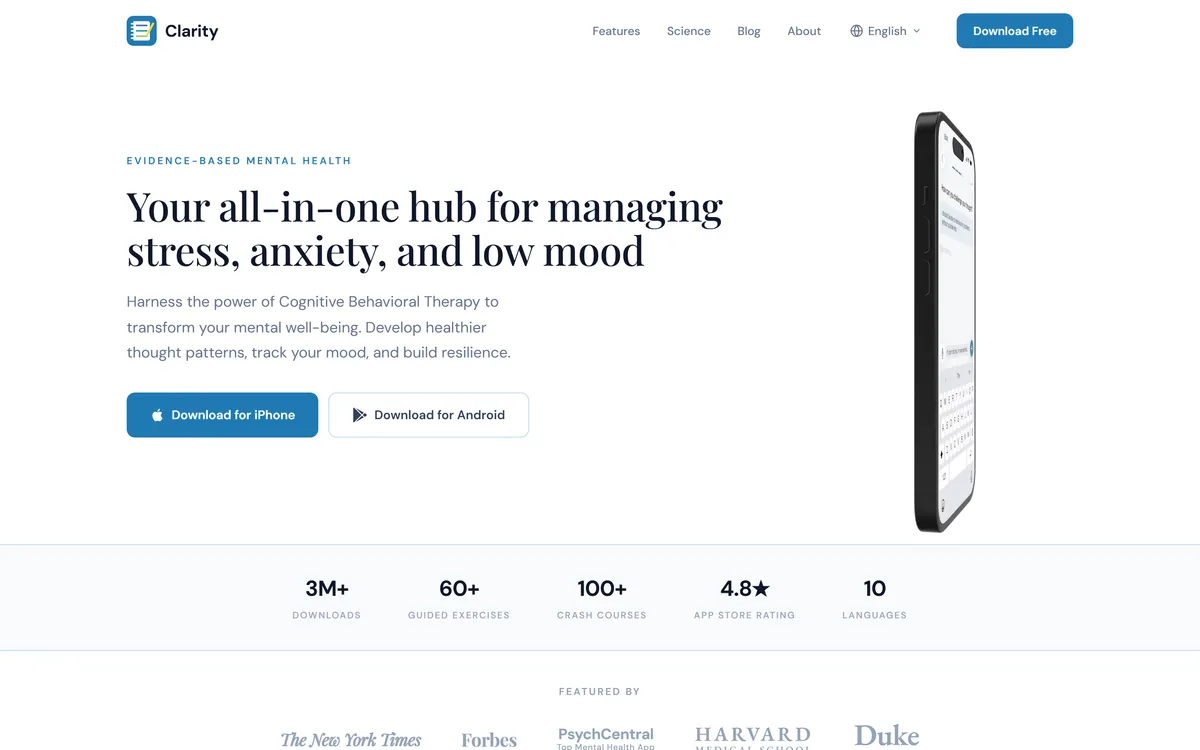
Clarity is a mental health app built on cognitive behavioural therapy, with 60+ guided exercises, AI journalling, chatbots trained in CBT, DBT and ACT, mood and emotion tracking, standardised screening tests, and a library of crash courses, meditation and breathwork.
thinkwithclarity.com7 viewsAdded May 29, 20261K visitors
Mental health apps divide cleanly into two groups, and the difference is whether they name a method.
One group offers encouragement, affirmations and a calming interface. That is not worthless — a moment of calm is a real thing — and it is not treatment, and the app rarely says so.
The other group builds on a specific therapeutic framework with clinical evidence behind it. Clarity is in the second group, and cognitive behavioural therapy is the framework with the largest literature of any psychological intervention.
Clarity: CBT In An App, Named Plainly
Built on cognitive behavioural therapy — 60+ guided exercises structured around identifying and challenging cognitive distortions.
AI journalling and chatbots trained in CBT, DBT and ACT, alongside a sleep coach.
Mood and emotion tracking with pattern analysis, weekly reports, streaks and badges.
Standardised screening tests for depression, anxiety and ADHD, plus guided journals and personality tests.
3M+ downloads, 4.8 App Store rating, 10 languages, with press coverage and university names displayed.
Clarity's homepage, captured 9 September 2026, showing the evidence-based positioning and the app's feature areas.
What Makes A Mental Health App Evidence-Based?
Clarity's positioning is explicit — evidence-based mental health, harnessing the power of cognitive behavioural therapy — and 60+ guided exercises structured around identifying and challenging cognitive distortions.
That specificity is what the claim rests on. CBT is not a general orientation; it is a set of techniques with defined steps. Identifying automatic thoughts, naming the distortion, examining the evidence, constructing a balanced alternative — these are a procedure rather than a sentiment.
That procedural quality is exactly why CBT translates to software better than most therapeutic approaches. An app can walk someone through a thought record; it cannot do what a therapist does in an unstructured session, which is why other modalities transfer worse.
The distortions themselves are the useful part to learn. Catastrophising, mind reading, all-or-nothing thinking, discounting the positive — most people recognise several immediately in their own thinking, and naming a pattern is what makes it possible to interrupt.
The honest boundary is that self-guided CBT has real evidence and weaker evidence than clinician-delivered CBT. The literature on digital CBT is genuinely supportive; it is not equivalent to therapy, and someone who needs the stronger version should not be talked out of it by an app that helps a bit.
The narrower application of the same framework is DreamSync, which runs CBT-I for insomnia specifically. Naming a method is what both have in common and what most of this category lacks.
CBT translates to software better than other approaches because it is a procedure rather than a sentiment. An app can walk you through a thought record.
AI Journalling And Chatbots Trained In CBT
Clarity offers AI journalling with adaptive questions, plus separate chatbots described as trained in CBT, DBT and ACT, and a sleep coach.
Offering three modalities rather than one is unusual and worth noting, because they suit different problems. CBT works on thoughts, DBT on emotional regulation and distress tolerance, ACT on accepting difficult feelings rather than arguing with them.
The journalling is the more defensible of the two features. Adaptive questions that respond to what you wrote produce something closer to a structured reflection than a blank page, and blank pages are why most journalling attempts stop within a fortnight.
A chatbot is where the caution belongs, and the reason is specific rather than general. A conversational agent discussing mental health will occasionally encounter someone in genuine crisis, and what it does in that moment matters more than everything else it does combined.
The right expectation is a structured exercise partner rather than a therapist. It can walk you through a thought record, ask the next question in a technique, and prompt reflection. It cannot notice what you are not saying, which is a substantial part of what a person does.
Screening Tests Are Not Diagnoses
Clarity includes standardised mental health assessments for ADHD, depression and anxiety, alongside personality tests.
Standardised screening instruments are genuinely useful and routinely misunderstood. They were designed to identify who should be assessed further, not to determine what someone has — and the difference is not pedantic.
A screening score above a threshold means a conversation with a clinician is warranted. It does not mean you have the condition, because these instruments are deliberately tuned to catch more than they should rather than miss cases, and because symptoms overlap enormously between conditions.
The specific risk with self-administered screening is self-diagnosis, which is more consequential than it sounds. Someone who concludes they have ADHD from an app score may pursue the wrong treatment, or dismiss a different problem producing the same symptoms — poor sleep, thyroid dysfunction, depression, or ordinary overwhelm.
The genuinely valuable use is as a prompt and a record. A score that pushes someone to book an appointment they had been avoiding is a good outcome, and bringing a tracked history to that appointment is far better evidence than recollection, which is unreliable in exactly the ways that matter.
A conversational tool such as Youper takes the opposite approach — talking something through rather than working through a structured exercise — and the two suit different moments.
Treat a screening score as a reason to see someone, never as an answer.
Learn the distortion names — recognising a pattern is what lets you interrupt it.
Bring tracked mood history to a clinical appointment; recollection is unreliable.
Expect the first weeks of thought records to feel mechanical, because they are.
Find out what the chatbot does in a crisis before relying on it at a bad moment.
Mood Tracking And What Memory Distorts
Clarity tracks moods, emotions and activities, deriving insights from patterns and trends, with weekly reports, streaks and badges.
The value here is correcting a specific and well-documented failure of memory. People are poor at recalling how they felt over time, and the recall is systematically biased by how they feel now — a bad week makes the previous month feel bad too.
That distortion matters clinically, because it is exactly what someone reports to a doctor. A tracked record showing three good weeks and one bad one tells a different story from a memory that reports a bad month, and the treatment implications differ.
Pattern analysis across activities is the more actionable half. Discovering that your low days follow poor sleep, or cluster around a particular obligation, is information that generic advice cannot supply and that is genuinely usable.
The gamification — streaks and badges — is the part to hold loosely. It improves adherence, which matters because an abandoned app helps nobody, and it can also produce a perverse effect where maintaining a streak becomes the goal and an honest entry on a bad day feels like breaking something.
If tracking points at sleep as the driver, an experiment-led app like SleepQ will test that far more directly than a mood diary can.
Using A CBT App Without Replacing Care
The failure mode is not that these apps do harm. It is that someone who needs more than an app uses one for a year instead.
The sequence below treats it as a step rather than a destination.
Track mood honestly for two weeks before starting any exercise, so you have a baseline rather than an impression.
Learn the cognitive distortions by name, since recognising a pattern is what makes interrupting it possible.
Do the thought records properly, accepting that the first fortnight feels mechanical — that is how the technique works.
Take a screening test as a prompt to book an appointment rather than as an answer to a question.
Bring your tracked history to that appointment, because it is better evidence than anything you will remember.
Set a review point — six or eight weeks — and if things are not improving, escalate rather than continuing.
Clarity: Features And Reach
Product type
Evidence-based mental health app
Framework
Cognitive behavioural therapy, stated explicitly
Exercises
60+ guided therapeutic exercises
Thought work
Thought analysis, cognitive distortions, gratitude, goal setting, emotion tracking
AI features
AI journalling with adaptive questions, CBT chatbot, DBT bot, ACT bot, sleep coach
Tracking
Mood, emotion and activity tracking with pattern insights and weekly reports
Gamification
Monthly badges, streaks and progress tracking
Assessments
Standardised tests for depression, anxiety and ADHD, plus personality tests and guided journals
Last checked . Read from thinkwithclarity.com in a browser session, with the screenshot above captured alongside.
Positioned on the site as evidence-based mental health, harnessing cognitive behavioural therapy
60+ guided therapeutic exercises stated
Thought reframing confirmed, covering thought analysis, cognitive distortions, gratitude, goal setting and emotion tracking
AI journalling with adaptive questions confirmed
Chatbots confirmed as a CBT chatbot, DBT bot, ACT bot and sleep coach
Mood, emotion and activity tracking confirmed, with pattern insights, weekly reports, badges and streaks
Standardised assessments confirmed for depression, anxiety and ADHD, plus personality tests and guided journals
Wellness library confirmed with 100+ crash courses, meditation, breathwork, soundscapes and affirmations
Platforms confirmed as iPhone and Android
3M+ downloads, a 4.8 App Store rating and 10 languages stated
Press names displayed including The New York Times, Forbes and PsychCentral, with Harvard Medical School and Duke University shown
A Science page present in the site navigation
What we could not confirm: the operating company's legal name or location; pricing and what the free tier includes; which underlying models power the chatbots and journalling; what the Science page cites, and whether any clinician is involved in the product; what the displayed press and university names signify, since no relationship or article is described alongside them; how the chatbots behave when a user is in crisis; and how mental health data is stored and retained. We did not use the app, so nothing here reflects tested content quality.
Is Clarity The Right Support?
A reasonable first step when
You want structured exercises rather than general encouragement.
You recognise your own thinking in descriptions of cognitive distortions.
You want tracked mood evidence to bring to a doctor rather than recollection.
You would use a journalling prompt but never face a blank page.
You are managing ordinary stress and low mood rather than something acute.
Speak to a professional when
You are in crisis, where an app is not the right thing at all.
Symptoms are severe, persistent, or interfering with daily functioning.
You would take a screening score as a diagnosis rather than a prompt.
You would use an app for a year instead of the appointment you have been avoiding.
Your difficulty is specifically insomnia, where a dedicated CBT-I programme fits better.
Other Mental Health Tools
Wellbeing apps address different things — thoughts, mood, sleep, practice, life stage — and are not interchangeable.
Youper — conversational support rather than structured exercise
DreamSync — CBT-I specifically, when insomnia is the presenting problem
Insight Timer — a free meditation library, for practice rather than intervention
Soula — perinatal support through a specific life stage
SleepQ — if the pattern in your tracking points at sleep
Editor's Verdict
4.0/5
Clarity does the thing that separates a serious mental health app from a wellness one: it names a method. Cognitive behavioural therapy has a large clinical literature and specific techniques, and a product built on 60+ structured exercises around cognitive distortions is doing something different from an app offering encouragement. The mood tracking closes the loop by making patterns visible that memory distorts. It scores where it does because self-guided CBT has weaker evidence than clinician-delivered CBT, and because standardised screening tests in a consumer app are the feature that most needs careful framing. AInexfinder Editor Score: 4.0/5.
Clarity pricing
AInexfinder does not list plan prices or billing details. For current pricing, plans, and trials, visit the official Clarity website.
Vendor pricing, credits, and billing policies change over time. Always confirm on the official site before you buy.
Frequently asked questions
What is Clarity?
Clarity is a mental health app built on cognitive behavioural therapy, with 60+ guided exercises around cognitive distortions, AI journalling, chatbots trained in CBT, DBT and ACT, mood and emotion tracking, standardised screening tests for depression, anxiety and ADHD, and a library of courses, meditation and breathwork.
What makes an app evidence-based?
Naming a specific framework with clinical literature behind it, and implementing its actual techniques. CBT is a set of defined steps — identify the automatic thought, name the distortion, examine the evidence, construct a balanced alternative — which is a procedure rather than a sentiment, and procedures translate to software.
Is self-guided CBT as good as therapy?
No. The evidence for digital CBT is genuinely supportive, and it is weaker than for clinician-delivered CBT. An app is a reasonable first step for ordinary stress and low mood, and it is not a substitute for someone who needs the stronger version — and it should not be a reason to delay that.
Are the screening tests a diagnosis?
No, and this is the most important thing to understand about them. Screening instruments identify who should be assessed further; they are deliberately tuned to catch more than they should rather than miss cases, and symptoms overlap enormously between conditions. A score above threshold means see someone, not you have this.
What is the risk of self-diagnosing from an app?
Pursuing the wrong treatment, or dismissing a different problem producing the same symptoms — poor sleep, thyroid dysfunction, depression, or ordinary overwhelm all present similarly to several conditions. The useful outcome is a score that pushes someone to book an appointment they had been avoiding.
Why does mood tracking help?
Because memory for how you felt over time is unreliable and systematically biased by how you feel now — a bad week makes the previous month feel bad too. That distortion is exactly what someone reports to a doctor, and a tracked record showing three good weeks and one bad one tells a different story.
What is the difference between the CBT, DBT and ACT bots?
They target different things. CBT works on thought patterns; DBT on emotional regulation and distress tolerance; ACT on accepting difficult feelings rather than arguing with them. Offering all three is unusual and reflects that they suit different problems rather than being interchangeable.
Can I rely on the chatbot in a bad moment?
Find out what it does first. A conversational agent discussing mental health will occasionally encounter someone in genuine distress, and what happens in that moment matters more than everything else combined. The site does not state it, and it is the question worth answering before you need the answer.
Do Harvard and Duke endorse Clarity?
The site displays those names along with press names including The New York Times and Forbes, without describing a relationship or citing an article alongside them. Treat displayed institution and publication names as a marketing element until the specific coverage or connection is named.
When should I stop using an app and see someone?
If you are in crisis, an app is not the right thing at all. Beyond that, set a review point — six or eight weeks — and if things are not improving, escalate rather than continuing. The failure mode with these apps is not harm; it is someone using one for a year instead of making an appointment.
Daniel reviews AI tools the slow way — by actually using them on real projects. His reviews cover what works, what breaks, and who each tool is genuinely a good fit for.
Daniel and the AInexfinder editorial team research Clarity using public product information, listing evidence, and (when available) hands-on checks. Scores reflect listing completeness and transparency — not paid placement.
Listings may include affiliate or sponsored placements, which are labeled when present. Editorial scores and cons are not sold. See our affiliate disclosure and review methodology.
Youper is an AI emotional-health assistant built around conversational check-ins, mood tracking and journaling. The company has announced it is shutting down on 30 September 2026, after which accounts, chat history and personal data are permanently deleted.
Earkick is an iOS self-care app built around a panda companion, offering mood and anxiety check-ins, progress statistics, breathing and CBT exercises, soundscapes and a panic button. It states that everything stays on your device or in your own iCloud, with no registration and no tracking.
Soula is an emotional support companion built for women, distinguished by memory: it retains conversation history across sessions and surfaces patterns in stress, sleep and mood over weeks. It states plainly that it is not therapy, routes crises to human help, and is built by MAMATECH Ltd with GDPR compliance and encryption.
Mindsera is an AI journalling app that analyses entries as you write, surfaces patterns and emotions over time, and offers more than fifty mental models as structured prompts. It accepts typed, spoken and photographed handwritten entries, and runs on iOS, Android and the web.
Wysa is an anonymous, CBT-based AI mental-health support tool designed as a safer alternative to general AI, with human-in-the-loop clinical oversight, backed by peer-reviewed research, and sold to health systems, employers and insurers, not a substitute for professional care.
Moody Month is an iOS hormone-tracking app that gives daily forecasts across the cycle, perimenopause, pregnancy and postpartum, with symptom logging, wearable integration and content, from a women-owned team, with privacy you should still read carefully.