Earkick is an iOS self-care app built around a panda companion, offering mood and anxiety check-ins, progress statistics, breathing and CBT exercises, soundscapes and a panic button. It states that everything stays on your device or in your own iCloud, with no registration and no tracking.
apps.apple.com7 viewsAdded March 26, 20267K visitors
Mental wellbeing apps ask for an unusual amount of trust. What you type into one is more sensitive than almost anything else on your phone, and most of them want an account before you begin.
Earkick's answer is to want nothing. No registration, no login, no server-side record — the app states that everything stays on your device or in your own iCloud.
That is the strongest thing about it. The complication is what has happened to everything around the app, which is the first thing anyone evaluating it now needs to know.
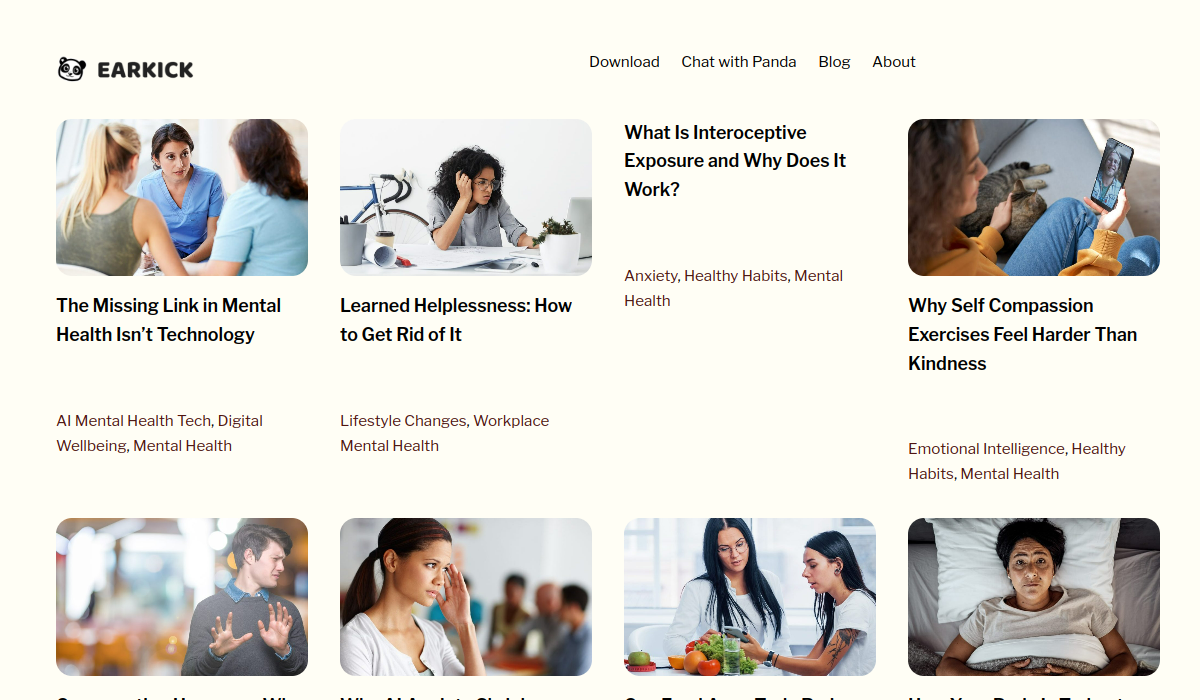
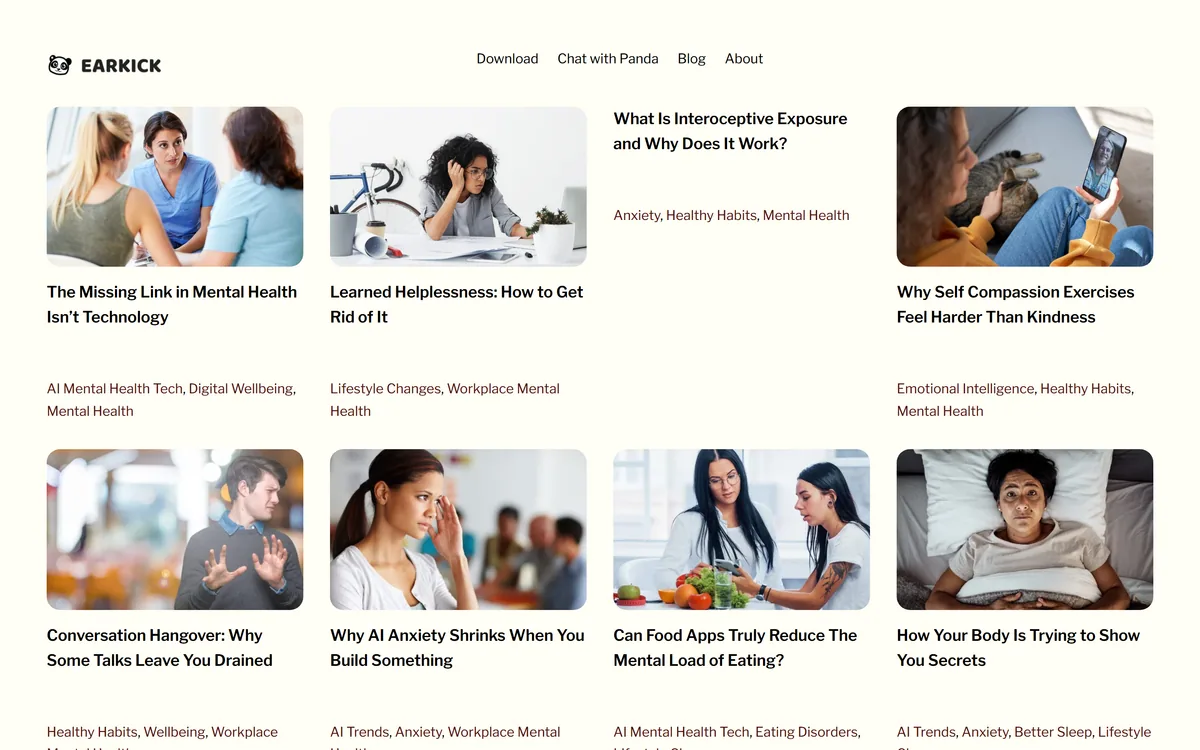
What earkick.com now serves, captured 9 September 2026 — the domain redirects to the Earkick blog.
What Happened To The Earkick Website?
As of the date we checked, earkick.com and every path beneath it — including its own about page — redirects to blog.earkick.com. The chat and app subdomains that the blog links to no longer resolve at all.
The blog itself is very much alive: thirty-seven pages of posts on anxiety, sleep, workplace mental health and eating disorders, with a disclaimer stating that expert writers specialising in psychology write it and medical professionals proofread it.
The App Store listing is also alive and current — version 2.13.8, shipped in February 2026, rated 4.7 from more than 3,300 ratings, originally released in October 2021.
The detail that changes the picture is the publisher. The listing names Elomia Health, Inc. as the seller, with elomia.com as the seller URL. Elomia is a separate AI mental wellbeing company whose own site, on the date we looked, does not mention Earkick anywhere.
We can report all of that and not explain it. No announcement accompanies the change on either site, and a publisher name on an App Store listing is a fact about the listing rather than a description of a transaction. What it means practically is set out below.
The app is current and well rated. The website is a blog, two subdomains have gone, and the listing names a different publisher. All three are true at once.
What A Missing Website Means For You
Practically, the consequences are narrower than they first appear, and worth separating from the alarm.
The app works. It is downloadable, updated as recently as February 2026, and its privacy model means it does not depend on a server staying up in order to function — which is the one circumstance where an absent company matters least.
What you lose is everything around it. There is no product page describing current features, no published support route beyond the App Store, no changelog, and no terms page reachable from the domain.
For a subscription, that is a real consideration. Knowing who to contact about billing, and under whose terms your data sits, is ordinary due diligence — and here it requires reading the App Store listing rather than a website.
The honest position is that this is a functioning, well-reviewed app with an unclear corporate context. Download it if the app suits you; do not build a long-term routine on it without confirming who you would be contacting.
On-Device Privacy As The Core Promise
The listing is unusually direct about it: one hundred percent private, Swiss-made, no registration, no tracking, no stored data, with everything kept on your device or in secure iCloud.
That combination is rare, and each part of it does specific work.
No registration means there is no account to breach, no email address linking your mood entries to your identity, and nothing to export if a company is ever compelled to. It is the strongest privacy guarantee any app can offer, because it removes the data rather than protecting it.
Keeping data in your own iCloud rather than a company's database means the backup is under your Apple account and your control — the same local-first argument that makes tools like Pieces defensible for developers handling sensitive context.
The caveat is that an AI companion has to send something somewhere in order to respond. On-device storage and on-device inference are different claims, and the listing states the first clearly. Anyone for whom this genuinely matters should confirm the second directly rather than inferring it.
Confirm who to contact about billing before subscribing.
Check whether responses are generated on device or in the cloud.
Set up the panic button contacts before you need them.
Use check-ins consistently — the value is entirely in the trend.
Keep a real crisis number saved separately from any app.
Check-Ins, CBT Exercises And A Panic Button
The feature set is described plainly: smart check-ins tracking mood, anxiety and emotions; progress statistics visualising patterns over time; breathing and CBT exercises for managing stress; soundscapes; and a panic button to ground yourself and alert friends or family.
Two of those are more substantial than the rest.
The check-in and statistics pair is the actual product. Self-report mood tracking is well-established, and its value comes almost entirely from the trend rather than any single entry — noticing that Sundays are consistently worse, or that a bad fortnight followed a specific change, is information you cannot get from memory.
CBT exercises are the evidence-backed component. Cognitive behavioural techniques have a substantial research base for anxiety and low mood, and delivering them through an app is a reasonable use of the format even though it is not therapy.
The panic button is the feature to configure before you need it. Alerting a named person is a meaningfully different capability from a breathing exercise, and it only works if the contacts are set up in advance. Written journalling is the adjacent practice, handled more deliberately by Reflection.
Where An App Stops And Care Begins
Earkick's own blog carries the right disclaimer: the content is informational and educational, and is not intended to diagnose, treat or replace professional medical or psychological advice.
That line deserves repeating rather than skipping, because this category invites a specific confusion.
A mood tracker with a friendly companion, a conversational tone and CBT exercises can feel like care while providing none of the things that make care effective — assessment, continuity, accountability, and a person who notices when something changes.
The useful framing is that an app like this is closer to a journal with structure than to a therapist. It is genuinely valuable for that, and the trend data it produces can make a first conversation with a clinician considerably more concrete.
For anything acute — persistent hopelessness, self-harm, thoughts of suicide — no app is the right destination, and the correct action is a crisis line or a doctor. Keeping that number saved somewhere other than a phone app is a five-minute task worth doing regardless of what you install. For downregulation in the moment rather than tracking over time, RelaxFrens is built for that instead.
Using A Mental Health App Responsibly
Wellbeing apps are downloaded during a bad week and abandoned during a good one, which is precisely backwards — the trend only becomes useful once it spans both.
This sequence gets the value out without mistaking the tool for treatment.
Check in daily, including on days when nothing is wrong.
Configure the panic button contacts before you need them.
Look at the statistics monthly rather than daily.
Take a screenshot of the trend to a clinician if you see one.
Confirm the billing and support route before subscribing.
Save a crisis number somewhere that is not inside an app.
Earkick: A Self-Care Panda On Your Phone
Private by design — no registration, no account, data stated as staying on your device or in your own iCloud.
Check-ins, progress stats, breathing and CBT exercises, soundscapes and a panic button.
The website is effectively gone: earkick.com redirects to a blog, and the chat and app subdomains no longer resolve.
The App Store listing names a different publisher — Elomia Health, Inc. — from the company that built it.
Still actively maintained: version 2.13.8 shipped in February 2026, rated 4.7 from over 3,300 ratings.
Earkick: App Status And Publisher
Platform
iOS, requiring iOS 15.6 or later
App Store name
Earkick — Self Care AI Coach
Publisher on the listing
Elomia Health, Inc., with elomia.com as the seller URL
Current version
2.13.8, released 12 February 2026
Originally released
25 October 2021
Rating
4.7 from more than 3,300 ratings, in Health & Fitness
Website status
earkick.com and all paths redirect to blog.earkick.com
Subdomains
The chat and app subdomains linked from the blog did not resolve when checked
Privacy claims
No registration, no tracking, no stored data; kept on device or in your own iCloud
Pieces — the same local-first privacy argument elsewhere
Vici — physical load, which interacts with the mental kind
Praktika — another conversational avatar, in a different domain
Earkick: Verified On The App Store
Last checked . Checked on the date above by following earkick.com, reading the live blog including its footer, and reading the current App Store listing and its published metadata.
earkick.com and every path tested, including its own about page, confirmed as redirecting to blog.earkick.com
The chat and app subdomains linked from the blog did not resolve when requested
The blog confirmed live and active, with thirty-seven pages of posts
The blog footer carries social links and a disclaimer, and names no operating company
Blog disclaimer states content is informational and educational and does not replace professional advice
App Store listing confirmed live under the name Earkick — Self Care AI Coach
Listing metadata gives version 2.13.8 released 12 February 2026, originally released 25 October 2021
Rating shown as 4.7 from more than 3,300 ratings in Health & Fitness
Publisher and seller on the listing given as Elomia Health, Inc., with elomia.com as the seller URL
Elomia's own site read on the same date and found to make no mention of Earkick
Listing states 100% private, Swiss-made, no registration, no tracking and no stored data
Features stated on the listing as smart check-ins, progress stats, breathing and CBT exercises, panic button and soundscapes
What we could not confirm: why the publisher on the App Store listing differs from the company that built the app, since no announcement accompanies it on either site and we treat the listing as a fact about the listing rather than a description of any transaction; why earkick.com now serves only a blog, or whether the web chat is returning; whether AI responses are generated on device or sent to a server, which the privacy claims do not address; what a subscription includes and who administers it; and whether an Android version exists. We did not install the app.
Editor's Verdict
3.4/5
The app itself is in good shape: actively updated, rated 4.7 across more than three thousand ratings, and built on a privacy stance most of this category cannot match — no registration, no account, nothing stored on someone else's server. What complicates the recommendation is everything around it. The website now redirects to a blog, the chat and app subdomains no longer resolve, and the App Store listing names a different company as publisher than the one that built it. None of that breaks the app; all of it belongs in your decision. AInexfinder Editor Score: 3.4/5.
Earkick pricing
AInexfinder does not list plan prices or billing details. For current pricing, plans, and trials, visit the official Earkick website.
Vendor pricing, credits, and billing policies change over time. Always confirm on the official site before you buy.
Frequently asked questions
Is Earkick still available?
Yes. The iOS app is live and current — version 2.13.8 shipped in February 2026, rated 4.7 from more than 3,300 ratings. It is the website that has largely gone, with earkick.com now redirecting to the Earkick blog.
Why does the App Store list a different company?
The listing names Elomia Health, Inc. as publisher, with elomia.com as the seller URL. No announcement accompanies that on either site, and Elomia's own site does not mention Earkick. We report the listing rather than explain it.
Does the website redirect matter?
Less than it looks, and not nothing. The app works and does not depend on a server. What you lose is a product page, a support route and published terms — which matters most if you are subscribing rather than using it free.
How private is it really?
The listing states no registration, no tracking and no stored data, with everything on device or in your own iCloud. That removes the data rather than protecting it, which is the strongest guarantee an app can offer.
Does the AI run on my phone?
The privacy claims cover storage, not processing, and those are different questions. If on-device inference genuinely matters to you, confirm it directly rather than inferring it from the storage statement.
What does it actually do?
Check-ins on mood, anxiety and emotions; statistics showing patterns over time; breathing and CBT exercises; soundscapes; and a panic button that can ground you and alert chosen contacts. The check-in and trend pair is the real product.
Are CBT exercises in an app useful?
The techniques have a substantial evidence base for anxiety and low mood, and delivering them through an app is a reasonable use of the format. It is not therapy, and the app's own blog says as much.
Can it replace therapy?
No, and it does not claim to. A structured mood log is closer to a journal than a therapist — no assessment, no continuity, nobody who notices when something changes. Its best use is making a first clinical conversation more concrete.
What should I do in a crisis?
Contact a crisis line or a doctor. No app is the right destination for persistent hopelessness, self-harm or thoughts of suicide, and saving a real number somewhere outside your phone apps is a five-minute task worth doing now.
Is there an Android version?
We did not find an equivalent listing. The app is iOS, requiring iOS 15.6 or later, and with the website no longer carrying product pages there is no published roadmap to check against.
Daniel reviews AI tools the slow way — by actually using them on real projects. His reviews cover what works, what breaks, and who each tool is genuinely a good fit for.
Daniel and the AInexfinder editorial team research Earkick using public product information, listing evidence, and (when available) hands-on checks. Scores reflect listing completeness and transparency — not paid placement.
Listings may include affiliate or sponsored placements, which are labeled when present. Editorial scores and cons are not sold. See our affiliate disclosure and review methodology.
Youper is an AI emotional-health assistant built around conversational check-ins, mood tracking and journaling. The company has announced it is shutting down on 30 September 2026, after which accounts, chat history and personal data are permanently deleted.
Soula is an emotional support companion built for women, distinguished by memory: it retains conversation history across sessions and surfaces patterns in stress, sleep and mood over weeks. It states plainly that it is not therapy, routes crises to human help, and is built by MAMATECH Ltd with GDPR compliance and encryption.
Mindsera is an AI journalling app that analyses entries as you write, surfaces patterns and emotions over time, and offers more than fifty mental models as structured prompts. It accepts typed, spoken and photographed handwritten entries, and runs on iOS, Android and the web.
Wysa is an anonymous, CBT-based AI mental-health support tool designed as a safer alternative to general AI, with human-in-the-loop clinical oversight, backed by peer-reviewed research, and sold to health systems, employers and insurers, not a substitute for professional care.
Moody Month is an iOS hormone-tracking app that gives daily forecasts across the cycle, perimenopause, pregnancy and postpartum, with symptom logging, wearable integration and content, from a women-owned team, with privacy you should still read carefully.
Liven is a wellbeing and self-development app combining short courses on procrastination, stress and burnout with mood tracking, guided journaling, habit building and an AI companion called Livie. The company states it was co-created with more than fifteen licensed therapists and psychologists.