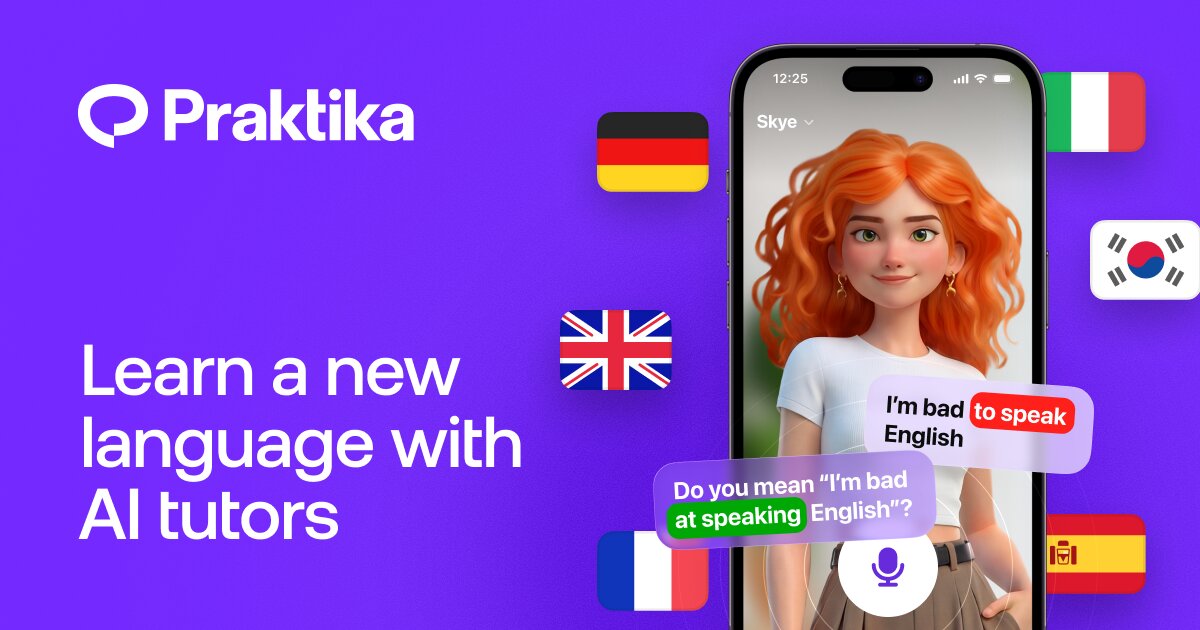
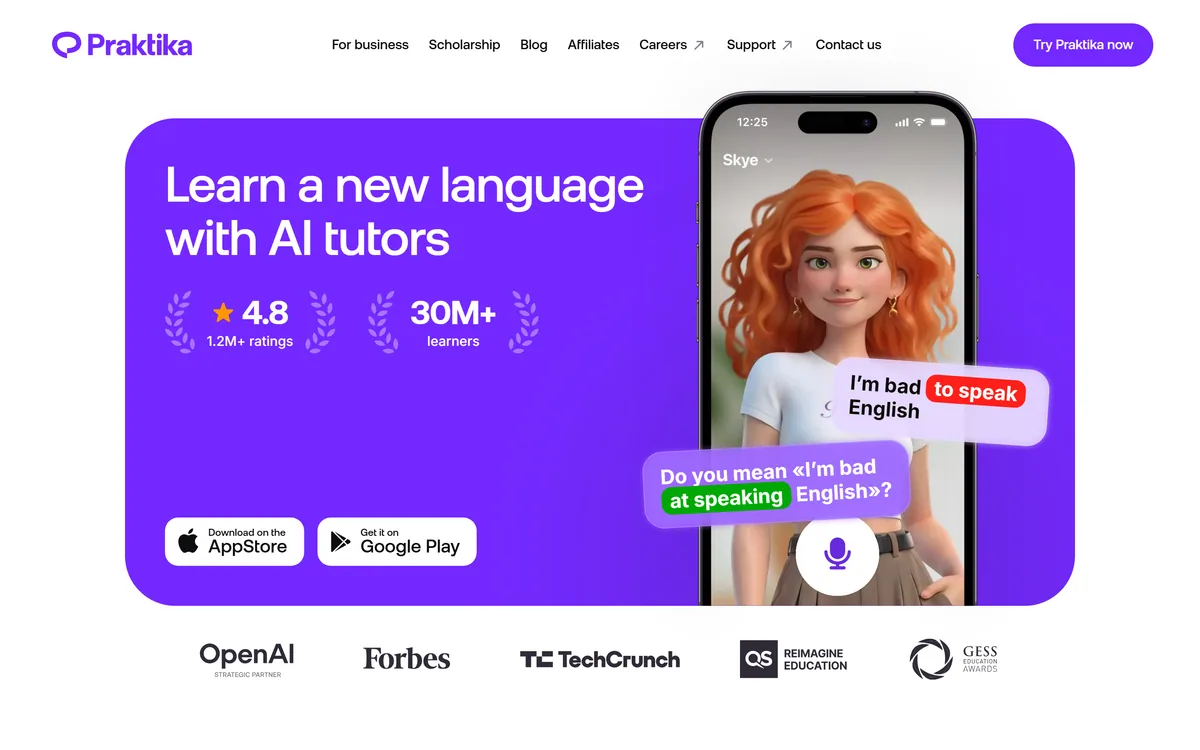
Praktika teaches languages through conversation with AI avatar tutors who speak your native language, adapt to a personal study plan, and give instant corrections on pronunciation, grammar and word choice. It states 30M+ learners and a 4.8 rating from 1.2M+ ratings, on iOS and Android.
praktika.ai9 viewsAdded January 11, 20266K visitors
Almost everyone who has studied a language at school can read some of it and speak none of it. That is not a failure of the teaching so much as a consequence of arithmetic: thirty students, one teacher, forty minutes, which is perhaps ninety seconds of speaking each.
The adult version is worse. People who can construct a sentence perfectly on paper freeze when a real person is waiting, because being wrong out loud in front of someone is genuinely uncomfortable.
Praktika's proposition is a conversation partner who is always available and to whom none of that discomfort applies.
Praktika: Speaking Practice With AI Tutors
Tutors speak your native language, so a complete beginner can start without being stranded.
Instant, gentle corrections on pronunciation, grammar and word choice as you speak.
Soft, balanced or strict — you choose how hard the corrections land, which is unusually thoughtful.
Free conversation on any topic alongside an adaptive personal study plan.
30M+ learners and a 4.8 rating from 1.2M+ ratings, on iOS and Android.
Praktika's homepage, captured 9 September 2026, showing the AI avatar tutor positioning.
Does Talking To An Avatar Build Fluency?
Praktika positions itself as private language tutor quality with app convenience, offering free conversation on any topic and instant feedback on every message.
The mechanism it relies on is well established: speaking is a production skill, production skills improve with practice, and most learners get almost none.
What an AI partner supplies is volume. A learner can have thirty minutes of conversation a day, which is more speaking practice than most language courses provide in a month, and it costs nothing socially to make mistakes.
That last part is the real innovation. The barrier for adult learners is overwhelmingly embarrassment — the fear of sounding stupid in front of someone whose time you are taking — and an AI tutor removes it entirely.
The honest limit is that it also removes the stakes. Real conversation has consequences: being misunderstood matters, the other person may lose patience, and you must keep up rather than pause to think. That pressure is where fluency finally consolidates, and no simulation reproduces it — the same gap immersion tools like Language Reactor face from the comprehension side.
The barrier for adult learners is embarrassment, not opportunity. An AI tutor removes it entirely — and removes the stakes with it.
Corrections Without Embarrassment
Praktika describes instant, gentle corrections on pronunciation, grammar and word choice, with the example of correcting I'm bad to speak English to I'm bad at speaking English.
That example is well chosen because it illustrates the specific value of a machine tutor.
A human conversation partner mostly does not correct you. Interrupting to fix a preposition is socially awkward, so people understand what you meant and move on — which is kind and means the error is never addressed.
The result is fossilisation: a mistake repeated for years because nobody ever mentioned it, and eventually so automatic that unlearning it is harder than learning it was.
An AI tutor corrects every instance without any social cost, which is exactly the intervention human practice cannot provide. That alone justifies the category for intermediate learners who have plateaued with errors they cannot see.
Choosing Soft, Balanced Or Strict
Praktika lets you choose the tone and intensity of feedback across soft, balanced and strict settings.
This is a small control with a large effect, and it reflects something genuinely true about learning.
Correction tolerance varies enormously between people and within one person over time. Somebody fragile about speaking needs encouragement more than accuracy at first, because the objective in week one is that they come back.
The same person three months later is being held back by exactly that gentleness, and needs errors named plainly to progress. A fixed setting is wrong for at least one of those stages.
The practical advice is to start soft and move to strict deliberately rather than leaving it where it was set. Most people will under-correct themselves indefinitely, which feels pleasant and produces a plateau.
Start on soft, then move to strict once speaking feels less uncomfortable.
Practise daily in short sessions rather than weekly in long ones.
Use free conversation on subjects you actually care about.
Notice which corrections repeat — those are your fossilised errors.
Add real conversation once basic fluency exists, since stakes matter.
Learning In Your Native Language
Praktika states that your tutor speaks in your native language and guides you through the process, so you need never be afraid of starting from scratch.
This is the design decision that separates it from immersion-first approaches, and both positions are defensible.
Full immersion from day one is theoretically ideal and practically brutal for adults. A beginner dropped into target-language-only instruction spends the first weeks comprehending almost nothing, and most quit before the benefit arrives.
Native-language scaffolding solves the retention problem at the cost of some immersion benefit. You understand the instructions, you know why a correction was made, and you get to a point where immersion is viable.
The risk is staying in the scaffolding too long. Explanations in your own language are comfortable, and comfortable is the enemy of progress — so the useful discipline is to reduce reliance on it deliberately rather than waiting for it to become unnecessary.
The habit problem is not specific to languages either. Interactive practice platforms such as Coddy solve the same retention question in a different skill, using streaks and short daily sessions — and the lesson transfers: consistency beats intensity, and the tool that survives a bad week is the one that wins.
What An AI Tutor Cannot Give You
It is worth naming the limits, because this category oversells consistently and the gaps are specific.
Cultural pragmatics are the first. Language is not only grammar — what is rude, what is too formal, when directness is expected — and those are learned from people rather than from a model that has read about them.
Accent variation is the second. AI tutors speak clearly and consistently, and real speakers mumble, use dialect, speak fast and overlap each other. A learner comfortable only with clear speech is not ready for a real conversation.
Unpredictability is the third. Real conversations go somewhere you did not expect and require you to follow, which is a different skill from responding to a well-formed question.
And accountability is the fourth. A human tutor notices when you have not practised and asks about it, whereas an app cannot make you open it — which is why streaks and study plans exist and why most language apps still lose their users.
The complementary gap is comprehension. Speaking practice builds production and does nothing for understanding native speech at speed, which is what immersion tools such as Language Reactor supply from real content — and a learner strong in one and weak in the other stalls quickly.
The same split appears in first-language literacy. Reading intervention platforms like LUCA listen at the sound level to diagnose what is missing, which is the analytical counterpart to a conversational tutor and a reminder that practice and diagnosis are different services.
Practising A Language You Cannot Speak Yet
The pattern with language apps is enthusiastic daily use for two weeks and then nothing, usually because the sessions were too long and too formal.
This sequence builds the habit at a size that survives a bad week.
Set a floor of ten minutes daily rather than an hour twice a week.
Start on soft corrections so the first sessions are not discouraging.
Talk about subjects you genuinely care about, not textbook topics.
Move to strict corrections once speaking stops feeling uncomfortable.
Keep a note of corrections that repeat — those are the errors to attack.
Add a real conversation partner once you can hold a basic exchange.
Language Practice Terms
Terms from language acquisition that explain why speaking practice works.
undefined
undefined
undefined
undefined
undefined
undefined
Praktika: Reach And Founders
Operating company
Praktika.ai Company
Product type
AI language learning through spoken conversation
Positioning
Private language tutor quality with app convenience
Learners
30M+ stated
Displayed rating
4.8 from 1.2M+ ratings
Platforms
iOS and Android
Native language support
Tutors speak in your native language
Study plan
Adapts to your goals, interests and pace
Feedback
Instant corrections on pronunciation, grammar and word choice
Correction intensity
Soft, balanced or strict
Free conversation
Practise any topic in your own words
Named tutors
Raika, Tama, Skye, Camila and Min-Jun among them
Also offered
A business offering, a scholarship, an affiliate program
What we could not confirm: pricing and what a free tier includes; which languages are supported and at which levels, which is the most basic missing fact; which models drive the tutors and the speech recognition; how voice recordings of learners are stored and retained; whether the 30M+ figure counts downloads or active learners; and how accent and dialect variation in the learner's speech is handled. We did not use the app.
Editor's Verdict
4.1/5
The reason most people who study a language cannot speak it is that they never speak it, and the reason for that is embarrassment rather than opportunity. Praktika's design targets exactly that: a tutor who never gets impatient, never judges, and is available at eleven at night when a class is not. The correction intensity setting — soft, balanced or strict — is the detail that shows real thought, because tolerance for being corrected varies enormously and the wrong level ends the practice. It cannot replicate the stakes of a real conversation, which is where fluency finally consolidates. AInexfinder Editor Score: 4.1/5.
Praktika pricing
AInexfinder does not list plan prices or billing details. For current pricing, plans, and trials, visit the official Praktika website.
Vendor pricing, credits, and billing policies change over time. Always confirm on the official site before you buy.
Frequently asked questions
What is Praktika?
Praktika teaches languages through spoken conversation with AI avatar tutors who speak your native language, follow an adaptive study plan, and give instant corrections on pronunciation, grammar and word choice. It states 30M+ learners and a 4.8 rating from 1.2M+ ratings.
Does talking to an AI actually build fluency?
It builds the production skill, which most learners never practise. Thirty minutes of conversation a day is more speaking than most courses provide in a month, and the real innovation is that mistakes cost nothing socially.
What does it not replicate?
The stakes. Real conversation has consequences — being misunderstood matters, the other person may lose patience, and you must keep up rather than pause to think. That pressure is where fluency finally consolidates, and no simulation reproduces it.
Why are corrections so valuable here?
Because human partners mostly do not correct you. Interrupting to fix a preposition is socially awkward, so people understand what you meant and move on — which is kind and means the error is never addressed, then repeated for years until it is automatic.
What is fossilisation?
An error repeated so long it becomes automatic, and eventually harder to unlearn than it was to learn. It is the specific problem an AI tutor solves, because it corrects every instance without any social cost — an intervention human practice cannot provide.
Which correction setting should I use?
Start soft and move to strict deliberately. Somebody fragile about speaking needs encouragement first, because the objective in week one is that they come back. The same person three months later is held back by that gentleness.
Is learning in your native language a good idea?
At the start, yes. Full immersion from day one is theoretically ideal and practically brutal — beginners comprehend almost nothing for weeks and most quit before the benefit arrives. The risk is staying in the scaffolding after it stops being necessary.
What can an AI tutor not teach?
Cultural pragmatics — what is rude, what is too formal, when directness is expected — which are learned from people. It also cannot expose you to real accents, dialect, fast speech and people talking over each other.
Will it make me practise?
No, and this is the honest limit of every language app. A human tutor notices when you have not practised and asks about it; an app cannot make you open it. That is why study plans and streaks exist, and why most language apps still lose their users.
How should I structure practice?
Ten minutes daily beats an hour twice a week, and talking about subjects you actually care about beats textbook topics. Keep a note of corrections that repeat — those are your fossilised errors, and they are what to attack deliberately.
Daniel reviews AI tools the slow way — by actually using them on real projects. His reviews cover what works, what breaks, and who each tool is genuinely a good fit for.
Daniel and the AInexfinder editorial team research Praktika using public product information, listing evidence, and (when available) hands-on checks. Scores reflect listing completeness and transparency — not paid placement.
Listings may include affiliate or sponsored placements, which are labeled when present. Editorial scores and cons are not sold. See our affiliate disclosure and review methodology.
ELSA Speak is an English speaking app that listens to your voice and gives instant, word-level pronunciation feedback. It personalises lessons by level, goal, preferred accent and industry, offers a bilingual tutor that lets beginners start in their own language, and runs AI role-play across everyday scenarios.
PolyChat teaches 17 languages through dialogue-based lessons with no energy system limiting how much you practise, offering A1-C2 paths with a stated 5,000-plus lessons per language, a custom lesson creator, an AI chat tutor, a translator and an Adult Mode for slang and real-world speech.
Talkio AI is a language-learning app focused on speaking: you practise conversations with AI tutors at your level through guided courses or open chats, get feedback and pronunciation practice, and track progress, from a Denmark-based team behind Voice Control for ChatGPT.
Langua from LanguaTalk offers AI conversation practice in over 20 languages with human-like voices, instant corrections, adjustable speech speed, saved vocabulary feeding into flashcards, and human tutors alongside the AI.