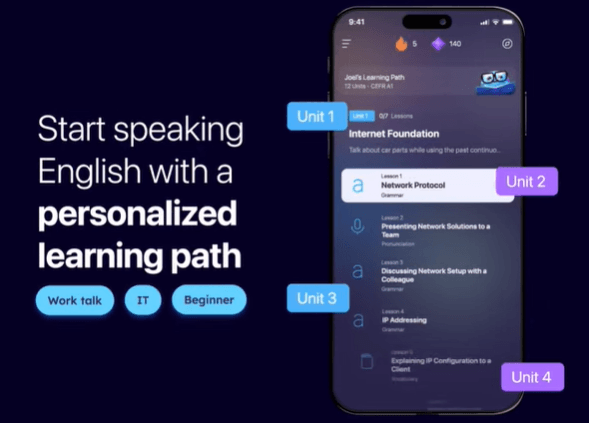
ELSA Speak is an English speaking app that listens to your voice and gives instant, word-level pronunciation feedback. It personalises lessons by level, goal, preferred accent and industry, offers a bilingual tutor that lets beginners start in their own language, and runs AI role-play across everyday scenarios.
elsaspeak.com7 viewsAdded June 19, 20251.3M+ visitors
Learners who have studied English for a decade can read a contract and still dread a phone call. That gap is not a knowledge problem, and no amount of grammar study closes it.
Speaking is the one skill you cannot practise alone effectively, because you cannot hear yourself accurately. Your brain supplies what you meant to say.
ELSA Speak exists to close that specific loop: you speak, it tells you which sounds were wrong, and you try again — the thing a teacher does and a textbook cannot.
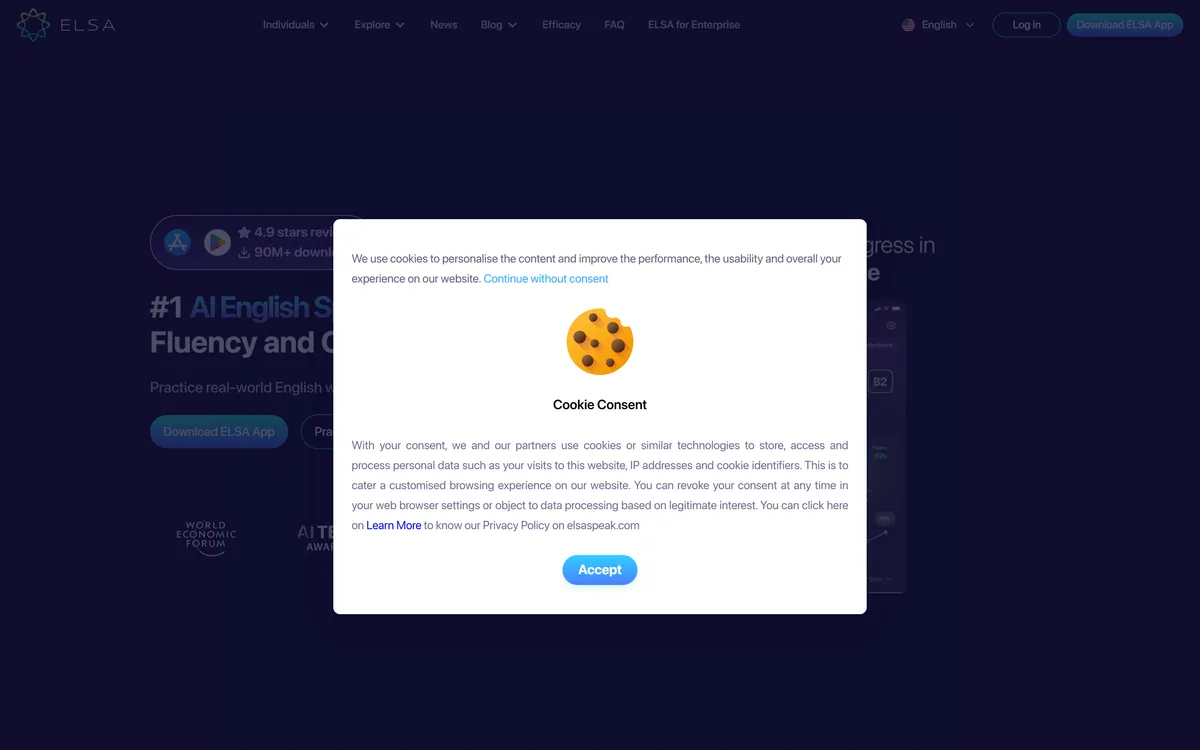
ELSA Speak's homepage, captured 9 September 2026.
ELSA Speak: Pronunciation Feedback Per Word
Feedback on your own voice, instantly, on the specific sounds you got wrong rather than a general score.
A bilingual tutor so beginners can start a conversation in their native language and move across gradually.
AI role-play across real scenarios, plus personalisation by level, goal, preferred accent and industry.
Publishes efficacy research — a dedicated page most language apps do not have.
Individual, business, schools and API products, with dashboards for classroom and team progress.
Why Is Speaking Harder Than Grammar To Learn?
ELSA's positioning is narrow and correct: practise real-world English with instant, personalised feedback tuned to your voice.
The reason that narrowness works is a genuine asymmetry between the four language skills.
Reading and writing are self-correcting. You can check a sentence against a reference, notice you were wrong, and adjust — the feedback loop closes without another person in it. Listening is nearly as forgiving; you can replay something until it resolves.
Speaking is not. The mismatch between the sound you produced and the sound you intended is invisible from inside your own head, which is why learners repeat the same mispronunciation for years without noticing.
Worse, the errors that matter most are the ones your first language makes inaudible to you. If your native language does not distinguish two English sounds, you cannot hear the difference in your own speech — and only an external listener, human or machine, can point at it.
You can check your grammar against a book. You cannot hear your own accent, because your brain supplies what you meant to say.
Accent Choice And What It Signals
Among the personalisation options sits preferred accent, alongside level, goals, progress and industry focus.
Offering a choice of target accent is a small feature with a defensible position behind it.
The unhelpful framing of pronunciation is that there is one correct English and everything else is an error. That is both wrong and demoralising — the majority of English conversations now happen between two non-native speakers, and intelligibility rather than nativeness is what actually matters.
Letting a learner choose a target treats accent as a preference rather than a deficiency, which is the accurate framing. Someone working with an American team has a different target from someone sitting a British exam.
Industry focus does related work. The vocabulary and register a nurse needs differs from a software engineer's, and practising the words you will actually say beats practising a general corpus — the same argument that makes scenario-based practice in Praktika more useful than free conversation.
A Bilingual Tutor And Role-Play Scenarios
The bilingual tutor is described as letting beginners start conversations in their native language, making the transition to English less intimidating so mastery builds gradually.
This is the best idea on the page, and it addresses a genuine chicken-and-egg problem.
An English-only conversational app assumes you can already hold an English conversation. For a true beginner that is exactly the thing they cannot do, which means the whole category is quietly closed to the learners who need it most.
Starting in the learner's own language removes that barrier. The instruction, the explanation and the encouragement arrive in a language they understand, while the practice gradually shifts.
AI role-play across varied scenarios is the complement. Ordering food, taking a call, sitting an interview — these are performance situations, and rehearsing them without an audience is the point. The anxiety that stops people speaking is social, and an app removes the social risk while keeping the practice. Listening practice from real video is a different discipline again, and where Language Reactor is stronger.
Practise aloud daily, briefly, rather than weekly at length.
Choose a target accent deliberately rather than accepting the default.
Set the industry focus so you rehearse the words you will actually use.
Use role-play for the situations that make you anxious, not the easy ones.
Read the efficacy page before believing any improvement claim.
Ninety Million Downloads And What They Mean
Two figures sit near the top of the page: 90 million-plus downloads, and 90 million-plus learners who have already joined.
Those are the same number describing two different things, and only one of them can be right.
A download is an install, and installs vastly exceed users in consumer apps — people download, open once, and never return. A learner implies use. Treating them as interchangeable inflates the more meaningful figure to match the less meaningful one.
This is worth flagging not as a criticism of the product but because it is the single most common pattern in consumer app marketing, and reading it correctly is a skill worth having.
The displayed 4.9-star rating carries the same caveat — no platform is named and no review count is given, so it cannot be compared against anything. What is more informative is the existence of a dedicated efficacy page, which is discussed below.
Publishing Efficacy Research
ELSA carries a page in its main navigation labelled Efficacy, and repeats it in the footer as Proven Learning Efficacy.
This is genuinely unusual and the most credible thing about the product.
Language learning apps almost universally market on engagement — streaks, minutes, lessons completed — because engagement is easy to measure and improvement is not. Whether anyone actually got better at English is a research question requiring instruments, control groups and time.
A company that builds a page around that question is inviting a kind of scrutiny most of its competitors avoid entirely, and the mere presence of the page is a signal even before you read what is on it.
The caveat is the one that applies to all vendor-published research: read who conducted it, whether it was peer-reviewed, what was measured, and against what comparison. A page called Proven Learning Efficacy is a claim; the study behind it is the evidence, and the two deserve separate assessment. None of this concerns producing speech, which is what a synthesis tool like Voicemaker does.
Practising English Until It Sticks
Speaking improves through frequency rather than duration, which is the opposite of how most people study.
This sequence uses the app for the thing it is uniquely good at.
Set your level, goal, target accent and industry before the first lesson.
Practise aloud for ten minutes daily rather than an hour weekly.
Repeat the specific sounds it flags rather than moving on for variety.
Use the bilingual tutor if English-only conversation is still intimidating.
Role-play the situation you dread, not the one you find comfortable.
Re-record the same passage monthly and listen back to hear the change.
Key features of ELSA Speak
Word-level pronunciation feedback on your own voice
Bilingual tutor for absolute beginners
AI role-play across real-world scenarios
Personalisation by level, goal, accent and industry
Progress dashboards across skill areas
Business and school deployments with admin dashboards
An API for embedding the assessment
Separate help centres per product
Pros & cons
Pros
7
Targets the one skill you genuinely cannot self-correct
Word-level feedback beats a general fluency score
The bilingual tutor removes the barrier that closes this category to beginners
Accent as a preference rather than a deficiency is the accurate framing
Industry focus means practising the vocabulary you will actually use
Publishes efficacy research, which almost nothing in this category does
Individual, business, school and API products cover real deployment routes
Cons
7
Downloads and learners are given as the same 90 million figure
The 4.9-star rating names no platform and no review count
The efficacy page is a claim until you read the study behind it
Bilingual tutor language coverage is not stated
Pronunciation practice does not address grammar or idiom
Nothing replaces a teacher for register, nuance and context
Value depends on daily use, which most learners will not sustain
Best For
Learners who read well and avoid speaking
Professionals working in English with non-native colleagues
Job seekers rehearsing interviews in a second language
True beginners who found English-only apps unusable
Schools and employers needing progress dashboards
ELSA Speak Against Other Language Apps
Language tools differ by which skill they actually train.
Last checked . Read from elsaspeak.com in a browser session on the date above, including the full footer. The screenshot was captured at the same time.
Positioned as the number one AI English speaking app for fluency and confidence
Core promise stated as practising real-world English with instant, personalised feedback
Personalisation stated across level, goals, progress, preferred accent and industry focus
A bilingual AI tutor described as letting beginners start conversations in their native language
AI role-play described across a variety of real-world scenarios with instant feedback
Feedback described as real-time and tuned to the learner's own voice
Progress tracking described through visual dashboards across skill areas
B2B solutions, school integrations and team or classroom dashboards stated
Audiences named as professionals, job seekers and students
90M+ downloads and 90M+ learners both displayed, alongside a 4.9-star rating
An efficacy page present in the main navigation and repeated in the footer as proven learning efficacy
What we could not confirm: how the 90 million figure can describe both downloads and learners, or which is the more accurate reading; which platform the 4.9-star rating comes from or how many reviews it represents; what the efficacy research measured, who conducted it and whether it was peer-reviewed, since we read the navigation entry rather than the study; how many languages the bilingual tutor supports; and pricing, which we did not reproduce. We did not complete a lesson or record speech.
Editor's Verdict
4.2/5
ELSA Speak targets the one part of language learning you genuinely cannot self-correct. You can check your own grammar against a book; you cannot hear your own accent, because your brain hears what you intended. Instant feedback on your actual voice closes a loop that is otherwise only closeable by a teacher. The bilingual tutor is the smartest feature — dropping the requirement to already speak English before you can start practising English. It publishes efficacy research, which almost nothing in this category does, and its two headline numbers describe the same figure twice. AInexfinder Editor Score: 4.2/5.
ELSA Speak pricing
AInexfinder does not list plan prices or billing details. For current pricing, plans, and trials, visit the official ELSA Speak website.
Vendor pricing, credits, and billing policies change over time. Always confirm on the official site before you buy.
Frequently asked questions
What is ELSA Speak?
An English speaking app that listens to your voice and gives instant word-level pronunciation feedback. It personalises by level, goal, target accent and industry, offers a bilingual tutor for beginners, and runs AI role-play across real scenarios.
Why is speaking harder to practise alone?
Because you cannot hear yourself accurately — your brain supplies what you meant to say. Reading and writing are self-correcting against a reference; the gap between the sound you made and the sound you intended is invisible from inside your own head.
Which errors matter most?
The ones your first language makes inaudible to you. If your native language does not distinguish two English sounds, you cannot hear the difference in your own speech, and only an external listener can point at it.
What is the bilingual tutor for?
It lets a beginner start a conversation in their own language. An English-only conversational app assumes you can already hold an English conversation, which is exactly what a true beginner cannot do — so the whole category is otherwise closed to them.
Why choose a target accent?
Because there is no single correct English, and most English conversations now happen between two non-native speakers. Intelligibility matters more than nativeness, and treating accent as a preference rather than a deficiency is both accurate and less demoralising.
Does 90 million downloads mean 90 million users?
No, and the site gives the same figure for both. Installs vastly exceed active users in consumer apps — people download, open once and never return. Read the download number as reach and the learner number as unverified.
How credible are its improvement claims?
More than most, because it publishes an efficacy page rather than marketing on streaks and minutes. That page is still a claim — read who conducted the research, what was measured, and against what comparison before treating it as settled.
How often should I practise?
Ten minutes most days beats an hour weekly. Pronunciation is motor learning, and motor learning responds to frequency rather than duration — which is why a weekly session produces so little compared with daily repetition.
Can it replace a teacher?
For pronunciation drilling, largely — it is available constantly and never gets bored of the same sound. For register, idiom, nuance and knowing when a sentence is technically correct but socially wrong, no.
Is it useful for a specific job?
That is what the industry focus option is for. The vocabulary and register a nurse needs differs from a software engineer's, and rehearsing the words you will actually say beats practising a general corpus.
Daniel reviews AI tools the slow way — by actually using them on real projects. His reviews cover what works, what breaks, and who each tool is genuinely a good fit for.
Daniel and the AInexfinder editorial team research ELSA Speak using public product information, listing evidence, and (when available) hands-on checks. Scores reflect listing completeness and transparency — not paid placement.
Listings may include affiliate or sponsored placements, which are labeled when present. Editorial scores and cons are not sold. See our affiliate disclosure and review methodology.
Praktika teaches languages through conversation with AI avatar tutors who speak your native language, adapt to a personal study plan, and give instant corrections on pronunciation, grammar and word choice. It states 30M+ learners and a 4.8 rating from 1.2M+ ratings, on iOS and Android.
PolyChat teaches 17 languages through dialogue-based lessons with no energy system limiting how much you practise, offering A1-C2 paths with a stated 5,000-plus lessons per language, a custom lesson creator, an AI chat tutor, a translator and an Adult Mode for slang and real-world speech.
Talkio AI is a language-learning app focused on speaking: you practise conversations with AI tutors at your level through guided courses or open chats, get feedback and pronunciation practice, and track progress, from a Denmark-based team behind Voice Control for ChatGPT.
Langua from LanguaTalk offers AI conversation practice in over 20 languages with human-like voices, instant corrections, adjustable speech speed, saved vocabulary feeding into flashcards, and human tutors alongside the AI.