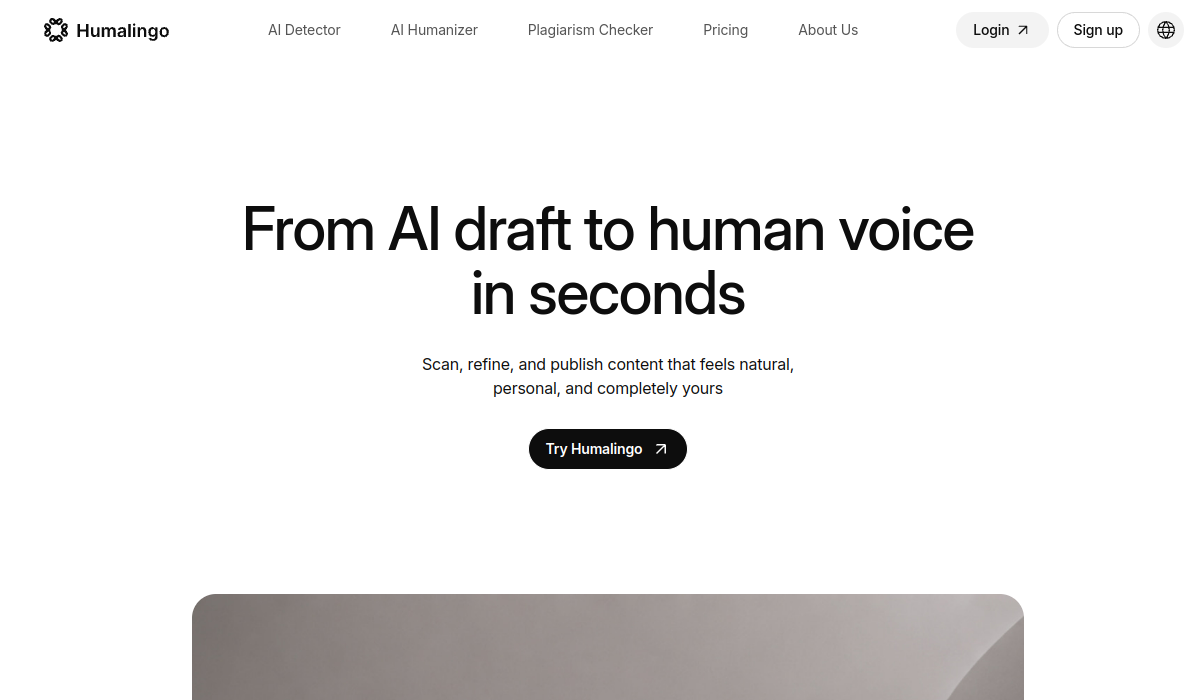
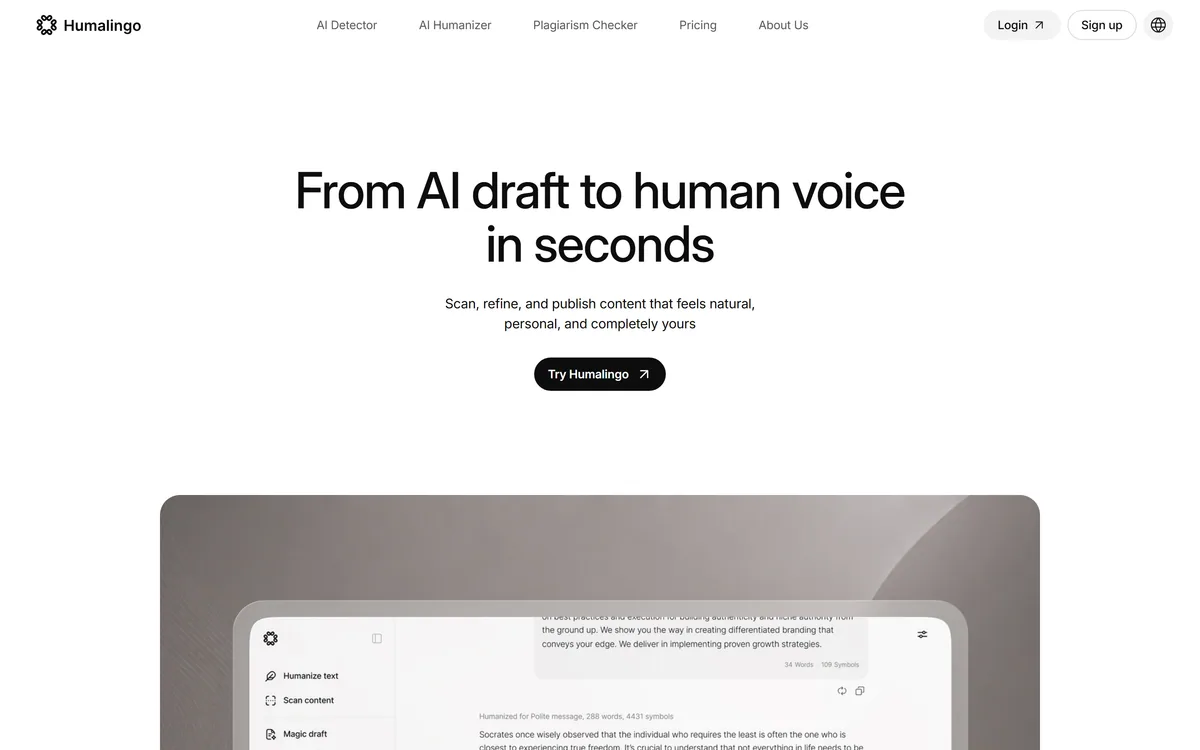
Humalingo combines an AI detector that highlights machine-written passages and explains what triggered them with a rewriting tool that adjusts text by purpose, tone and mode. It also offers a plagiarism checker and a paraphraser, and displays testimonials describing academic and workplace use.
Humalingo does two things that belong to different worlds. One is a detector that shows how AI-detection systems read your text and explains what triggered them, which is genuinely informative.
The other is a rewriter that changes text until it reads differently. Paired together, the pitch is straightforward: check how it scores, rewrite, check again.
That loop has legitimate uses and one prominent illegitimate one, and the site's own testimonials describe both. This listing covers the technology accurately and is direct about where the line falls.
Humalingo's homepage, captured 9 September 2026.
Humalingo: A Detector And A Humanizer
Two halves: a detector highlighting AI-written passages and explaining what triggered them, and a rewriter that adjusts the text.
Rewriting by purpose, tone and mode — inform, persuade, reflect or analyse — rather than a single paraphrase.
A plagiarism checker and paraphraser alongside, with detection stated as working in any language.
Testimonials describe academic use, including reworking papers to pass a professor's detection policy.
No detector-evasion guarantee is available from any tool, and this one cannot offer it either.
Why Can No Tool Guarantee Passing A Detector?
The detector half is described as showing how AI detectors view your content before you publish, with a full analysis highlighting generated passages and explaining what triggered detection.
The explanation is the useful part. The guarantee that anyone in this category implies is not available, and the reason is structural rather than a limitation of any particular product.
A detection score is produced by a system you do not control, running a model you cannot inspect, updated on a schedule nobody publishes. Text that scores as human today can score differently next month against the same detector, because the detector changed rather than the text.
There is no fixed target to optimise against. Any tool claiming a passing outcome is describing a snapshot, and the honest version of the claim is that it scored a certain way when tested, against whichever detectors were tested.
This applies to every tool in this category equally, including Rephrasy and the others. It is not a criticism specific to Humalingo — it is the reason the whole promise cannot be made good.
A detection score comes from a system you do not control, updated on a schedule nobody publishes. There is no fixed target to optimise against.
What Detectors Actually Get Wrong
The other half of the problem is that AI detectors are themselves unreliable, in both directions, and this matters for anyone on either side of the question.
False positives are the serious failure. Detectors flag writing that is unusually regular, plainly worded or grammatically consistent — which describes a great deal of competent human writing, and disproportionately describes people writing in a second language, who have learnt formal register from textbooks.
Several institutions and vendors have acknowledged this pattern, and it is why detection scores are increasingly treated as one signal among several rather than as evidence.
False negatives are equally common in the other direction, which is what makes the evasion market exist at all.
The practical consequence for an honest writer is uncomfortable: your own work can be flagged, and no tool fixes that reliably. The defensible response is documentation — drafts, version history, notes — rather than rewriting until a number moves, because a rewrite log is not evidence of authorship and a draft history is.
Where This Crosses Academic Integrity
Two testimonials on the homepage describe the same use case. A graduate student describes three papers due in one week, a professor with explicit AI-detection policies, drafts reworked quickly, and passing every check. A research assistant describes a supervisor flagging a report section, a rewrite in under five minutes, and the new version passing every detector.
We can report those as displayed and be clear about the underlying act.
Submitting work generated by a model as your own, having rewritten it to read differently, misrepresents authorship. That breaches academic integrity policy at essentially every institution, and the rewriting is what the policy is designed to catch rather than a way around it.
The consequences are also asymmetric. The student carries the academic penalty; no tool vendor is party to that hearing, and a receipt for a rewriting subscription is not a defence.
None of this is a claim about the company, which sells a text tool. It is a statement about what the described use involves, and anyone reading those testimonials as a recommendation should understand what they would be agreeing to.
Never submit generated writing as your own, rewritten or otherwise.
Keep drafts and version history — that is what evidences authorship.
Treat any detection score as a signal, not a verdict.
Check your institution's or employer's stated policy directly.
If a rewrite removes your argument, the argument was never yours.
The Legitimate Uses That Do Exist
It would be dishonest to present this category as having no valid application, because it plainly does, and the other testimonials on the page describe several.
Editing your own writing is the clearest. A social media manager keeping voice consistent across five brands, or a content strategist raising a draft to client standard, is doing ordinary editorial work with a tool. The words started as theirs.
Second-language writing is the strongest case. Someone who has the ideas and the expertise but writes English that reads stiffly is not misrepresenting anything by improving the prose, and the same tool that flattens a native writer's voice can genuinely lift theirs.
Checking before publishing is legitimate too. Knowing that your marketing page reads as machine-written is useful commercial information regardless of how it was produced, since readers respond to it.
The distinction throughout is authorship. Improving how your own thinking is expressed is editing; presenting someone else's output — including a model's — as your own thinking is not, and no feature setting changes which one you are doing. The same line runs through academic writing tools such as LabReportAI, and it is drawn in exactly the same place.
What The Detector Half Is Actually Good At
Setting the evasion framing aside, one feature here is genuinely worth having: the detector explains what triggered detection rather than returning a percentage.
That is more useful than every score-only detector, and for an unexpected reason.
The characteristics that trigger detectors — uniform sentence rhythm, predictable word choice, an absence of specificity, hedged generalities — are also the characteristics of boring writing. A detector that names them is, incidentally, a fairly good prose critic.
So a writer using it to understand why their own work reads as flat is getting real feedback, in the same territory as Hemingway Editor's highlights though arrived at from an entirely different direction.
The plagiarism checker sits alongside and answers a different question — whether text matches an existing source — which is a factual check rather than a probabilistic one, and considerably more reliable for it.
Editing AI Drafts Into Your Own Words
If you use a model to draft and want the result to be genuinely yours, the work is substantive rather than cosmetic.
This sequence is about authorship rather than about scores.
Write your argument in your own words first, however roughly.
Use a model for structure or phrasing, never for the claims.
Replace every generality with a specific you actually know.
Read it aloud and cut any sentence you could not defend.
Keep the draft history — it is the only real evidence of authorship.
For anything graded or supervised, follow the stated policy exactly.
Humalingo: Products And Ownership
Products
AI detector, AI humanizer, plagiarism checker, paraphraser and word counter
Detector output
Highlights generated passages and explains what triggered detection
Language support
Detection stated as working in any language
Rewriter controls
Writing purpose — inform, persuade, reflect or analyse — plus tone and mode
Stated aim
Preserving meaning while the text is refined
Audiences named
Writers, corporate, media, online business and personal
Testimonials
Nine displayed, with first names and role labels
Academic testimonials
Two describe reworking academic or supervised writing to pass detection checks
Policies published
Terms of use, privacy policy and subscription terms
Company information
An about page is linked; no operating company is named in the footer
Last checked . Read from humalingo.com in a browser session on the date above, including the full footer. The screenshot was captured at the same time.
Positioned as taking content from AI draft to human voice in seconds
An AI detector described as highlighting generated content and explaining what triggered detection
Detection stated as available in any language, alongside plagiarism checking
An AI humanizer described with writing purpose, tone and mode controls
Purpose options listed as inform, persuade, reflect and analyse
Meaning preservation stated as maintained however much the text is refined
Audiences named as writers, corporate, media, online business and personal
Nine testimonials displayed with first names and role labels
One testimonial describes a graduate student reworking papers against a professor's AI detection policy and passing every check
One testimonial describes a research assistant rewriting a flagged report section that then passed every detector
Products listed as plagiarism checker, AI humanizer, paraphraser, AI detector and word counter
What we could not confirm: which detectors the tool tests against or how often that list is updated; the basis for any claim about passing detection, since detectors change without notice; the accuracy of the detector half in either direction; whether the testimonials describe real users; what operating company is behind the service, which the footer does not name; and pricing, which we did not reproduce. We did not submit text to the tool.
Editor's Verdict
2.3/5
The underlying technology is competent and the detector's explanation of what triggered a flag is genuinely more useful than a bare percentage. We score it low for what it is sold to do. Two of the testimonials on its own homepage describe reworking academic and supervised work specifically to pass detection checks, and submitting generated writing as your own breaches academic integrity at essentially every institution. The detector-evasion promise is also structurally unavailable — no tool can guarantee an outcome decided by a system it does not control and that changes without notice. AInexfinder Editor Score: 2.3/5.
Humalingo pricing
AInexfinder does not list plan prices or billing details. For current pricing, plans, and trials, visit the official Humalingo website.
Vendor pricing, credits, and billing policies change over time. Always confirm on the official site before you buy.
Frequently asked questions
What is Humalingo?
A pair of tools: an AI detector that highlights machine-written passages and explains what triggered them, and a rewriter that adjusts text by purpose, tone and mode. A plagiarism checker and paraphraser sit alongside.
Can it guarantee my text passes AI detection?
No tool can. A detection score comes from a system you do not control, running a model you cannot inspect, updated on a schedule nobody publishes. Text scoring as human today can score differently next month because the detector changed.
Is it acceptable to use for coursework?
Submitting generated writing as your own — rewritten or not — misrepresents authorship and breaches academic integrity policy at essentially every institution. The rewriting is what those policies exist to catch, not a route around them.
Two testimonials describe exactly that. What should I read into them?
That the use case is being marketed. We report them as displayed and state the position plainly: the academic penalty falls on the student, no vendor is party to that hearing, and a subscription receipt is not a defence.
What if my own writing gets flagged?
It happens, and disproportionately to second-language writers whose formal register came from textbooks. The defensible response is documentation — drafts, version history, notes — because a draft history evidences authorship and a rewrite log does not.
Are AI detectors reliable?
Not enough to treat as evidence. They produce false positives on plain, regular human writing and false negatives on generated text, which is why institutions increasingly treat a score as one signal among several rather than a verdict.
What are the legitimate uses?
Editing writing that started as yours — keeping voice consistent across brands, lifting a stiff second-language draft, or checking whether a marketing page reads as machine-written, which is useful commercial information regardless of how it was written.
Is the detector half useful on its own?
More than most, because it explains what triggered a flag. Uniform rhythm, predictable phrasing and hedged generalities are what detectors notice — and they are also what makes writing dull, so the explanation doubles as prose criticism.
How is the plagiarism checker different?
It answers a factual question — does this text match an existing source — rather than a probabilistic one. That makes it considerably more reliable than detection, and a different kind of check entirely.
What should I use instead for graded work?
Your own words, with a draft history. Write the argument roughly first, use a model for structure rather than claims, replace generalities with specifics you actually know, and follow whatever policy your institution has published.
Daniel reviews AI tools the slow way — by actually using them on real projects. His reviews cover what works, what breaks, and who each tool is genuinely a good fit for.
Daniel and the AInexfinder editorial team research Humalingo using public product information, listing evidence, and (when available) hands-on checks. Scores reflect listing completeness and transparency — not paid placement.
Listings may include affiliate or sponsored placements, which are labeled when present. Editorial scores and cons are not sold. See our affiliate disclosure and review methodology.
Undetectable AI rewrites AI-generated text so it reads as human-written and is less likely to be flagged by detectors. It also sells detection tools of its own — for text, images, voice, video and deepfakes — plus a suite of writing utilities and a Chrome extension.
RewritePal is a free online writing assistant for paraphrasing, grammar and spelling correction, tone adjustment, and making AI-generated text read more naturally, with a 40,000-character editor and no account required.
Free AI Humanizer is a tool on CopyChecker that rewrites AI-generated text to read more naturally, with controls for mode, readability level, purpose, and strength, capped at 500 words per run and usable without signup.
Decopy AI is a free suite of writing and study utilities covering text humanizing, AI detection, summarisation of documents, video and audio, speech conversion, a maths solver, flashcard and worksheet creation, and story and article generation — usable without creating an account.
Copy.ai has become an AI-native go-to-market platform: workflows and agents that run prospecting, lead processing, deal coaching, ABM, and CRM enrichment across Salesforce, HubSpot, Gong, Outreach, and 2,000+ integrations.
Writesonic has become an AI search growth platform — tracking whether your brand appears across 10 AI platforms, running optimisation and citation work through an Action Center, and reporting results against traffic and revenue.