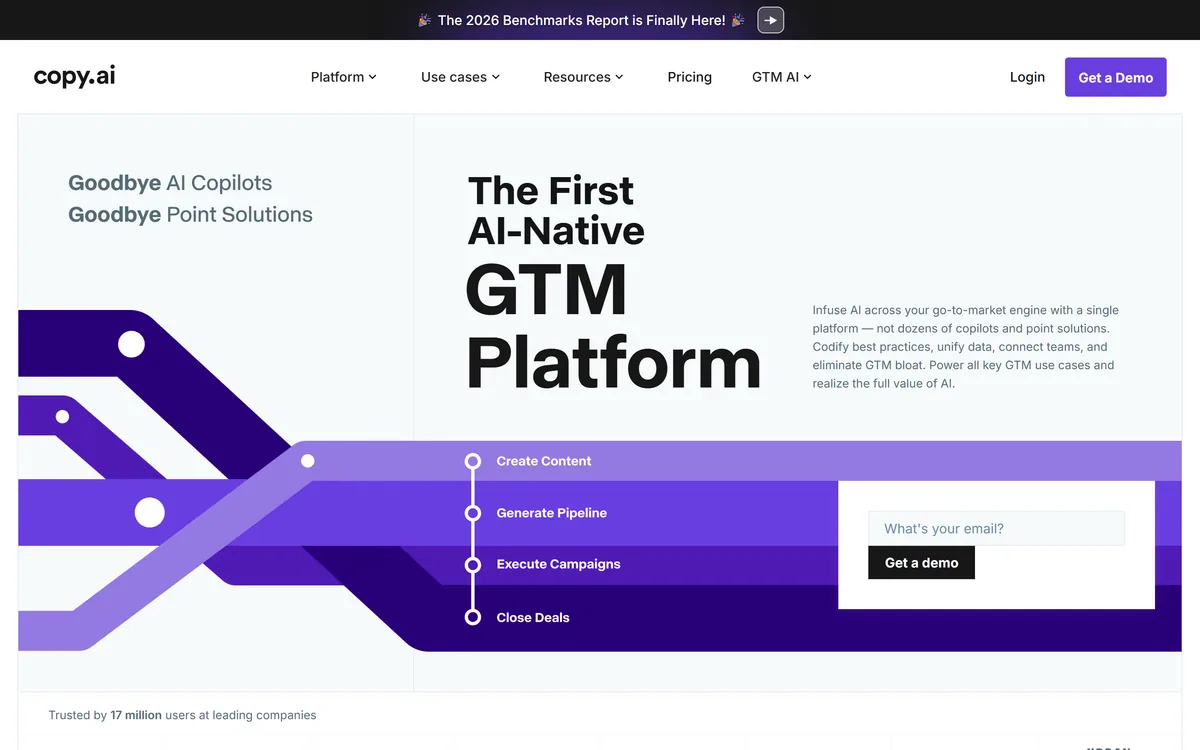
Copy.ai has become an AI-native go-to-market platform: workflows and agents that run prospecting, lead processing, deal coaching, ABM, and CRM enrichment across Salesforce, HubSpot, Gong, Outreach, and 2,000+ integrations.
Copy.aicopy.ai54,032 viewsAdded December 21, 202510M+ visitors
Copy.ai is not what it was, and that is the single most important thing to know before evaluating it. It launched as one of the first mainstream AI copywriting tools and built its reputation there.
Its own homepage now sells something else entirely: an AI-native go-to-market platform that unifies sales, marketing, and operations through automated workflows. Writing is a component, not the product.
This review covers what the platform actually does today, why the repositioning happened, who it now fits, and why anyone arriving expecting a writing assistant will be disappointed for reasons that are not Copy.ai's fault.
Copy.ai's own homepage no longer sells copywriting — the pitch is go-to-market operations.
The Short Version On Copy.ai
It changed: Copy.ai was one of the first AI copywriting tools. It is now a go-to-market platform for sales, marketing, and revenue operations.
What it runs: workflows and agents for prospecting, inbound lead processing, deal coaching, account-based marketing, and CRM enrichment.
Where it plugs in: Salesforce, HubSpot, Gong, Outreach, Salesloft, Zapier — a stated 2,000+ integrations.
Who it is for now: revenue teams with real GTM process, not individuals who want faster blog drafts.
The mismatch to avoid: buying it expecting a writing tool. On writing alone it is expensive and beaten by cheaper options.
Key features of Copy.ai
Workflows that run multi-step go-to-market processes end to end
Copy Agents making decisions inside those workflows
Infobase company knowledge layer and Brand Voice tone control
Prospecting, inbound lead processing, and lead routing
Deal coaching and forecasting drawing on call data
Account-based marketing and CRM enrichment
Translation and localisation for multi-market teams
Model-agnostic across OpenAI, Anthropic, Gemini, and Perplexity
Pros & cons
Pros
5
Workflows act on CRM data rather than producing text you paste somewhere
Genuinely deep integrations — Salesforce, HubSpot, Gong, Outreach, Salesloft
Model agnostic, so you are not locked to one AI provider's roadmap
Use cases are specific process, not vague capability claims
Enterprise compliance baseline with SOC 2, GDPR, and SSO
Cons
5
The name misleads — most arrivals expect a writing tool and get a GTM platform
Requires real configuration before any value appears
Expensive and beaten by cheaper options if writing is all you need
Competes against CRM-native AI that already owns the data
Exposes rather than fixes an undocumented go-to-market process
Best For
Revenue operations teams automating documented GTM process
Sales teams drowning in inbound leads that need triage
Marketing teams running account-based campaigns at scale
Organisations that want model choice across AI providers
Companies selling across multiple markets and languages
Copy.ai Against The Obvious Alternatives
The right comparison depends entirely on whether you want writing or revenue operations.
The original business rested on a real advantage: in 2021, generating usable marketing copy was hard, and Copy.ai did it well enough to charge for. That advantage did not survive.
Once every general assistant could produce a competent product description for nothing, a dedicated copywriting subscription had no floor to defend. Every tool in that category faced the same problem, and most either repositioned or shrank.
Copy.ai moved toward the work that a general chatbot cannot do — the part that needs your CRM, your pipeline, and your process rather than just a prompt.
Any model can write a cold email. Almost none of them know which account it is for, what the last call covered, or where to write the result back.
The Building Blocks
The platform is assembled from a small set of primitives, and understanding them makes the product far less confusing than the marketing language suggests.
Workflows — multi-step processes that run without a person driving each stage
Copy Agents — agents that make decisions inside those workflows
Actions — the individual operations a workflow performs, including writing to other systems
Tables — structured data the workflows read from and write back to
Infobase — the company knowledge layer that stops output being generic
Brand Voice — tone consistency across everything generated
Chat — the conversational surface, closest to the old product
What Teams Actually Run On It
The named use cases are unusually specific, which is a good sign — they describe process rather than capability.
Top Of Funnel
The Prospecting Cockpit and inbound lead processing cover research and triage: enriching accounts, working out who is worth contacting, and routing what arrives without a human reading every form fill.
This is where the CRM integration earns its place. A workflow that reads Salesforce, enriches a record, and writes back is doing something no standalone assistant can.
Mid And Late Funnel
Deal coaching and forecasting draw on call data through the Gong integration, turning conversation history into guidance for reps and signal for managers.
Account-based marketing sits alongside it, generating campaign material that is specific to a named account rather than to a segment.
Operations Work
CRM enrichment and GTM systems integration are the unglamorous jobs that make everything else work. Bad CRM data breaks forecasting, routing, and personalisation simultaneously.
Translation and localisation round out the set for teams selling across markets.
Getting It Live Without Wasting A Quarter
Rollouts fail in a predictable pattern, so the sequence below is worth following in order.
Pick one process that is already documented and already annoying — inbound routing is usually the best first candidate.
Populate Infobase with real company context before building anything. Thin context produces generic output no workflow can rescue.
Connect only the systems that process touches. Connecting everything at once multiplies the debugging surface.
Run the workflow alongside the manual version for two weeks and compare outcomes, not outputs.
Set Brand Voice once the workflow is producing correct results, not before.
Only then add a second process. Teams that build five workflows at once rarely get any of them reliable.
Model Choice And Governance
Copy.ai describes itself as model agnostic across OpenAI, Anthropic, Gemini, and Perplexity. That matters more for a platform than for a chat tool — you are building process on top of it, and being tied to one provider's roadmap is a real risk.
Compliance covers SOC 2, GDPR, and SSO, which is the baseline for anything touching CRM records. The named customer list skews enterprise: Siemens, ServiceNow, Gong, Rubrik, Thermo Fisher Scientific, and Lenovo among them.
That customer profile tells you where the product is aimed. This is sold to revenue organisations with process to automate, not to individuals with a blog.
The Honest Downsides
The brand is the biggest problem. "Copy.ai" says copywriting, so a large share of people arriving are the wrong audience, and they leave concluding it is overpriced — which is true for what they came for and irrelevant to what it sells.
Setup is a project. Workflows, Infobase, and integrations all need configuration, and the value only appears once that work is done.
It also sits in a crowded space now. Competing against CRM-native AI means competing against tools that already own the data, which is a structural disadvantage.
And if your GTM process is undocumented, automating it will mostly reveal that — usefully, but not comfortably.
Still Want It For Writing?
If writing is genuinely your requirement, Chat and Brand Voice will do the job, and they are competent. But you would be paying for a GTM platform to use its smallest component.
A dedicated writing tool or a general assistant will cost less and serve you better. That is not a criticism of Copy.ai — it is a product that moved on, and matching the tool to the actual need matters more than brand familiarity.
Is Copy.ai The Right Choice For You?
It Fits If
You run sales and marketing operations with process worth automating
Your CRM is Salesforce or HubSpot and the data is in reasonable shape
Inbound lead volume is beyond what a person can triage properly
You want model choice rather than being tied to one AI provider
Someone will own configuring workflows and Infobase properly
Look Elsewhere If
You mainly want help writing blog posts or marketing copy
You are an individual or a very small team
Your GTM process is undocumented and lives in people's heads
Your CRM already has capable native AI you are paying for
Nobody has time to configure it before judging it
Compare Copy.ai With These
Depending on whether your problem is pipeline or publishing, one of these is probably a closer match.
Jasper AI — the other early copywriting tool that repositioned, toward marketing agents and brand governance
HubSpot AI — agents native to the CRM, if your customer data already lives in HubSpot
Writesonic — still focused on content and SEO production if writing is the actual need
Zapier AI — broader automation when the workflows reach past sales and marketing
How This Listing Was Verified
Last checked . Everything below was read from Copy.ai's own site during this check, and the screenshot above was captured at the same time.
Product positioning taken from Copy.ai's current homepage, which sells a GTM platform rather than copywriting
Feature names — Workflows, Copy Agents, Actions, Tables, Infobase, Brand Voice — as Copy.ai lists them
Integration names and the 2,000+ figure recorded as Copy.ai states them, not independently counted
Compliance claims (SOC 2, GDPR, SSO) and named customers reported as vendor claims
The repositioning is documented here because most existing reviews still describe the 2021 copywriting product.
Editor's Verdict
4.2/5
Copy.ai has an AInexfinder Editor Score of 4.2/5.
Copy.ai pricing
AInexfinder does not list plan prices or billing details. For current pricing, plans, and trials, visit the official Copy.ai website.
Vendor pricing, credits, and billing policies change over time. Always confirm on the official site before you buy.
Frequently asked questions
Is Copy.ai still an AI writing tool?
Not primarily. Copy.ai now sells an AI-native go-to-market platform covering prospecting, lead processing, deal coaching, ABM, and CRM enrichment. Chat and Brand Voice cover writing, but they are one component rather than the product.
What does Copy.ai integrate with?
Salesforce, HubSpot, Gong, Outreach, Salesloft, and Zapier are named directly, with a stated 2,000+ integrations overall. Those CRM and call-data connections are what let workflows act rather than just generate text.
What is Infobase?
Copy.ai's company knowledge layer. It holds the context — positioning, product detail, process — that stops generated output being generic. A thin Infobase produces weak results no workflow can compensate for.
Should I buy Copy.ai just for writing?
No. It will do the job, but you would be paying for a go-to-market platform to use its smallest part. A dedicated writing tool or a general assistant costs less and fits better.
Which AI models does Copy.ai use?
It describes itself as model agnostic across OpenAI, Anthropic, Gemini, and Perplexity. For a platform you build process on, that avoids being tied to a single provider's roadmap.
How long does Copy.ai take to set up?
Longer than a writing tool. Workflows, Infobase, and integrations all need configuring, and value only appears afterwards. Start with one documented process, run it alongside the manual version, and expand from there.
Is Copy.ai safe for CRM data?
It states SOC 2 compliance, GDPR, and SSO, and lists enterprise customers including Siemens, ServiceNow, and Thermo Fisher Scientific. As with any tool writing back to a CRM, run it through your own security review first.
Daniel reviews AI tools the slow way — by actually using them on real projects. His reviews cover what works, what breaks, and who each tool is genuinely a good fit for.
Daniel and the AInexfinder editorial team research Copy.ai using public product information, listing evidence, and (when available) hands-on checks. Scores reflect listing completeness and transparency — not paid placement.
Listings may include affiliate or sponsored placements, which are labeled when present. Editorial scores and cons are not sold. See our affiliate disclosure and review methodology.
Writesonic has become an AI search growth platform — tracking whether your brand appears across 10 AI platforms, running optimisation and citation work through an Action Center, and reporting results against traffic and revenue.
LogicBalls is an AI writing and content platform whose central idea is verification before generation — it asks clarifying questions rather than assuming intent. It offers thousands of task-specific tools across writing, research, analysis and explanation, and claims 15M+ clarified generations.
Smartcat combines AI translation across 280+ languages with a CAT tool, translation memory, a marketplace of 500,000+ linguists, and AI agents for writing, auditing and maintaining content — integrated with Figma, Contentful, WordPress, Git and Salesforce.
Jasper has moved from AI copywriting to orchestrating marketing agents, with 100+ specialised agents, Content Pipelines, the Jasper IQ context hub, Jasper Studio for custom agents, and brand governance across everything a marketing team produces.
neuroflash is a German audience intelligence and AI content platform. Alongside its ChatFlash, ContentFlash and ImageFlash modules it runs Digital Twins — simulated respondents built on over a million real survey profiles — for testing copy before it ships.
Spiral, a product from Every, uses stylometry to build a voice profile from your existing writing, then drafts tweets, blog posts, LinkedIn updates and newsletters in that voice. It adds shareable team styles, a knowledge base, and MCP and API access.