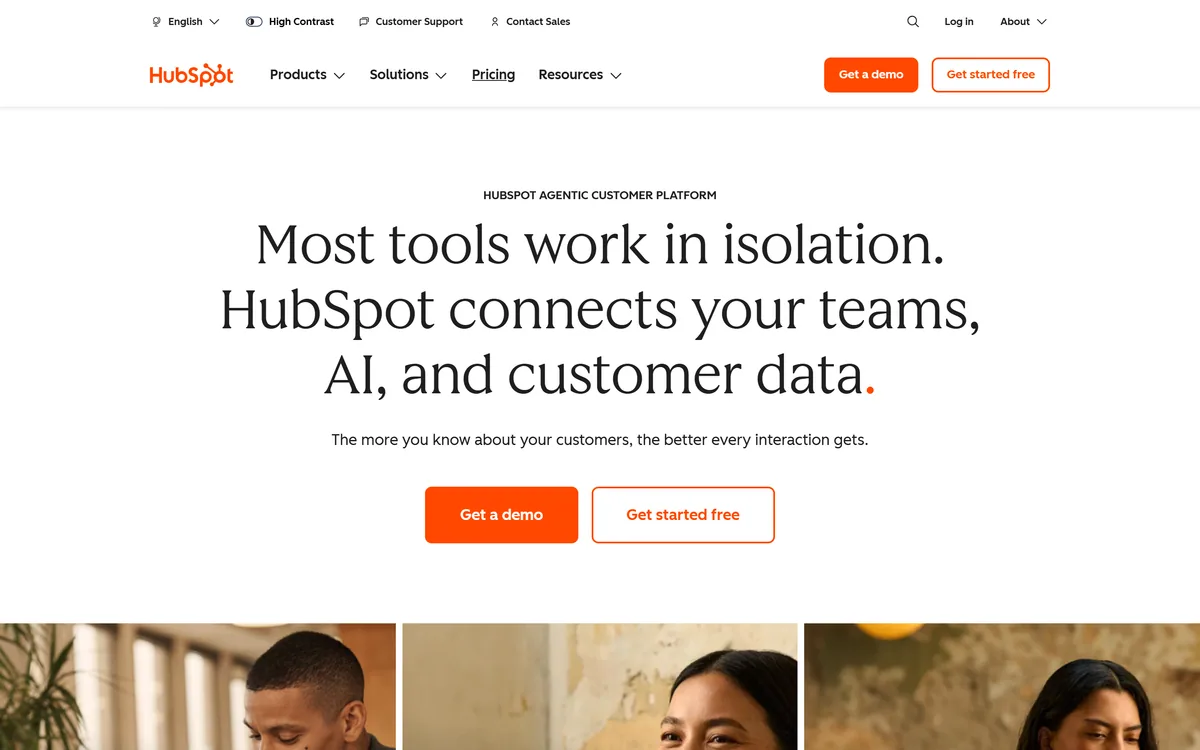
HubSpot AI is branded Breeze — an assistant plus a set of agents for prospecting, content, customer service, campaigns, nurture, and revenue, all running on live CRM data, with an Agent Builder for custom ones.
HubSpot Inchubspot.com134,014 viewsAdded June 8, 2025250K visitors
HubSpot's AI is branded Breeze, and it is not a chatbot bolted onto a CRM. It is a set of agents that act on the live customer data already in the platform.
That distinction is the whole argument. A general assistant can write a follow-up email; a Breeze agent knows which deal it belongs to, what the customer bought, and what the last three conversations covered.
This review covers what each agent does, why CRM data quality determines whether any of it works, how the credit model affects cost, and where HubSpot AI genuinely falls short.
HubSpot's AI is not a separate product — Breeze runs on the CRM data already in the platform.
HubSpot Breeze Reference
Maker
HubSpot
AI brand
Breeze
Category
AI agents built into a CRM platform
Assistant
Breeze Assistant
Named agents
Prospecting, Customer, Content, Data, Campaign, Nurture, and Revenue agents
Custom agents
Agent Builder
Sales automation
Smart Deal Progression
Hubs covered
Marketing Hub, Sales Hub, and Service Hub
Availability
Starter, Professional, and Enterprise customers
Usage model
Custom agents consume HubSpot Credits, bought up front or pay-as-you-go
Security
SOC 2 Type 2 compliance
The Agents, And What Each One Owns
Rather than one general assistant, HubSpot ships agents shaped around specific jobs across Marketing Hub, Sales Hub, and Service Hub.
Prospecting And Revenue Agents
The Prospecting Agent works the top of the funnel — researching leads and handling outreach against records already in the CRM. The Revenue Agent focuses further down, on pipeline and closing.
Smart Deal Progression sits alongside them, moving deals forward based on what has actually happened rather than on a rep remembering to update a stage.
Customer Agent
The Customer Agent handles support conversations using your knowledge base and ticket history. Because it sits on the same records as your service team, it hands off with context rather than making the customer repeat themselves.
That handoff quality is the usual difference between a support bot people tolerate and one they resent.
Content, Campaign, And Nurture Agents
The Content Agent produces marketing material, the Campaign Agent assembles multi-step campaigns, and the Nurture Agent manages the sequences that keep leads warm.
These are the most replaceable of the set — plenty of tools write marketing copy. Their advantage is knowing your segments and history, not their prose.
Data Agent And Agent Builder
The Data Agent works on the CRM records themselves, which matters because everything else depends on that data being right. Agent Builder lets teams create custom agents for workflows the standard set does not cover.
Why CRM Data Quality Decides Everything
Breeze agents reason over your CRM. If that CRM is well maintained, they produce specific, contextual work that no external tool could match.
If it is full of duplicates, stale records, and half-filled fields — which describes most CRMs — the agents produce confident output based on wrong information. That is worse than no automation, because it is harder to notice.
This is the single most important thing to establish before adopting Breeze. The honest first step is usually a data cleanup, not an agent rollout, and the Data Agent exists partly because HubSpot knows this.
The Integration Advantage
HubSpot's real strength is that marketing, sales, and service already share one database. Most organisations run three systems that disagree with each other, and reconciling them is a permanent tax.
AI amplifies that advantage. An agent that can see a customer's marketing engagement, sales history, and support tickets together answers questions no single-department tool can.
It also means adopting Breeze is not a tool decision but a platform decision. The value is inseparable from having your customer data in HubSpot in the first place.
Credits, Tiers, And Predicting Cost
Breeze is available to Starter, Professional, and Enterprise customers, so AI is not reserved for the largest plans — which is unusual and genuinely welcome.
Custom agents consume HubSpot Credits, bought up front or on a pay-as-you-go basis. That makes AI usage a separate variable from your subscription, and one that is difficult to forecast before you know how heavily agents will run.
Model the credit consumption of one agent against real volume before rolling out several. The pattern that catches teams out is enthusiasm — five agents enabled at once, with the bill arriving a month later.
Governance And Oversight
HubSpot emphasises full visibility into what the agents are doing, alongside SOC 2 Type 2 compliance.
Visibility matters more with CRM agents than with most AI tools, because these ones contact customers. An agent sending a poorly judged follow-up is not an internal embarrassment; it reaches someone you are trying to sell to.
Set review gates on anything customer-facing before it goes out, at least until you trust a given agent's judgement on your data.
The Real Limitations
Everything depends on being a HubSpot customer. If your CRM is elsewhere, none of this applies, and adopting HubSpot to get Breeze is a migration project rather than a purchase.
Content generation is competent rather than distinguished. Judged purely as writing tools, the Content and Campaign agents lose to dedicated alternatives — their edge is context, not craft.
The overall platform is expensive as you climb tiers, and credits add a second axis of cost on top.
There is also a lock-in question worth naming. The deeper you build agents and custom workflows into HubSpot, the more expensive leaving becomes, and that is a strategic decision rather than a feature comparison.
Rolling It Out Sensibly
Audit your CRM data first. Every hour spent on duplicates and stale records improves every agent afterwards, and skipping this step is the most common reason Breeze disappoints.
Enable one agent, on one process, and run it alongside the manual version long enough to compare. The Customer Agent and Prospecting Agent are usually the clearest wins to start with.
Keep humans reviewing outbound communication until an agent has earned trust on your specific data.
Use Agent Builder only after the standard agents are working. Custom agents consume credits and multiply the number of things that can quietly go wrong.
Is HubSpot AI Worth It?
For HubSpot customers, Breeze is close to a straightforward yes. Agents that act on live CRM data do work that external AI tools structurally cannot, and availability from the Starter tier makes it accessible rather than an enterprise-only feature.
Choose it if you already run marketing, sales, or service in HubSpot and your data is in reasonable shape. Do not choose HubSpot because of Breeze alone — the AI is good, and it is not worth a CRM migration on its own.
Check hubspot.com for current plans and credit pricing, and treat a data cleanup as part of the implementation cost rather than an optional extra.
Key features of HubSpot AI
Breeze Assistant across Marketing, Sales, and Service Hubs
Prospecting Agent and Revenue Agent for pipeline work
Customer Agent handling support with full ticket and record context
Content, Campaign, and Nurture agents for marketing execution
Data Agent for maintaining CRM record quality
Agent Builder for custom agents on your own workflows
Smart Deal Progression driven by recorded activity
Full visibility into agent activity, with SOC 2 Type 2 compliance
Pros & cons
Pros
5
Agents act on live CRM data rather than on pasted context
One database across marketing, sales, and service beats three that disagree
Available from the Starter tier, not restricted to enterprise plans
Customer Agent hands off to humans with context intact
Agent Builder covers workflows the standard set misses
Cons
5
Useless unless your CRM is HubSpot — otherwise it is a migration, not a purchase
Output quality is only as good as your CRM data, and most CRMs are messy
Content and campaign writing is competent but beaten by dedicated tools
Credits add an unpredictable cost axis on top of tier pricing
Deep agent adoption increases lock-in and the cost of ever leaving
Best For
Existing HubSpot customers with reasonably clean CRM data
Sales teams automating research and early outreach
Service teams deflecting routine tickets without losing context on handoff
RevOps teams that need marketing, sales, and service to share one record
Smaller companies wanting CRM AI without an enterprise contract
Editor's Verdict
4.4/5
HubSpot AI has an AInexfinder Editor Score of 4.4/5.
HubSpot AI pricing
AInexfinder does not list plan prices or billing details. For current pricing, plans, and trials, visit the official HubSpot AI website.
Vendor pricing, credits, and billing policies change over time. Always confirm on the official site before you buy.
Frequently asked questions
What is Breeze?
Breeze is HubSpot's AI brand. It covers the Breeze Assistant plus agents for prospecting, customer service, content, campaigns, nurture, revenue, and CRM data, all operating on live records across Marketing, Sales, and Service Hubs.
Do I need to be a HubSpot customer to use Breeze?
Yes. Breeze's entire advantage is acting on data already in HubSpot's CRM. Adopting HubSpot purely to get Breeze is a platform migration, not a tool purchase, and rarely justified on the AI alone.
Why is my Breeze output inaccurate?
Almost always CRM data quality. Agents reason over your records, so duplicates, stale entries, and half-filled fields produce confident but wrong output. A data audit is part of the implementation, not an optional extra.
How is HubSpot AI priced?
Breeze is available to Starter, Professional, and Enterprise customers, and custom agents consume HubSpot Credits bought up front or pay-as-you-go. AInexfinder does not publish plan prices — check hubspot.com, and model credit use against real volume first.
What can I build with Agent Builder?
Custom agents for workflows the standard set does not cover. Use it after the built-in agents are working — custom agents consume credits and add more places for problems to go unnoticed.
Is it safe to let Breeze agents contact customers?
With review gates, yes. HubSpot provides visibility into agent activity and holds SOC 2 Type 2 compliance, but these agents reach real customers, so keep humans reviewing outbound communication until an agent has proven itself on your data.
Which Breeze agent should I start with?
Usually the Customer Agent or the Prospecting Agent — both have clear success measures. Run one agent on one process alongside the manual version long enough to compare before enabling more.
Daniel reviews AI tools the slow way — by actually using them on real projects. His reviews cover what works, what breaks, and who each tool is genuinely a good fit for.
Daniel and the AInexfinder editorial team research HubSpot AI using public product information, listing evidence, and (when available) hands-on checks. Scores reflect listing completeness and transparency — not paid placement.
Listings may include affiliate or sponsored placements, which are labeled when present. Editorial scores and cons are not sold. See our affiliate disclosure and review methodology.
Clay is go-to-market data infrastructure built around waterfall enrichment: instead of one provider, it queries a marketplace of more than 200 in sequence until a field is filled. Claygent AI agents research companies and people, and the results push into a CRM, ad platforms or a native sequencer.
Trellus is an AI dialer that works inside Salesloft, Outreach and HubSpot, offering parallel dialling of up to five lines, real-time call guidance, conversational analytics, voice agents for practice and inbound, and a LinkedIn tool, aimed at multiplying sales conversations.
AutogenAI is an enterprise platform for writing proposals, bids and grant applications. It covers the workflow from qualifying an opportunity through drafting, research, review and compliance, using custom language engines built on each customer's own tone of voice and content library.
Aviso is an agentic revenue intelligence platform for go-to-market teams. It covers forecasting, pipeline inspection, conversation and relationship intelligence, coaching, sales engagement and customer success, with more than 30 prebuilt agentic workflows and a no-code studio for building new agents.
Ironclad is an AI contract lifecycle management platform covering create, review, sign, store, analyze and fulfill. Jurist is its agentic AI contract partner for legal review, Ironclad AI runs behind every workflow stage, and 20+ integrations connect it to Salesforce, Word, Slack, DocuSign and SAP.
Gainsight is a customer success and retention platform that turns product, engagement and support signals into scored risk and the right action, spanning customer success, product experience, community and education, with agentic AI across all of it.