
HubSpot AI is branded Breeze — an assistant plus a set of agents for prospecting, content, customer service, campaigns, nurture, and revenue, all running on live CRM data, with an Agent Builder for custom ones.
FreemiumBusiness & Marketing
AutogenAI is an enterprise platform for writing proposals, bids and grant applications. It covers the workflow from qualifying an opportunity through drafting, research, review and compliance, using custom language engines built on each customer's own tone of voice and content library.
| Category | AI proposal, bid and grant writing for enterprises |
|---|---|
| Core modules | Qualify and Extract, Manage, Write, Research, Review, Integrations |
| Language engines | Custom engines built with each customer's brand tone of voice |
| Knowledge access | Connects to organisational content and knowledge repositories |
| Segments served | Federal contractors, enterprise bid teams, and nonprofit grant writing |
| Certifications | FedRAMP High authorised, ISO 27001, SOC 2 Type II, NIST RMF compliant, GDPR compliant, with AICPA attestation |
| Stated customer count | More than 270 companies |
| Named customers | Serco, HGS, Fujitsu, Siemens, Specsavers |
| Vendor-stated results | 70% increase in drafting speed, 85% increase in productivity, 241% increase in success rates, 100% increase in bids submitted |
| Recognition | G2 category awards for Best ROI, Fastest Implementation and Best Support |
| US registered office | 1450 Broadway, Floor 15, New York, NY 10018 |
| Charging model | Enterprise, contact sales, seat-based licensing; no prices published here |
Proposal work has a shape that makes it unusually well matched to automation, and it is worth setting out because it explains the whole category.
First, it is enormously repetitive at the component level. Any organisation that bids regularly answers the same questions repeatedly — your health and safety policy, your quality management approach, your approach to social value, your relevant experience. The specifics change; the substance rarely does.
Second, it is deadline-driven and lumpy. Tenders arrive with fixed submission dates, frequently several at once, and the work cannot be spread evenly. Bid teams are either idle or working weekends, which makes capacity the binding constraint rather than skill.
Third, it is compliance-heavy. Tenders specify word limits, mandatory sections, evidence requirements and formatting rules, and a non-compliant bid can be disqualified before anyone reads its quality. Checking that mechanically is exactly the sort of task humans do badly at 2am.
Fourth, and most importantly, the outcome is binary and the value is large. You win the contract or you do not. That makes the return on any marginal improvement very legible to a finance director, which is why enterprise pricing survives here.
Put together, that is a far stronger case than most AI writing applications have — stronger than volume SEO writers like Byword can make. The work genuinely is repetitive, the constraint genuinely is capacity, and the payoff genuinely is measurable.
Bid teams are either idle or working weekends. The binding constraint has always been capacity, not writing skill — which is exactly the constraint software can move.
The phrase sounds like marketing and describes the thing that makes this different from drafting a proposal in a general chat model.
A bid does not just need to be well written. It needs to sound like your organisation, use your terminology, reflect your accreditations, cite your actual case studies and describe methodologies you genuinely operate. Generic excellent prose that describes a company you are not is worse than mediocre prose that is accurate.
Building an engine on a customer's own tone of voice, connected to their knowledge repository, is what closes that gap. It means the draft arrives already carrying your language and your evidence rather than requiring a rewrite to insert both.
Patent drafting platforms such as Solve Intelligence solve the same grounding problem in another regulated discipline. That also addresses the most dangerous failure mode in AI-assisted bidding, which is not poor writing — it is a confident, fluent claim your organisation cannot substantiate. A bid that asserts a certification you do not hold or an experience you do not have is a serious problem, not a typo. Grounding generation in your actual content library is the structural defence against that.
The Research module extends the same logic to evidence sourcing, and Review to compliance checking. Together they describe a product built by people who have sat in a bid room, rather than a writing tool with a tender template.
The honest limit is that none of it supplies strategy. Deciding which opportunities to pursue, what your win themes are, and how to price remain the parts that actually determine outcomes.
Buried in the certification list is the single most commercially significant fact about this company.
FedRAMP High authorisation is the US federal government's most stringent cloud security standard, applied to systems handling data where compromise would have severe or catastrophic effect. Achieving it is a long, expensive process involving hundreds of controls and continuous monitoring, and comparatively few companies of any size hold it.
The practical consequence is that federal contractors can use AutogenAI on the proposals they write for government agencies. Most AI writing tools cannot be used for that work at all, regardless of how good they are, because the security posture disqualifies them before capability is discussed.
That converts a certification into a market position. For a company bidding for US federal contracts, the shortlist of usable AI proposal tools is short, and this is on it.
General legal AI like Harvey competes on breadth rather than on this authorisation. The rest of the stack is genuinely strong too — ISO 27001, SOC 2 Type II, NIST RMF and GDPR with AICPA attestation covers UK, EU and enterprise procurement as well as US federal.
For any buyer, this is also the right lens on the sensitivity of the data. An unsubmitted bid contains your pricing approach, your win themes and your assessment of competitors. It is among the most commercially sensitive material an organisation produces, and a tool holding it needs exactly this kind of posture.
Four numbers appear prominently and they need very different amounts of scepticism.
70% increase in drafting speed and 85% increase in productivity are plausible and are the least interesting. They describe doing the same work faster, which is what you would expect and which is measurable on your own baseline.
100% increase in bids submitted is the most meaningful figure of the four, and it is the one to focus on. In bid work, capacity is the constraint — a team that can only produce four submissions a quarter is declining opportunities it might have won. Doubling throughput changes the shape of the pipeline rather than only the effort per bid.
241% increase in success rates is the one to treat carefully. Win rates depend overwhelmingly on factors outside any writing tool: whether you were the incumbent, whether your price was competitive, whether you had the right past performance, whether the buyer had already decided. A drafting platform can improve the quality and compliance of a submission, and attributing a multiple of win rate to it stretches the causal chain a long way.
There is also a selection effect worth naming: organisations that adopt bid software are frequently the ones simultaneously professionalising their whole bid function. The tool arrives alongside better processes, and the improvement is shared.
None of these are dishonest. They are customer-reported, unbaselined figures, and the sensible response is to measure bids submitted on your own numbers during a pilot.
This site does not publish plan prices, and AutogenAI does not either. The structure is what you can plan around.
The model is enterprise, contact-sales, with seat-based licensing. There is no self-serve entry, which is consistent with a product built around a custom language engine trained on your content — that is an onboarding project, not a signup.
The variables that typically drive a quote here are the number of bid team seats, whether federal deployment is required, and how much content library integration the language engine build involves. That last one is where implementation effort lives and is worth scoping early.
For a bid function the arithmetic is unusually legible, which is why the category sustains enterprise pricing. If a platform lets you submit more bids and your average contract value is known, the calculation almost writes itself — and unlike most software, one additional win can cover several years of licence.
Two questions to put directly. Whether FedRAMP High deployment is a separate contract or environment, since federal-authorised instances usually are. And what happens to your trained language engine and content library if you leave — that is your institutional knowledge, and portability is worth settling before it accumulates.
Given no trial exists, the pilot itself is the evaluation. Insist on running it against real historical bids rather than a demo tender.
Opportunity qualification and requirement extraction from tender documents
Proposal workflow management
AI-assisted drafting grounded in your own content
Custom language engines built on your brand tone of voice
Research module for evidence and content sourcing
Review module for compliance and quality checking
Integrations with existing systems
Grant writing workflows for nonprofits
FedRAMP High authorised deployment for federal contractors
There is little direct competition at this assurance level, which is much of the point.
| Tool | Built for | Assurance | Entry |
|---|---|---|---|
| AutogenAI | Proposals, bids and grants end to end | FedRAMP High, ISO 27001, SOC 2 Type II | Enterprise contact sales |
| Solve Intelligence | Patent drafting and prosecution | ISO 42001, ISO 27001, SOC 2 Type II | Demo-led contact sales |
| Harvey | General legal work | Enterprise-grade | Contact sales |
| Claude | General long-form writing | Enterprise terms available | Self-serve and enterprise |
| Cypris | R&D and patent intelligence | SOC 2 Type II | Enterprise contact sales |
The closest comparisons are specialist drafting tools in other regulated disciplines rather than general writing software.
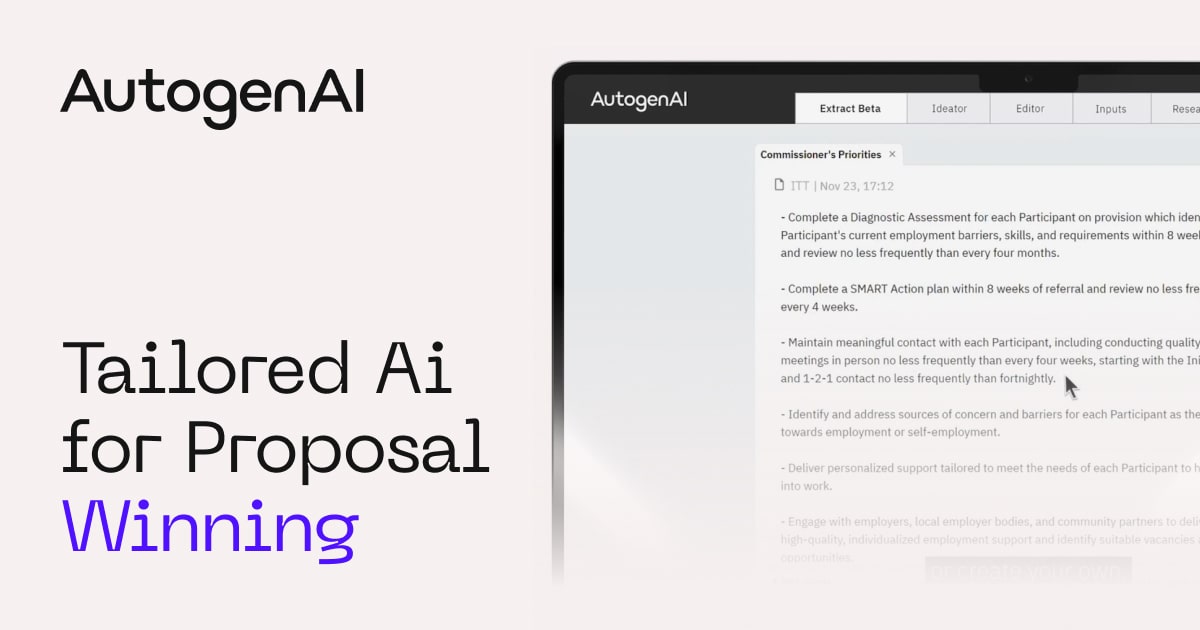
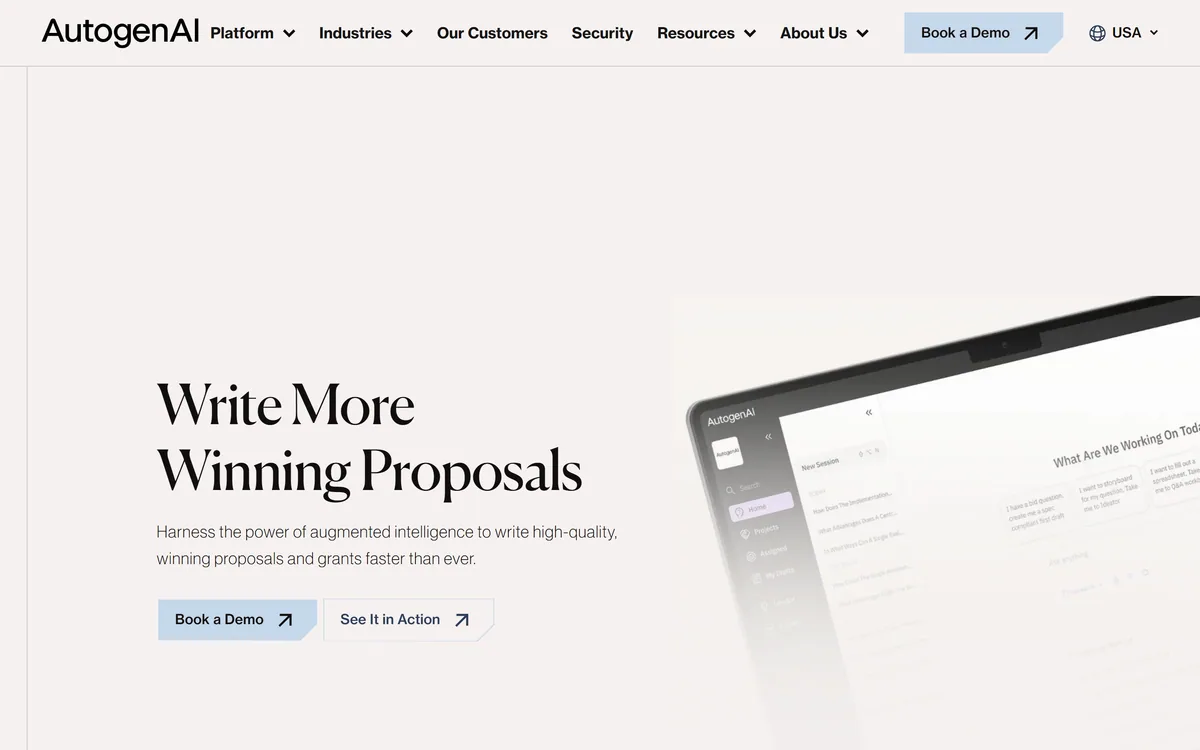
Last checked . Read from autogenai.com during this check, with the screenshot above captured at the same time.
Outcome figures are customer-reported and published without baselines. The 241% success-rate claim in particular stretches attribution — bid win rates depend overwhelmingly on incumbency, price, past performance and buyer intent rather than on drafting, and organisations adopting bid software are usually professionalising the whole function at the same time. Certification claims are the vendor's own; verify FedRAMP status through the official marketplace listing if it is decisive for you.
The certification stack is the standout — FedRAMP High authorisation is genuinely hard to obtain and unlocks federal work most competitors cannot touch, alongside ISO 27001 and SOC 2 Type II. It is marked down for outcome claims published without baselines, particularly a 241% success-rate figure that no bid platform can credibly attribute to itself, and for being enterprise-only with no way to trial it. AInexfinder Editor Score: 4.3/5.
AInexfinder does not list plan prices or billing details. For current pricing, plans, and trials, visit the official AutogenAI website.
Visit official website for pricingVendor pricing, credits, and billing policies change over time. Always confirm on the official site before you buy.
Log in to write a review.
No reviews yet. Be the first to share your experience with AutogenAI.
Assigned reviewer
Daniel ReedSenior AI Tools Reviewer
Daniel reviews AI tools the slow way — by actually using them on real projects. His reviews cover what works, what breaks, and who each tool is genuinely a good fit for.
Daniel and the AInexfinder editorial team research AutogenAI using public product information, listing evidence, and (when available) hands-on checks. Scores reflect listing completeness and transparency — not paid placement.
HubSpot AI is branded Breeze — an assistant plus a set of agents for prospecting, content, customer service, campaigns, nurture, and revenue, all running on live CRM data, with an Agent Builder for custom ones.
Clay is go-to-market data infrastructure built around waterfall enrichment: instead of one provider, it queries a marketplace of more than 200 in sequence until a field is filled. Claygent AI agents research companies and people, and the results push into a CRM, ad platforms or a native sequencer.
Trellus is an AI dialer that works inside Salesloft, Outreach and HubSpot, offering parallel dialling of up to five lines, real-time call guidance, conversational analytics, voice agents for practice and inbound, and a LinkedIn tool, aimed at multiplying sales conversations.
Aviso is an agentic revenue intelligence platform for go-to-market teams. It covers forecasting, pipeline inspection, conversation and relationship intelligence, coaching, sales engagement and customer success, with more than 30 prebuilt agentic workflows and a no-code studio for building new agents.
Ironclad is an AI contract lifecycle management platform covering create, review, sign, store, analyze and fulfill. Jurist is its agentic AI contract partner for legal review, Ironclad AI runs behind every workflow stage, and 20+ integrations connect it to Salesforce, Word, Slack, DocuSign and SAP.
Gainsight is a customer success and retention platform that turns product, engagement and support signals into scored risk and the right action, spanning customer success, product experience, community and education, with agentic AI across all of it.