Duplichecker review on AInexfinder — freemium AI tool for Writing & Content. Features, pricing notes, and alternatives.
FreemiumWriting & Content
ProWritingAid is a writing platform for novelists from Orpheus Technology, combining grammar and style reports with manuscript-level critique — Chapter Critique, Character Analysis, Virtual Beta Reader and Marketability Analysis — across Word, Google Docs and Scrivener.
A grammar checker will tell you a sentence is passive. It will not tell you that your protagonist has no discernible motivation after chapter nine, that your middle third is three scenes of people agreeing with each other, or that a character introduced with great promise simply stops appearing.
Those are the problems that stop novels being finished, and ProWritingAid is the mainstream writing tool that attempts both levels — the sentence and the manuscript.
This review covers which of the many reports actually earn your time, why the manuscript-level tools are the reason to choose it over Grammarly, how the integrations decide whether you use it at all, and what Marketability Analysis can honestly tell you.
The line-editing half — grammar checker, writing reports, Rephrase, Sparks — does what you expect. It is thorough, it produces a lot of reports, and on its own it is competing in a crowded market where Grammarly has better brand recognition and a cleaner interface.
The story-critique half is where it stands alone. Chapter Critique, Character Analysis, Manuscript Analysis, Plot Analysis and the Virtual Beta Reader operate on the book rather than on the prose.
That distinction matters because the two kinds of problem are found at completely different scales. A weak verb is visible in a sentence; a collapsed character arc is only visible across two hundred pages, and no amount of line editing surfaces it.
The honest summary: if you write non-fiction, blog posts or business documents, the line editing is the whole product and you should compare it on those terms. If you are writing a novel, the story tools are the reason to be here and the grammar checking is a bonus.
A grammar checker finds the weak verb on page four. It will never notice that nothing has happened since page ninety.
There are a lot of them, and running everything on everything produces noise rather than a better book. The useful order is roughly this.
This deserves its own section because it is the feature most likely to be over-trusted by exactly the people most anxious about their book.
What a model can genuinely assess: whether your manuscript matches the conventions of its stated genre, whether the opening does what openings in that category do, whether length and structure sit inside normal ranges, whether the pitch is coherent.
What it cannot know: whether anyone will buy it. Commercial success in fiction depends on timing, an editor's personal enthusiasm, what a publisher already has on their list, marketing spend, and luck — none of which is in your document.
The useful reading is "does this look like a book of its kind?" That is a real question with a real answer, and a manuscript that answers it badly has a specific, fixable problem. The unhelpful reading is treating a score as a prediction, which will either falsely reassure you or talk you out of a good book.
The same caution applies more mildly to every report here. These are instruments for finding problems, not verdicts on quality — and a novel that scores well on all of them can still be boring, which no software can tell you.
Word, Google Docs, Scrivener, Apple Notes, Notion, Apple Pages, Atticus, Milanote, browser extensions for Chrome, Firefox and Edge, plus Mac and Windows desktop apps.
General-purpose checkers such as Grammarly integrate widely but stop at the sentence. Scrivener is the one that matters most for the target user, because Scrivener is where a very large share of serious novelists actually work, and a tool that cannot reach it is a tool you have to copy and paste into.
Atticus points the same way — it is a book formatting and writing tool, and supporting it signals that the company understands the self-publishing workflow rather than only the drafting one.
The practical significance is retention. Writing tools that require you to leave your manuscript get used twice and abandoned. One that lives inside the document you are already in gets used every session.
The Premium Pro tier goes further in a direction software usually does not: live workshops with authors and editors, a library of 200+ recorded workshops, daily cowriting sprints, group critique and networking events. That is a community product bolted to a software product, and for isolated writers it may be the more valuable half.
The failure mode is running every report on a first draft and concluding your book is broken in forty ways. A drafting tool like Squibler is for getting words down; this is for the pass afterwards.
Chapter Critique with scores, strengths and weaknesses
Character Analysis tracking arcs across a manuscript
Manuscript Analysis at whole-book level
Plot Analysis for structure and pacing
Virtual Beta Reader simulating reader response
Marketability Analysis assessing genre fit
Grammar checker and unlimited writing reports
Rephrase and Sparks for line-level suggestions
Story Canvas and planning tools before drafting
Integrations with Word, Google Docs, Scrivener, Atticus and Notion
Premium Pro workshops, cowriting sprints and group critique
These overlap on grammar and diverge completely on what else they can see.
| Tool | Works at | Story critique | Best for |
|---|---|---|---|
| ProWritingAid | Sentence and manuscript | Character, plot, chapter, beta reader | Novelists revising a full draft |
| Grammarly | Sentence | No | Everyday writing and business documents |
| AuthorFlows | Manuscript structure | Story Analyzer with severity ratings | Writers who want the studio and the critique together |
| Squibler | Drafting | Limited | Generating prose rather than assessing it |
| Hemingway Editor | Sentence readability | No | Tightening prose quickly |
| Company | Orpheus Technology |
|---|---|
| Category | Writing platform with line editing and story critique |
| Planning tools | Story Canvas, Plot Analysis |
| Writing tools | Writing Sessions, Creative Nudges, Placeholders, Reflections, Resets, Writing Sprints |
| Line editing | Grammar Checker, Writing Reports, Rephrase, Sparks |
| Story critique | Chapter Critique, Plot Analysis, Character Analysis, Manuscript Analysis, Virtual Beta Reader, Marketability Analysis |
| Integrations | Microsoft Word, Google Docs, Scrivener, Apple Notes, Notion, Apple Pages, Atticus, Milanote |
| Browser extensions | Chrome, Firefox, Edge |
| Desktop apps | Mac and Windows |
| Premium Pro extras | Live author and editor workshops, 200+ on-demand workshop library, daily cowriting sprints, group critique sessions, networking events, guided challenges |
| Named audience | Storytellers and novelists, from first manuscript to established authors |
Drafting, structural critique and line editing are three separate stages people try to do at once.
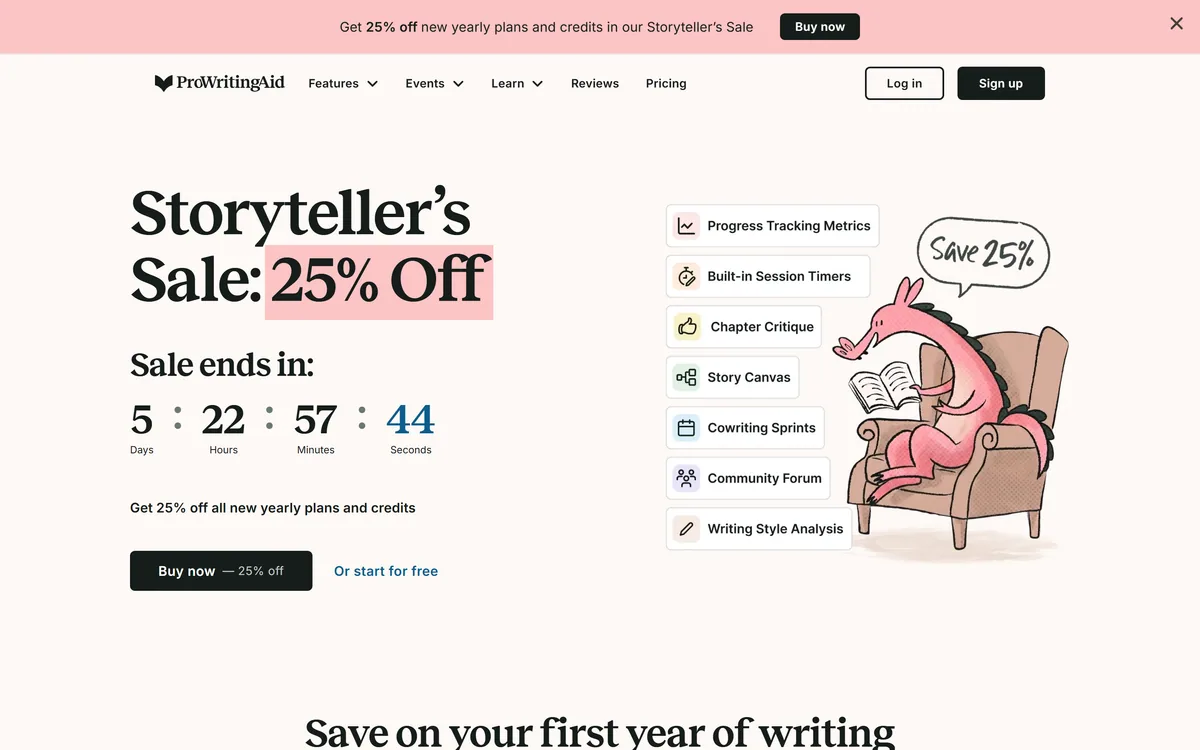
Last checked . Read from prowritingaid.com during this check, with the screenshot above captured at the same time.
The discussion of what Marketability Analysis can and cannot know describes the limits of automated manuscript assessment generally rather than measured output from this tool. Report limits vary by subscription tier; check current allowances on the site.
ProWritingAid has an AInexfinder Editor Score of 4.5/5.
AInexfinder does not list plan prices or billing details. For current pricing, plans, and trials, visit the official ProWritingAid website.
Visit official website for pricingVendor pricing, credits, and billing policies change over time. Always confirm on the official site before you buy.
Log in to write a review.
No reviews yet. Be the first to share your experience with ProWritingAid.
Assigned reviewer
Daniel ReedSenior AI Tools Reviewer
Daniel reviews AI tools the slow way — by actually using them on real projects. His reviews cover what works, what breaks, and who each tool is genuinely a good fit for.
Daniel and the AInexfinder editorial team research ProWritingAid using public product information, listing evidence, and (when available) hands-on checks. Scores reflect listing completeness and transparency — not paid placement.
Duplichecker review on AInexfinder — freemium AI tool for Writing & Content. Features, pricing notes, and alternatives.
Hemingway Editor highlights writing problems by colour — long sentences in yellow, unreadable ones in red, complex words in purple, adverbs and passive voice in blue — and reports a readability grade. A paid tier adds AI fixes, an advanced grammar checker and tone adjustment.
Linguix is a browser-based writing assistant checking grammar, spelling and style across seven languages on any website, with an AI rewriter, a content score, text shortcuts for repeated replies, a team style guide, and business features including role assignment and a grammar-check API.

Grammarly is an AI writing assistant that checks grammar, clarity, and tone wherever you already write — browser, desktop, mobile keyboard, Google Docs, and Microsoft Office — and now ships AI agents for humanising, detecting, and grading text.
Originality.ai detects AI-generated text and checks for plagiarism, with fact checking, readability and grammar tools alongside. It runs on a patented modified BERT model, publishes its own false positive rates, and is built around team workflows for publishers and agencies rather than individual writers.

Copy.ai has become an AI-native go-to-market platform: workflows and agents that run prospecting, lead processing, deal coaching, ABM, and CRM enrichment across Salesforce, HubSpot, Gong, Outreach, and 2,000+ integrations.