
Duplichecker review on AInexfinder — freemium AI tool for Writing & Content. Features, pricing notes, and alternatives.
FreemiumWriting & Content
Originality.ai detects AI-generated text and checks for plagiarism, with fact checking, readability and grammar tools alongside. It runs on a patented modified BERT model, publishes its own false positive rates, and is built around team workflows for publishers and agencies rather than individual writers.
AI detection is the most contested category in this entire market, and for good reason. The claims are hard to verify, the consequences of error fall on individuals, and a great deal of nonsense is sold under the label.
Originality.ai is one of the more credible entrants, largely because it does something its competitors mostly avoid: it publishes its own error rates and links to independent studies rather than only to favourable ones.
This review takes the technology seriously and is equally direct about its limits. What follows covers how detection actually works, what the accuracy figures can and cannot support, the one application where these tools should never be used, and why the surrounding fact-checking and plagiarism tooling may matter more than the detector itself.
Understanding the mechanism explains both the capability and the ceiling, and it is not complicated.
Language models generate text by repeatedly choosing likely next words. That produces prose with a statistical signature: word choices cluster around the probable, sentence lengths even out, and the distinctive unpredictability of human writing is smoothed away. Detectors are classifiers trained to recognise that signature.
This is why the output is a probability rather than a verdict. A detector is not finding a watermark or a hidden marker. It is estimating how much a passage resembles machine-generated text versus human text, based on patterns learned from examples.
Two consequences follow directly, and both matter. Some human writing is genuinely more predictable than average — formal academic prose, technical documentation, writing by non-native speakers working carefully within a limited construction set. That writing scores as machine-like because, statistically, it is.
And some AI text is deliberately made less predictable. Paraphrasing tools — including humanizers built for exactly this — exist precisely to disrupt the signature, which is why Originality.ai states it trains specifically on rewritten content from tools like Quillbot and Grammarly.
That is an arms race with no stable end state, and any detector's accuracy is a snapshot against the models and evasion techniques current at the time it was measured.
A detector does not find a marker. It estimates how predictable your sentences are — which is why careful, formal, non-native writing gets flagged.
This needs stating as plainly as possible, because it is where real harm has already occurred.
An AI detection score must never be the sole basis for accusing a student, an employee or a writer of misconduct.
The arithmetic makes the reason obvious. Even a very low false positive rate produces a substantial number of wrongly flagged people at scale. A detector with a 1% false positive rate, run across 10,000 student essays, wrongly flags roughly 100 innocent students. Those hundred face an accusation that is extremely difficult to disprove — you cannot demonstrate the absence of assistance.
That burden is not distributed evenly, which is the more serious problem. Multiple studies have found that text by non-native English speakers is disproportionately misclassified as AI-generated, because the writing patterns that make prose read as non-native overlap with the patterns that make prose read as machine-generated.
Competing detectors such as GPTZero have published similar cautions. Several universities have withdrawn AI detection from their academic integrity processes for precisely these reasons, and some detection vendors have themselves cautioned against disciplinary use of their scores.
Originality.ai's transparency about false positive rates deserves genuine credit here. It is also exactly why those published rates should be read as a warning about how to use the tool rather than as reassurance.
The defensible use is as a signal that prompts a conversation, alongside drafts, version history and the writer's own account — never as evidence on its own.
The detector gets the attention. For most buyers the rest of the platform is where the recurring value sits.
Plagiarism checking is the mature, uncontroversial half. It matches text against existing published sources, which is a determinate comparison rather than a probabilistic estimate — either the passage appears elsewhere or it does not. For a publisher, that is often the more important check.
Fact checking is the most interesting addition, validating claims against cited sources. Whether content was AI-written matters much less than whether it is true, and confidently stated invented facts are the actual failure mode of generated content. A tool that surfaces unsupported claims addresses the real risk.
Dedicated editing tools like ProWritingAid go deeper here. Readability, grammar and guideline checking handle the editorial baseline, and the AI Allowance setting is a pragmatic touch — letting an organisation define an acceptable threshold rather than pretending a zero-tolerance policy is enforceable.
Deep Scan, which explains why a passage looks generated rather than only scoring it, is the right direction for the whole category. An explanation can be argued with; a number cannot.
The Chrome extension's writing replay, capturing keystroke history, is a genuinely different kind of evidence — it shows a document being composed over time, which is far more probative than any classifier output.
This site does not publish plan prices. Originality.ai's structure is worth understanding because it differs from most subscription tools.
Access is credit-based — you buy credits and spend them per scan, with credits stated to expire two years from purchase. There are also tiered plans aimed at different users, from students and individual writers through to agencies, publishers and enterprise.
There is a genuine free entry point: three daily scans without creating an account, with more available once you register. No free trial of the paid tiers is offered.
The credit model suits this category well, because content checking is bursty. A publisher auditing a back catalogue consumes an enormous amount in one week and almost nothing for months, which subscriptions handle badly.
Two things to plan for. The two-year expiry means bulk-buying credits far ahead of use has a real cost. And scans are capped at 2,000 words each, so a long article consumes multiple scans — worth factoring into any estimate of what an audit will cost.
One privacy point specific to the free tier: the vendor states text is not stored by default on free scans but may be used for training, with an opt-out available on paid use. If you are checking confidential or client material, that distinction matters more than the price.
Practical guidance, because the number is routinely over-interpreted in both directions.
A high AI score means the text is statistically similar to machine-generated writing. It does not mean the text was machine-generated, and it certainly does not mean the writer did anything wrong.
A low score means the text does not match the patterns the model was trained on. It does not mean the text is human — a capable writer editing generated output defeats detection almost trivially, which is the most common real-world workflow anyway.
Detection is therefore weakest exactly where it would be most useful: on the hybrid content that now makes up most professional writing. The binary question the tool answers has largely stopped matching how anyone actually works.
Longer passages are more reliable than short ones, because statistical signals need volume. A 200-word sample tells you much less than a 2,000-word one, and confident judgements on short text should be distrusted regardless of vendor.
The most useful framing is that a score is one input among several. Combined with plagiarism results, fact-check flags, editorial judgement and the writer's own account, it contributes to a decision. Alone, it supports nothing.
| Company location | Collingwood, Ontario, Canada |
|---|---|
| Category | AI content detection, plagiarism and content quality checking |
| Detection model | Modified BERT model, covered by US Patent No. 12,253,988 |
| Scan limit | Up to 2,000 words per check |
| Multilingual | Stated support across 30 languages, with 97.8% accuracy cited on the multilingual model |
| Models targeted | Vendor states detection across current large language models, including recent frontier releases |
| Paraphrase detection | Trained on AI-rewritten content from tools such as Quillbot and Grammarly |
| Additional tools | Plagiarism checker, Content Quality Score, Fact Checker, Grammar Checker, Readability Checker, Guideline Checker, Deep Scan, AI Allowance |
| Integrations | Chrome and Firefox extensions, Google Classroom, Moodle plugin, and an API |
| Chrome extension feature | Writing replay showing keystroke history during composition |
| Team features | Role-based access, bulk scanning, QA workflow for publishers, scan history retention and sharing |
| Transparency | Publishes its own accuracy study and false positive rates, and links third-party studies |
| Security | TLS 1.2+ with 256-bit encryption, one-click scan history deletion, opt-out from training data use |
| Charging model | Credit-based pay-as-you-go with credits expiring two years from purchase, plus tiered plans; three free daily scans without an account, no free trial; no prices published here |
Four definitions that make the difference between using this tool well and using it badly.
AI content detection using a patented modified BERT model
Plagiarism checking against published sources
Fact Checker validating claims against citations
Content Quality Score
Grammar and readability checking
Guideline Checker against your own editorial standards
Deep Scan explaining why text appears AI-generated
AI Allowance for setting an acceptable threshold
Paraphrase and AI-rewrite detection
Multilingual detection across 30 languages
Chrome and Firefox extensions, with writing replay
Google Classroom and Moodle integrations
API with published documentation
Team roles, bulk scanning and shared scan history
Compare on transparency about error rates and on what surrounds the detector, not on headline accuracy claims.
| Tool | Primary audience | Beyond detection | Error transparency |
|---|---|---|---|
| Originality.ai | Publishers, agencies and content teams | Plagiarism, fact checking, readability, guidelines | Publishes its own false positive rates |
| GPTZero | Education and general users | Writing analysis | Publishes research and cautions on use |
| Copyleaks | Enterprise and education | Plagiarism at scale, LMS integrations | Publishes accuracy claims |
| Free AI Humanizer | The opposite side of the same arms race | Rewriting to evade detection | Not applicable |
Detection sits next to plagiarism checking, editing and the tools built to defeat detection.
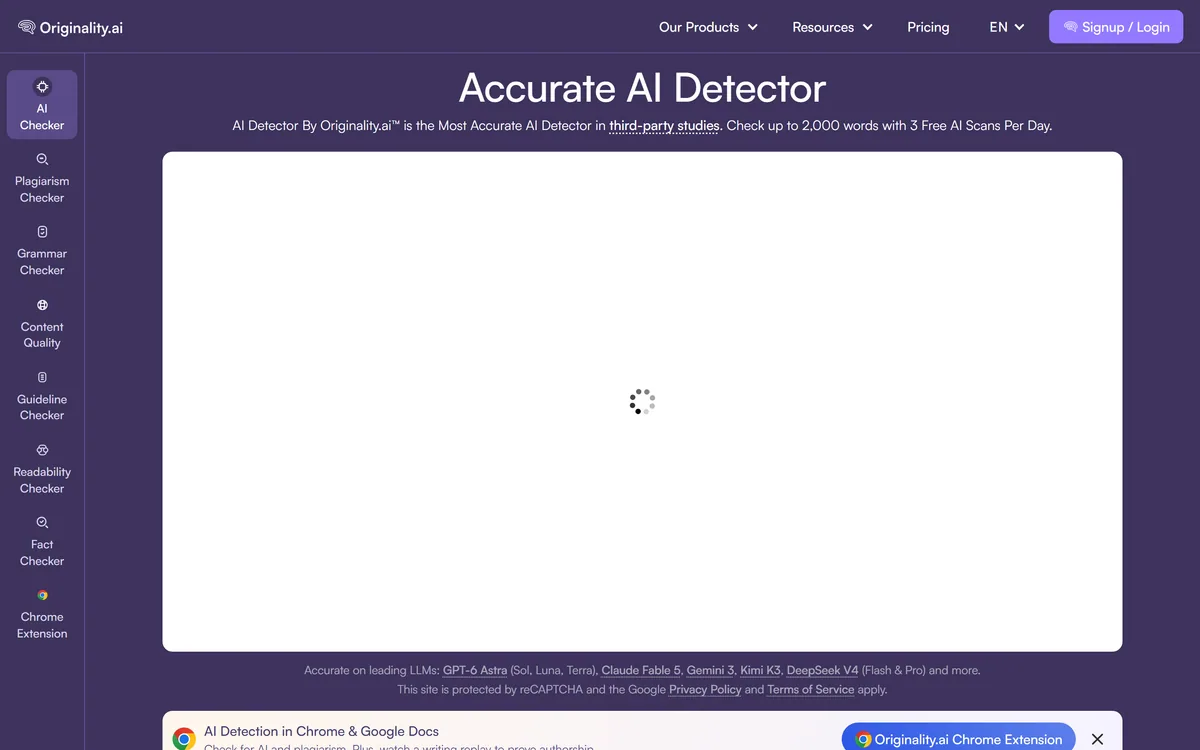
Last checked . Read from originality.ai during this check, with the screenshot above captured at the same time.
Accuracy figures are the vendor's own, though it is more transparent than most in publishing false positive rates and linking third-party studies. AI detection is probabilistic and multiple studies have found text by non-native English speakers is disproportionately misclassified — a score must never be the sole basis for an accusation of misconduct against any individual. Institution names shown as trusted by are cited by the vendor and are not endorsements of any specific claim.
Originality.ai has an AInexfinder Editor Score of 4.0/5.
AInexfinder does not list plan prices or billing details. For current pricing, plans, and trials, visit the official Originality.ai website.
Visit official website for pricingVendor pricing, credits, and billing policies change over time. Always confirm on the official site before you buy.
Log in to write a review.
No reviews yet. Be the first to share your experience with Originality.ai.
Assigned reviewer
Daniel ReedSenior AI Tools Reviewer
Daniel reviews AI tools the slow way — by actually using them on real projects. His reviews cover what works, what breaks, and who each tool is genuinely a good fit for.
Daniel and the AInexfinder editorial team research Originality.ai using public product information, listing evidence, and (when available) hands-on checks. Scores reflect listing completeness and transparency — not paid placement.
Duplichecker review on AInexfinder — freemium AI tool for Writing & Content. Features, pricing notes, and alternatives.
ProWritingAid is a writing platform for novelists from Orpheus Technology, combining grammar and style reports with manuscript-level critique — Chapter Critique, Character Analysis, Virtual Beta Reader and Marketability Analysis — across Word, Google Docs and Scrivener.
Hemingway Editor highlights writing problems by colour — long sentences in yellow, unreadable ones in red, complex words in purple, adverbs and passive voice in blue — and reports a readability grade. A paid tier adds AI fixes, an advanced grammar checker and tone adjustment.

Grammarly is an AI writing assistant that checks grammar, clarity, and tone wherever you already write — browser, desktop, mobile keyboard, Google Docs, and Microsoft Office — and now ships AI agents for humanising, detecting, and grading text.

Copy.ai has become an AI-native go-to-market platform: workflows and agents that run prospecting, lead processing, deal coaching, ABM, and CRM enrichment across Salesforce, HubSpot, Gong, Outreach, and 2,000+ integrations.

Writesonic has become an AI search growth platform — tracking whether your brand appears across 10 AI platforms, running optimisation and citation work through an Action Center, and reporting results against traffic and revenue.