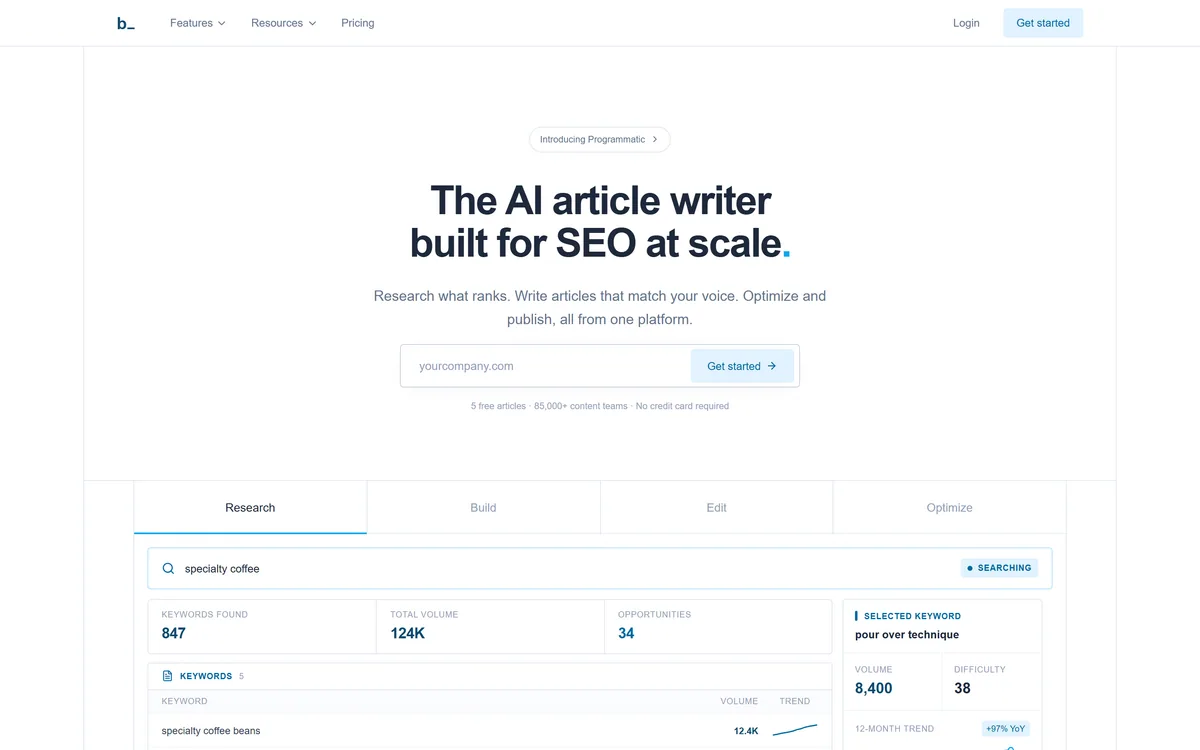
Byword is an AI article writer aimed at SEO content produced at scale. It runs a four-stage loop — research keywords, build the article, edit it, optimise it — writes in your brand voice, and publishes to your CMS, with a programmatic mode for generating large sets of pages from structured data.
byword.ai10 viewsAdded February 3, 20269K visitors
There is an uncomfortable truth under every AI writing tool: the writing was never the expensive part. Anyone can generate two thousand words about anything, and the market has been able to for years.
The expensive part is knowing which two thousand words are worth generating — which query has demand, which has weak incumbents, and which will never rank no matter how good the article is.
Byword's structure suggests it understands this, because research is the first tab rather than a bolt-on. This review covers what the four-stage loop actually does, why brand voice matching matters more than it sounds, what programmatic SEO is and when it goes badly wrong, and where volume content stopped working.
The research tab is the interesting one. Anything can write; fewer things know what to write about.
Workflow, Output And Scale
Category
AI SEO article writing and publishing at scale
Workflow stages
Research, Build, Edit, Optimize
Research outputs
Keywords found, total search volume, opportunity counts, per-keyword volume, difficulty and trend
Writing
Articles matched to your existing brand voice
Programmatic mode
Generation of large page sets from structured input
Publishing
Direct publishing from the platform to your site
Onboarding
Enter a company domain to generate a tailored starting point
Free entry
A small number of free articles with no credit card required
Stated user base
More than 85,000 content teams, per the vendor's homepage
Charging model
Freemium, then subscription tiers metered on articles and connected sites; no prices published here
Volume SEO Writing, Summarised
Byword is an AI article writer built for producing SEO content in bulk rather than one considered piece at a time — the whole product is shaped around volume.
The workflow is four stages: Research, Build, Edit and Optimize, which is the sequence a competent content strategist follows manually.
Keyword research is built in, surfacing search volume, difficulty and opportunity counts rather than expecting you to arrive with a list.
It writes in your voice and publishes to your CMS, closing the loop from keyword to live page.
Free articles to start with no card required, then subscription tiers metered on article volume; the homepage cites more than 85,000 content teams.
Research First Is The Right Order
Most AI writing tools — KoalaWriter and Autoblogging.ai among them — open with a text box. You type a topic, you get an article, and the tool has no opinion about whether that topic was worth writing about.
Byword opens with research: enter a seed term and it returns keywords found, total volume, and a count of opportunities, with difficulty and trend data on each. Only then do you build.
That ordering is not cosmetic. It changes what the tool is for — from a writing assistant into something closer to a content operation, where the decision about what to publish is part of the product rather than a prerequisite you bring from elsewhere.
It also means you can evaluate the tool honestly on the step that matters. Ask it for keywords in your category and look at what it returns. If the suggestions are terms you already knew, the research layer is not earning its place. If it surfaces queries with genuine volume and weak results, that alone is worth more than the drafting.
Dedicated planning tools like MarketMuse sell this step on its own. The difficulty and trend figures deserve the same scepticism you would apply to any SEO tool's estimates. Search volume is modelled, not measured, and difficulty scores are proprietary heuristics that differ substantially between vendors. Use them to rank options against each other, not as absolute truths.
Generating the article was never the bottleneck. Knowing which article to generate is the entire job, and it is the step most of these tools skip.
Brand Voice Is Doing More Work Than It Appears
Writing articles that match your voice sounds like a nicety. In practice it is what determines whether the output is publishable without a rewrite.
Generic AI prose has a recognisable texture — even paragraph lengths, hedged claims, transitional phrases that connect nothing, and a relentless neutrality. Readers detect it, and increasingly so do the people deciding what to link to.
Matching an existing site's voice means the model has real material to imitate: your vocabulary, your sentence rhythm, the level of assumed knowledge, the things you never say. That is a far more useful constraint than a tone slider offering professional, casual or friendly.
The honest limit is that voice is not expertise. A model can reproduce how you write and cannot reproduce what you know that is not already published. On any topic where your advantage is knowing something the open web does not, matched voice makes the gap harder to spot rather than smaller.
The practical test is to have the tool write about something you know intimately, then read it as a specialist. Whether it is thin will be obvious in about ninety seconds.
Programmatic SEO, And How It Fails
Byword's homepage flags a programmatic capability, and it is worth explaining properly because it is the most powerful and most dangerous thing in this category.
Programmatic SEO means generating large numbers of pages from structured data against a template. Best restaurants in every city. Compatibility between every pair of products. A page for every combination of two attributes. Done well, it is how comparison sites, directories and marketplaces built enormous organic footprints.
It works when each generated page answers a real query with genuinely different information. A page per city works if the restaurants differ, which they do.
It fails when the pages are the same page with a noun swapped. Search engines have been explicit about this for years, and the current guidance targets scaled content abuse — producing many pages primarily to manipulate rankings rather than to help anyone — regardless of whether a human or a machine generated them.
The distinction is not how the page was made. It is whether the page contains something. A thousand pages each holding real data is an asset; a thousand pages each holding the same paragraph with a different city name is the thing the policy exists to demote.
So the question to ask before switching this on is simply: what is different on page 400 compared with page 399? If the answer is only the noun, do not do it.
Run the research step on your own category before writing anything, and judge the tool on that alone.
Generate one article on a topic you know deeply, then read it as a subject expert.
Check whether the internal links and structure would survive an editor rather than just a crawler.
If you are considering programmatic pages, write out what genuinely differs between two adjacent pages.
Publish ten manually and watch them for a month before letting anything run to volume.
What The Meter Counts
This site does not publish plan prices. The structure is what stays true, and here it is conventional for the category.
Byword offers a small number of free articles to start with no card required, then subscription tiers. The meter is articles, and typically also the number of connected sites — those two together are what push you up a tier.
Per-article metering has a specific consequence worth planning around: you pay for articles generated, not articles published. Every regeneration, every abandoned draft, every experiment with a different angle consumes the same allowance as a piece that goes live.
That makes the research step doubly valuable, because it is the cheapest place to avoid waste. Choosing the wrong topic costs you an article either way; choosing it before generating costs you nothing.
Two things to confirm before upgrading: whether unused articles roll over month to month, and whether the site connection limit is separate from the article limit, since agencies almost always hit the site cap first.
The free articles are a genuine test rather than a teaser, because you can judge both research quality and prose quality inside them. Use them on your real category, not on a demo topic.
Where Volume Content Still Works
The honest position in 2026 is that this category has narrowed considerably, and being specific about where it still works is more useful than either enthusiasm or dismissal.
It still works on informational queries with settled answers and weak incumbent pages — the long tail where the current results are thin affiliate posts from 2019. A well-structured, accurate, genuinely helpful 1,500 words beats those, and there are a lot of them.
A closed-loop publisher like BlogBuster automates further still. It still works as supporting content around pages that are written by humans: the explainers and definitions that surround a product, building topical coverage so the money pages have context to sit in.
It has stopped working on competitive commercial queries, where the incumbents are well-resourced and the bar is genuine expertise or original data. Volume alone does not move those and has not for some time.
It never worked in health, legal and financial territory, where being wrong has consequences and where search engines apply the highest scrutiny to who is publishing.
The structural point worth holding on to: when generating an article costs almost nothing, articles stop being scarce and therefore stop being valuable on their own. Whatever remains scarce — original data, real expertise, a genuine point of view — is where the return moved.
Works: long-tail informational queries with weak, dated incumbent pages
Works: supporting and definitional content around human-written commercial pages
Works: local and regional variants where the underlying facts genuinely differ
Fails: competitive commercial queries against well-resourced incumbents
Fails: anything in health, legal or financial territory
Fails: templated pages where only the noun changes between them
Key features of Byword
Built-in keyword research with volume, difficulty and trend data
Opportunity identification from a seed term or domain
Article generation matched to your existing brand voice
Four-stage Research, Build, Edit and Optimize workflow
In-platform editor for revising drafts
On-page optimisation pass before publishing
Direct publishing to your site
Programmatic generation of large page sets
Multi-site management for agencies
Free articles to start with no card required
Pros & cons
Pros
5
Putting research before writing reflects where the actual difficulty in SEO content lies
Brand voice matching from your existing site produces far more publishable drafts than a tone setting
Combining research and drafting removes one subscription from a typical stack
The free articles are enough to judge both research and prose quality on your own category
Programmatic mode is genuinely powerful where the underlying data really differs
Cons
5
You are metered on articles generated, so regenerations and abandoned drafts cost the same as published ones
Voice matching can disguise thin expertise rather than supply it
Volume and difficulty figures are modelled estimates, as they are in every SEO tool
Programmatic generation is the fastest route to scaled content abuse if the pages do not genuinely differ
The approach no longer moves competitive commercial queries, whatever the volume
Best For
Content teams with a large long-tail keyword opportunity
Agencies producing SEO content across multiple client sites
Marketplaces and directories with genuinely differentiated structured data
Startups building topical coverage around human-written product pages
Publishers refreshing thin, dated informational content at scale
Byword Against Other Volume Writers
These all generate articles. They differ on whether research is part of the product and how far automation reaches.
You have a large long-tail opportunity with weak incumbent pages
You need supporting content around pages humans will write
You want keyword research and drafting in one place rather than two subscriptions
You have genuinely differentiated structured data for programmatic pages
Someone will read and edit before publishing
Do Not Scale If
You compete on commercial queries against well-resourced incumbents
You publish in health, legal or financial territory
Your programmatic pages would differ only by a swapped noun
Your advantage is expertise that is not already on the open web
Nobody will read the output before it goes live
Other Tools In The SEO Content Stack
These divide between planning what to write and producing it, and most teams end up needing one of each.
BlogBuster — the fully automated loop, publishing to more platforms
KoalaWriter — fewer, better articles rather than volume
MarketMuse — content strategy and gap analysis without generation
Autoblogging.ai — bulk generation aimed squarely at WordPress
Originality.ai — the detection side, if you need to know what was AI-written
Read From Byword's Own Pages
Last checked . Read from byword.ai during this check, with the screenshot above captured at the same time; the homepage figures below are taken from that capture.
Product positioned on site as an AI article writer built for SEO at scale
Stated workflow of researching what ranks, writing to match your voice, then optimising and publishing from one platform
Four workflow stages shown in the product interface: Research, Build, Edit and Optimize
Research view showing keywords found, total volume and opportunity counts, with per-keyword volume, difficulty and trend
A programmatic capability is promoted on the homepage
Onboarding by entering a company domain
Free articles offered with no credit card required
More than 85,000 content teams cited on the homepage
Pricing page linked from the homepage; no plan prices published here, in line with this site's pricing policy
User counts and research figures are the vendor's own and unaudited; search volume and difficulty scores in every SEO tool are modelled estimates rather than measurements. Search engines target scaled content abuse — pages produced primarily to manipulate rankings rather than to help readers — irrespective of whether a person or a model wrote them, so read the current guidance before using the programmatic mode.
Editor's Verdict
3.8/5
Byword has an AInexfinder Editor Score of 3.8/5.
Byword pricing
AInexfinder does not list plan prices or billing details. For current pricing, plans, and trials, visit the official Byword website.
Vendor pricing, credits, and billing policies change over time. Always confirm on the official site before you buy.
Frequently asked questions
What does Byword do?
It researches keywords, drafts SEO articles matched to your brand voice, lets you edit and optimise them, and publishes them to your site. Research being the first stage rather than an add-on is what distinguishes it from most AI writers.
Is Byword free to try?
Yes — a small number of free articles with no credit card required, then subscription tiers metered on article volume and usually on connected sites. Use the free articles on your real category rather than a demo topic; they are enough to judge both research and prose.
What is programmatic SEO?
Generating large numbers of pages from structured data against a template — a page per city, per product pair, per attribute combination. It works when each page genuinely contains different information and fails hard when only the noun changes.
Will Google penalise AI-written articles?
Google's stated position targets scaled content abuse — pages made primarily to manipulate rankings rather than help readers — regardless of who or what wrote them. Automation is not the trigger; producing many pages with nothing distinct on them is.
Does AI content still rank in 2026?
On long-tail informational queries with weak, dated incumbents, yes and reliably. On competitive commercial queries against well-resourced sites, no — that gap now needs genuine expertise or original data, which no writing tool supplies.
Byword vs KoalaWriter — which is better?
Different jobs. Byword is built for volume with keyword research at the front; KoalaWriter is oriented toward producing a smaller number of stronger individual articles. Pick on whether your constraint is knowing what to write or producing enough of it.
Can Byword match my existing writing style?
It writes to match your brand voice from your existing site, which is a far stronger constraint than a tone setting. What it cannot do is reproduce expertise you have never published — test it on a topic you know deeply and the gap shows up quickly.
Daniel reviews AI tools the slow way — by actually using them on real projects. His reviews cover what works, what breaks, and who each tool is genuinely a good fit for.
Daniel and the AInexfinder editorial team research Byword using public product information, listing evidence, and (when available) hands-on checks. Scores reflect listing completeness and transparency — not paid placement.
Listings may include affiliate or sponsored placements, which are labeled when present. Editorial scores and cons are not sold. See our affiliate disclosure and review methodology.
AIKTP generates SEO-optimised articles of 2,000 to 2,500 words in around thirty seconds using ChatGPT, Gemini and Claude, across eighteen languages. It bundles keyword research, clustering, entity extraction, image tools, auto-publishing to WordPress and Shopify, and bulk Google and Bing indexing.
SEOWriting AI analyses SERP competitors and generates articles optimised for search and AI engines, with one-click and bulk generation across 48 languages, AI images, affiliate content models, Amazon product tools and WordPress auto-posting.
SEO.AI, based in Kongens Lyngby, Denmark, is an SEO agent that creates content, publishes it directly to your CMS, and builds backlinks through an automatic link exchange network. It supports 50+ languages and integrates with WordPress, Webflow, Wix, Squarespace, Shopify and Magento.
Frase runs SEO and AI search end to end: auditing a site page by page, researching and briefing, drafting in a defined brand voice, optimising for both rankings and AI citation, publishing to WordPress, Webflow, Sanity and Wix or its own CMS, then monitoring for ranking decay and AI mentions.
RivalFlow, built by SpyFu, analyses a page you already have against competitors ranking for the same terms, then returns around 23 specific content gaps with ready-to-paste copy and placement guidance. It connects to Google Search Console to track whether rankings move afterwards.
SEOwind produces SEO content through a multi-agent system covering briefs, research, drafting and quality scoring, with human editorial checkpoints before delivery. It uses retrieval-grounded research to reduce fabrication, scores content against EEAT criteria, and delivers white-label exports ready for a CMS.