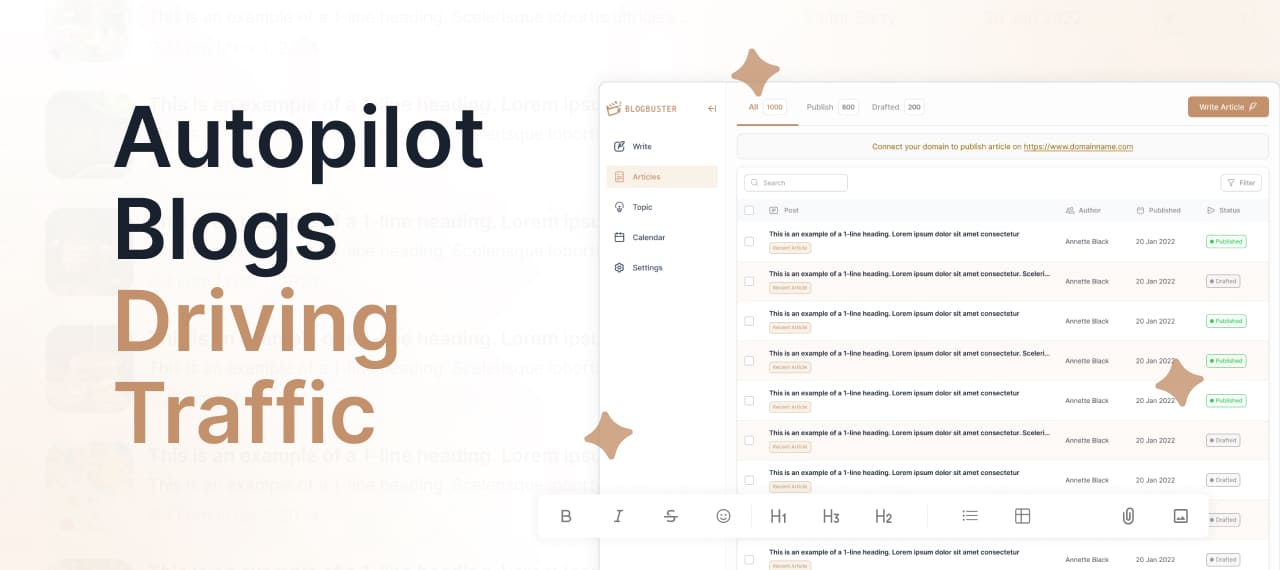
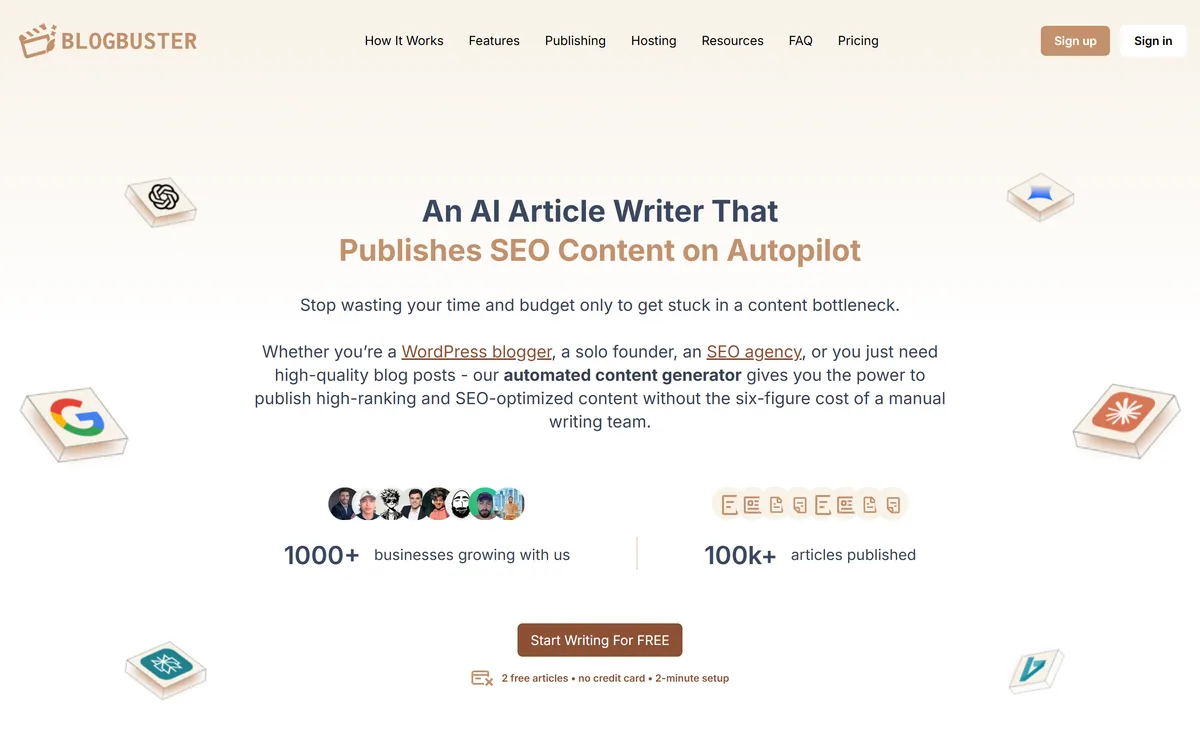
BlogBuster is an AI content platform that analyses your website, suggests topics, writes long-form articles with images and internal links, and publishes them straight to WordPress, Shopify, Webflow or its own hosting. It supports more than 50 languages and includes automated backlink placement.
blogbuster.so10 viewsAdded May 20, 20251K visitors
There is a category of tool that has quietly become one of the largest on the market — Byword and Autoblogging.ai sit in the same shelf — software that writes and publishes a blog for you while you do something else. BlogBuster is a clear, well-executed example of it.
The pitch is unambiguous — enter your website, get topic suggestions, approve them, and articles appear on your blog on a schedule. No brief, no writer, no editing pass unless you want one.
Whether that is a good idea depends almost entirely on what you are publishing and why, and the honest answer is different for a plumber in Leeds than for a Series B SaaS company. This review covers what the pipeline actually does well, why the site-analysis step is the most valuable part, what to make of the automated backlinks, and the specific conditions under which autopilot publishing goes badly wrong.
The word doing the heaviest lifting on this page is autopilot — and it is the word to interrogate.
Autopilot Blogging In Five Lines
BlogBuster is an AI content platform that researches topics, writes long-form articles and publishes them to your CMS without a person in the loop — the vendor's own word for it is autopilot.
It reads your existing site first to pick up brand voice and industry terminology, which is the difference between generic AI copy and something that sounds like your blog.
Articles run 2,000+ words with tables, lists, generated visuals and automatically inserted internal links.
Publishing is native to WordPress, Shopify and Webflow, with a custom CMS API path and BlogBuster's own hosted subdomain as a fallback.
Plans include automated monthly backlinks — the feature that deserves the most scrutiny before you switch anything on.
What The Pipeline Does, Step By Step
The workflow is four stages and it is worth walking through because the sequencing tells you where the quality comes from.
First, site analysis. You give it your domain and it reads what is already there — existing content, positioning, the vocabulary your industry actually uses. This is the step that separates the current generation of these tools from the 2022 generation, which happily wrote about your product using words nobody in your market says.
Second, topic recommendation. It proposes subjects with keyword rationale attached, and you pick from the list or write your own. This is the last point at which a human is required, and skipping it is what autopilot means.
Third, generation. Articles come out over 2,000 words with tables, bullet lists, listicles, custom visuals and internal links inserted automatically against your existing pages.
Fourth, publishing. Straight into WordPress, Shopify or Webflow, or into BlogBuster's own hosting on a branded subdomain if you have no CMS worth connecting.
Connect the domain and let the analysis run before you look at any topic suggestions.
Read the first ten suggested topics carefully — this is the clearest signal of whether it understood your business.
Generate one article and read it as a customer would, not as an SEO would.
Check every internal link it inserted actually points somewhere sensible and relevant.
Publish that one manually, watch it for a month, and only then consider turning the schedule on.
Internal Linking Is The Feature That Earns Its Place
Of everything on the list, automatic internal linking is the most consistently underrated and the most likely to actually move traffic.
Internal links do real structural work. They pass authority between pages, they tell a crawler which of your pages matter and how they relate, and they keep a reader moving through the site rather than bouncing back to the results page.
Tools such as KoalaWriter draft an article and stop there; linking it into the site is left to you. They are also the first thing every content team stops doing. Adding relevant links means remembering what else you have published, which nobody does reliably past about eighty posts. A system that holds the whole site in view and links new content into it does something a busy human genuinely will not.
The caveat is that automatic linking degrades in a specific way: it starts inserting links because a keyword matched rather than because the destination helps. A link to your pricing page from the phrase how much in an unrelated sentence is worse than no link.
Check the first fifty links it places. If they read as editorially sensible, this feature alone justifies a lot.
Internal linking is the part of SEO everyone agrees matters and nobody keeps up with. Automating it is more valuable than automating the writing.
The Backlink Feature Needs A Careful Read
Plans include a monthly allowance of automated backlinks, and this is the part to slow down on.
Backlinks are the strongest ranking signal in search and always have been, which is precisely why the market for buying them is enormous and why search engines treat manufactured link building as something to detect and discount.
Google's own guidelines are clear that links intended to manipulate rankings, including links exchanged or placed in bulk through automated services, fall outside what they want to count. Sites relying on such links have historically seen those links devalued, and in some cases have seen wider ranking impact.
What matters here is what the links actually are, and the site does not specify. A network of the platform's own customers linking to each other is a very different proposition from a genuine editorial placement. So is a directory listing, so is a guest post on a site with real readers.
The correct move is to ask directly and get a specific answer before enabling anything: where do these links come from, are they marked as sponsored or nofollow, and can you see examples on live sites. If the answer is vague, treat the allowance as a reason for caution rather than a benefit.
When Autopilot Publishing Actually Works
Being fair to this category requires admitting there are cases where it works well, and they have a shape.
Autopilot content performs where the subject matter is stable, factually settled, and the reader's need is informational rather than expert. What size skirting board for a Victorian house. How long does sourdough starter keep. Which visa category applies to a short business trip.
These queries have answers that do not change, do not require judgement, and are currently served by pages that are themselves not very good. A competent 2,000-word article with a table and a clear structure genuinely competes.
It fails, badly, in the opposite conditions. Anything where the facts move weekly. Anything where being wrong has consequences — health, legal, financial. Anything where your differentiation is that you know something the market does not, because a model trained on the public web by definition does not know it.
Where your view is the product, a human writing with a general model like Claude is not slower in any way that matters. And it fails in a slow, expensive way that is worth naming: a site filled with adequate, unremarkable content becomes a site nobody links to or cites. You can rank without being memorable for a while. You cannot build anything on it.
Works well: stable informational topics with settled answers and weak incumbent pages
Works well: local and long-tail service queries with low competition
Works well: supporting content around a product where the money pages are written by humans
Fails: fast-moving subjects where last month's article is now wrong
Fails: anything in health, legal or financial territory where accuracy carries consequences
Fails: thought leadership, original research, or anything where your view is the product
Practical Concerns Before You Connect A CMS
Four things worth settling in advance, none of which are unique to this tool but all of which apply to it.
Write access to your live site. Connecting a publishing integration means granting something the ability to post on your domain unattended. Use a dedicated account with the narrowest permissions your CMS allows, and never an administrator credential.
Review before publish. There is an editor and you can use it. The question is whether you will, once the novelty passes and thirty articles a month are appearing. Decide the policy now and staff it, or accept that nothing is being read before it goes live.
Generated visuals. Custom images are included, and they are better than stock photography for uniqueness. Check what they actually look like at your brand's standard, because a technically unique image can still be visibly generated.
The 50-language claim. Multilingual generation is offered with culturally adapted output. Treat that as untested until a native speaker reads one, because this is exactly where automated content is hardest to evaluate and easiest to get quietly wrong.
Key features of BlogBuster
Website analysis to learn brand voice and industry vocabulary
Keyword-backed topic recommendations
Long-form article generation the vendor states runs past 2,000 words
Tables, lists and listicle structures inside generated articles
AI-generated custom visuals rather than stock imagery
Automatic internal linking against your existing pages
Native publishing to WordPress, Shopify and Webflow
Custom CMS publishing via API
Hosted blog on a branded subdomain for sites without a CMS
More than 50 languages with locally adapted output
Automated monthly backlink placement
HTML and Markdown export
Multiple connected sites from one account
Pros & cons
Pros
5
Reading your existing site first produces noticeably less generic output than a cold prompt
Automatic internal linking is the highest-value automation here and the one teams never keep up with
Native publishing to three major CMS platforms removes the copy-paste step entirely
Hosted subdomain fallback means a site with no blog infrastructure can still start
Markdown and HTML export means content is not trapped in the platform
Cons
5
The source of the automated backlinks is not specified, and manufactured links carry real risk
Autopilot publishing means nothing is edited unless you deliberately build that habit
Publishing integrations require write access to your live site, which needs careful permissioning
Multilingual output is very hard to quality-check without a native speaker on hand
Volume-first content does not build the kind of site anyone cites or links to on its own merits
Best For
Small businesses with no blog and no capacity to write one
Local service businesses chasing long-tail informational queries
Founders who need supporting content around human-written product pages
Agencies running content for many small clients at once
Writesonic — broader assisted writing rather than a closed publishing loop
Claude — the manual alternative when you want a human directing every draft
Checks Behind This Assessment
Last checked . Read from blogbuster.so during this check, with the screenshot above captured at the same time.
Four-stage workflow confirmed on site: enter website, select topics, edit, publish
Article length stated by the vendor as 2,000+ words
Article elements listed as tables, bullet points, listicles, custom visuals and internal linking
Brand voice derived from an analysis of the connected site
CMS integrations stated as WordPress, Shopify, Webflow and custom CMS via API, plus native hosting on a branded subdomain
Language coverage stated as more than 50, with culturally adapted output
Export options stated as HTML and Markdown
Automated monthly backlinks included with plans, with the source of those links not specified on site
Article volume and connected-site counts vary by plan tier
Terms, privacy and contact links present in the site footer
No plan prices published here, in line with this site's pricing policy
The backlink allowance is described without specifying where the links are placed. Search engines discount links built primarily to manipulate rankings, so establish exactly what these placements are before enabling them. Article length, language count and quality claims are the vendor's own and were not independently tested.
Editor's Verdict
3.6/5
BlogBuster has an AInexfinder Editor Score of 3.6/5.
BlogBuster pricing
AInexfinder does not list plan prices or billing details. For current pricing, plans, and trials, visit the official BlogBuster website.
Vendor pricing, credits, and billing policies change over time. Always confirm on the official site before you buy.
Frequently asked questions
How does BlogBuster write content that sounds like my brand?
It analyses your existing website before generating anything, picking up your positioning and the vocabulary your industry actually uses. That step is what separates it from a cold prompt, and it is the first thing to sanity-check when you review the topic suggestions.
Can BlogBuster publish directly to WordPress?
Yes, natively, along with Shopify and Webflow, with a custom CMS path via API. Use a dedicated publishing account with the narrowest permissions your CMS allows rather than an administrator credential.
Are the automated backlinks safe for SEO?
Impossible to say without knowing where they are placed, and the site does not specify. Search engines discount links built mainly to influence rankings, so ask directly where the links come from, whether they carry sponsored or nofollow attributes, and request live examples before enabling anything.
Does AI-generated content rank on Google?
Google's stated position is that it rewards helpful content regardless of how it was produced, and penalises content made primarily to game rankings. In practice, automated content does well on stable informational topics with weak incumbent pages, and poorly where accuracy, freshness or genuine expertise decide the result.
How long are BlogBuster's articles?
The vendor states 2,000+ words, assembled with tables, lists and generated visuals. Length is not quality — read one end to end as a customer would before judging whether it is publishable on your domain.
What languages does BlogBuster support?
More than 50, described as culturally adapted rather than translated. Multilingual automated content is the hardest kind to evaluate, so have a native speaker read a full article before you publish a whole language.
Do I still need an editor if I use BlogBuster?
Yes, and that is the honest answer for any tool in this category. The editor exists and the question is whether you will use it once thirty articles a month are appearing. Decide the review policy before you turn the schedule on, not after.
Daniel reviews AI tools the slow way — by actually using them on real projects. His reviews cover what works, what breaks, and who each tool is genuinely a good fit for.
Daniel and the AInexfinder editorial team research BlogBuster using public product information, listing evidence, and (when available) hands-on checks. Scores reflect listing completeness and transparency — not paid placement.
Listings may include affiliate or sponsored placements, which are labeled when present. Editorial scores and cons are not sold. See our affiliate disclosure and review methodology.
RepublishAI is a WordPress autoblogging platform built around specialised AI agents: one analyses search results, one writes, one generates branded images, one builds internal links and one handles SEO metadata. It publishes directly into WordPress and includes a content refresh system for older posts.
ContentBot automates content production through AI Content Workflows (Flows), bulk Imports, an AI Blog Writer, landing page generation and a humanizer, with a WordPress plugin, Chrome extension and 110+ language support via Google Translate.
ContentMonk monitors how often ChatGPT, Perplexity, Claude and Google AI Overviews cite your brand, tracks classical keyword rankings alongside it, joins both to Search Console and Analytics data, and then generates and publishes articles to WordPress or Webflow. It is sold both as software and as a done-for-you service.
Copy.ai has become an AI-native go-to-market platform: workflows and agents that run prospecting, lead processing, deal coaching, ABM, and CRM enrichment across Salesforce, HubSpot, Gong, Outreach, and 2,000+ integrations.
Writesonic has become an AI search growth platform — tracking whether your brand appears across 10 AI platforms, running optimisation and citation work through an Action Center, and reporting results against traffic and revenue.
Talefy, from AIcberg Labs, is an interactive AI storytelling platform. Readers make choices that change the plot, and creators build characters, worlds and branching narratives across fantasy, sci-fi, romance, horror and comedy.