ContentBot automates content production through AI Content Workflows (Flows), bulk Imports, an AI Blog Writer, landing page generation and a humanizer, with a WordPress plugin, Chrome extension and 110+ language support via Google Translate.
RepublishAI
Verified
RepublishAI is a WordPress autoblogging platform built around specialised AI agents: one analyses search results, one writes, one generates branded images, one builds internal links and one handles SEO metadata. It publishes directly into WordPress and includes a content refresh system for older posts.
3.4Editor Score
republishai.com8 viewsAdded April 11, 20266K visitors

Agents Instead Of One Big Prompt
- RepublishAI is a WordPress plugin that researches, writes, illustrates, links and publishes blog posts automatically, using a set of specialised agents rather than a single generation step.
- The agent split is the design idea: a Research Agent reads search results, a Writing Agent drafts, an Image Agent generates branded visuals with alt text, a Linking Agent builds internal links and an SEO Agent handles metadata.
- The Autopilot runs a six-stage process — domain analysis, SERP analysis, content gap analysis, strategic planning, then writing at a stated 3,500+ words.
- The plugin and manual editor are free; the automated research-write-publish loop is the subscription.
- Adoption is small. The WordPress directory listed 50+ active installations, a 4.5 rating from two reviews, and a last update around nine months before this check.
Architecture, Integration And Adoption
| Category | WordPress AI autoblogging and content automation |
|---|---|
| Delivery | WordPress plugin, with a hosted dashboard for multi-site management |
| Named agents | Research Agent, Writing Agent, Image Agent, Linking Agent, SEO Agent |
| Autopilot stages | Domain analysis, SERP analysis, content gap analysis, strategic planning, professional writing, publishing |
| Stated article length | 3,500+ words |
| SEO integration | Yoast SEO for meta titles, descriptions and keywords |
| Images | Generated branded visuals with alt text, rather than stock photography |
| Internal linking | Built automatically to develop topical authority |
| Content maintenance | Refresh system for updating older posts |
| Team features | Writer invitations with shared credits and permission controls |
| Multi-site | Multiple WordPress sites managed from one dashboard |
| Free tier | Plugin installation and the manual editor; Autopilot requires a subscription |
| WordPress directory listing | 50+ active installations, 4.5 stars from 2 reviews, tested to WordPress 6.8.8, requiring WordPress 6.0+ and PHP 7.4+ |
| Last update at time of check | Approximately nine months prior, with a directory compatibility warning displayed |
Why Splitting The Job Into Agents Is A Real Improvement
Most content automation tools — Autoblogging.ai and Byword among them — do one thing: send a prompt, receive an article, publish it. RepublishAI breaks the job into five specialised roles, and the reasoning behind that is sound.
Asking a single model to simultaneously research a topic, structure an argument, write engaging prose, choose imagery, place internal links and compose metadata is asking for competence across six different tasks in one pass. What you get is competent-at-everything, excellent-at-nothing — the flat, uniformly adequate texture people recognise instantly as machine-written.
Separating the roles means each step gets its own focus and, more importantly, its own input. The Research Agent's job is to find out what is already ranking. The Writing Agent's job is to write given that research. Neither has to hold the other's context.
The Linking Agent is the most valuable of the five and the least discussed. Internal linking requires knowing the whole site, which is exactly the sort of state a single-pass generation cannot carry. A dedicated pass over your existing content is the right architecture for it.
The Image Agent producing branded visuals with alt text rather than stock photography addresses two real problems at once — visual sameness across AI-written sites, and the accessibility gap that automated publishing usually widens.
None of this makes generated content good. It makes it structurally better organised than the single-prompt approach, which is a genuine if modest distinction.
One prompt asked to research, write, illustrate, link and optimise gives you six mediocre outputs. Five agents give you five focused ones, which is not the same as five good ones.
SERP Analysis Is The Interesting Stage And The Limiting One
The six-stage Autopilot puts substantial work in before any writing begins, and the SERP analysis stage deserves particular attention because it is both the strongest and the most constrained part of the design.
Reading the top ten results for a query before writing is what a competent human content strategist does. It reveals what search engines currently reward for that query — the format, the depth, the sub-questions, whether the winning pages are listicles or explainers or comparison tables.
Writing to match that pattern is a legitimate strategy and it works, and it is the same method KoalaWriter uses to inform its drafting. The content gap analysis stage extends it sensibly: finding sub-topics the ranking pages omit is a real, if narrow, path to differentiation.
The limitation is structural and worth stating plainly. A system that studies what ranks and produces something similar can only ever produce a well-executed version of what already exists. It cannot produce the thing nobody has written, because by definition that thing is not in the results it read.
For a large class of informational queries that is entirely sufficient, and pretending otherwise would be dishonest — most search results are not original and do not need to be. But it does mean this approach reliably produces the eleventh good article on a topic rather than the first.
The Adoption Numbers Deserve An Honest Reading
The WordPress plugin directory publishes figures no vendor controls, and they tell a different story from the marketing site.
At the time of this check the listing showed 50+ active installations, a 4.5 star rating from two reviews, and a last update roughly nine months earlier, with the directory displaying its standard warning that the plugin had not been tested against the three most recent WordPress releases.
Fifty installations is very small. It does not indicate the product is bad — plenty of good tools are early, and the hosted subscription may have users the plugin count does not capture — but it does mean you are an early adopter rather than joining an established base.
The update gap is the more actionable concern. A WordPress plugin holds publishing credentials and write access to your site, and plugins that stop being updated are one of the more common routes into a WordPress installation. This is a maintenance question, not a quality judgement.
The practical response is not to avoid it but to check the current state before installing. Look at the directory listing yourself, see whether it has been updated since, and confirm compatibility with your WordPress version.
Two reviews is too small a sample to tell you anything at all about quality, in either direction.
- Check the plugin's current last-updated date before installing, not the one quoted anywhere
- Confirm it is tested against your WordPress version rather than an older one
- Install on a staging site first, as with any plugin that writes to your database
- Use a dedicated WordPress account with author-level rather than administrator permissions
- Have a rollback plan, since automated publishing can create a lot of content quickly
What The Content Refresh System Is Actually For
One feature sits apart from the generation pipeline and is arguably the most defensible thing here.
The refresh system updates existing posts rather than writing new ones, and that addresses a real and widely neglected problem. Content decays: a post written three years ago goes stale, its statistics age, the product it describes has changed, and it slides down the results.
Refreshing published content is consistently one of the highest-return activities in search optimisation, and almost nobody does it, because updating old posts feels like maintenance while writing new ones feels like progress.
Automating the unglamorous half is a sensible application of the technology. It is also lower risk than automated publishing, since you are improving pages that already have a track record rather than adding untested new ones.
The caution is that a refresh which merely reshuffles wording without adding anything is worse than no refresh — it changes a page that was working. Compare the before and after on your first five and check that something substantive was actually added.
- Start with the refresh system rather than the Autopilot, on posts that already rank somewhere.
- Compare each refreshed post against its original and confirm real information was added.
- Watch the rankings of the first five refreshed posts for a month before refreshing more.
- Only then generate a single new article and read it end to end as a reader would.
- Publish that one manually and give it a month before enabling anything automatic.
The Structural Risks Of Automated Publishing
These apply to the whole category — BlogBuster and every other closed-loop publisher included — rather than to this product specifically, and they are the things worth deciding about before you install anything.
Site-level quality signals. Search engines assess sites, not only pages. A large volume of adequate content can drag down the pages that were genuinely good, which is the opposite of the intended effect.
Nobody reads it. Automated publishing means content goes live without review by default. Thirty articles a month is more than most teams will ever read, and one factual error on your domain is your error regardless of what produced it.
Regulated topics. Health, legal, financial and safety content carries consequences when it is wrong. This category of tool has no business publishing unreviewed content in those areas.
Write access. Any plugin with publishing rights can post anything. Scope the account narrowly and treat the credential as you would any other production access.
The reasonable position is that this class of tool is a drafting and maintenance system with automation available, rather than an automation system with drafting available. Which of those you treat it as determines almost everything about the outcome.
Should This Run On Your WordPress Site?
Turn It On When
- You run WordPress and content production is genuinely blocked rather than merely slow
- You have an archive of ageing posts that would benefit from a refresh programme
- Your topics are stable and informational rather than fast-moving or regulated
- You manage several small sites and per-site content effort does not scale
- Someone will review output before it publishes, and you can name who
Do Not Let It Near If
- Your site covers health, legal, financial or safety topics
- Your existing content is strong and volume would dilute the site's quality signals
- Nobody is available to read what gets published
- You are unwilling to give a plugin publishing access to your live site
- You need original research or expertise that does not exist in search results
Other Ways To Automate WordPress Content
The category is crowded and the products differ mainly in how much of the loop they close and how much review survives.
- BlogBuster — the same closed loop with a broader set of CMS targets
- Autoblogging.ai — bulk scheduled generation aimed squarely at WordPress
- KoalaWriter — SERP-informed drafting with more manual control
- Byword — volume-first generation across many sites
- Writesonic — assisted writing rather than autonomous publishing
Key features of RepublishAI
Research Agent that analyses current search results before writing
Writing Agent producing long-form articles from that research
Image Agent generating branded visuals with alt text
Linking Agent building internal links across your existing content
SEO Agent handling meta titles, descriptions and Open Graph tags
Six-stage Autopilot from domain analysis through to publishing
Content refresh system for updating older posts
Yoast SEO integration
Direct publishing into WordPress with scheduling control
Multi-site management from a single dashboard
Team collaboration with shared credits and permission controls
Free manual AI editor alongside the automated pipeline
Pros & cons
Pros
6- Splitting the work across specialised agents is a better architecture than one large prompt
- A dedicated linking pass solves the one SEO task human teams reliably abandon
- Generated branded images with alt text address visual sameness and accessibility together
- The content refresh system targets the highest-return and most neglected SEO activity
- A free plugin and free manual editor make evaluation genuinely low-commitment
- Yoast integration means it works with the metadata setup most WordPress sites already have
Cons
6- Only 50+ active installations on the WordPress directory at the time of this check
- Last updated roughly nine months earlier, with a directory compatibility warning showing
- Two reviews is far too small a sample to indicate anything about quality
- WordPress only, unlike competitors that publish to several platforms
- Writing to match what already ranks can only produce a good version of what exists
- The vendor site was not directly reachable during this check
Best For
- WordPress site owners with a stalled content programme
- Publishers with a large archive of ageing posts needing refreshes
- Small agencies running content for several WordPress clients
- Niche site operators working on stable informational topics
- Anyone wanting automatic internal linking across an existing archive
How It Differs From The Nearest Alternatives
All four write and publish. The differences are architecture, reach and how established each one is.
| Tool | Architecture | Publishing targets | Maturity signal |
|---|---|---|---|
| RepublishAI | Five specialised agents plus a six-stage pipeline | WordPress, with multi-site management | Small directory install base |
| BlogBuster | Single pipeline with site analysis | WordPress, Shopify, Webflow, API, own hosting | Broader integration surface |
| Autoblogging.ai | Bulk generation with multiple writer modes | WordPress | Established in the autoblogging niche |
| KoalaWriter | SERP-informed drafting, human publishes | WordPress | Widely used for assisted writing |
Checks And Their Sources
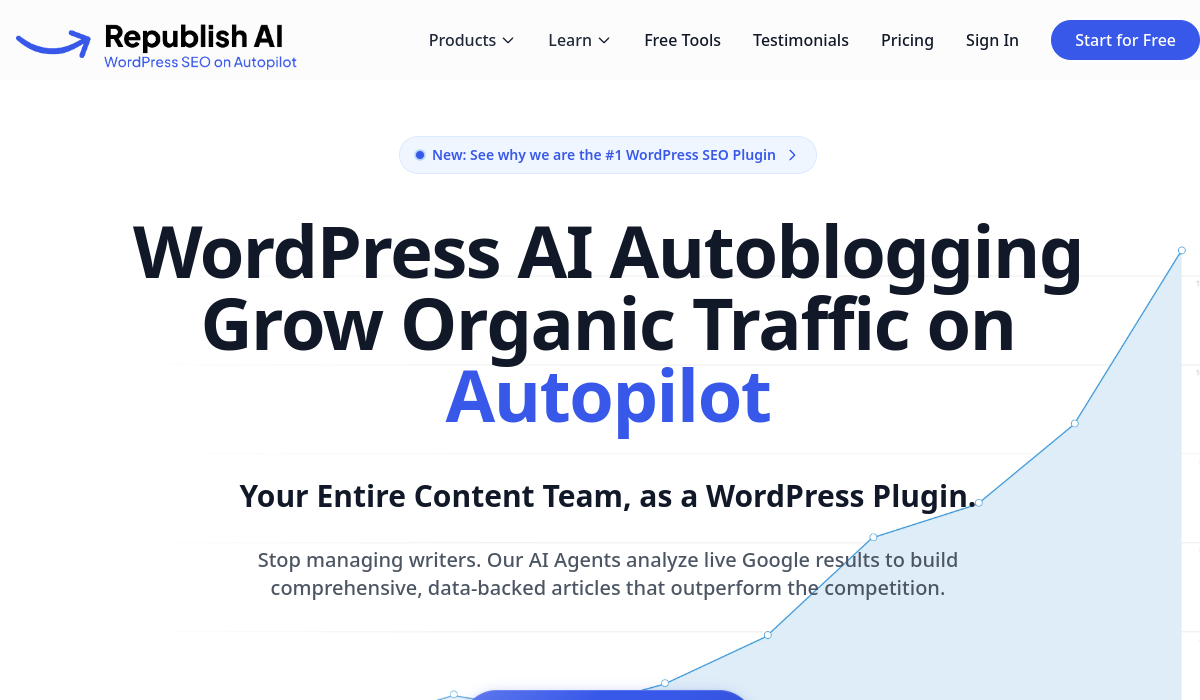
Last checked . The vendor site returned an error when accessed directly for this check, so the product details below come from the plugin's WordPress.org directory listing and from the vendor's own indexed pages, with the screenshot above captured separately.
- Five named agents described by the vendor: Research, Writing, Image, Linking and SEO
- Six-stage Autopilot process described: domain analysis, SERP analysis, content gap analysis, strategic planning, professional writing and publishing
- Stated article length of 3,500+ words
- Yoast SEO integration for meta titles, descriptions and keywords
- Branded image generation with alt text rather than stock photography
- Automatic internal linking and a content refresh system for older posts
- Multi-site management and team collaboration with shared credits and permissions
- Free plugin installation and free manual editor, with Autopilot behind a subscription
- WordPress.org listing at the time of this check: 50+ active installations, 4.5 stars from 2 reviews, tested to WordPress 6.8.8, requiring WordPress 6.0+ and PHP 7.4+
- Directory compatibility warning displayed, with the last update approximately nine months prior
- No plan prices published here, in line with this site's pricing policy
The vendor site was not reachable directly during this check, so no footer review was possible and product claims come from the WordPress.org listing and indexed vendor pages. Install counts and update dates change — check the plugin's current directory listing yourself before installing. Article length and quality claims are the vendor's own and were not independently tested.
Editor's Verdict
3.4/5RepublishAI has an AInexfinder Editor Score of 3.4/5.
RepublishAI pricing
AInexfinder does not list plan prices or billing details. For current pricing, plans, and trials, visit the official RepublishAI website.
Visit official website for pricingVendor pricing, credits, and billing policies change over time. Always confirm on the official site before you buy.
Frequently asked questions
What does RepublishAI actually do?
It is a WordPress plugin that researches a topic against live search results, writes a long-form article, generates branded images, builds internal links, fills in SEO metadata and publishes the post — using a separate specialised agent for each of those steps.
Is RepublishAI free?
The plugin installs free and the manual AI editor is free to use. The Autopilot — the part that researches, writes and publishes automatically — requires a subscription.
How many people use RepublishAI?
The WordPress.org directory showed 50+ active installations at the time of this check, with two reviews. That is a small base, so you would be an early adopter rather than joining an established user community. Check the current listing before installing.
Why does splitting the work into agents matter?
Asking one prompt to research, write, illustrate, link and optimise produces something uniformly mediocre at all five. Separate agents each get their own focus and input — and the linking agent in particular needs knowledge of your whole site, which a single generation pass cannot carry.
Is it safe to give a plugin publishing access to my site?
It requires care rather than avoidance. Install on staging first, use a dedicated author-level account rather than an administrator, and check the plugin's update history — plugins that stop being maintained are a common route into a WordPress installation.
Does refreshing old posts actually improve rankings?
Updating existing content is consistently one of the highest-return SEO activities and almost nobody does it, because it feels like maintenance rather than progress. The caveat is that a refresh which only reshuffles wording changes a page that was working — check that something substantive was added.
Will content written from SERP analysis rank?
It can, on stable informational topics where the existing results are weak. What it cannot do is produce something nobody has written, because the method starts by reading what already ranks. Expect a well-executed eleventh article on a subject rather than a first.
Reviews
Log in to write a review.
User Reviews
No reviews yet. Be the first to share your experience with RepublishAI.
Reviewed by Daniel Reed
Assigned reviewer
Daniel ReedSenior AI Tools Reviewer
Daniel reviews AI tools the slow way — by actually using them on real projects. His reviews cover what works, what breaks, and who each tool is genuinely a good fit for.
Hands-on reviewsProduct testingAI software
Daniel and the AInexfinder editorial team research RepublishAI using public product information, listing evidence, and (when available) hands-on checks. Scores reflect listing completeness and transparency — not paid placement.
- Last verified
- Methodology
- How we review AI tools
- Sources used
- republishai.com
- AInexfinder listing fields (features, pros/cons, description)
- Public vendor pages when available
- Editorial policy
- Listings may include affiliate or sponsored placements, which are labeled when present. Editorial scores and cons are not sold. See our affiliate disclosure and review methodology.
Related tools
BlogBuster is an AI content platform that analyses your website, suggests topics, writes long-form articles with images and internal links, and publishes them straight to WordPress, Shopify, Webflow or its own hosting. It supports more than 50 languages and includes automated backlink placement.
ContentMonk monitors how often ChatGPT, Perplexity, Claude and Google AI Overviews cite your brand, tracks classical keyword rankings alongside it, joins both to Search Console and Analytics data, and then generates and publishes articles to WordPress or Webflow. It is sold both as software and as a done-for-you service.

Copy.ai has become an AI-native go-to-market platform: workflows and agents that run prospecting, lead processing, deal coaching, ABM, and CRM enrichment across Salesforce, HubSpot, Gong, Outreach, and 2,000+ integrations.
FreemiumWriting & Content

Writesonic has become an AI search growth platform — tracking whether your brand appears across 10 AI platforms, running optimisation and citation work through an Action Center, and reporting results against traffic and revenue.
FreemiumWriting & Content
Talefy, from AIcberg Labs, is an interactive AI storytelling platform. Readers make choices that change the plot, and creators build characters, worlds and branching narratives across fantasy, sci-fi, romance, horror and comedy.
FreemiumWriting & Content
Compare:RepublishAI vs ContentBotRepublishAI vs BlogBusterRepublishAI vs ContentMonkRepublishAI vs Copy.ai
RepublishAI alternatives Explore More
Embed this listing on your site
Featured on AInexfinder