ContentMonk monitors how often ChatGPT, Perplexity, Claude and Google AI Overviews cite your brand, tracks classical keyword rankings alongside it, joins both to Search Console and Analytics data, and then generates and publishes articles to WordPress or Webflow. It is sold both as software and as a done-for-you service.
contentmonk.io8 viewsAdded May 12, 20266K visitors
For twenty years the question was where you ranked. The newer question is whether you get mentioned at all when someone asks an assistant rather than a search box — and a mention has no position number, no impressions column and no click.
That gap has produced a category of tools that sample AI answers on a schedule and count brand appearances — Profound and AthenaHQ among them. Most of them stop there. ContentMonk's distinguishing choice is to keep going: it joins that visibility data to classical rankings and to your own Search Console and Analytics, then offers to write and publish the content it thinks will move the number.
That combination is genuinely useful and genuinely risky, and the risk is not where most buyers look. What follows separates the measurement from the publishing, because they deserve very different levels of trust.
The Answer-Engine Summary
It tracks prompts, not just keywords — a daily set of questions run against ChatGPT, Perplexity, Claude and Google AI Overviews to see whether your brand is named.
Classical rank tracking runs alongside it, which matters because the two channels behave differently and most teams still get more traffic from the old one.
The differentiator is the join: it pulls Search Console and Analytics in, so visibility can be checked against actual acquisition rather than admired on its own.
It also writes and publishes — briefs, articles, repurposed social posts, and one-click publishing to WordPress or Webflow.
Two products, one site: a subscription to the software, or a done-for-you engagement where ContentMonk's team runs it. Decide which you are buying before the demo.
Tracking Prompts Is Not Tracking Keywords
The core measurement is a set of prompts run daily against several assistants, recording whether your brand appears in the answer and which sources the assistant cited.
Understanding what this can and cannot tell you is the difference between using the tool well and being misled by it. Assistant answers are not deterministic. The same prompt can return different sources on consecutive days, and answers vary by the user's account, history, region and the model version being served. A daily sample is a sample, not a ranking.
That makes trend the only reliable read. Whether you were mentioned on Tuesday is noise; whether your mention rate across a stable prompt set rose over eight weeks is signal. Any tool presenting a single day's result as a position is overstating what the method supports.
The source analysis is the more actionable half. Knowing which domains the assistants keep citing for your category tells you where to earn a presence — and it is frequently not your own site. If four of five cited sources are review sites, comparison pages and forums, publishing another article on your blog is not the intervention the data points to.
An assistant mention is a sample from a distribution, not a rank. Read the trend across weeks, never the reading from a single day.
Why Running Both Channels Matters
ContentMonk tracks classical keyword rankings alongside prompts, and this is a more sensible design than it might appear.
The obvious reason is that most businesses still receive far more traffic from conventional search results than from assistant citations, so abandoning rank tracking to chase the newer metric trades a large measured channel for a small one.
The subtler reason is diagnostic. When an assistant cites a page, it usually found that page through conventional retrieval. Watching both series together tells you whether an AI visibility problem is really an AI problem or simply a ranking problem wearing a new name — and in a large share of cases it is the latter. That overlap is why established optimisation platforms such as Surfer SEO moved into this territory rather than being displaced by it.
The Opportunity Engine, And What It Joins Together
ContentMonk describes a proprietary engine that analyses Search Console, Analytics, rank and answer-engine data together to surface recommendations.
Ignore the branding and look at the inputs, because the inputs are the actual value. Most visibility trackers sit outside your property and can only tell you what they sampled. Connecting Search Console and Analytics means the tool can ask a question the others cannot: did anything change for us when that mention rate moved?
That question is the one that separates a real programme from an expensive dashboard. Assistant citations are easy to celebrate and hard to attribute — assistant referrals often arrive with no referrer at all, or as direct traffic, so an honest answer usually requires triangulation rather than a single clean number.
Treat the recommendations as prompts for judgement rather than as instructions. A join across four data sources produces correlations in abundance, and a tool that also sells you the content to act on them has an obvious incentive to find work worth doing.
Connect Search Console and Analytics on day one — without them the tool is just another sampler.
Fix your prompt set early and resist editing it, because changing the questions resets the trend you are trying to read.
Watch the cited-source list more closely than your own mention count; it tells you where the influence actually sits.
Compare movements against your classical rankings before concluding that anything is specific to AI.
Record what you changed and when, so a shift months later can be attributed to something rather than guessed at.
Publishing Straight To Your CMS Is The Risky Part
The generation side produces briefs and articles, repurposes them into social posts, and publishes directly to WordPress or Webflow. The monthly article allowance scales with the tier.
This is where care is owed. Search engines have spent several years getting better at recognising content produced at volume without expertise behind it, and the penalty for getting this wrong is not a slower result — it is a site-wide loss of trust that takes far longer to recover than it took to cause.
Google's published position is not that AI-generated content is disallowed; it is that content produced primarily to manipulate rankings is, whoever or whatever wrote it. The distinction is one of purpose and quality, not of authorship. A generated article that a knowledgeable person edited, corrected and added something real to is fine. Thirty of them published unread each month is the exact pattern the guidance describes.
The safe way to use this half of the product is to treat one-click publishing as a feature you deliberately do not use. Optimisation-first tools such as Clearscope take the opposite stance by design, improving a page rather than adding one. Generate into drafts, have someone who knows the subject edit them, and publish the ones that survive. If that sounds like it removes the efficiency, it removes the part of the efficiency that was going to cost you.
A Twenty-Minute Test Of Any AI Visibility Claim
Before subscribing to any tool in this category, run this. It costs nothing and it calibrates every number the dashboard will later show you.
The bar to clear is step four. A tool whose reported mention rate does not roughly match what you observe by hand is sampling in a way that does not represent your buyers.
Write down ten prompts a real buyer would actually type — not your keywords, the questions behind them.
Run all ten by hand in ChatGPT and Perplexity, and record whether your brand appears and which sources are cited.
Repeat the same ten the next day. The differences between the two runs are your noise floor, and every tool in this category is subject to it.
Compare that hand-collected picture with what the tool reports for the same prompts over the same days. Divergence is the thing to ask the vendor about.
List the domains cited across all twenty runs. If your site is rarely among them, your first move is earning a presence on the sources that are — not publishing more of your own pages.
Software Or Agency: Two Products On One Site
ContentMonk sells a subscription to the platform and a done-for-you service where its team operates it. These are different purchases with different risks and it is worth being clear which one you are in.
The software is the safer buy. You keep control of what gets published, you learn the channel, and the recurring commitment is smaller.
The service can be the better buy for a team with no capacity, but it moves editorial judgement outside your organisation — and editorial judgement is precisely what stops the publishing side from harming you. If you go this route, insist on reviewing drafts before they go live and be explicit that nothing publishes unreviewed.
The customer list is a reasonable signal here. Named companies including lemlist, GetResponse, UserPilot and Expandi are recognisable software businesses, and vendors do not usually name customers who would object.
What ContentMonk Charges For
Pricing is subscription-based, in tiers, with the tier determining the volume of what you get rather than unlocking fundamentally different capabilities.
Three meters move together: how many prompts are tracked daily, how many keywords are rank-tracked daily, and how many briefs or articles are included each month. The done-for-you engagement is quoted separately.
Read that structure carefully, because it prices content volume as the primary variable. That is a reasonable way to package software and a poor way to run a content programme — the number of articles you should publish is set by how many you can make genuinely good, not by how many your plan includes.
We do not publish amounts, since tiers change. The question to settle before buying is whether the tracking alone would justify the subscription for you. If it would, the included articles are a bonus you can use sparingly. If it would not, you are buying volume.
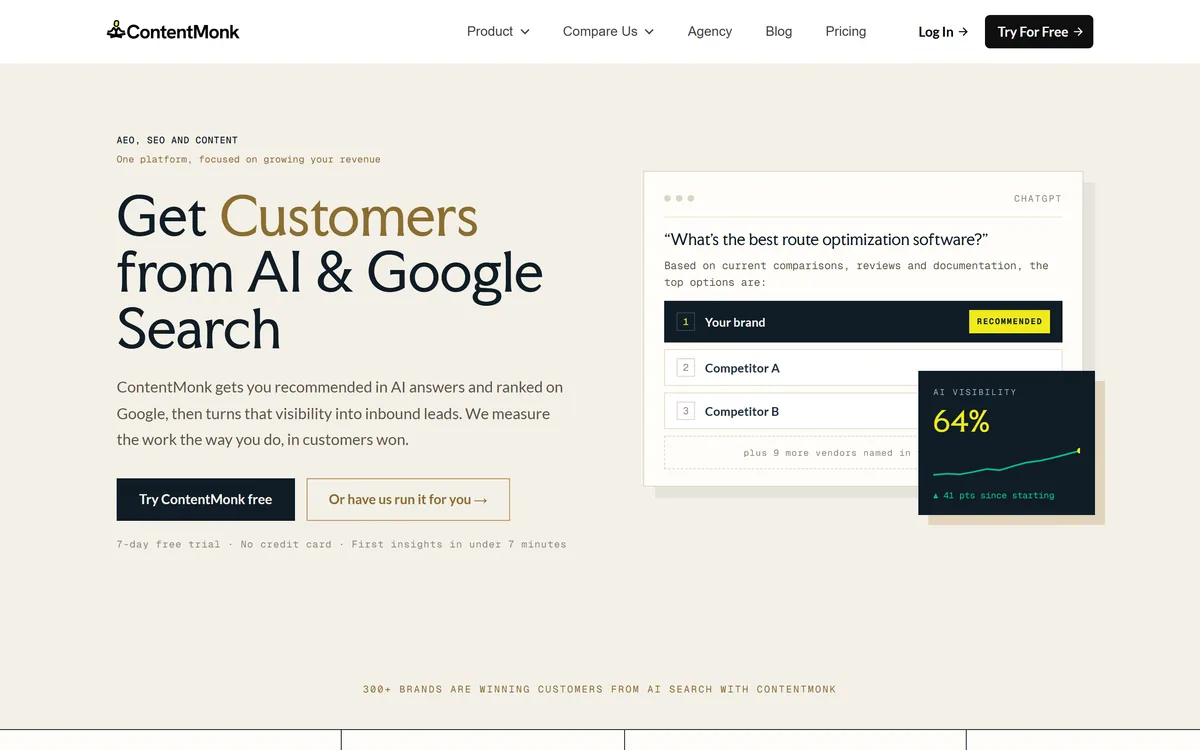
ContentMonk's homepage, captured 9 September 2026. Answer-engine visibility leads, with classical SEO tracking positioned alongside rather than beneath it.
AEO, GEO And The Vocabulary You Need
This category has generated more terminology than substance. Four terms actually matter when reading any tool in it.
Answer Engine Optimisation (AEO)
Work aimed at being cited in a generated answer rather than ranked in a list of links. The mechanics overlap heavily with conventional SEO, because assistants retrieve from indexed pages.
Generative Engine Optimisation (GEO)
Used more or less interchangeably with AEO by most vendors. Treat the two as the same discipline described by different marketing departments.
Prompt set
The fixed list of questions a tool runs on a schedule. Its composition determines everything you will see, and changing it resets your trend line — so build it carefully and then leave it alone.
Citation source
The domains an assistant references when answering. Usually more actionable than your own mention rate, because it tells you which pages influence the answer.
Share of voice
The proportion of sampled answers naming you rather than a competitor. Meaningful only against an unchanged prompt set, sampled often enough to see past day-to-day variation.
Key features of ContentMonk
Daily prompt tracking across ChatGPT, Perplexity, Claude and Google AI Overviews
Citation source analysis showing which domains assistants favour in your category
An opportunity engine joining Search Console, Analytics, rank and answer-engine data
Content brief and full article generation with a monthly allowance by tier
Repurposing of articles into LinkedIn and Reddit posts
One-click publishing to WordPress and Webflow
REST API, webhooks and an MCP server for programmatic access
Pros & cons
Pros
6
Joins answer-engine visibility to your own Search Console and Analytics, which most rivals cannot do
Tracks classical rankings in parallel, so you can tell an AI problem from an ordinary ranking problem
Citation source analysis points at where influence actually sits, which is often not your own site
Real integration surface — CMS publishing, REST API, webhooks and an MCP server
Named, recognisable customers rather than unattributed logos
A single subscription covers both channels instead of requiring two separate tools
Cons
6
One-click publishing into a live CMS is a genuine risk to a site that already ranks, and the product makes it easy
Monthly article allowances price volume as the goal, which is the wrong incentive for content quality
Platform-scale statistics are vendor counts with no stated methodology and cannot be verified
Answer sampling is inherently noisy, and no tool in this category can fully solve that
A vendor that both measures your visibility and sells you content has an obvious incentive to find work worth doing
The done-for-you option moves editorial judgement outside your organisation, which is where the safeguard should sit
Best For
Software and ecommerce brands whose buyers genuinely consult AI assistants
Marketing teams that already rank and want to know whether it converts into citations
Teams wanting one dashboard for both classical and answer-engine visibility
Organisations with an editor who can review generated drafts properly
Agencies managing visibility reporting across several client sites
ContentMonk Against The AI Visibility Trackers
Almost every tool here samples assistant answers. The real differences are whether they connect to your own analytics, and whether they also produce content.
Tool
Core focus
Produces content?
Notable difference
ContentMonk
AI visibility plus classical rank tracking
Yes — briefs, articles and direct publishing
Joins Search Console and Analytics, so visibility can be checked against acquisition
Content optimisation, now with AI visibility added
Yes — optimisation rather than full generation
Comes from the classical SEO side, with a longer track record there
ContentMonk By The Numbers It Publishes
Assistants tracked
ChatGPT, Perplexity, Claude, Google AI Overviews
Prompt tracking
Daily, with the volume set by tier
Keyword rank tracking
Daily, with the volume set by tier
Data sources joined
Google Search Console, Google Analytics, rank data, answer-engine data
Content output
Briefs, articles, and repurposing to LinkedIn and Reddit posts
Publishing targets
WordPress and Webflow
Developer access
REST API, webhooks, and an MCP server
Named customers
eLogii, GoBolt, lemlist, Expandi, Hunch, Certificial, GetResponse, UserPilot, Pest Pro Thermal, RemoteCrew
Delivery models
Self-serve software subscription, or a done-for-you agency engagement
Legal entity
ContentMonk, LLC
Published policies
Terms of Service and Privacy Policy
Who ContentMonk Suits
A good fit when
You already rank reasonably well and want to know whether that is translating into assistant citations.
You want visibility data joined to Search Console and Analytics rather than sitting in a separate dashboard.
You have someone who can edit generated drafts with real subject knowledge before anything is published.
You want one tool covering both channels rather than a rank tracker and a separate AI monitor.
You are a software or ecommerce business whose buyers genuinely do ask assistants for recommendations.
A weak fit when
You would use the one-click publishing as intended, with nobody reviewing what goes live — that is the fastest way to damage a site that currently performs.
Your site has little classical search presence yet; assistants mostly cite pages that already rank, so the foundational work comes first.
You need measurement you can audit precisely, since answer sampling is inherently variable and no vendor can eliminate that.
Your customers do not use assistants to find suppliers, which is still true in plenty of local and relationship-driven markets.
You want a pure measurement tool with no commercial interest in recommending that you publish more.
Related Search And Visibility Tools
Worth comparing before committing, because this category is young and the products differ more than their homepages suggest.
Profound — measurement-only answer-engine analytics, without a content business attached
AthenaHQ — built around generative engine optimisation from the start rather than bolted onto SEO
Otterly AI — a lighter, cheaper way to monitor brand mentions in AI search
Surfer SEO — the established optimisation platform that has moved into the same territory
Clearscope — content optimisation with a quality-over-volume philosophy, a useful counterweight
How We Verified ContentMonk
Last checked . Read from contentmonk.io, including the footer and product pages, with the screenshot above captured in the same session.
Prompt tracking confirmed across ChatGPT, Perplexity, Claude and Google AI Overviews, run daily with volume set by tier
Classical keyword rank tracking confirmed as a daily service alongside prompt tracking
Source analysis described as showing which domains AI citations favour
A proprietary opportunity engine described as analysing Search Console, Analytics, SEO and answer-engine data together
Content brief and article generation included monthly, with repurposing to LinkedIn and Reddit
Direct publishing to WordPress and Webflow confirmed, alongside a REST API, webhooks and an MCP server
Named customers listed on the site including eLogii, GoBolt, lemlist, Expandi, Hunch, Certificial, GetResponse and UserPilot
Both a software subscription and a done-for-you agency engagement offered
Footer read directly and confirmed to carry product pages, industries, comparisons, reviews, blog, case studies, help centre, Terms of Service and Privacy Policy
Operating entity identified on the site as ContentMonk, LLC
What we could not confirm: the platform-scale figures the site advertises — answers analysed, keywords held, articles written and brands served — are vendor counts with no published methodology and cannot be checked from outside; we did not run the product, so the sampling frequency and the stability of its mention data are taken from the site rather than measured; and no independent assessment exists of how closely its sampled answers match what a given user would actually see.
Editor's Verdict
3.8/5
ContentMonk earns a fair score for doing something most of its rivals do not: it joins answer-engine visibility to classical rank data and to your own Search Console and Analytics, which is the only way to tell whether a mention in ChatGPT produced anything. The integration list is real, and MCP support is a genuinely forward-looking touch. It loses ground because publishing generated articles straight into a live CMS is the single fastest way to damage a site that currently ranks, because monthly article allowances push volume as the answer to a quality problem, and because none of the platform-scale figures it advertises can be checked from outside. AInexfinder Editor Score: 3.8/5.
ContentMonk pricing
AInexfinder does not list plan prices or billing details. For current pricing, plans, and trials, visit the official ContentMonk website.
Vendor pricing, credits, and billing policies change over time. Always confirm on the official site before you buy.
Frequently asked questions
What does ContentMonk do?
It tracks whether AI assistants — ChatGPT, Perplexity, Claude and Google AI Overviews — mention your brand when asked questions in your category, tracks classical keyword rankings alongside that, joins both to your Search Console and Analytics data, and then generates and can publish content to WordPress or Webflow.
Is ContentMonk free?
No. It is a tiered subscription, with the tier setting how many prompts are tracked daily, how many keywords are rank-tracked, and how many articles are included each month. A separate done-for-you engagement is quoted individually. We do not publish amounts because tiers change — check the pricing page.
How accurate is AI visibility tracking?
It is a sample, not a measurement. Assistant answers vary between runs, between users and between model versions, so a single day's result carries little information. Read trends across weeks against an unchanged prompt set, and treat any tool presenting a daily figure as a ranking with scepticism. Validate by running ten of your own prompts by hand for two days before trusting the dashboard.
Is publishing AI-generated articles safe for SEO?
It depends entirely on what happens between generation and publication. Google's stated position targets content made primarily to manipulate rankings, regardless of who or what wrote it. A generated draft that a knowledgeable person edited and improved is fine; a monthly quota published unread is the pattern the guidance describes. Use the generation, do not use the one-click publish.
What makes ContentMonk different from Profound or Otterly?
Two things. It connects to your Search Console and Analytics, so visibility can be checked against actual acquisition rather than viewed in isolation, and it tracks classical rankings in the same product. It also generates and publishes content, which those measurement-focused tools deliberately do not — a difference in scope that cuts both ways.
Do I still need conventional SEO if I use ContentMonk?
Yes, and the tool's own design concedes it by tracking rankings alongside prompts. Assistants overwhelmingly cite pages that conventional retrieval already surfaces, so a site with no search presence rarely gets cited. In practice an AI visibility problem is frequently an ordinary ranking problem with a newer name.
Can ContentMonk publish directly to my website?
Yes, to WordPress and Webflow, and there is also a REST API, webhooks and an MCP server. Our recommendation is to configure it to create drafts rather than published posts. The convenience of direct publishing is real, and so is the damage from a quota of unreviewed articles landing on a site that currently performs.
Daniel reviews AI tools the slow way — by actually using them on real projects. His reviews cover what works, what breaks, and who each tool is genuinely a good fit for.
Daniel and the AInexfinder editorial team research ContentMonk using public product information, listing evidence, and (when available) hands-on checks. Scores reflect listing completeness and transparency — not paid placement.
Listings may include affiliate or sponsored placements, which are labeled when present. Editorial scores and cons are not sold. See our affiliate disclosure and review methodology.
RepublishAI is a WordPress autoblogging platform built around specialised AI agents: one analyses search results, one writes, one generates branded images, one builds internal links and one handles SEO metadata. It publishes directly into WordPress and includes a content refresh system for older posts.
ContentBot automates content production through AI Content Workflows (Flows), bulk Imports, an AI Blog Writer, landing page generation and a humanizer, with a WordPress plugin, Chrome extension and 110+ language support via Google Translate.
BlogBuster is an AI content platform that analyses your website, suggests topics, writes long-form articles with images and internal links, and publishes them straight to WordPress, Shopify, Webflow or its own hosting. It supports more than 50 languages and includes automated backlink placement.
Copy.ai has become an AI-native go-to-market platform: workflows and agents that run prospecting, lead processing, deal coaching, ABM, and CRM enrichment across Salesforce, HubSpot, Gong, Outreach, and 2,000+ integrations.
Writesonic has become an AI search growth platform — tracking whether your brand appears across 10 AI platforms, running optimisation and citation work through an Action Center, and reporting results against traffic and revenue.
Talefy, from AIcberg Labs, is an interactive AI storytelling platform. Readers make choices that change the plot, and creators build characters, worlds and branching narratives across fantasy, sci-fi, romance, horror and comedy.