SE Ranking is an SEO platform built around cross-channel visibility, adding trackers for AI Overviews, AI Mode and assistant answers alongside conventional rank tracking, backed by 188 country databases and exposed through an API and an MCP server for use inside AI assistants.

Surfer SEO
Verified
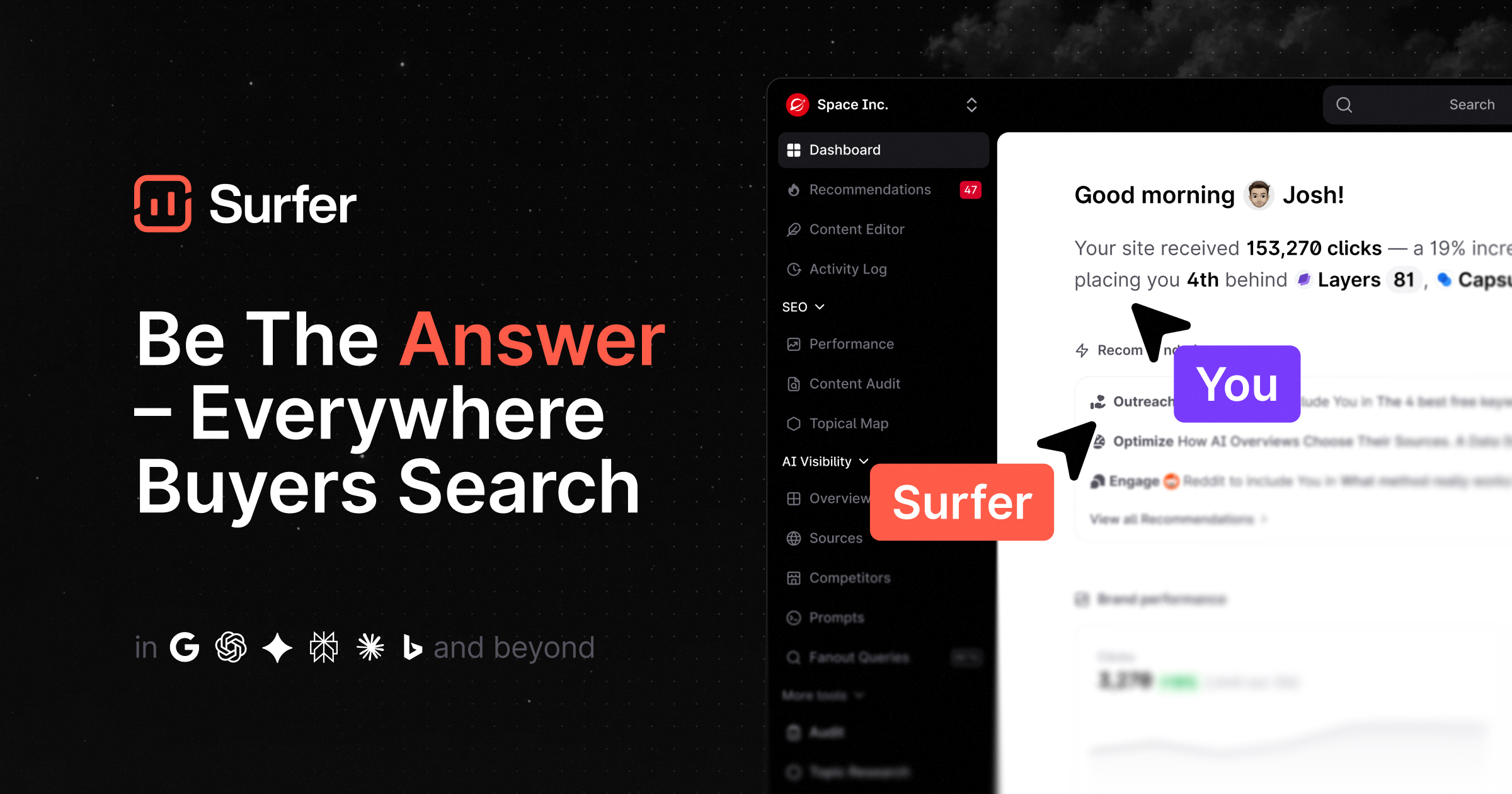
Surfer SEO analyses top-ranking results to guide content optimisation through its Content Editor and Content Score, and has expanded into AI visibility — tracking brand mentions in ChatGPT, Claude, Gemini, Perplexity, and Google AI Overviews.
4.4Editor Score
Surfer SEOsurferseo.com67,014 viewsAdded July 2, 20251M+ visitors
Surfer SEO analyses the pages already ranking for a keyword and tells you what yours is missing — terms, structure, length, and headings — scored as you write.
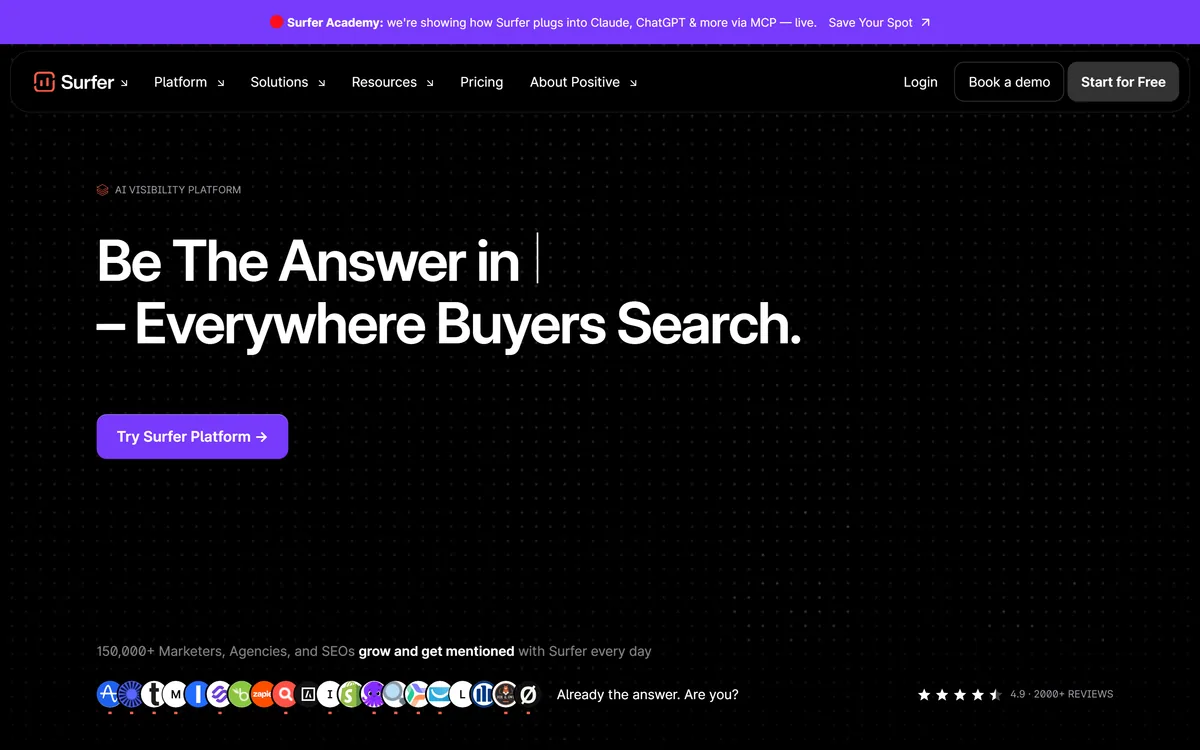
The product has widened considerably. Surfer now describes itself as an AI visibility platform, tracking whether your brand appears in ChatGPT, Claude, Gemini, Perplexity, and Google AI Overviews as well as in ordinary search results.
That shift is the most important thing to understand about it, because it reflects a real change in how people find things. This review covers the classic optimisation tools, the newer AI visibility layer, and where the whole approach has limits.
Surfer SEO Platform Details
| Maker | Surfer Sp. z o.o., Wrocław, Poland, part of Positive |
|---|---|
| Category | Content optimisation and AI search visibility platform |
| Core tools | Content Editor, Content Score, Content Audit, SERP Analyzer |
| Planning | Topical Map and keyword research |
| AI visibility | AI Tracker, monitoring mentions across AI search tools |
| AI tools tracked | ChatGPT, Claude, Gemini, Perplexity, and Google AI Overviews |
| Generation | Surfer AI for article generation, plus the Surfy Agent workflow |
| Integrations | Google Docs, WordPress, Keyword Surfer Chrome extension, Surfer MCP |
| Enterprise | API access, ISO 27001 certification, European data sovereignty option |
| Free trial | Yes |
How The Content Editor Actually Works
Surfer's SERP Analyzer examines the top results for your target query and derives what those pages have in common — terms used, how often, headings, and typical length.
The Content Editor turns that into live guidance while you write, with a Content Score that moves as you cover the ground competitors already cover.
The honest framing is that this measures conformity, not quality. A high score means your page resembles what already ranks, which is useful information and not the same thing as being the best answer.
The AI Tracker And Why It Exists
Search behaviour has genuinely changed. A growing share of questions are answered inside ChatGPT, Claude, Perplexity, or Google's AI Overviews, and the user never reaches a website at all.
Surfer's AI Tracker monitors whether your brand and content appear in those answers. That is a different measurement from rank tracking — you are not asking where you sit on a results page but whether you were cited at all.
This is the most forward-looking part of the product. Being invisible to AI answers is a strategic problem that a rank tracker will never show you, because your ranking can be fine while your traffic falls.
Planning With Topical Maps
Topical Map handles the layer above individual pages: which cluster of related topics you need to cover to be treated as authoritative on a subject rather than as a site with one good article.
This matters more under AI answers than it did under traditional search. Models citing sources tend to favour material that demonstrates depth across a topic, not a single optimised page.
Used properly it turns content planning from a keyword list into a structure, which is where most content programmes fall apart.
Surfer AI, Surfy Agent, And MCP
Surfer AI generates full articles that already conform to the optimisation guidance, and the Surfy Agent automates more of the workflow around producing them.
Surfer MCP exposes the platform to AI assistants, so a model can pull Surfer's data into its own work rather than you moving it by hand.
Generated articles are best treated as structured drafts. They cover the required ground reliably, which is the tedious part, but they arrive without the specifics, opinions, and first-hand detail that make a page worth citing.
Where It Fits In A Workflow
Surfer works alongside the tools writers already use rather than replacing them.
That integration is deliberate. Optimisation guidance that lives in a separate tab gets ignored; guidance inside the document does not.
- Google Docs, for writing with live guidance in place
- WordPress, for publishing without a copy-paste round trip
- Keyword Surfer, a Chrome extension showing data on the results page
- Surfer MCP, for pulling Surfer data into an AI assistant
- An API on the enterprise plan for custom pipelines
The Optimisation Trap
The biggest risk with Surfer is treating the Content Score as the goal. Writers chasing a number produce pages stuffed with required terms that read badly and say nothing new.
Because the guidance is derived from pages that already rank, following it perfectly makes your page maximally similar to existing ones. That is a reasonable floor and a terrible ceiling.
This tension is sharper now that AI answers cite sources. A model summarising a topic has little reason to cite the fifth page saying the same thing as the first four — differentiation, not conformity, is what gets picked up.
The practical discipline is to hit a respectable score and then spend the remaining effort on what only you can say.
Other Limits Worth Knowing
Recommendations can be mechanical, particularly on term frequency. Surfer will ask for phrases that no competent writer would use naturally, and ignoring some of them is usually correct.
Coverage and data quality vary by language and by niche. English and mainstream commercial topics are well served; specialist or non-English markets much less so.
AI visibility tracking is inherently noisy, because AI answers vary between sessions and users. Treat trends as meaningful and individual results as anecdotes.
And Surfer optimises content — it does not fix technical SEO, site speed, or backlinks, which are frequently the actual reason a page underperforms.
Using Surfer Sensibly
Aim for a good score rather than a perfect one, then stop. The last stretch of Content Score is bought with awkward phrasing almost every time.
Set up AI visibility tracking for your core commercial topics early. If citations in AI answers are going to affect your traffic, you want the baseline now rather than after the decline.
Use Topical Map to plan and Surfer AI to draft, but budget real editorial time for specifics — data, examples, and opinions the model cannot generate.
For a team, ISO 27001 certification, the European data sovereignty option, and API access on the enterprise plan are the details worth checking before rollout.
The Verdict On Surfer
Surfer SEO is a strong content optimisation platform that has adapted more thoughtfully than most to AI-driven search, and the AI Tracker addresses a measurement gap that most SEO tools have not acknowledged yet.
Choose it if you publish content regularly, need consistency across multiple writers, and want visibility into whether AI answers cite you. Look elsewhere if your problem is technical SEO or links, or if you publish rarely enough that a subscription cannot pay for itself.
There is a free trial, which is the right way to judge whether the guidance suits your subject matter. Check surferseo.com for current plans.
Key features of Surfer SEO
Content Editor with a live Content Score while you write
SERP Analyzer deriving guidance from currently ranking pages
AI Tracker monitoring mentions in ChatGPT, Claude, Gemini, Perplexity, and AI Overviews
Topical Map for planning topic clusters rather than single pages
Content Audit for improving pages already published
Surfer AI article generation and the Surfy Agent workflow
Google Docs and WordPress integrations, Keyword Surfer extension, and Surfer MCP
Pros & cons
Pros
5- AI visibility tracking addresses a gap most SEO tools ignore entirely
- Live in-document guidance keeps multiple writers consistent
- Topical Map turns keyword lists into an actual content structure
- Works inside Google Docs and WordPress rather than in a separate tab
- ISO 27001 certification and a European data sovereignty option for teams
Cons
5- Content Score rewards conformity, which is a poor goal under AI citation
- Term recommendations can be mechanical and are sometimes better ignored
- Data quality drops noticeably outside English and mainstream niches
- AI visibility results are noisy — only trends are meaningful
- Does nothing for technical SEO, site speed, or backlinks
Best For
- Content teams publishing regularly with several writers
- Agencies standardising optimisation across many client sites
- Brands that need to know whether AI answers cite them
- In-house SEO teams planning topic clusters rather than one-off posts
- Editors who need consistent guidance without briefing every writer individually
Editor's Verdict
4.4/5Surfer SEO has an AInexfinder Editor Score of 4.4/5.
Surfer SEO pricing
AInexfinder does not list plan prices or billing details. For current pricing, plans, and trials, visit the official Surfer SEO website.
Visit official website for pricingVendor pricing, credits, and billing policies change over time. Always confirm on the official site before you buy.
Frequently asked questions
What does Surfer's Content Score actually measure?
How closely your page resembles the pages already ranking for that query — terms used, structure, headings, and length. It measures conformity rather than quality, which is useful as a floor but a poor target in itself.
What is the Surfer AI Tracker?
A tool that monitors whether your brand and content appear in AI answers from ChatGPT, Claude, Gemini, Perplexity, and Google AI Overviews. That is a different question from where you rank, and one traditional rank tracking cannot answer.
Can I rely on Surfer AI to write articles for me?
Treat the output as a structured draft. It covers the required ground reliably, which is the tedious part, but arrives without the specifics, data, and opinions that make a page worth citing — especially by AI answers.
Should I always aim for a perfect Content Score?
No. The last stretch of score is almost always bought with awkward phrasing, and perfect conformity makes your page maximally similar to what already exists. Reach a good score, then spend the remaining effort on what only you can say.
Does Surfer help with technical SEO or backlinks?
No. Surfer optimises content. Technical SEO, site speed, and link acquisition are outside its scope, and they are frequently the actual reason a page underperforms.
Does Surfer work for non-English content?
It supports other languages, but data quality and coverage are noticeably stronger for English and mainstream commercial topics. Test it on your own subject matter during the trial before committing.
Is there a free trial of Surfer SEO?
Yes, along with some free tools. The trial is the right way to judge whether the guidance suits your niche and language. Check surferseo.com for current plans and what the enterprise tier adds.
Reviews
Log in to write a review.
User Reviews
No reviews yet. Be the first to share your experience with Surfer SEO.
Reviewed by Daniel Reed
Assigned reviewer
Daniel ReedSenior AI Tools Reviewer
Daniel reviews AI tools the slow way — by actually using them on real projects. His reviews cover what works, what breaks, and who each tool is genuinely a good fit for.
Hands-on reviewsProduct testingAI software
Daniel and the AInexfinder editorial team research Surfer SEO using public product information, listing evidence, and (when available) hands-on checks. Scores reflect listing completeness and transparency — not paid placement.
- Last verified
- Methodology
- How we review AI tools
- Sources used
- surferseo.com
- AInexfinder listing fields (features, pros/cons, description)
- Public vendor pages when available
- Editorial policy
- Listings may include affiliate or sponsored placements, which are labeled when present. Editorial scores and cons are not sold. See our affiliate disclosure and review methodology.
Related tools
GrowthPro AI is a local-SEO and AI-visibility (GEO) platform that audits whether AI engines recommend a business, then runs AI agents to improve Google Maps and AI-search presence, respond to reviews and convert leads, aimed at local and multi-location businesses.
MarketMuse is a content planning platform from MarketMuse, Inc. built on patented topic modelling rather than keyword correlation. It scores Personalized Difficulty against your own site's authority, generates content briefs, analyses inventory and maps clusters.
Clearscope is a content optimisation platform from Mushi Labs, combining search intent analysis and query discovery with Prompt Tracking that monitors brand visibility across ChatGPT, Gemini, and Claude.

Listomize is an Etsy SEO platform that generates titles, tags, and descriptions within Etsy's own limits, scores listings, optimises 100+ listings from a CSV, tracks competitors and trends, and auto-generates Pinterest pins.
FreemiumBusiness & Marketing

Lahjty (لهجتي) is an Arabic-first marketing platform for MENA campaigns. From one brief it produces dialect-aware ad copy, headlines, campaign images with Arabic text rendered in, dialect-aware voice, and SEO articles grounded in your own brand sources — with a Partner API and an MCP server for teams that want it inside their own workflow.
FreemiumBusiness & Marketing
Compare:Surfer SEO vs SE RankingSurfer SEO vs GrowthPro AISurfer SEO vs MarketMuseSurfer SEO vs Clearscope
Surfer SEO alternatives Explore More
Embed this listing on your site
Featured on AInexfinder