
SE Ranking is an SEO platform built around cross-channel visibility, adding trackers for AI Overviews, AI Mode and assistant answers alongside conventional rank tracking, backed by 188 country databases and exposed through an API and an MCP server for use inside AI assistants.
MarketMuse
Verified
MarketMuse is a content planning platform from MarketMuse, Inc. built on patented topic modelling rather than keyword correlation. It scores Personalized Difficulty against your own site's authority, generates content briefs, analyses inventory and maps clusters.
4.1Editor Score
marketmuse.com7 viewsAdded May 22, 202568K visitors
Most content planning is a list of keywords sorted by volume, filtered by a difficulty score, handed to a writer.
That process has a flaw large enough to invalidate it: the difficulty score describes an average website, and you are not one. A term that is hard for a generic site can be easy for a site that has published forty good articles on the surrounding subject, and impossible for one that has published none.
MarketMuse's Personalized Difficulty exists precisely for that gap, and it is the reason to look at the platform rather than at a cheaper keyword tool.
What Does Personalized Difficulty Actually Measure?
The standard difficulty metric in every keyword tool is a property of the search result, not of you. It looks at who currently ranks, how strong those domains are, and produces a number describing how hard the term is in general.
That number is useful for comparing terms against each other and useless for deciding whether you should write the article, because it contains no information about your site.
Personalized Difficulty adds the missing half. It asks how hard this topic is for this domain, given what this domain has already published and the topical authority that gives it. The same keyword scores differently for two different sites, which is correct.
The practical consequence is that it changes which articles get written. A team using generic difficulty avoids anything scored above a threshold, which systematically steers them away from the topics where their existing authority is their advantage — the exact topics they should be writing.
It also identifies the opposite error. An easy-looking topic in a subject area where the site has no authority at all is easy for someone else, and writing it produces a page nobody links to, nobody cites, and nobody reads.
This is where it diverges most from a page-level tool. Surfer SEO answers how to make a given article competitive; the question here is whether that article should exist at all.
A standard difficulty score describes an average site. You are not an average site, and the same keyword is a different problem for two different domains.
Topic Authority Beats Keyword Volume
MarketMuse states that it uses proprietary data and patented topic modelling rather than commodity keyword data or TF-IDF correlation analysis, and the distinction is worth understanding.
TF-IDF correlation is the older approach: look at pages that rank, count which terms appear more often than expected, and tell the writer to include them. It produces recommendations like use this phrase four more times, which is why so much SEO content reads as though it was written to satisfy a checklist.
Topic modelling asks a different question — what concepts does thorough coverage of this subject involve — and that maps far better onto how search engines have actually evolved. Coverage is about which ideas are addressed, not which strings appear.
It also aligns with writing well, which correlation-based advice frequently does not. A recommendation to explain a related concept improves the article; a recommendation to repeat a phrase degrades it.
The claim is not independently verifiable from outside, and topic modelling is not a magic term. But the direction is right, and it explains why briefs from a platform like this read as an outline rather than as a keyword quota.
Content Briefs Are Where The Time Goes
MarketMuse's Content Brief Generator is the operational centre of the product, and briefs are underrated as a bottleneck.
The bottleneck in content operations is rarely writing. It is the twenty minutes to an hour before writing, when someone has to work out what the article should cover, what the competitors already say, which questions to answer, and what makes this piece worth publishing.
Done properly, that research is most of the quality. Done badly, the writer starts from a headline and produces something generic, which is the origin of most content that never ranks.
A generated brief with the subtopics, questions and competitive gaps identified turns the writer's job into writing, which is what they are good at. That is a real reallocation of effort rather than a shortcut.
The caveat is that a brief is a floor, not a ceiling. An article that covers exactly what the brief specifies covers exactly what competitors already cover, and matching the field is not a reason for anyone to link to you. The brief handles the table stakes; the writer still has to add something.
Term-coverage graders such as Clearscope and research tools like Frase occupy the same brief-shaped gap, and cost considerably less if planning is not your problem.
- Use Personalized Difficulty to find topics where your existing authority is the advantage.
- Treat a brief as the floor of coverage rather than the specification.
- Audit inventory before planning, since removal often beats addition.
- Consolidate competing pages on the same topic rather than adding a third.
- Judge the platform on decisions changed, not on articles produced.
Inventory Analysis And The Content Nobody Reads
Content Inventory analysis and Quality Analysis are the least exciting parts of MarketMuse and frequently the most valuable, because most established sites have a subtraction problem rather than an addition problem.
The pattern is universal. A site publishes for five years, accumulates several hundred pages, and a substantial fraction of them attract no traffic, no links and no citations. They are not neutral — they dilute topical focus, compete with each other for the same terms, and consume crawl attention.
Knowing which pages those are is genuinely hard by inspection, because the ones that feel important are not reliably the ones that perform. An inventory analysis that scores every page against topical coverage and performance makes the decision evidential rather than sentimental.
The three actions that follow are consolidate, improve or remove. Consolidation is the most commonly correct and the least commonly done: three thin articles on overlapping subjects almost always lose to one thorough one, and merging them is faster than writing something new.
This is also where the platform pays for itself soonest. Improving what exists produces results in weeks, where a new article takes months to mature — and the analysis costs a fraction of the writing.
If the plan then has to be executed inside WordPress, a plugin such as GetGenie puts the drafting where the publishing already happens.
Using MarketMuse Without Writing More
The failure mode with a content strategy platform is treating its output as a production quota.
A plan recommending forty articles to a team that can write four a month is not a plan; it is a source of guilt.
- Run the inventory analysis first, before planning a single new article.
- Identify the pages to consolidate or remove, and do that work before adding anything.
- Take your five best-performing pages and check what topical coverage they are missing, since improving them is cheaper than starting over.
- Only then use Personalized Difficulty to shortlist new topics, filtered by what your team can genuinely produce this quarter.
- Generate briefs for that shortlist and have a writer add something the brief does not contain.
- Measure the change in traffic to improved pages separately from new ones, since they mature on very different timescales.
MarketMuse: Product And Company
| Operating company | MarketMuse, Inc. |
|---|---|
| Product type | AI content planning and optimisation platform |
| Core method | Proprietary data with patented topic modelling, stated as distinct from TF-IDF correlation |
| Personalized Difficulty | Topic difficulty scored against your own site's authority |
| Content Planning | Plans built from topic coverage and authority |
| Content Brief Generator | Structured briefs for writers |
| Optimize | On-page optimisation with a generative component |
| Content Clusters | Topic cluster mapping |
| Content Inventory | Analysis of existing pages |
| Quality Analysis | Scoring of page quality against topical coverage |
| Link Recommendations | Internal linking suggestions |
| Footer sections | Product, Company, Connect, with G2 recognition badges |
Five Points On MarketMuse
- Personalized Difficulty scores a topic against your site's authority rather than against an average site's — the feature that distinguishes it.
- Topic modelling, not TF-IDF correlation: the site is explicit that it uses proprietary data and patented topic modelling rather than commodity keyword data.
- Content Inventory analysis tells you what to consolidate or remove, which usually matters more than what to add.
- Content briefs are the operational output — the artefact a writer actually works from.
- Operated by MarketMuse, Inc., with Content Planning, Briefs, Optimize, Clusters, Quality Analysis and Link Recommendations as named products.
Key features of MarketMuse
Personalized Difficulty scoring topics against your own site's authority
Topic modelling rather than TF-IDF term correlation
Content Planning driven by coverage gaps and authority
Content Brief Generator producing structured outlines for writers
Optimize for on-page work, with a generative component
Content Clusters for mapping topic groups
Content Inventory and Quality Analysis of existing pages
Internal link recommendations
Pros & cons
Pros
6- Personalized Difficulty answers the question generic difficulty scores cannot
- Topic modelling produces briefs that read as outlines rather than keyword quotas
- Inventory analysis makes consolidation decisions evidential rather than sentimental
- Improving existing pages pays back faster than publishing new ones
- Briefs reallocate research effort so writers can write
- A named operating company with complete legal pages
Cons
6- Almost nothing to work with on a new site with no topical authority yet
- Assumes an editorial operation able to act on strategy, which many buyers lack
- No CMS or analytics integrations were listed on the pages we read
- Pricing and seat structure are not published
- The patented topic modelling claim is not verifiable from outside
- A brief covering the field produces content that matches the field, not content that beats it
Best For
- Established sites with several years of published content
- Teams that need evidence before deleting or consolidating pages
- Editorial operations where briefing is the bottleneck
- Content leads arguing for strategy over volume
- Publishers whose existing authority should be shaping the plan
MarketMuse Beside Other SEO Content Tools
These tools all advise on content. They differ on whether the advice is about the page, the plan, or the site.
| Tool | Unit of analysis | Signature output | Best for |
|---|---|---|---|
| MarketMuse | The site's topical authority | Personalized Difficulty and content briefs | Deciding what to write, consolidate or remove |
| Surfer SEO | The individual page against the SERP | On-page optimisation score | Making a specific article competitive |
| Clearscope | Term coverage on a page | Content grades for writers | Editorial teams with a defined process |
| Frase | SERP research and briefs | Briefs and answer research | Fast research at lower cost |
| GetGenie | The WordPress editor | Research and drafting in place | Publishers who want it all in one tab |
Which Teams Should Buy MarketMuse?
Worth the seat when
- You have an established site whose existing authority should be steering what you write.
- You suspect a large fraction of your pages attract nothing and want evidence.
- Briefing is your bottleneck and writers are waiting on research.
- You need to argue for consolidation and require data rather than opinion.
- You publish enough that planning badly is expensive.
Overkill when
- Your site is new, where topical authority scoring has almost nothing to work with.
- You publish occasionally, and the seat cost exceeds the value of better planning.
- Your bottleneck is writing capacity rather than knowing what to write.
- You want on-page optimisation for one article, which cheaper tools do directly.
- Nobody will act on a recommendation to delete pages, which is where most of the value sits.
Other Content Strategy Tools
Content tools work at different altitudes — the site, the plan, or the page in front of you.
- Surfer SEO — page-level optimisation against the current SERP
- Clearscope — term coverage grading for editorial teams
- Frase — faster, cheaper research and briefs
- GetGenie — when the research should live in the WordPress editor
- ContentMonk — for producing the long-form content a plan calls for
MarketMuse: Reading The Product Pages
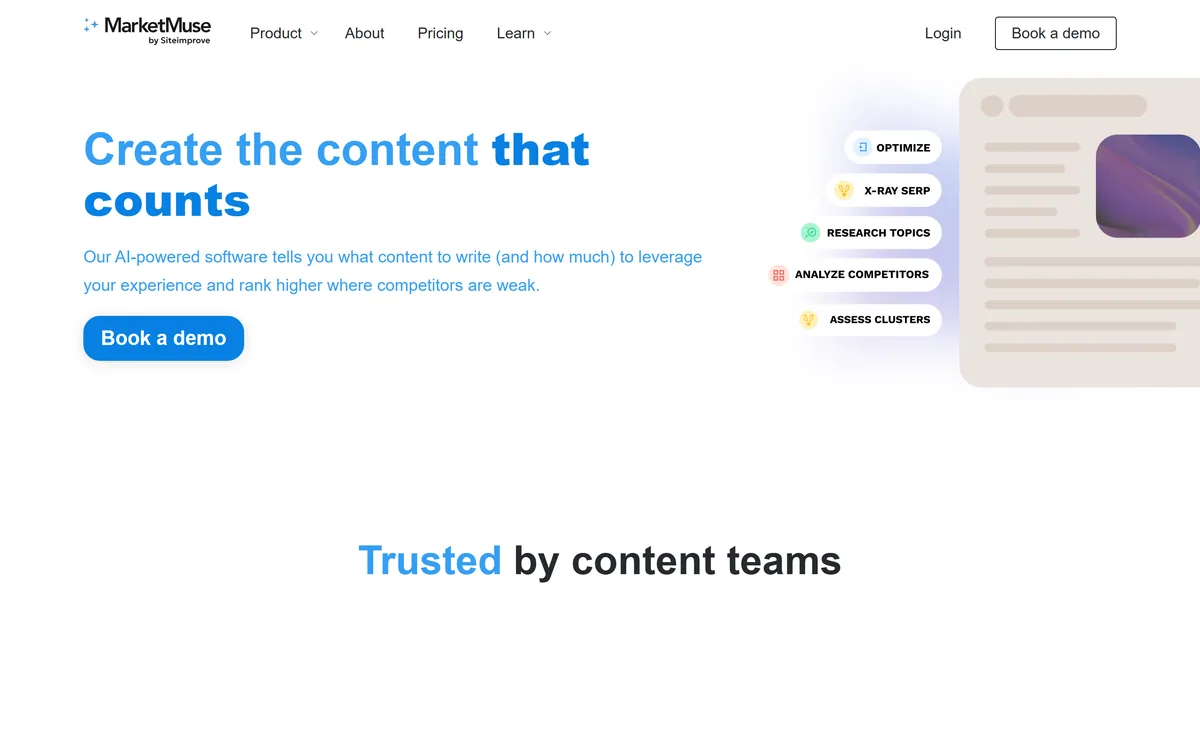
Last checked . Read from marketmuse.com and its footer navigation, with the screenshot above captured in the same session.
- Operating company confirmed as MarketMuse, Inc.
- Positioned as an AI content platform for deciding what content to create and how much depth is needed
- Personalized Difficulty confirmed as a named scoring feature
- Topic Authority identification confirmed as a stated capability
- Content Planning confirmed as a named product
- Content Brief Generator confirmed as a named product
- Optimize confirmed, with a generative component
- Competitive Content Analysis confirmed
- Content Clusters confirmed
- Content Inventory analysis confirmed
- Quality Analysis confirmed
- Link Recommendations confirmed
- Method stated on the site as proprietary data and patented topic modelling rather than commodity keyword data or TF-IDF correlation analysis
- Footer sections confirmed for Product, Company and Connect, including Privacy Policy and Terms of Service, with G2 badges
- No acquisition or change of ownership is mentioned on the pages we read
What we could not confirm: how Personalized Difficulty is calculated, or what data feeds topical authority; which patent is referenced and what it covers; pricing and seat structure; integrations with CMS or analytics platforms, none of which were listed on the pages we read; language and market coverage; how frequently the underlying data refreshes; and any independent evaluation of whether the platform's recommendations improve rankings. We did not use the product, so nothing here reflects tested output.
Editor's Verdict
4.1/5MarketMuse's best idea is Personalized Difficulty, and it addresses a genuine flaw in how content teams plan. Standard keyword difficulty scores tell you how hard a term is for an average site, which is a number about nobody. Scoring it against your own site's topical authority answers the question you actually have: can we rank for this. Content Inventory is the second real strength, because deciding what to delete or consolidate usually beats deciding what to add. It sits below the top because the platform assumes an editorial operation capable of acting on strategy, and most teams that buy it are short of writers rather than short of plans. AInexfinder Editor Score: 4.1/5.
MarketMuse pricing
AInexfinder does not list plan prices or billing details. For current pricing, plans, and trials, visit the official MarketMuse website.
Visit official website for pricingVendor pricing, credits, and billing policies change over time. Always confirm on the official site before you buy.
Frequently asked questions
What is MarketMuse?
MarketMuse is a content planning platform from MarketMuse, Inc. built on proprietary data and patented topic modelling rather than commodity keyword data. Its named products include Content Planning, the Content Brief Generator, Optimize, Content Clusters, Content Inventory, Quality Analysis and Link Recommendations.
What makes Personalized Difficulty different?
Standard keyword difficulty describes how hard a term is for an average website, which is a number about nobody. Personalized Difficulty asks how hard the topic is for your domain, given what you have already published. The same keyword scores differently for two sites — which is correct, and which changes what you should write.
How is topic modelling different from TF-IDF?
TF-IDF correlation counts which terms appear more often on ranking pages and tells the writer to include them, which is why so much SEO content reads like a checklist. Topic modelling asks which concepts thorough coverage involves. That maps better onto how search engines evolved, and it happens to align with writing well rather than against it.
Is MarketMuse useful for a new website?
Much less so. Its central idea is scoring topics against your existing topical authority, and a new site has almost none for the platform to reason about. The features that make it distinctive — Personalized Difficulty, inventory analysis, consolidation decisions — all assume a body of published work to analyse.
What does Content Inventory analysis actually tell me?
Which pages to consolidate, improve or remove. Most established sites have a subtraction problem: a substantial fraction of pages attract no traffic and no links, dilute topical focus and compete with each other. Deciding which by inspection is hard, because the pages that feel important are not reliably the ones that perform.
Should I really delete content?
Consolidate more often than delete. Three thin articles on overlapping subjects almost always lose to one thorough one, and merging them is faster than writing something new. It is also where the platform pays back soonest — improved pages move in weeks, where a new article takes months to mature.
Are the content briefs enough on their own?
No, and this is the most important limitation to understand. A brief specifies the coverage competitors already have, so an article matching it exactly matches the field. Matching the field is not a reason for anyone to link to you or cite you. The brief handles table stakes; the writer still has to add something.
How does MarketMuse compare to Surfer SEO?
Different altitude. Surfer works on a specific page against the current search result and is stronger for making one article competitive. MarketMuse works on your site's topical authority and is stronger for deciding what to write at all. If your bottleneck is optimising drafts, Surfer; if it is choosing topics, MarketMuse.
Does MarketMuse integrate with my CMS?
No integrations were listed on the pages we read, which is worth confirming with the vendor if your workflow depends on it. A platform that produces briefs and recommendations but requires manual transfer into your publishing system adds a step, and that step is where strategy tends to get quietly ignored.
How should a team start with it?
With the inventory analysis, before planning a single new article. Consolidate or remove what is not working, then check what topical coverage your five best pages are missing, since improving them is cheaper than starting over. Only then use Personalized Difficulty to shortlist new topics, filtered by what you can actually produce.
Reviews
Log in to write a review.
User Reviews
No reviews yet. Be the first to share your experience with MarketMuse.
Reviewed by Daniel Reed
Assigned reviewer
Daniel ReedSenior AI Tools Reviewer
Daniel reviews AI tools the slow way — by actually using them on real projects. His reviews cover what works, what breaks, and who each tool is genuinely a good fit for.
Hands-on reviewsProduct testingAI software
Daniel and the AInexfinder editorial team research MarketMuse using public product information, listing evidence, and (when available) hands-on checks. Scores reflect listing completeness and transparency — not paid placement.
- Last verified
- Methodology
- How we review AI tools
- Sources used
- marketmuse.com
- AInexfinder listing fields (features, pros/cons, description)
- Public vendor pages when available
- Editorial policy
- Listings may include affiliate or sponsored placements, which are labeled when present. Editorial scores and cons are not sold. See our affiliate disclosure and review methodology.
Related tools
GrowthPro AI is a local-SEO and AI-visibility (GEO) platform that audits whether AI engines recommend a business, then runs AI agents to improve Google Maps and AI-search presence, respond to reviews and convert leads, aimed at local and multi-location businesses.
Clearscope is a content optimisation platform from Mushi Labs, combining search intent analysis and query discovery with Prompt Tracking that monitors brand visibility across ChatGPT, Gemini, and Claude.

Surfer SEO analyses top-ranking results to guide content optimisation through its Content Editor and Content Score, and has expanded into AI visibility — tracking brand mentions in ChatGPT, Claude, Gemini, Perplexity, and Google AI Overviews.

Listomize is an Etsy SEO platform that generates titles, tags, and descriptions within Etsy's own limits, scores listings, optimises 100+ listings from a CSV, tracks competitors and trends, and auto-generates Pinterest pins.
FreemiumBusiness & Marketing

Lahjty (لهجتي) is an Arabic-first marketing platform for MENA campaigns. From one brief it produces dialect-aware ad copy, headlines, campaign images with Arabic text rendered in, dialect-aware voice, and SEO articles grounded in your own brand sources — with a Partner API and an MCP server for teams that want it inside their own workflow.
FreemiumBusiness & Marketing
Compare:MarketMuse vs SE RankingMarketMuse vs GrowthPro AIMarketMuse vs ClearscopeMarketMuse vs Surfer SEO
MarketMuse alternatives Explore More
Embed this listing on your site
Featured on AInexfinder