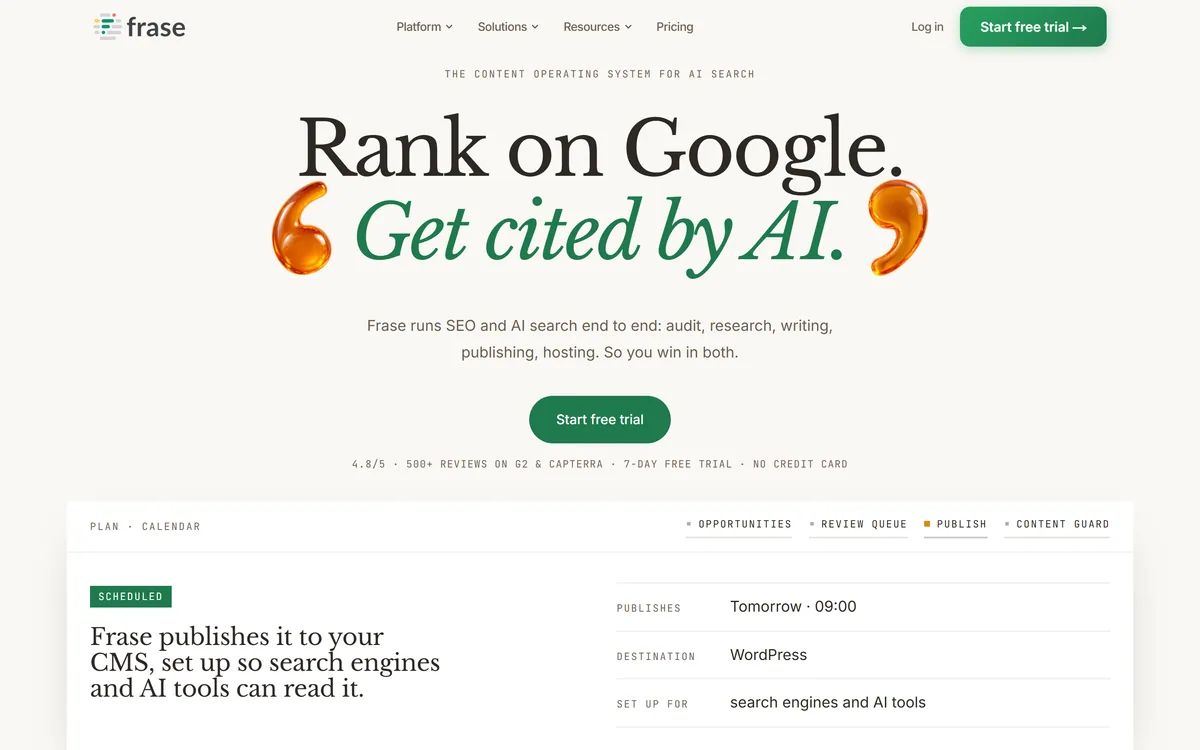
Frase runs SEO and AI search end to end: auditing a site page by page, researching and briefing, drafting in a defined brand voice, optimising for both rankings and AI citation, publishing to WordPress, Webflow, Sanity and Wix or its own CMS, then monitoring for ranking decay and AI mentions.
For twenty years there was one question in content marketing: does this page rank. That question now has a sibling, and the two do not always have the same answer.
People search Google and they ask assistants. Google ranks pages; assistants name sources. A site engineered for the first can be entirely absent from the second, and you usually find out from a customer weeks later.
Frase's framing is that both are one job and should run through one system — which is either the correct read of where search is going or a considerable bet on it.
Frase's homepage, captured 9 September 2026.
Frase: Ranking On Google And Cited By AI
Both search behaviours in one loop — audit, research, write, optimise, publish, monitor.
An autonomy dial: publish autonomously, keep every page under review, or anywhere between.
AI visibility monitoring tracking which of your pages assistants actually cite.
Runs from Claude, Cursor and any MCP tool, alongside a CLI and API.
70-plus languages written natively rather than translated, with publishing to WordPress, Webflow, Sanity and Wix.
What Is GEO And How Does It Differ From SEO?
Frase splits its optimisation into two: content optimisation that scores and lifts pages for Google, and GEO optimisation that tunes content to get cited by AI.
The distinction is real, and it comes down to what each system is doing with your page.
A search engine ranks documents. It decides which page best answers a query and sends the person there, so the work is winning a position and earning a click.
An assistant extracts an answer. It reads several sources, synthesises, and names some of them — so the work is being the source whose material is clearest to lift, and whose claim is specific enough to quote.
That changes what good looks like in a way most content teams have not internalised. Long preambles, keyword-padded introductions and answers buried nine paragraphs down survive in a ranking system and disappear in an extraction one. Frase's own audit output names exactly that failure — an answer buried in paragraph nine — which is a sharper diagnosis than a keyword report.
A search engine ranks documents and sends a click. An assistant extracts an answer and names a source. Those reward different pages.
Why AI Visibility Is Hard To Measure
Frase offers AI visibility monitoring, tracking which of your pages AI tools mention, plus free GEO score and AI visibility checkers.
Measuring this is genuinely difficult, and understanding why keeps the numbers in proportion.
Rankings are stable and public. The same query returns roughly the same results for everyone, so a position can be checked and tracked. AI answers are none of those things — they vary by phrasing, by user, by session, by model version, and often between two identical requests.
So AI visibility is a sampling exercise rather than a measurement. Someone asks a set of questions repeatedly across several assistants and counts how often you appear, which produces a directional signal rather than a position.
That is still worth having. Going from never mentioned to sometimes mentioned is a real change, and the trend is meaningful even when the absolute number is soft. Just do not treat it as a rank, and ask any vendor which assistants they sample, how often, and with what queries.
The Autonomy Dial And Publishing On Its Own
Frase describes an autonomy setting explicitly: let it publish on its own, keep every page under review, or anywhere in between — you set the dial.
That framing is a better piece of product thinking than the automation itself.
Content automation triggers an entirely reasonable fear. A tool that publishes to your live site without review can put something wrong, off-brand or embarrassing in front of customers, and the damage is public before anyone notices.
Most vendors respond by underselling the automation. Frase instead makes the level an explicit, adjustable decision, which lets a team start at full review, watch what the system would have published, and move the dial as trust accumulates.
That is the right adoption path, and it is worth using deliberately. Start at review, keep it there for a month of real output, and only then decide — because the question is not whether the tool can publish autonomously but whether you would have approved what it produced. Whether any of it converts is a different measurement again, and Cometly's job rather than a content platform's.
Start at full review and keep it there for a month.
Ask which assistants a visibility number samples, and how often.
Run the free checkers on your own site before buying anything.
Fix buried answers before writing anything new.
Treat AI visibility as a trend, never as a ranking position.
Audit, Fix Pack And Content Guard
The entry point is an audit that scores every page for search and for AI answers, orders the most valuable fixes first, and packages them — its example shows a readiness score, three prioritised problems and a fix pack of forty-four items.
Leading with an audit rather than a subscription is smart positioning, because it inverts the usual sale.
Most content tools ask you to commit and then discover value. An audit shows you what is currently costing you before you change anything, which is a far easier internal conversation than a licence request.
The three example problems are also well chosen, because each names a distinct failure: a guide AI never cites, a page whose ranking slipped from three to seven, and an answer buried in paragraph nine. Those are different diseases with different treatments.
Content Guard is the other half — catching ranking decay and shipping the fix. Decay is the most under-managed problem in content marketing precisely because nothing announces it; a page just quietly stops working, and without monitoring nobody looks until a quarterly report. Product pages decay the same way, at a scale only a bulk tool like Describely can address.
Running Frase From Claude Or Cursor
Alongside the interface, Frase offers an MCP server, a CLI and an API, described as running it from Claude, Cursor and any MCP tool.
For a marketing product that is an unusual thing to build, and it says something about where the company thinks the work is going.
The conventional assumption is that a marketer opens a content platform and uses it. An MCP server assumes something else: that the person is already working inside an assistant, and the platform should be reachable from there rather than requiring a context switch.
For technical content teams that is genuinely useful — briefs, audits and optimisation checks become things you ask for in the middle of writing rather than tasks you leave to do.
It also hedges the platform's own risk. If the interface people work in keeps moving, being available through a standard protocol matters more than owning the destination — the same reasoning that puts Komo and other search products in front of agents rather than only in front of people.
Running A Content Programme For Both Searches
The temptation with a platform this broad is to start producing. That is backwards — the fastest returns are almost always in pages you already have.
This sequence starts where the value is highest and moves the automation dial slowly.
Run the audit before writing a single new page.
Fix buried answers on pages that already rank — that is the cheapest GEO win.
Define brand voice properly before letting anything draft.
Keep autonomy at full review for a month and read what it would have shipped.
Watch AI visibility as a trend across several assistants, not one.
Let Content Guard find decay rather than auditing manually each quarter.
Frase: Modules And Languages
Positioning
A content operating system for AI search — rank on Google, get cited by AI
Listening
Frase Answers, capturing the questions visitors actually ask
Research
SEO research ending in a brief, plus topic cluster mapping
Writing
An AI agent drafting with brand context, and a brand voice module
Optimising
Content optimisation for Google, GEO optimisation for AI citation, AI visibility monitoring and a site audit
Publishing
FraseCMS, plus integrations with WordPress, Webflow, Sanity and Wix
Monitoring
Content Guard for ranking decay, and backlink gap analysis with outreach drafting
Autonomy
An adjustable dial from full review to autonomous publishing
Developer access
MCP server, CLI and API, usable from Claude and Cursor
Languages
70-plus, written natively rather than translated
Free tools
GEO score checker, AI visibility checker and agent readiness checker
Displayed rating
4.8 out of 5 from 500-plus reviews on G2 and Capterra, with a seven-day trial and no card
Key features of Frase
Site audit scoring pages for search and AI answers
Prioritised fix packs from the audit
SEO research ending in a content brief
Topic cluster mapping
AI drafting with a defined brand voice
GEO optimisation and AI visibility monitoring
Publishing to WordPress, Webflow, Sanity, Wix or FraseCMS
Content Guard for ranking decay and backlink gap outreach
Pros & cons
Pros
7
Treats Google ranking and AI citation as one job, which is where search has gone
The autonomy dial is the right way to sell automation to nervous teams
Leading with an audit shows value before asking for commitment
Content decay monitoring addresses the most under-managed problem in content
An MCP server meets teams inside the assistants they already work in
Free checkers let you assess your own site before buying
70-plus languages written natively rather than machine-translated
Cons
7
AI visibility is a sampling exercise, not a measurable position
The sampling method behind visibility figures is not published
Readiness score calculation is not explained
Autonomous publishing is a real risk if the dial is set and forgotten
A broad platform competes with specialists at every individual step
Our capture stopped before the footer, so company details went unread
No pricing on the pages we read
Best For
Content teams where organic search is a real acquisition channel
SEO teams adapting to AI answers rather than only rankings
Agencies running content programmes for several clients
Publishers with large back catalogues quietly decaying
Technical marketers who would use an MCP server
Frase Against Other Search Optimisation Suites
Content tools differ by which search behaviour they are built for.
Document360 — making documentation reachable by assistants
Frase: Read From The Platform Pages
Last checked . Read from frase.io in a browser session on the date above, with the screenshot captured at the same time.
Positioned as the content operating system for AI search — rank on Google, get cited by AI
Modules listed across listening, research, writing, optimising, publishing and monitoring
GEO optimisation described as tuning content to get cited by AI, distinct from Google optimisation
AI visibility described as monitoring where AI search cites you
An autonomy setting described as adjustable from autonomous publishing to full review
An MCP server, CLI and API stated, described as running Frase from Claude and Cursor
Multilingual support stated at 70-plus languages written natively rather than translated
Publishing integrations named as WordPress, Webflow, Sanity and Wix, alongside FraseCMS
Content Guard described as catching ranking decay and shipping the fix
A site audit shown producing a readiness score, prioritised issues and a fix pack
Free tools offered including a GEO score checker, AI visibility checker and agent readiness checker
Rating displayed as 4.8 out of 5 from 500-plus reviews on G2 and Capterra, with a seven-day trial and no card required
What we could not confirm: our capture did not reach the site footer, so we read nothing below the sections described and make no claim in either direction about what is published there, including the operating company. We also could not confirm which assistants AI visibility samples, how often or with what queries; how the readiness score is calculated; what autonomous publishing actually checks before shipping; how native multilingual writing differs in practice from translation; and pricing, which sits on a separate page. We did not audit a site or publish a page.
Editor's Verdict
4.2/5
Frase has recognised something most SEO tools have not adjusted for: buyers now find answers in two places that reward different things, and a site built to win one is frequently invisible in the other. Running audit, research, writing, publishing and monitoring as one loop is a defensible structure, and the autonomy dial — from full review to autonomous publishing — is the right way to sell automation to people who are nervous about it. The MCP server suggests a company that expects agents to do the asking. AI visibility measurement remains genuinely hard, and the numbers should be read as directional. AInexfinder Editor Score: 4.2/5.
Frase pricing
AInexfinder does not list plan prices or billing details. For current pricing, plans, and trials, visit the official Frase website.
Vendor pricing, credits, and billing policies change over time. Always confirm on the official site before you buy.
Frequently asked questions
What is Frase?
A content platform covering audit, research, writing, optimisation, publishing and monitoring, built to serve both Google rankings and AI citation. It publishes to WordPress, Webflow, Sanity and Wix or its own CMS.
What is GEO?
Generative engine optimisation — shaping content so AI assistants cite it. A search engine ranks documents and sends a click; an assistant extracts an answer and names a source, and those reward differently structured pages.
What changes for content teams?
Long preambles, padded introductions and answers buried nine paragraphs down survive in a ranking system and disappear in an extraction one. Fixing buried answers on pages that already rank is usually the cheapest available win.
Can AI visibility actually be measured?
Only as a sample. AI answers vary by phrasing, user, session and model version, so visibility is measured by asking a set of questions repeatedly and counting appearances. That is directional and useful — it is not a ranking position.
What should I ask about visibility numbers?
Which assistants are sampled, how often, and with what queries. Those three answers determine whether a visibility figure means anything, and any vendor that will not answer them is selling a number rather than a measurement.
Is autonomous publishing safe?
It is a dial, which is the right design. Start at full review, keep it there for a month of real output, and read what the system would have shipped. Then decide — the question is whether you would have approved it, not whether it can publish.
Why does it have an MCP server?
So briefs, audits and optimisation checks can be asked for from inside Claude or Cursor rather than requiring a context switch to another platform. It also hedges the company's risk if the interface people work in keeps moving.
What is content decay?
A page quietly losing traffic as competitors publish, facts age and intent shifts. Nothing announces it, which is why it is the most under-managed problem in content marketing and why monitoring for it is a product rather than a report.
Should I start by writing new pages?
No — run the audit first. The fastest returns are almost always in pages you already have, particularly ones that rank but bury their answer where an assistant will not find it.
Who is it not for?
Teams publishing a handful of pages a year, and companies where customers do not arrive through content at all. The platform earns its cost when organic search is a real channel someone is accountable for.
Daniel reviews AI tools the slow way — by actually using them on real projects. His reviews cover what works, what breaks, and who each tool is genuinely a good fit for.
Daniel and the AInexfinder editorial team research Frase using public product information, listing evidence, and (when available) hands-on checks. Scores reflect listing completeness and transparency — not paid placement.
Listings may include affiliate or sponsored placements, which are labeled when present. Editorial scores and cons are not sold. See our affiliate disclosure and review methodology.
AIKTP generates SEO-optimised articles of 2,000 to 2,500 words in around thirty seconds using ChatGPT, Gemini and Claude, across eighteen languages. It bundles keyword research, clustering, entity extraction, image tools, auto-publishing to WordPress and Shopify, and bulk Google and Bing indexing.
SEOWriting AI analyses SERP competitors and generates articles optimised for search and AI engines, with one-click and bulk generation across 48 languages, AI images, affiliate content models, Amazon product tools and WordPress auto-posting.
SEO.AI, based in Kongens Lyngby, Denmark, is an SEO agent that creates content, publishes it directly to your CMS, and builds backlinks through an automatic link exchange network. It supports 50+ languages and integrates with WordPress, Webflow, Wix, Squarespace, Shopify and Magento.
Byword is an AI article writer aimed at SEO content produced at scale. It runs a four-stage loop — research keywords, build the article, edit it, optimise it — writes in your brand voice, and publishes to your CMS, with a programmatic mode for generating large sets of pages from structured data.
RivalFlow, built by SpyFu, analyses a page you already have against competitors ranking for the same terms, then returns around 23 specific content gaps with ready-to-paste copy and placement guidance. It connects to Google Search Console to track whether rankings move afterwards.
RankYak automates the full SEO publishing loop: scoring keywords against your site's authority, building a topical map, writing researched articles in 40-plus languages, publishing on a calendar you control, and running daily checks on existing pages using your Search Console data.