

Copy.ai has become an AI-native go-to-market platform: workflows and agents that run prospecting, lead processing, deal coaching, ABM, and CRM enrichment across Salesforce, HubSpot, Gong, Outreach, and 2,000+ integrations.
FreemiumWriting & Content
Describely generates and enriches ecommerce product content in bulk — descriptions, titles and meta descriptions — governed by AI Content Rules. It grades every SKU on how likely it is to surface in ChatGPT, Google and Gemini, and integrates with Shopify, WooCommerce, Akeneo, Wix, Squarespace and CSV.
Almost every online catalogue has the same problem in the same place. The top fifty products have good descriptions written by a person, and the remaining several thousand have whatever the supplier's spreadsheet contained.
That is not negligence, it is arithmetic. Writing eight thousand product descriptions by hand is a year of somebody's life, and no retailer approves that headcount for copy nobody is certain converts.
Describely is built for that specific gap: producing and enriching catalogue content at a scale where hand-writing was never a realistic option.
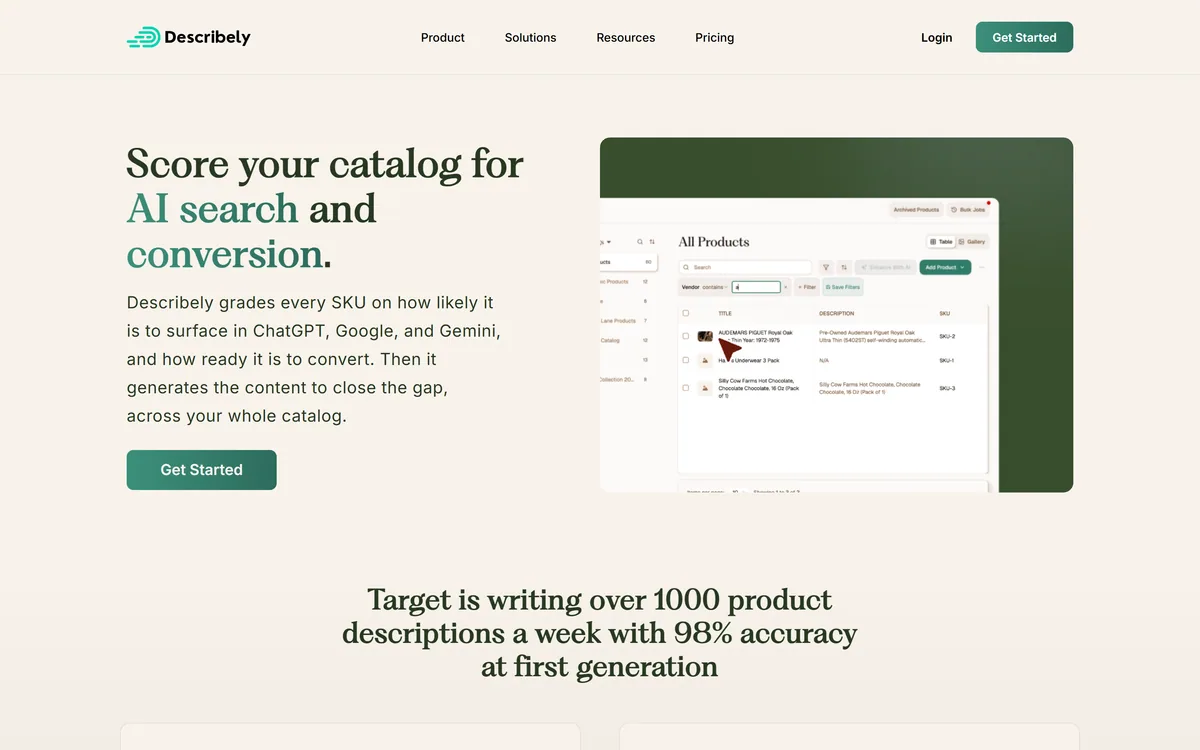
Describely offers bulk content generation for thousands of listings, product data enrichment for sparse details, and generation of descriptions, titles and meta descriptions.
The failure at scale is not quality on any individual product. It is the distribution: a handful of excellent listings, a long tail of supplier-imported fragments, and no consistency between them.
That inconsistency has direct commercial consequences. A shopper comparing two products on the same site gets a paragraph for one and a specification code for the other, which reads as neglect regardless of which product is better.
The data enrichment piece addresses the more fundamental version of the problem, where the source information is simply missing. A description cannot describe what nobody recorded, and supplier feeds are routinely incomplete on exactly the attributes shoppers care about.
The honest limit is that enrichment infers, and inference about physical products can be wrong in ways that matter — a material, a dimension, a compatibility claim. That is the specific risk that makes the audit feature load-bearing rather than optional, and it is why catalogue imagery pipelines such as Clipping Magic sit alongside rather than inside this workflow.
A shopper comparing two products gets a paragraph for one and a specification code for the other. That reads as neglect regardless of which product is better.
Describely's AI Content Rules are described as tailoring content to your brand, with a named customer noting that adjusting rules per department removed the need for constant fine-tuning.
This is the architectural decision that separates a catalogue tool from a chat window, and it matters more than any output quality claim.
Prompting is stateless. Every generation restates the requirements, and any inconsistency in how they are stated appears in the output — which across eight thousand products means drift nobody planned.
Rules are stateful. Brand voice, forbidden claims, required attributes, formatting conventions and regulatory constraints are defined once and applied to everything, which is how you get a catalogue that reads as one catalogue.
The per-department variation the customer describes is the practical refinement. Electronics copy and homeware copy should not sound identical, and rules that can differ by category while sharing a brand voice is exactly the right granularity.
Describely's headline offer is grading every SKU on how likely it is to surface in ChatGPT, Google and Gemini, and how ready it is to convert, then generating content to close the gap.
This is a current and defensible move. Product research increasingly starts in an assistant — what is a good X for Y under Z — and the answer is assembled from product information the assistant can actually read and reason about.
What that rewards is different from what keyword optimisation rewarded. Assistants need specific, structured, unambiguous attributes: materials, dimensions, compatibility, use cases stated plainly rather than implied by marketing language.
The consequence is convenient. Copy written to be legible to an assistant — concrete, specific, complete — is also copy that answers a shopper's actual question, so the two objectives point the same way for once.
The caution is that nobody can verify these scores externally. Assistant visibility is measured by asking questions repeatedly and observing, which makes the number a vendor's method rather than a fact — the same limitation that applies to dedicated visibility platforms such as Conductor.
Describely lists a Content Audit that verifies claims and catches errors, and it is the feature most likely to prevent an expensive incident.
Bulk generation changes the shape of risk. A single wrong description is a customer service email; the same wrong claim generated across a category is a compliance problem and potentially a recall of every listing that carried it.
The categories where this bites are specific and predictable. Materials, allergens, safety certifications, compatibility, dimensions and country of origin are all things a generator can produce plausibly and incorrectly.
Regulated claims are worse still. Words that imply a health, environmental or performance benefit carry legal weight in most jurisdictions, and a model with no knowledge of your regulatory position will use them naturally because they are persuasive.
The right posture is to treat generation as drafting and the audit as a gate, with human review required for any regulated category. That is slower than generate-and-publish and it is the only defensible way to run this at scale.
Even done well, there are things bulk generation cannot produce, and knowing them tells you where to spend your remaining human attention.
It cannot know what is actually good about a product. The detail a buyer noticed at a trade show, the reason this supplier's version is better made, the thing customers keep saying in reviews — none of that is in a specification feed.
It cannot write a genuinely distinctive brand voice. Rules constrain output towards a defined style, which prevents drift and does not create a voice somebody would recognise. That still requires a writer.
It cannot fix a bad photograph, and product imagery outperforms product copy on conversion in almost every study anyone has published.
The sensible allocation follows from that. Generate the long tail, write the top fifty by hand, and put remaining effort into photography — the reverse of how most teams instinctively spend their content budget, and the same tension writing tools like Scribeist face wherever volume meets voice.
The failure with bulk content is generating everything, publishing it, and then discovering a systematic error in twelve hundred listings.
This sequence catches problems while they are still cheap to fix.
Bulk product description generation
Product title and meta description generation
Product data enrichment for sparse listings
AI Content Rules for brand governance
Content Audit verifying claims and catching errors
SKU-level scoring for AI search and conversion readiness
AI Images for bulk image enhancement
ShopAssist, an on-site chatbot
Content tools differ by whether they write at scale, plan strategy, or produce the surrounding assets.
| Tool | What it produces | Scale | Best for |
|---|---|---|---|
| Describely | Product descriptions, titles and metadata | Thousands of SKUs at once | Catalogues too large to hand-write |
| MarketMuse | Content strategy and topic plans | Editorial | Deciding what to publish |
| SEO.AI | Search-oriented articles | Page by page | Content marketing rather than catalogue |
| Clipping Magic | Clean product imagery | Bulk | The photographs alongside the copy |
| Conductor | AI and search visibility measurement | Enterprise | Measuring rather than producing |
| Product type | Ecommerce product content generation |
|---|---|
| Core features | Product description generator, bulk generation, data enrichment, AI Content Rules, AI Images, Content Audit, ShopAssist |
| Bulk scale | Thousands of listings at once, per the site |
| Governance | AI Content Rules, adjustable per department |
| Audit | Verifies claims and catches errors |
| AI search | Grades every SKU for likelihood of surfacing in ChatGPT, Google and Gemini |
| Integrations | Shopify, WooCommerce, Akeneo, Wix, Squarespace, CSV |
| Industries | Retailers, home decor, agencies, fashion and apparel, distributors, electronics |
| Named customer | Target Australia, cited at 1,000+ descriptions a week with 98% first-generation accuracy |
| Named comparisons | ChatGPT, Copy.ai, ShopifyMagic, Jasper, Gemini and Writesonic |
| Copyright | © 2026 Describely |
Last checked . Read from describely.ai in a browser session on the date above, with the screenshot captured alongside.
What we could not confirm: pricing and how generation volume is metered; how the 98% first-generation accuracy figure was measured or by whom; the methodology behind SKU-level AI search scoring, which cannot be verified externally by anyone; which models generate the content; the operating company and its jurisdiction, which the footer does not name beyond the product; and whether product data submitted for enrichment is retained or used for training. We did not generate any content.
Products covering the rest of a listing and the demand around it.
The reason ecommerce product copy is bad is not that anyone thinks it does not matter. It is that a catalogue of eight thousand SKUs cannot be written by hand and nobody will approve the headcount. Describely is built for exactly that arithmetic, and its two good decisions are Content Rules — brand constraints that apply to every generation rather than prompts retyped each time — and a content audit that verifies claims and catches errors. Scoring SKUs for AI search visibility is a genuinely current addition. The permanent caution with catalogue generation is that a factual error, once generated, appears eight thousand times. AInexfinder Editor Score: 4.1/5.
AInexfinder does not list plan prices or billing details. For current pricing, plans, and trials, visit the official Describely website.
Visit official website for pricingVendor pricing, credits, and billing policies change over time. Always confirm on the official site before you buy.
Log in to write a review.
No reviews yet. Be the first to share your experience with Describely.
Assigned reviewer
Daniel ReedSenior AI Tools Reviewer
Daniel reviews AI tools the slow way — by actually using them on real projects. His reviews cover what works, what breaks, and who each tool is genuinely a good fit for.
Daniel and the AInexfinder editorial team research Describely using public product information, listing evidence, and (when available) hands-on checks. Scores reflect listing completeness and transparency — not paid placement.
Copy.ai has become an AI-native go-to-market platform: workflows and agents that run prospecting, lead processing, deal coaching, ABM, and CRM enrichment across Salesforce, HubSpot, Gong, Outreach, and 2,000+ integrations.

Writesonic has become an AI search growth platform — tracking whether your brand appears across 10 AI platforms, running optimisation and citation work through an Action Center, and reporting results against traffic and revenue.
LogicBalls is an AI writing and content platform whose central idea is verification before generation — it asks clarifying questions rather than assuming intent. It offers thousands of task-specific tools across writing, research, analysis and explanation, and claims 15M+ clarified generations.
Smartcat combines AI translation across 280+ languages with a CAT tool, translation memory, a marketplace of 500,000+ linguists, and AI agents for writing, auditing and maintaining content — integrated with Figma, Contentful, WordPress, Git and Salesforce.

Jasper has moved from AI copywriting to orchestrating marketing agents, with 100+ specialised agents, Content Pipelines, the Jasper IQ context hub, Jasper Studio for custom agents, and brand governance across everything a marketing team produces.
Spiral, a product from Every, uses stylometry to build a voice profile from your existing writing, then drafts tweets, blog posts, LinkedIn updates and newsletters in that voice. It adds shareable team styles, a knowledge base, and MCP and API access.