Scribeist is an AI writing workspace with purpose-built tools per project type: Mythos entity tracking and timelines for novels, SEO formatting and a site board for blogs, and a notes space. It connects to OpenAI, Anthropic, Google, xAI, Mistral, OpenRouter, LM Studio and Ollama.
scribeist.com7 viewsAdded February 1, 20262K visitors
Writing tools almost always assume writing is one thing. You get an editor, a chat panel, and a set of features that serve a blog post and a novel identically — which means they serve neither properly.
The needs are genuinely different. A novelist needs to remember that a character's sister was introduced in chapter three with brown eyes. A blogger needs headers, meta descriptions and internal links. Neither cares about the other's problem.
Scribeist builds separate workspaces for each, which is a more honest structure. It also does something rarer: it lets you point it at whatever model you choose, including one running on your own machine.
Scribeist: Three Workspaces, One Editor
Different tools per project type — novels get Mythos and Timelines, blogs get SEO formatting and a site board, notes get a second-brain space.
Mythos tracks entities: characters, places and lore linked directly to the prose that mentions them.
Bring your own model, including local ones — OpenAI, Anthropic, Google, xAI, Mistral, OpenRouter, LM Studio and Ollama.
Voice Capture takes writing samples so generated text matches how you actually write.
Publishes and exports widely: WordPress, Ghost, HubSpot, Dev.to, Hashnode, Beehiiv, Micro.blog, plus PDF, DOCX, Markdown and EPUB.
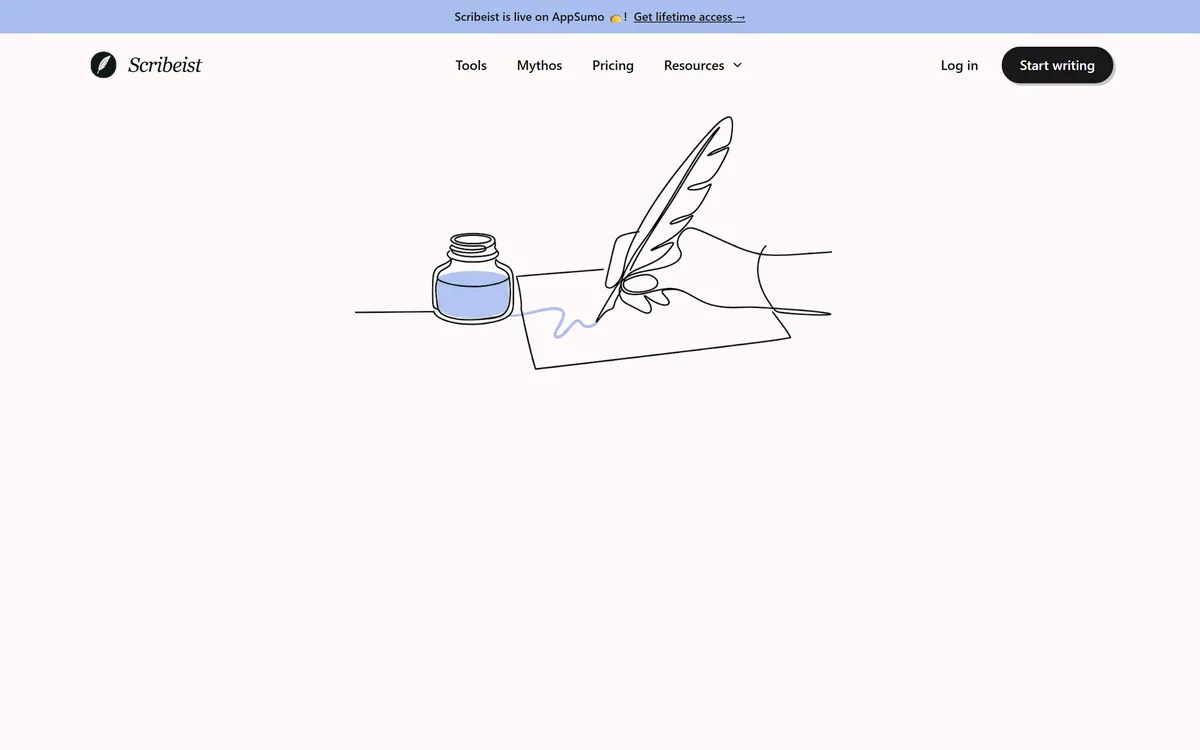
Scribeist's homepage, captured 9 September 2026. The page is deliberately minimal; the product detail sits behind the Tools and Mythos navigation.
Why Should A Novel And A Blog Post Use Different Tools?
Scribeist provides purpose-built tools per writing type rather than one editor with a chat panel attached, and the case for that is strongest at the extremes.
Long fiction has a continuity problem no other writing has. Across ninety thousand words, a writer must keep hundreds of facts consistent — who knows what, when, in which order, and with what eye colour — and the failure mode is not bad prose but a reader noticing chapter twenty contradicts chapter four.
Blogging has an entirely different problem: structure that machines read. Headers in the right hierarchy, a meta description, internal links to related posts, and a topic that fits into a wider site. None of that has anything to do with continuity.
A generic editor gives both writers the same blank page and the same assistant, which is why so many writing tools feel adequate and unhelpful. The specific work of each kind of writing goes unassisted.
The risk of specialising is the mirror image: a tool doing three jobs competes with dedicated products at each. A novelist comparing this against fiction-specific software and a blogger comparing it against SEO-specific software will both find something deeper elsewhere — which makes the case strongest for people who genuinely do both.
Compare that with a tool that picked one job. Jasper AI is built for marketing copy and brand voice, and is judged on that alone.
A novelist needs to remember what a character's sister looked like in chapter three. A blogger needs internal links. A generic editor helps with neither.
Mythos Is The Feature Novelists Actually Need
Mythos links characters, places and lore to the prose that mentions them, and it is the most valuable thing in the product for anyone writing long fiction.
The reason is that continuity errors in a manuscript are found by readers rather than by writers. You wrote it, so you remember what you meant, and your memory papers over the contradiction every time you re-read the passage.
The traditional solution is a series bible — a separate document listing every character, place and rule — and the traditional problem is that it drifts. The manuscript changes, the bible does not get updated, and by draft three it describes a version of the story that no longer exists.
Linking entities directly to the prose closes that gap structurally rather than through discipline. The record of who a character is lives attached to where they appear, which means it updates as a by-product of writing rather than as a separate chore.
Timelines complement it by mapping character arcs, pacing and chapter lengths visually. Pacing problems are notoriously invisible from inside a draft, and a chart showing that three consecutive chapters are twice the length of everything around them tells you something re-reading will not.
Bring Your Own Model Is A Real Choice
Scribeist supports OpenAI, Anthropic, Google, xAI, Mistral, OpenRouter, LM Studio and Ollama — which is an unusually long list, and the last two are the significant entries.
LM Studio and Ollama run models locally on your own machine. That means the text never leaves your computer, which matters enormously for a specific group of writers and not at all for everyone else.
Consider who is in that group. Anyone under a non-disclosure agreement. Anyone writing about a real organisation. A novelist who simply does not want an unpublished manuscript sitting on a third party's servers under terms that could change. Those are ordinary positions, and most writing tools cannot accommodate any of them.
The commercial models on the list matter differently. They let you match the model to the task — one for structural feedback, another for line editing — and they insulate you from a single vendor's pricing and deprecation decisions.
The honest trade with local models is capability. A model that runs on a laptop is meaningfully weaker than a frontier model, and for creative feedback that gap is noticeable. Bringing your own model is a choice about privacy and control, and it costs something.
Model choice is becoming a differentiator across the category — a workspace like Cleve makes the same argument — but local model support is still rare.
Use a local model through Ollama or LM Studio for anything you cannot put on a server.
Feed Voice Capture real samples of your own writing, not your best writing.
Keep Mythos entities updated as you write rather than in a separate pass.
Check the timeline view when pacing feels wrong but you cannot say why.
Export at milestones in DOCX or Markdown, since a manuscript should never live in one place.
Voice Capture And The Sound Of Generated Prose
Voice Capture takes writing samples so the AI output matches your style, and this addresses the single most common complaint about AI-assisted writing.
Generated prose has a characteristic sound: balanced, fluent, slightly over-explained, and utterly unlike any specific person. Readers who cannot name it can still detect it, and for a novelist that quality is fatal because voice is most of what they are selling.
Providing samples is the right mechanism, and the result should be judged sceptically. Style is not only vocabulary and sentence length — it is what you choose to describe, what you leave out, and where you place emphasis, and none of those are easily imitated from a sample.
The most useful application is probably not generating prose at all. Style matching makes an assistant better at line editing in your voice, suggesting a cut that sounds like you would have made it, and that is a lower bar than composition and a more useful one.
A practical note: feed it representative samples rather than your best paragraphs. A model matched to your most polished writing will produce something you cannot sustain, and the mismatch between assisted and unassisted passages is exactly what a reader notices.
None of this decides what to write. That question belongs to a strategy tool such as MarketMuse, which sits earlier in the process than any editor.
Setting Up A Manuscript Workspace
The setup decisions in a writing tool matter more than in most software, because a manuscript is a long relationship and switching mid-draft is painful.
Establish the exit before you establish the workflow.
Export a test document to DOCX and Markdown on day one, and confirm the formatting survives.
Choose your model deliberately: local through Ollama or LM Studio if confidentiality matters, commercial if capability does.
Set up Mythos entities for your main characters and places before writing rather than retrospectively.
Feed Voice Capture three representative pieces of your own writing, not your three best.
Write a chapter, then check the timeline view to see whether the pacing matches what you intended.
Export the whole project monthly, because no writing tool should be the only place a manuscript exists.
Key features of Scribeist
Separate purpose-built workspaces for novels, blogs, essays and notes
Mythos entity tracking linking characters, places and lore to the prose
Timelines mapping character arcs, pacing and chapter lengths
Canvas for visually planning themes, scenes and research
SEO formatting and a Site SEO Board with crawling and internal link mapping
Context-aware AI chat that references your own work
Voice Capture matching generated text to your writing style
Eight model providers including local models via LM Studio and Ollama
Direct publishing to seven platforms plus five export formats
Pros & cons
Pros
7
Refuses to treat all writing as one activity, which most tools do
Mythos closes the continuity gap structurally rather than through discipline
Timelines make pacing visible, which is invisible from inside a draft
Local model support means an unpublished manuscript need never leave your machine
Model choice insulates you from one vendor's pricing and deprecation decisions
Very wide export and publishing support, so nothing is trapped
A published AI Policy alongside Privacy and Terms, which is unusual
Cons
6
Competes with specialists on both fiction and SEO, and will be shallower than either
Local models are meaningfully weaker, so privacy costs capability
Style matching cannot capture what you choose to describe or omit
No operating company, location or pricing published on the pages we read
Whether you bring your own API keys or the vendor bills usage is unclear
Collaboration and multi-user editing support is unstated
Best For
Writers who work across fiction and blogging
Novelists whose series bible has drifted from the manuscript
Anyone writing under confidentiality who needs a local model
Writers who want to choose the model rather than inherit one
Bloggers publishing to WordPress, Ghost or Beehiiv directly
Scribeist Beside Other Writing Tools
Writing tools differ on whether they specialise by output type and whether you choose the model.
Features, Pricing, Tools, Mythos, Blog, Changelog, Help Center, Roadmap, Privacy Policy, Terms of Service, AI Policy
Which Writers Should Try Scribeist?
A fit for your manuscript when
You write both fiction and blog posts and want one tool that knows the difference.
Continuity across a long manuscript is a real problem you currently solve with a drifting document.
You need the text to stay on your own machine, which local model support allows.
You want to choose your model rather than inherit a vendor's decision.
You publish to WordPress, Ghost, Beehiiv or the other supported targets.
Write elsewhere when
You only write marketing copy, where a specialist goes deeper.
You want a full SEO platform, which this is not attempting to be.
You need collaborative editing with several writers in one document.
Your novel workflow is already built around dedicated fiction software.
You would not use the model choice, in which case the differentiator is wasted.
Reading The Scribeist Feature Pages
Last checked . Read from scribeist.com and its footer navigation, with the screenshot above captured in the same session.
Positioned as an AI-powered writing workspace with purpose-built tools per project type
Mythos confirmed as an entity tracking system linking characters, places and lore to prose
Timelines confirmed for mapping character arcs, pacing and chapter lengths
Canvas confirmed for visual planning of themes, scenes and research
Planning sheets confirmed including outline, plot board and chapter cards
SEO formatting confirmed for headers, meta descriptions and link structure
Site SEO Board confirmed with site crawling, internal link mapping and topic cluster identification
AI Chat confirmed as context-aware and referencing the user's own work
Voice Capture confirmed as matching AI output to a writing sample
Supported writing types confirmed as novels, blog posts, essays and notes
Publishing targets confirmed for WordPress, Ghost, HubSpot, Dev.to, Hashnode, Beehiiv and Micro.blog
Export formats confirmed as PDF, DOCX, Markdown, EPUB and Google Drive
Supported models confirmed as OpenAI, Anthropic, Google, xAI, Mistral, OpenRouter, LM Studio and Ollama
Footer confirmed with Features, Pricing, Tools, Mythos, Blog, Changelog, Help Center, Roadmap, Privacy Policy, Terms of Service and an AI Policy
A promotional banner on the homepage stated the product was live on AppSumo at the time of capture
What we could not confirm: the operating company's legal name or location; pricing and plan structure; whether you supply your own API keys for the listed model providers or the vendor bills for usage; how large a manuscript the workspace handles; whether collaboration or multi-user editing is supported; how documents are stored when a cloud model is used; and how the SEO board obtains its crawl data. We did not use the product, so nothing here reflects tested output.
Other Writing And Publishing Tools
The writing category splits by output type, and by whether the tool decides what to write or helps write it.
Jasper AI — for marketing copy with brand voice controls across a team
ContentMonk — long-form production when volume is the requirement
MarketMuse — deciding what deserves writing before anyone writes it
Cleve — a workspace that builds memory from everything you have written
GitBook — if the writing is documentation rather than prose
Editor's Verdict
4.0/5
Two decisions make Scribeist worth attention. It refuses to treat all writing as one activity — a novel needs entity tracking and timelines, a blog post needs headers and internal links, and a tool that offers both a generic editor serves neither well. And it supports bringing your own model, including local ones through LM Studio and Ollama, which for anyone writing something they do not want on a vendor's servers is the difference between usable and unusable. Mythos is the standout feature. It scores where it does because the breadth means competing with specialists on both fronts at once. AInexfinder Editor Score: 4.0/5.
Scribeist pricing
AInexfinder does not list plan prices or billing details. For current pricing, plans, and trials, visit the official Scribeist website.
Vendor pricing, credits, and billing policies change over time. Always confirm on the official site before you buy.
Frequently asked questions
What is Scribeist?
Scribeist is an AI writing workspace with different tools for different project types: Mythos entity tracking, timelines and planning sheets for novels; SEO formatting and a site board for blogs; and a notes space. It supports eight model providers including local ones, and publishes to seven platforms.
Why does a novel need different tools from a blog post?
Because the problems are unrelated. Long fiction has a continuity problem — hundreds of facts that must stay consistent across ninety thousand words. Blogging has a structure problem — headers, meta descriptions, internal links, and a place in a wider site. A generic editor with a chat panel assists neither.
What does Mythos do?
It links characters, places and lore to the prose that mentions them. That matters because continuity errors are found by readers rather than writers — you wrote it, so your memory papers over the contradiction. A traditional series bible drifts from the manuscript; entities attached to the prose update as a by-product of writing.
Can I use my own AI model?
Yes — OpenAI, Anthropic, Google, xAI, Mistral, OpenRouter, LM Studio and Ollama are all listed. The last two are the significant ones: they run models locally, so text never leaves your machine. For anyone under an NDA, writing about a real organisation, or unwilling to put an unpublished manuscript on a server, that is decisive.
Is a local model as good as a cloud one?
No, and the gap is noticeable for creative feedback. A model running on a laptop is meaningfully weaker than a frontier model. Bringing your own model is a choice about privacy and control that costs capability — worth making when confidentiality matters, and not worth making by default.
What is Voice Capture?
It takes samples of your writing so generated text matches your style. It addresses the real complaint about AI prose — that it is balanced, fluent and unlike any specific person. Style is more than vocabulary though, and what you choose to describe or omit is not easily imitated from a sample.
Should I feed it my best writing?
No — feed it representative writing. A model matched to your most polished paragraphs produces something you cannot sustain, and the mismatch between assisted and unassisted passages is exactly what a reader notices. The most useful application is probably line editing in your voice rather than composition.
Can I get my manuscript out?
Yes — PDF, DOCX, Markdown, EPUB and Google Drive are all supported, alongside direct publishing to WordPress, Ghost, HubSpot, Dev.to, Hashnode, Beehiiv and Micro.blog. Test the export on day one rather than at the end, and export the whole project monthly. No writing tool should be the only place a manuscript exists.
Is it better than a dedicated novel-writing tool?
Probably not on depth. A tool doing fiction, blogging and notes competes with specialists at each, and a novelist comparing it against fiction-specific software will find deeper features there. The case is strongest for writers who genuinely do more than one kind of writing and do not want two subscriptions.
What is the Site SEO Board?
Site crawling, internal link mapping and topic cluster identification — which is site-level analysis rather than page-level editing. That is useful for a blogger maintaining a body of posts, though it is not attempting to be a full SEO platform, and the source of its crawl data is not stated.
Daniel reviews AI tools the slow way — by actually using them on real projects. His reviews cover what works, what breaks, and who each tool is genuinely a good fit for.
Daniel and the AInexfinder editorial team research Scribeist using public product information, listing evidence, and (when available) hands-on checks. Scores reflect listing completeness and transparency — not paid placement.
Listings may include affiliate or sponsored placements, which are labeled when present. Editorial scores and cons are not sold. See our affiliate disclosure and review methodology.
RepublishAI is a WordPress autoblogging platform built around specialised AI agents: one analyses search results, one writes, one generates branded images, one builds internal links and one handles SEO metadata. It publishes directly into WordPress and includes a content refresh system for older posts.
ContentBot automates content production through AI Content Workflows (Flows), bulk Imports, an AI Blog Writer, landing page generation and a humanizer, with a WordPress plugin, Chrome extension and 110+ language support via Google Translate.
BlogBuster is an AI content platform that analyses your website, suggests topics, writes long-form articles with images and internal links, and publishes them straight to WordPress, Shopify, Webflow or its own hosting. It supports more than 50 languages and includes automated backlink placement.
ContentMonk monitors how often ChatGPT, Perplexity, Claude and Google AI Overviews cite your brand, tracks classical keyword rankings alongside it, joins both to Search Console and Analytics data, and then generates and publishes articles to WordPress or Webflow. It is sold both as software and as a done-for-you service.
Copy.ai has become an AI-native go-to-market platform: workflows and agents that run prospecting, lead processing, deal coaching, ABM, and CRM enrichment across Salesforce, HubSpot, Gong, Outreach, and 2,000+ integrations.
Writesonic has become an AI search growth platform — tracking whether your brand appears across 10 AI platforms, running optimisation and citation work through an Action Center, and reporting results against traffic and revenue.