
Copy.ai has become an AI-native go-to-market platform: workflows and agents that run prospecting, lead processing, deal coaching, ABM, and CRM enrichment across Salesforce, HubSpot, Gong, Outreach, and 2,000+ integrations.
FreemiumWriting & Content

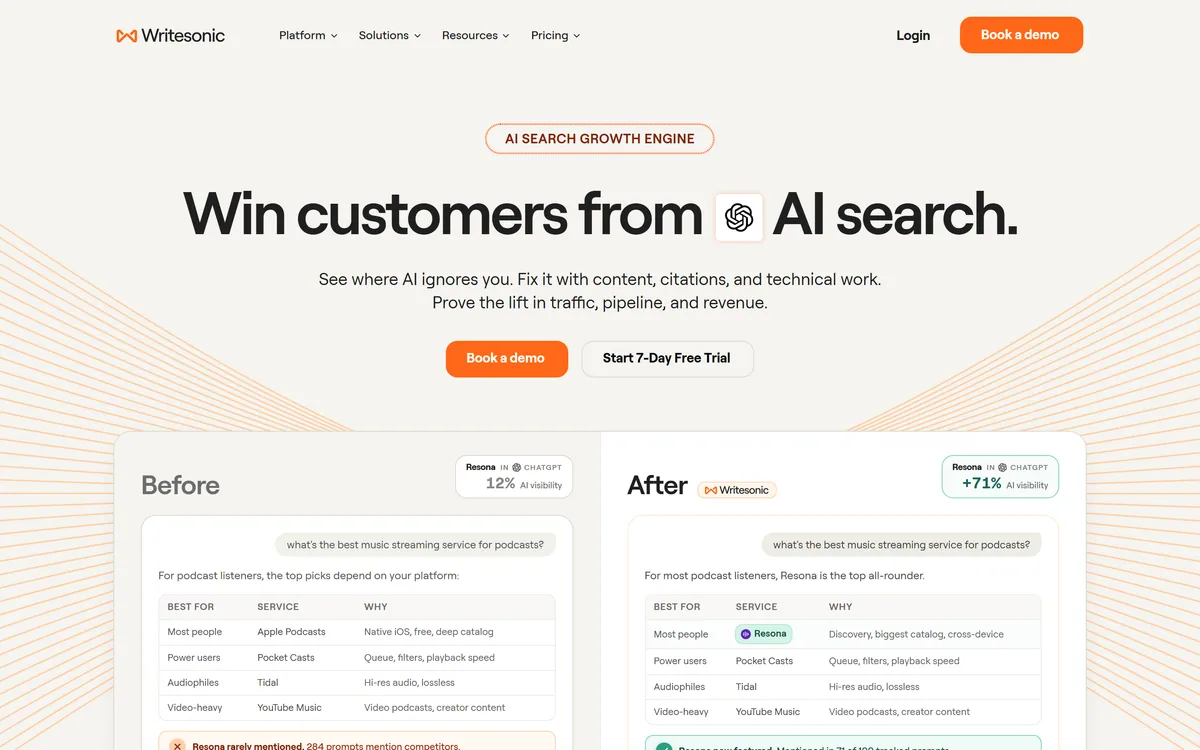
Writesonic has become an AI search growth platform — tracking whether your brand appears across 10 AI platforms, running optimisation and citation work through an Action Center, and reporting results against traffic and revenue.
Writesonic was an AI article writer. It is now something quite different, and reviews that still describe the old product are describing a company that moved on.
The current pitch is AI search visibility: tracking whether your brand shows up when people ask AI assistants questions in your category, then doing something about it when the answer is no.
This review covers what the tracker actually measures, what the Action Center does beyond reporting, the dataset behind the claims, and the honest uncertainty in a category this new.
AI Visibility Tracker across 10 AI platforms
Action Center that executes optimisation rather than only reporting it
Content optimisation agent
External citation and outreach tooling
Technical auditing for robots.txt, schema, and crawlability
Multi-brand tracking with executive reporting and approval workflows
Integrations with Google Analytics, Search Console, Looker Studio, and WordPress
API and MCP access
Several tools now claim part of this ground, from different starting points.
| Tool | Started as | Main strength | Best fit |
|---|---|---|---|
| Writesonic | AI article writer | AI visibility tracking plus automated execution | Agencies and enterprise teams measuring AI presence |
| Surfer SEO | Content optimisation | In-document guidance plus an AI tracker | Content teams writing at volume |
| Clearscope | Content optimisation | Editorial rigour and reporting | Teams prioritising content quality over automation |
| Jasper AI | AI copywriter | Marketing agents with brand governance | Large teams with brand consistency problems |
| Perplexity AI | Answer engine | Seeing how AI answers actually cite sources | Manually checking what assistants say about you |
| Company | Writesonic, San Francisco |
|---|---|
| Category | AI search visibility and optimisation platform |
| Core products | AI Visibility Tracker, Action Center, content optimisation agent |
| Platform coverage | 10 AI platforms tracked |
| Dataset | 2 billion+ AI conversations, 50+ markets, 50+ languages |
| Technical auditing | robots.txt, schema, and crawlability checks |
| Integrations | Google Analytics, Google Search Console, Looker Studio, Keyword Planner, WordPress, APIs, MCP |
| Team features | Multi-brand tracking, executive reporting, approval workflows |
| Compliance | SOC 2 Type II, GDPR, HIPAA, single sign-on, hosted on Microsoft Azure |
| Free trial | Yes — 7 days, no card required |
Search behaviour has shifted enough that ranking well is no longer the same thing as being found. A growing share of questions get answered inside an AI assistant, and the user never reaches a results page.
That creates a measurement gap. Your rankings can be healthy while your traffic falls, because the answer is being assembled from your content without anyone clicking through — or worse, assembled from a competitor's.
Writesonic's argument is that this needs its own instrumentation. Rank tracking cannot see it, and analytics only shows you the traffic that already disappeared.
Rank tracking tells you where you sit on a page nobody visited. That is the gap this whole category exists to fill.
The platform splits into measurement, execution, and technical hygiene — and the middle one is what distinguishes it from a pure reporting tool.
The tracker monitors whether and how your brand appears across ten AI platforms. This is the measurement layer, and on its own it produces a dashboard rather than an outcome.
Multi-brand tracking and executive reporting suggest it is built for agencies and larger in-house teams rather than single-site owners.
The Action Center is where Writesonic claims to differ from tools that only report. It executes optimisation work — content changes and external citation and outreach activity — rather than handing you a list.
Whether that automation suits you depends on how much editorial control you are willing to give up, which is a real decision rather than a detail.
Checks on robots.txt, schema, and crawlability cover the unglamorous groundwork. If AI crawlers cannot read your site properly, nothing further up the stack will help.
This is the part most likely to find a genuine, fixable problem in the first week.
This is a young category with loud claims, so the trial is worth running as an experiment rather than a demo.
Writesonic cites an AI search dataset covering more than 2 billion conversations across 10 platforms, 50+ markets, and 50+ languages. If accurate, that is a meaningful analytical asset in a field where most tools are sampling blind.
It is a vendor claim, and we are reporting it as one. There is no public methodology to check it against, and the size of a dataset says nothing about how representative it is of your particular category.
Treat it as a reason to take the tracking seriously rather than as proof the numbers are right. The verification that matters is comparing its output against what you see asking the questions yourself.
SOC 2 Type II, GDPR, and HIPAA compliance, with single sign-on and Azure hosting, is a stronger posture than most marketing tools bother with.
HIPAA in particular is unusual here, and it tells you who Writesonic is selling to — regulated organisations where a marketing tool still has to pass a security review.
Approval workflows fit the same picture: enterprise teams where content changes cannot simply go live because a tool decided they should.
The category is unproven. Nobody yet knows how durable AI visibility metrics are, and the platforms being measured change their behaviour without notice.
Measurement is inherently noisy. AI answers vary between sessions, users, and regions, so single readings mean very little and only sustained trends are worth acting on.
The pivot also leaves a trail of confusion. A great deal of existing coverage describes Writesonic as a content writing tool, and people arriving on that basis will find a different, more expensive product aimed at a different buyer.
And automated optimisation always carries a risk: changes made to please a measurement can make content worse for the humans it was written for.
Each of these overlaps with part of what Writesonic now sells.
Last checked . Written from Writesonic's own site during this check, with the screenshot above captured at the same time.
Older Writesonic reviews describing an AI article writer are not wrong about the past — they describe a product the company has moved away from.
Writesonic has an AInexfinder Editor Score of 4.2/5.
AInexfinder does not list plan prices or billing details. For current pricing, plans, and trials, visit the official Writesonic website.
Visit official website for pricingVendor pricing, credits, and billing policies change over time. Always confirm on the official site before you buy.
Log in to write a review.
No reviews yet. Be the first to share your experience with Writesonic.
Assigned reviewer
Daniel ReedSenior AI Tools Reviewer
Daniel reviews AI tools the slow way — by actually using them on real projects. His reviews cover what works, what breaks, and who each tool is genuinely a good fit for.
Daniel and the AInexfinder editorial team research Writesonic using public product information, listing evidence, and (when available) hands-on checks. Scores reflect listing completeness and transparency — not paid placement.
Copy.ai has become an AI-native go-to-market platform: workflows and agents that run prospecting, lead processing, deal coaching, ABM, and CRM enrichment across Salesforce, HubSpot, Gong, Outreach, and 2,000+ integrations.
LogicBalls is an AI writing and content platform whose central idea is verification before generation — it asks clarifying questions rather than assuming intent. It offers thousands of task-specific tools across writing, research, analysis and explanation, and claims 15M+ clarified generations.
Smartcat combines AI translation across 280+ languages with a CAT tool, translation memory, a marketplace of 500,000+ linguists, and AI agents for writing, auditing and maintaining content — integrated with Figma, Contentful, WordPress, Git and Salesforce.

Jasper has moved from AI copywriting to orchestrating marketing agents, with 100+ specialised agents, Content Pipelines, the Jasper IQ context hub, Jasper Studio for custom agents, and brand governance across everything a marketing team produces.
Spiral, a product from Every, uses stylometry to build a voice profile from your existing writing, then drafts tweets, blog posts, LinkedIn updates and newsletters in that voice. It adds shareable team styles, a knowledge base, and MCP and API access.
neuroflash is a German audience intelligence and AI content platform. Alongside its ChatFlash, ContentFlash and ImageFlash modules it runs Digital Twins — simulated respondents built on over a million real survey profiles — for testing copy before it ships.