
Copy.ai has become an AI-native go-to-market platform: workflows and agents that run prospecting, lead processing, deal coaching, ABM, and CRM enrichment across Salesforce, HubSpot, Gong, Outreach, and 2,000+ integrations.
FreemiumWriting & Content
Spiral, a product from Every, uses stylometry to build a voice profile from your existing writing, then drafts tweets, blog posts, LinkedIn updates and newsletters in that voice. It adds shareable team styles, a knowledge base, and MCP and API access.
The standard way to make an AI tool sound like you is to describe yourself in a prompt. 'Write in a conversational but authoritative tone, avoid jargon, use short sentences.' Everybody has typed some version of this, and everybody has watched the output come back sounding like a generic writer following instructions — which is exactly what it is.
The problem is that self-description is unreliable. Writers are poor judges of their own habits, and the features that make prose recognisable are mostly ones the writer never consciously chose: how long a sentence runs before it turns, whether a dash or a semicolon does the work, which words appear far more often than they should.
Spiral, built by Every, takes the measurement route instead. It analyses writing you have already produced, extracts those patterns, and applies them. This review covers what stylometry actually does, why the approach is genuinely different, where it breaks down, and who should care.
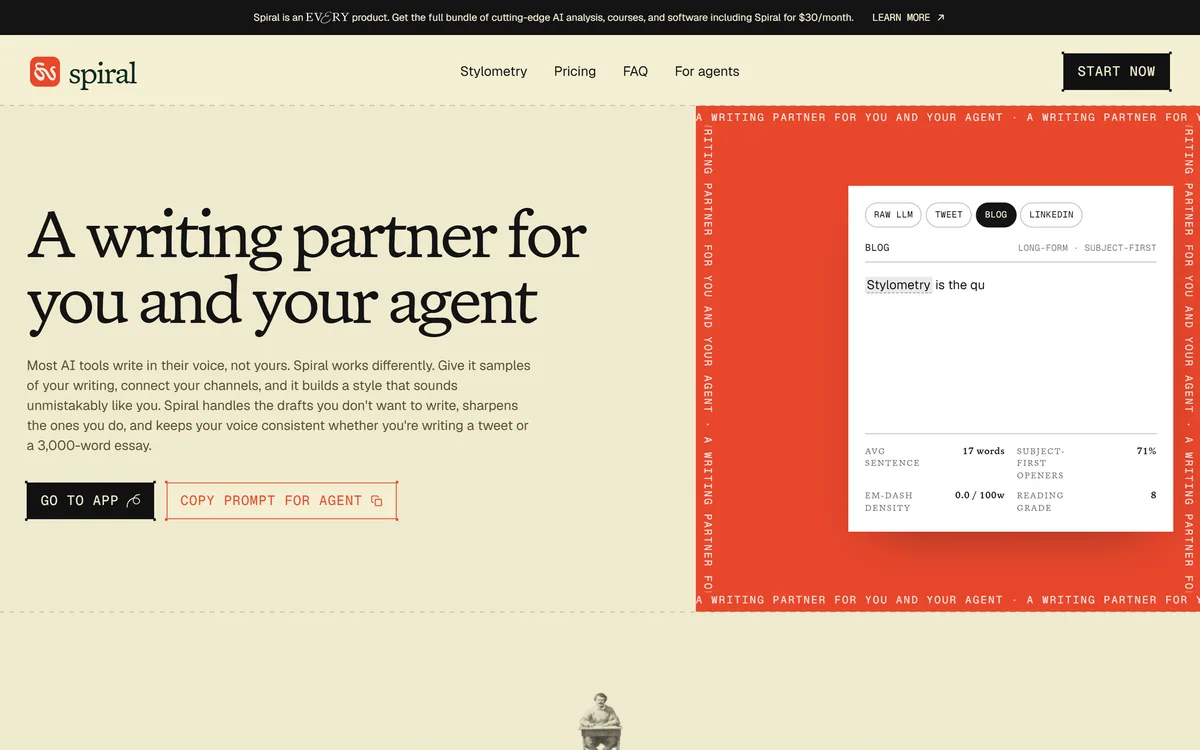
Stylometry is an established field with a long history in authorship attribution — the discipline used to argue about who wrote a disputed text. It works because writing style is measurable in ways writers do not control and often cannot see.
Sentence length distribution, punctuation frequency, vocabulary richness, syntactic patterns, how often you open with a subordinate clause: these are stable, individual, and largely invisible to the person producing them.
Spiral's Style Engine applies this to generation rather than attribution. You give it your writing, it builds a voice profile from the measurements, and it drafts against that profile.
The reason this matters is not that it is more sophisticated. It is that it removes the step everyone gets wrong. You are no longer being asked to describe your voice; you are being asked to supply examples of it, which is something you can actually do.
Nobody can describe their own prose accurately. Almost everybody can produce ten examples of it. Spiral asks for the second thing.
Stylometry captures how you write. It does not capture what you know, what you think, or why you would make a particular argument — and those are usually what makes writing worth reading.
The realistic consequence is that Spiral produces drafts that sound like you saying something generic, rather than drafts that say what you would have said. That is still valuable, because voice is a real editing burden, but it is a narrower claim than the marketing implies.
There is a second limit worth naming: a voice profile learned from your past writing reproduces your past writing. Habits you were trying to break get preserved and reinforced, and a writer whose style is still developing risks fixing it in place. If you already dislike something about how you write, the tool will faithfully give it back to you.
And samples matter enormously. Ten pieces of your best work produce a useful profile. A mixed pile including things you wrote badly, wrote for a different audience, or did not really write yourself produces a profile of nobody in particular.
Shareable Writing Styles turn out to be the more commercially interesting feature, for a reason that has nothing to do with AI.
Brand voice guidelines fail in a predictable way. They are written once, distributed as a document, read by everybody, and then interpreted five different ways by five writers who all believe they are following them. The result is copy that is inconsistent in ways nobody can quite point at.
A measured style profile is a different kind of artefact: it is derived from writing the organisation actually approved, and it applies the same way for everyone. That is closer to a specification than to a guideline.
Around this sit a knowledge base for reference material and brand documents, real-time collaboration with editorial feedback, and MCP plus API access — meaning Spiral can be driven from Claude Code, Cursor or ChatGPT rather than only from its own interface. The MCP support in particular signals a tool designed to sit inside an existing workflow rather than demanding a new one.
Spiral produces format-specific output for tweets, blog posts and LinkedIn, and treating that as a minor convenience misunderstands it.
A thought that works as a tweet has a compressed structure with the tension at the front. The same thought as a blog post needs setup, development and a reason to keep reading. On LinkedIn it needs the particular rhythm that platform rewards, which is neither of the other two.
Most tools handle this by generating once and asking you to trim, which produces the recognisable artefact of a blog paragraph squeezed into a tweet. Generating for the format from the start is a better design, and the stated use cases — social posting, newsletters, meeting recaps, presentations — are all formats where shape matters as much as content.
The quality of what comes out is decided almost entirely at setup, and most people rush it.
Three terms carry most of the weight in understanding what Spiral does differently.
| Made by | Every |
|---|---|
| Core method | Stylometry — measured analysis of your existing writing |
| Style Engine analyses | Sentence length, punctuation, word choice, syntax |
| Team feature | Custom Writing Styles shareable across a team |
| Format outputs | Tweet, blog, LinkedIn, with format-specific optimisation |
| Collaboration | Real-time writing with AI agents and editorial feedback |
| Reference storage | Knowledge base for brand documents and source material |
| Integrations | MCP and API, usable from Claude Code, Cursor and ChatGPT |
| Stated use cases | Social posts, copywriting, newsletters, meeting recaps, presentations |
| Named audiences | Individual writers, marketing teams, AI-native startups, agencies |
| Self-demonstration | The company states its landing page copy was produced with Spiral |
Style Engine that builds a voice profile from your existing writing
Stylometric analysis of sentence length, punctuation, word choice and syntax
Custom Writing Styles that can be shared across a team
Format-specific generation for tweets, blog posts and LinkedIn
Real-time collaboration with AI agents and editorial feedback
Knowledge base for brand documents and reference material
MCP support for use from Claude Code, Cursor and ChatGPT
API access for integration into existing workflows
Everything here generates text. The difference is what each one is optimising for.
| Tool | Approach to voice | Primary output | Best for |
|---|---|---|---|
| Spiral | Measured from your samples via stylometry | Posts, blogs, newsletters in your voice | Writers and teams with an established voice to preserve |
| Jasper AI | Brand voice settings and guidelines | Campaign and marketing content at scale | Larger marketing organisations |
| Copy.ai | Prompt and template driven | Go-to-market workflows | Sales and marketing operations |
| Supergrow | Templates tuned to one platform | LinkedIn posts specifically | People whose whole strategy is LinkedIn |
| Typefully | Composition and scheduling rather than voice | Threads and social publishing | Writers who need distribution more than drafting |
Drafting, editing, publishing and distribution are separate problems.
Last checked . Read from writewithspiral.com during this check, with the screenshot above captured at the same time.
The explanation of stylometry reflects the established field rather than any technical disclosure by Spiral. Observations about voice profiles reproducing existing habits are inherent to the approach rather than defects specific to this implementation.
Spiral has an AInexfinder Editor Score of 4.3/5.
AInexfinder does not list plan prices or billing details. For current pricing, plans, and trials, visit the official Spiral website.
Visit official website for pricingVendor pricing, credits, and billing policies change over time. Always confirm on the official site before you buy.
Log in to write a review.
No reviews yet. Be the first to share your experience with Spiral.
Assigned reviewer
Daniel ReedSenior AI Tools Reviewer
Daniel reviews AI tools the slow way — by actually using them on real projects. His reviews cover what works, what breaks, and who each tool is genuinely a good fit for.
Daniel and the AInexfinder editorial team research Spiral using public product information, listing evidence, and (when available) hands-on checks. Scores reflect listing completeness and transparency — not paid placement.
Copy.ai has become an AI-native go-to-market platform: workflows and agents that run prospecting, lead processing, deal coaching, ABM, and CRM enrichment across Salesforce, HubSpot, Gong, Outreach, and 2,000+ integrations.

Writesonic has become an AI search growth platform — tracking whether your brand appears across 10 AI platforms, running optimisation and citation work through an Action Center, and reporting results against traffic and revenue.
LogicBalls is an AI writing and content platform whose central idea is verification before generation — it asks clarifying questions rather than assuming intent. It offers thousands of task-specific tools across writing, research, analysis and explanation, and claims 15M+ clarified generations.
Smartcat combines AI translation across 280+ languages with a CAT tool, translation memory, a marketplace of 500,000+ linguists, and AI agents for writing, auditing and maintaining content — integrated with Figma, Contentful, WordPress, Git and Salesforce.

Jasper has moved from AI copywriting to orchestrating marketing agents, with 100+ specialised agents, Content Pipelines, the Jasper IQ context hub, Jasper Studio for custom agents, and brand governance across everything a marketing team produces.
neuroflash is a German audience intelligence and AI content platform. Alongside its ChatFlash, ContentFlash and ImageFlash modules it runs Digital Twins — simulated respondents built on over a million real survey profiles — for testing copy before it ships.