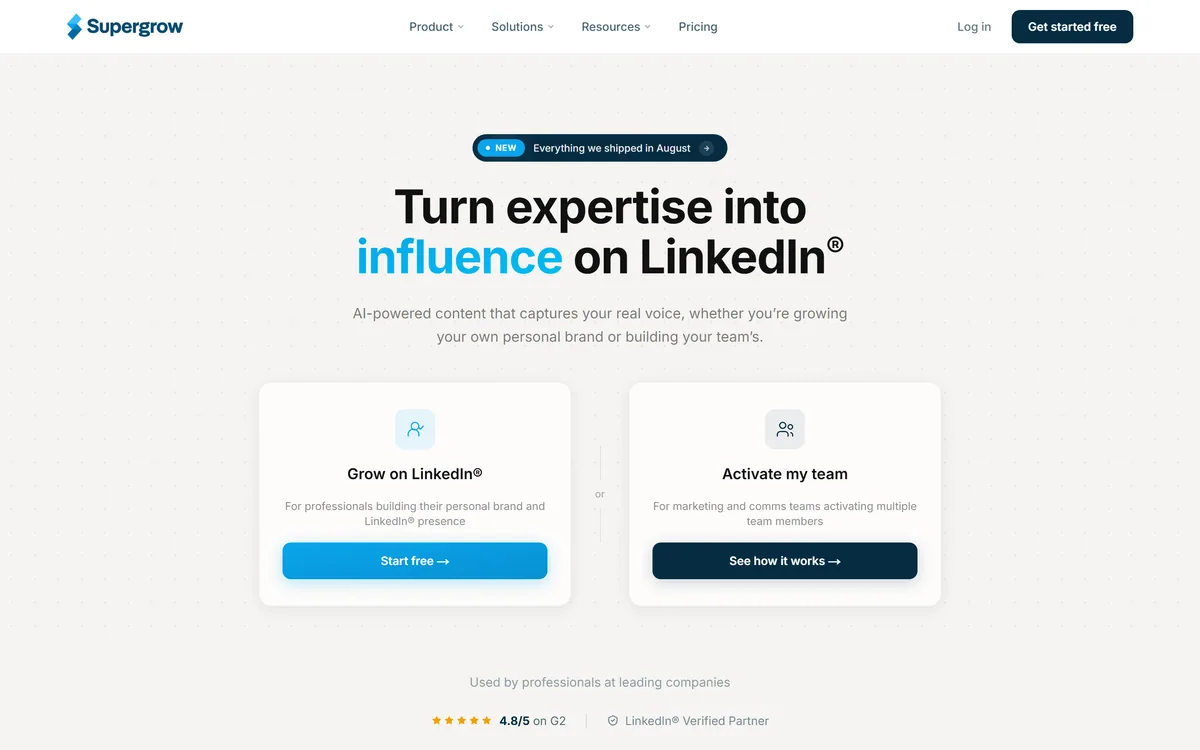
Supergrow is a LinkedIn-only content platform that builds a voice profile through an AI interview rather than a prompt, then generates, schedules and analyses posts. It adds repurposing from video, blogs and PDFs, team approval workflows, first-comment scheduling and a LinkedIn Verified Partner status.
Everyone can tell when a LinkedIn post was written by a general copy tool such as Copy.ai, and the reason is not grammar. It is that the post has no particular person behind it — a series of confident, agreeable statements that could have been written about any company by anyone.
That failure is structural rather than a matter of model quality. A prompt is a few hundred words; a voice is a lifetime of vocabulary, opinion and emphasis. Asking a model to write in your voice from a prompt is asking it to infer a person from a paragraph, and it cannot.
Supergrow's answer is to stop trying. Instead of a prompt it conducts an interview, and builds a profile from your actual answers. That is a better idea than most of this category has had, and it makes the remaining problem sharper rather than smaller.
What Problem Does Supergrow Solve?
It learns your voice through an interview, roughly ten to fifteen minutes, capturing vocabulary, tone, opinions and the topics you are known for — not through a prompt.
LinkedIn only, which is the reason its scheduling, analytics and formatting actually fit the platform rather than approximating it.
Repurposing is built in: existing videos, blog posts and PDFs become source material rather than starting from nothing.
First-comment scheduling is included, which matters because links in comments behave differently from links in posts.
Team features are real — approval routing, role-based permissions and multi-member dashboards — with LinkedIn Verified Partner status.
Supergrow's homepage, captured 9 September 2026. The focus on LinkedIn alone is a deliberate narrowing rather than a limitation.
Why An Interview Beats A Prompt
Supergrow builds a voice profile through conversation, describing it as capturing your vocabulary, tone, opinions and the topics you are known for, in an interview of ten to fifteen minutes.
The mechanism is sound for a reason worth spelling out. What makes writing sound like a specific person is mostly the things they would never think to specify: which words they avoid, how long their sentences run, whether they hedge or assert, what they find obvious and what they find worth arguing.
You cannot list those about yourself, because they are invisible from the inside. But they are recoverable from a transcript of you talking, which is exactly what an interview produces.
Capturing opinions is the more important half. Generic AI writing is bland not because it is badly written but because it takes no position — and a post that takes no position is one nobody has a reason to read. A profile that records what you actually think gives the model something to argue.
The realistic expectation is that this gets you closer, not all the way. A voice profile captures register and stance; it does not know what happened in your meeting yesterday, and specificity of that kind is what separates a good post from a plausible one.
You cannot write down your own voice, because the parts that make it yours are invisible from the inside. A transcript of you talking contains them.
Repurposing Is The Underrated Feature
Supergrow turns existing videos, blog posts and PDFs into LinkedIn content, and this is probably more valuable than the generation everyone notices.
The reason is that repurposing starts from something real. A talk you gave, a post you wrote, a report you produced — these contain your actual arguments and specific examples, which is precisely what generated-from-nothing content lacks.
It also matches how professional visibility actually accumulates, which article tools such as Byword serve from the other direction. Most people who post well are not generating new insight daily; they are re-expressing work they already did, for an audience that did not see it the first time.
The practical implication is that this feature should be your default and generation the exception. A post derived from something you made is verifiable, specific and yours; a post generated from a topic is none of those.
What Verified Partner Status Actually Buys
Supergrow states LinkedIn Verified Partner status, and this is a more consequential detail than it appears in a feature list.
LinkedIn has historically been hostile to third-party automation, and unsanctioned tools that post or scrape through unofficial means have periodically caused account restrictions for their users. That risk falls on the person whose account it is, not on the tool.
Partner status means the integration runs through sanctioned access. For anyone whose professional network is genuinely valuable — which is most people posting seriously on LinkedIn — that is the difference between a productivity tool and a gamble.
It also usually means the analytics are real rather than inferred. A tool with proper access reports what the platform reports; one without it estimates.
The related feature worth understanding is first-comment scheduling. Posts containing external links have long been thought to reach fewer people, so the common practice is to put the link in the first comment instead. Automating that removes the need to be present at publication time, which is the small friction that makes people skip it.
Verified Partner status means sanctioned access rather than automation that can put an account at risk.
Analytics from a partner integration are reported rather than estimated.
First-comment scheduling handles the link-placement practice without you being online.
Check what data the integration can read as well as write, since it sits on your professional identity.
Never give posting access to a tool without partner status if your network matters to you.
The Volume Problem Nobody Wants To Name
A voice profile that writes convincingly in your register removes the last constraint on how much you can publish, and that is not straightforwardly good.
The constraint used to be effort. Writing a thoughtful post took forty minutes, which meant you only did it when you had something worth forty minutes. That friction was doing quality control nobody designed.
Remove it and the natural equilibrium becomes daily posting, because the tool makes daily posting possible and the platform rewards frequency. What gets published is then determined by capacity rather than by having something to say.
The visible result is a feed everyone recognises: confident, well-structured posts that convey nothing, from people who used to post occasionally and well. Readers adjust by not reading, which means the increased volume produces less attention rather than more.
None of this is Supergrow's fault, and the interview approach makes its output better than most. But the discipline has to come from you, because no tool in this category will suggest you post less. A useful rule: if you would not have bothered writing it by hand, do not publish it — and use the time saved to make three good posts a week rather than seven mediocre ones.
Testing Whether It Sounds Like You
The free trial runs seven days with no commitment, which is enough to answer the only question that matters.
The bar is step four. Someone who reads your writing regularly is the only reliable judge of whether a voice profile worked.
Do the interview properly rather than rushing it. Answer as you would speak to a colleague, including the opinions you would actually defend — a hedged interview produces hedged posts.
Generate three posts on topics you genuinely know, then read them aloud. Anything you would not say out loud is a line to cut.
Now try repurposing: feed in a talk, article or report you produced, and compare the result with the generated posts. The repurposed one should be noticeably more specific.
Send both to a colleague who reads your writing, without saying which is which, and ask which sounds like you. Their answer is the product evaluation.
Publish one post — genuinely publish it — and read the comments. Engagement from people who know you is the honest signal.
Before subscribing, check what the LinkedIn integration can read as well as post, since it connects to your professional identity.
The Trial, The Tiers And The Team Question
Access begins with a seven-day free trial with no commitment, followed by a subscription; amounts are not disclosed on the pages we read. Team tiers exist with approval routing and role-based permissions.
The individual-versus-team distinction is the one to get right. For a single person building professional visibility, the individual tier is the product; multi-platform managers such as eclincher solve a different job. For a company running employee advocacy — where several people post and someone reviews before publication — the approval workflow is the reason to buy, and it is a genuinely different purchase.
The team case deserves a caution. Employee advocacy programmes fail when the posts obviously came from a marketing department, and a shared voice profile across staff produces exactly that. The approval workflow is only worth having if each person's voice profile is genuinely theirs.
The customer list — Google, Apple, Meta, NVIDIA, Cisco, SAP, Accenture, Goldman Sachs, HSBC — reads as employees at those companies rather than as institutional deployments, which is the usual shape for a tool of this kind. Read it that way.
We do not publish amounts, since they change. Check whether the voice profile survives cancellation, because re-doing the interview is the switching cost.
Individuals Or Advocacy Teams?
Worth the trial when
LinkedIn is where your professional reputation is actually built, and posting keeps slipping.
You have existing material — talks, articles, reports — that nobody outside a small circle has seen.
Generic AI writing has embarrassed you before, and the interview approach is the fix you wanted.
You run an employee advocacy programme and need approval routing with individual voices intact.
You want scheduling and analytics through sanctioned access rather than automation that risks your account.
Give it a pass when
You post across several platforms and want one tool for all of them, which this deliberately is not.
You would use it to post daily regardless of having something to say, which produces less attention rather than more.
Your audience is not on LinkedIn, in which case platform-specific tooling buys you nothing.
You already post well and consistently, where a voice profile adds cost rather than capability.
You are uncomfortable granting a third-party tool access to your professional identity.
Everything Supergrow Includes
Product type
LinkedIn-only content creation, scheduling and analytics
Voice capture
AI interview of roughly 10 to 15 minutes, building a profile from your answers
Profile contents
Vocabulary, tone, opinions and the topics you are known for
Teams wanting scheduling and analytics through sanctioned platform access
Supergrow Against Other Social Content Tools
The decision here is breadth versus depth. A tool covering six platforms fits none of them as precisely as one built for a single platform's conventions.
Tool
Platforms
Voice approach
Best for
Supergrow
LinkedIn only
Interview-built voice profile
Individuals and teams building professional visibility on LinkedIn
Last checked . Read from supergrow.ai, including the footer, with the screenshot above captured in the same session.
Product confirmed as a LinkedIn content platform covering creation, scheduling and analytics for individuals and teams
Voice capture described as building a profile through AI interview covering vocabulary, tone, opinions and the topics you are known for, over roughly 10 to 15 minutes
Content creation described as AI interviews, Content DNA and repurposing in one workspace
Repurposing confirmed from videos, blog posts and PDFs
Scheduling confirmed as calendar, queue and first-comment scheduling
Engagement features confirmed as Focus Mode and AI-generated comments
Analytics described as tracking visibility, engagement and pipeline impact
Team features confirmed as multi-member dashboards, approval routing and role-based permissions
LinkedIn Verified Partner status stated on the site
A 4.8 out of 5 G2 rating stated on the site
Trial confirmed as 7 days free with no commitment
Footer read directly and confirmed to carry Product, Resources, Company and Legal sections including blog, changelog, help centre, affiliate programme, status page, about, privacy and terms
What we could not confirm: no pricing amounts or tier structure are disclosed on the pages we read; no underlying AI model or provider is named; the enterprise names displayed appear to indicate where individual users work rather than institutional deployments, and nothing indicates those companies purchased or evaluated the product; no data is published on what the LinkedIn integration can read as opposed to write; and we did not use the product, so nothing here reflects tested output quality.
Other Content And Social Tools
Compare on whether a tool is built for one platform's conventions or approximates several.
eclincher — multi-platform social management if LinkedIn is only part of the job
Copy.ai — general marketing copy across channels rather than one platform
Writesonic — broader content generation including long form
Byword — articles rather than posts, for the other half of a content programme
ContentMonk — if the goal is visibility in AI answers rather than in a feed
Editor's Verdict
4.0/5
Supergrow scores well because it identified the actual reason AI writing tools fail on LinkedIn: prompting produces generic posts because a prompt cannot contain a voice. Replacing that with a ten-to-fifteen minute interview that captures vocabulary, tone, opinions and the topics you are known for is a genuinely better mechanism, and LinkedIn Verified Partner status means the scheduling and analytics work through sanctioned access rather than automation that risks an account. It loses ground because a voice profile makes it easy to publish at a volume you could not personally sustain, which is how a feed full of confident, empty posts gets made — and the tool does nothing to stop that. AInexfinder Editor Score: 4.0/5.
Supergrow pricing
AInexfinder does not list plan prices or billing details. For current pricing, plans, and trials, visit the official Supergrow website.
Vendor pricing, credits, and billing policies change over time. Always confirm on the official site before you buy.
Frequently asked questions
What is Supergrow?
Supergrow is a LinkedIn-only content platform. Rather than generating posts from a prompt, it conducts a ten-to-fifteen minute AI interview to build a voice profile covering your vocabulary, tone, opinions and topics, then writes, schedules and analyses posts using it. It also repurposes existing videos, blogs and PDFs into posts.
How does Supergrow learn my writing voice?
Through a conversational interview rather than a prompt. That works because the things making writing sound like you — which words you avoid, how long your sentences run, whether you hedge or assert — are invisible from the inside and impossible to specify, but entirely recoverable from a transcript of you talking about what you know.
Is Supergrow free?
There is a 7-day free trial with no commitment, after which it is a subscription; amounts are not published on the pages we read. Before subscribing, check whether your voice profile survives cancellation — re-doing the interview is the real switching cost, more than the monthly fee.
Is it safe to connect Supergrow to my LinkedIn account?
Supergrow states LinkedIn Verified Partner status, which means the integration runs through sanctioned access rather than unofficial automation. That matters: unsanctioned tools have historically caused account restrictions, and that risk falls on the account owner rather than the tool. Still check what the integration can read as well as write.
Will people be able to tell my posts are AI-written?
Less easily than with prompt-based tools, because the voice profile captures register and stance rather than approximating them. The reliable test is to send a generated post and one you wrote to a colleague who reads your writing, without saying which is which, and ask which sounds like you.
What is first-comment scheduling and why does it matter?
It automatically posts your first comment — usually containing a link — immediately after the post publishes. Posts with external links have long been thought to reach fewer people, so the common practice is to put the link in the comments instead. Automating it removes the need to be online at publication time.
Should I use Supergrow to post every day?
Probably not, and this is the honest caution about the whole category. Effort used to act as quality control — a post taking forty minutes only got written when you had something worth forty minutes. Remove that and volume gets set by capacity rather than by having something to say. Three good posts a week beats seven empty ones.
Does Supergrow work for other platforms?
No, and that is deliberate. LinkedIn-only focus is why its scheduling, formatting, analytics and conventions like first-comment posting actually fit the platform rather than approximating it. If you post across several networks, a multi-platform tool such as eclincher fits the job better, at the cost of that precision.
Can teams use Supergrow for employee advocacy?
Yes — it offers multi-member dashboards, approval routing and role-based permissions. The caution is that advocacy programmes fail when posts obviously came from marketing. The approval workflow is only worth having if each person's voice profile is genuinely theirs, rather than one house voice distributed across staff.
What is the repurposing feature, and why use it?
It turns existing videos, blog posts and PDFs into LinkedIn posts. It should be your default rather than the exception, because it starts from something real — your actual arguments and specific examples. Most people who post well are not generating new insight daily; they are re-expressing work they already did for an audience that missed it.
Daniel reviews AI tools the slow way — by actually using them on real projects. His reviews cover what works, what breaks, and who each tool is genuinely a good fit for.
Daniel and the AInexfinder editorial team research Supergrow using public product information, listing evidence, and (when available) hands-on checks. Scores reflect listing completeness and transparency — not paid placement.
Listings may include affiliate or sponsored placements, which are labeled when present. Editorial scores and cons are not sold. See our affiliate disclosure and review methodology.
Postiv packages LinkedIn strategy, drafting, carousel design, scheduling, analytics and comment replies into a single weekly ritual run by an assistant called Bob, working through the official LinkedIn API rather than a browser extension.
ViralBrain analyses LinkedIn creators you nominate as heroes, extracts the hooks, structures and calls to action behind their posts, and generates drafts in your own voice on a scheduled calendar. It publishes through LinkedIn's official API, offers an MCP server, and ships a large library of free single-purpose tools.
Velocity is a team of AI social-media agents for small businesses, agencies and multi-brand teams that research trends, draft on-brand captions and images, schedule and publish, and analyse results across Instagram, Facebook, YouTube, TikTok, LinkedIn, X and Bluesky.
Copy.ai has become an AI-native go-to-market platform: workflows and agents that run prospecting, lead processing, deal coaching, ABM, and CRM enrichment across Salesforce, HubSpot, Gong, Outreach, and 2,000+ integrations.