
ViralBrain analyses LinkedIn creators you nominate as heroes, extracts the hooks, structures and calls to action behind their posts, and generates drafts in your own voice on a scheduled calendar. It publishes through LinkedIn's official API, offers an MCP server, and ships a large library of free single-purpose tools.
Postiv
Verified
Postiv packages LinkedIn strategy, drafting, carousel design, scheduling, analytics and comment replies into a single weekly ritual run by an assistant called Bob, working through the official LinkedIn API rather than a browser extension.
4.0Editor Score
postiv.ai10 viewsAdded October 29, 20252K visitors
Postiv: What Bob Does For You
- One weekly sitting — three briefs waiting on Monday, described as about thirty minutes.
- Official LinkedIn API, stated as fully compliant rather than a browser extension.
- The whole toolkit: strategy, writing, images, carousels, scheduling, analytics and replies.
- Next week builds on this week — briefs are generated from what actually performed.
- Every teammate gets their own coach, with personal profiles and the company page together.
Key features of Postiv
Weekly content briefs built from recent performance
Drafting from a chat message, voice note or screenshot
Content pillars and a documented weekly plan
Brand-styled image and infographic generation
Carousel creation with your colours, fonts and logo
Per-post analytics for reach, engagement and profile visits
Comment inbox with tone-matched reply suggestions
Shared team workspace with individual coaches
Pros & cons
Pros
7- Diagnoses the failure as friction rather than motivation, and designs for that
- One weekly sitting is a workflow insight, not just another generator
- Built on the official API, so account risk sits with the platform's own rules
- Briefs convert composing into editing, which is far easier to begin
- Analytics sit beside next week's drafts rather than in a separate report
- Carousel automation removes the most time-consuming visual task
- Per-person coaching avoids the identical-post problem in advocacy programmes
Cons
7- Optimising briefs for engagement can converge on a generic LinkedIn register
- Streaks and leaderboards can feel coercive when they arrive from a manager
- Single-platform by design, so it does nothing outside LinkedIn
- The habit still depends on you supplying a real story each week
- Adoption and logo claims are stated without explanation of what they count
- Testimonials are vendor-selected, including some comparing named competitors
- Employers with restrictions on third-party account access may not permit it
Best For
- Founders selling to a professional audience
- Consultants who need visibility rather than reach
- Agencies running LinkedIn for several people
- Sales teams where personal profiles matter more than the page
- Anyone who has started and abandoned posting twice already
Postiv Beside Other Social Tools
Social tools differ by how much of the loop they close.
| Tool | Covers | Platform | Best for |
|---|---|---|---|
| Postiv | Strategy through to replies | LinkedIn, via the official API | Making a weekly habit stick |
| Supergrow | Writing and scheduling | Personal brand building | |
| Postwise | Drafting and growth features | Several social networks | Volume across platforms |
| Vista Social | Scheduling and management | Many networks | Agencies running client accounts |
| Posting by hand | Whatever you have time for | Anywhere | One person with genuine discipline |
Postiv: A Coach Called Bob For LinkedIn
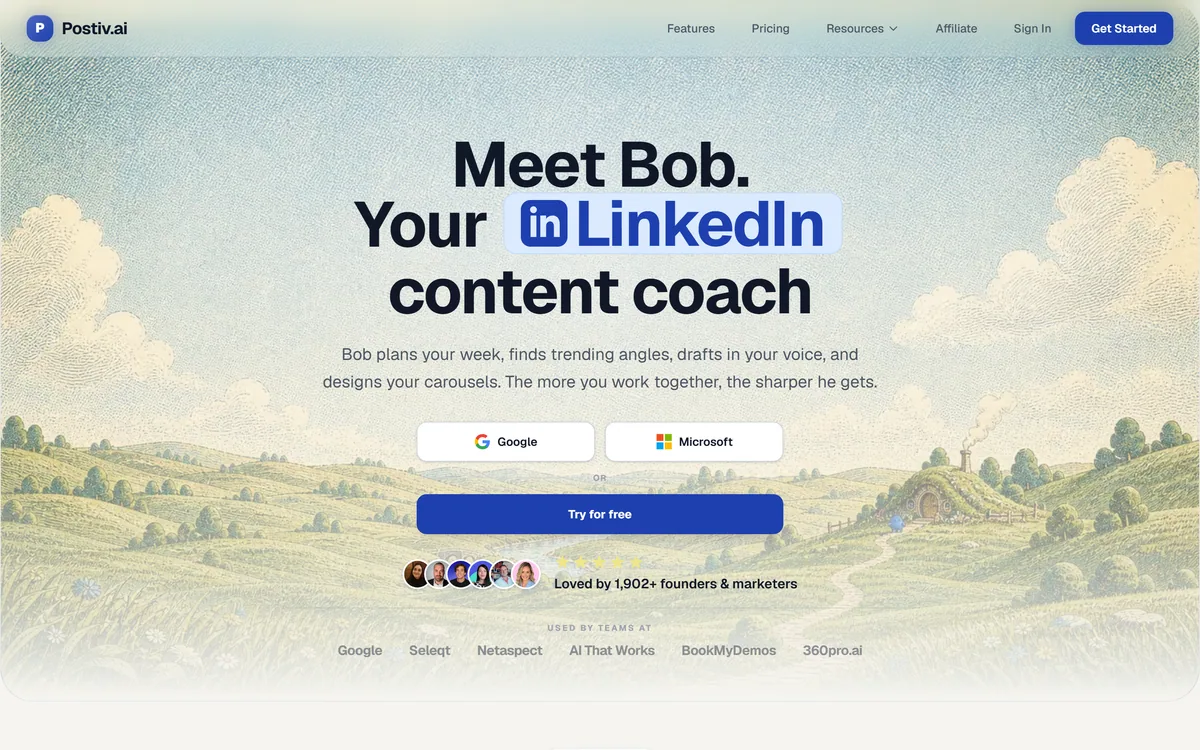
The product is personified rather than described: meet Bob, your LinkedIn content coach, who plans your week, finds trending angles, drafts in your voice and designs your carousels — sharper the more you work together.
Naming the assistant is a marketing choice with a genuine consequence, and it is worth taking seriously rather than dismissing.
A tool is something you use when you remember to. A coach is someone you have an appointment with. Framing a weekly content session as a meeting with Bob borrows the accountability structure that makes personal trainers effective, and accountability is precisely what fails here.
The mechanics behind the framing are ordinary and sound. Three briefs are prepared each Monday from what performed last week, you spend around thirty minutes adding the stories and opinions only you have, and the rest publishes on schedule.
The honest version of the value proposition is not that the AI writes better than you. It is that a prepared brief converts a blank box into an editing task, and editing is enormously easier to start than composing.
A tool is something you use when you remember. A coach is an appointment. The difference is the entire reason weekly posting habits survive or die.
Ideas, Drafts And The Weekly Rhythm
The loop is described in three stages: Monday you show up to three waiting briefs, Tuesday through Sunday posts publish and analytics accumulate beside them, and the next Monday's briefs are built from the best performers.
Compounding is the claim, and the underlying logic is sound but worth stating precisely.
Every platform rewards iteration on what worked, and almost nobody does it, because reviewing analytics is a separate task from writing and gets skipped first. Putting last week's numbers beside next week's briefs removes the step where a human has to decide to look.
The risk in the same mechanism is convergence. A system that optimises purely for engagement drifts toward whatever performs — and on LinkedIn what performs is a recognisable, slightly hollow register that readers have learned to scroll past.
The site's own framing pushes against that, repeatedly emphasising your real stories and your opinions as the input only you can supply. That is the correct instruction and the part no software enforces. Tools like Supergrow occupy the same ground, and the same caution applies to all of them.
Why Do Posting Habits Collapse In Week Three?
The site lists the objections in the words people actually use, and they are unusually well observed: two good weeks then a new client landed, staring at the blank post box, wanting real conversations rather than influencer status, juggling five tools already, and a team full of people worth following who will not post.
Every one of those is a friction problem rather than a motivation problem, which is the useful diagnosis.
People do not abandon content because they stopped believing in it. They abandon it because the sequence — decide what to say, write it, make an image, schedule it, come back for the comments — takes four tools and ninety minutes, and the first genuinely busy week ends the run.
The blank box deserves separate attention because it is a different failure. Facing an empty field with no constraints is one of the hardest cognitive positions to start from, and it is why the brief matters more than the drafting.
The fifth objection is the one most businesses feel hardest. Employees who would be excellent on LinkedIn do not post, not from unwillingness but because nobody has made it a fifteen-minute task with something already prepared. Single-purpose drafting tools like Postwise solve the blank box and leave the rest of the sequence exactly where it was.
- Diagnose the failure as friction, not motivation.
- Start from a brief, never from an empty field.
- Put analytics next to next week's drafts so nobody has to go looking.
- Supply the story yourself — that is the part with no substitute.
- Check the tool uses the official API before connecting an account.
One Coach Instead Of Five Tools
The consolidation claim is explicit — writing, visuals, scheduling, analytics and engagement in one place, described as one subscription and every tool.
One line in that section matters more than the rest: all fully LinkedIn compliant through the official API, and not a browser extension.
That distinction has real consequences. Automation tools that drive LinkedIn through a browser extension operate against the platform's terms, and the account carrying the risk is yours. People have lost profiles built over a decade this way, and no refund replaces a professional network.
Building on the official API constrains what a product can do — there are actions the API simply does not permit — but it means the vendor's capability set and the platform's rules are the same thing.
The toolkit itself covers the predictable ground competently: content pillars and a weekly plan, drafting from a chat message, voice note or screenshot, brand-styled images and carousels, per-post analytics, and reply suggestions gathered into one inbox. The carousel maker earns its place, because carousel design is genuinely time-consuming and the alternative is an hour in a design tool. Broader schedulers such as Vista Social cover more networks and go nowhere near this deep on one.
Team Accounts And Individual Voices
The team proposition is stated as every profile on your team posting every week from one shared workspace, with personal profiles and the company page together, plus streaks and leaderboards to sustain the habit.
Employee advocacy is a well-established idea that mostly fails in practice, and it fails for a specific reason.
Personal profiles reach further than company pages, and everyone in marketing knows it. What follows is usually a programme where staff are sent pre-written posts to publish, which produces six colleagues posting the same paragraph on the same morning — visibly, and to the same audience.
Individual coaching per person is the structurally better answer, because it starts from what each person actually knows rather than from a shared message.
Streaks and leaderboards are the part to handle carefully. They work, which is the problem: gamifying employee posting turns a professional profile into a performance metric, and the same mechanics that build habits also build resentment when they arrive from a manager. The site's own testimonials — presented as unedited LinkedIn posts and messages, typos included — describe time savings and pipeline effects, which is the outcome to watch rather than the streak count.
Posting Weekly Without Becoming An Influencer
The stated goal of most users here is not reach — it is being visible to a few hundred people who might hire them.
This sequence gets there without turning into a content operation.
- Write down who you want reading, and what you want them to think.
- Set content pillars narrow enough that a post is obvious to place.
- Book the same thirty minutes weekly and treat it as an appointment.
- Supply one real story or opinion per post, always.
- Reply to comments yourself; that is where conversations start.
- Review monthly whether anyone worth reaching is actually reading.
Postiv: Features And Scale
| Platform | LinkedIn only, stated as using the official API rather than a browser extension |
|---|---|
| Assistant | Branded as Bob, a content coach rather than a generator |
| Weekly ritual | Three briefs each Monday, described as about thirty minutes of your time |
| Strategy | Goals and expertise turned into content pillars and a weekly plan |
| Drafting | Briefing by chat message, voice note or screenshot |
| Visuals | Post images, infographics and carousels in your brand style |
| Analytics | Impressions, engagement and profile visits per post |
| Engagement | Reply suggestions in your tone, with comments from every profile in one inbox |
| Teams | Shared workspace, per-person coaches, streaks and leaderboards |
| Company page | Managed alongside personal profiles |
| Adoption | Stated as 1,902-plus founders and marketers |
| Social proof | A logo wall of companies whose teams are stated to use it, plus named testimonials |
Should Your Team Post On LinkedIn?
Let the coach plan when
- You have started and stopped posting more than once.
- The blank post box is where your attempts actually die.
- You are paying for three or four tools that each do one part.
- Your team includes people worth following who never post.
- Carousels would help and designing them will not happen.
Post without a coach when
- You already post consistently and enjoy writing it.
- Your buyers are not on LinkedIn in any meaningful number.
- Your organisation restricts third-party access to employee accounts.
- You need several networks rather than one done well.
- Gamified posting would land badly with your colleagues.
More Social Publishing Tools
Other ways to keep a professional presence going.
- Supergrow — LinkedIn writing and personal brand building
- Postwise — drafting and growth across social networks
- Vista Social — multi-network scheduling and management
- eclincher — social management for larger teams
- Spiral — writing in a voice trained on your own work
Postiv: Read From The Coach Pages
Last checked . Read from postiv.ai in a browser session on the date above, with the screenshot captured at the same time.
- Positioned as Bob, a LinkedIn content coach who plans, drafts and designs
- A weekly loop described as three briefs on Monday, publishing Tuesday to Sunday, and new briefs built from performance
- The Monday session described as roughly thirty minutes, once a week
- Stated as fully LinkedIn compliant through the official API, explicitly not a browser extension
- A toolkit listing strategy, AI writer, image and infographic generator, carousel maker, analytics and engagement
- Briefing described as possible by chat, voice note or screenshot
- Carousels described as applying your colours, fonts and logo automatically
- Comments from every profile gathered into a single inbox with tone-matched reply suggestions
- Team features listing a shared workspace, per-person coaches, streaks and leaderboards
- Company page management offered alongside personal profiles
- Adoption stated as 1,902-plus founders and marketers, with a logo wall of companies
- Testimonials presented as unedited LinkedIn posts and direct messages, attributed to named people with job titles
What we could not confirm: how the 1,902 figure is counted, or the nature of the relationship behind each logo displayed; which LinkedIn API endpoints are used and what that permits; how well drafted posts match an individual voice in practice; whether the performance-based brief generation avoids converging on a generic register; and pricing. Testimonials are vendor-selected. We did not connect an account or publish a post.
Editor's Verdict
4.0/5Postiv has diagnosed the problem correctly: nobody stops posting on LinkedIn because they ran out of ideas, they stop because the ritual has five steps across four tools and the third busy week wins. Collapsing that into one weekly sitting is a workflow insight rather than an AI one, and it is the reason this is more interesting than another post generator. Building on the official API rather than a browser extension is the decision that should reassure anyone who has watched an automation tool get an account restricted. AInexfinder Editor Score: 4.0/5.
Postiv pricing
AInexfinder does not list plan prices or billing details. For current pricing, plans, and trials, visit the official Postiv website.
Visit official website for pricingVendor pricing, credits, and billing policies change over time. Always confirm on the official site before you buy.
Frequently asked questions
What is Postiv?
A LinkedIn content coach branded as Bob. It plans your week, prepares briefs from what performed, drafts in your voice, designs carousels, schedules posts and suggests replies — in one weekly sitting.
Why do LinkedIn habits fail?
Friction, not motivation. The sequence takes four tools and ninety minutes, and the first genuinely busy week ends the run. The site quotes the objection exactly: two good weeks, then a new client landed.
Does it use a browser extension?
No — it states it works through the official LinkedIn API and is fully compliant. That matters because extension-driven automation operates against platform terms, and the account carrying that risk is yours.
Will posts sound like me?
That depends mostly on what you supply. The system drafts from your briefing and past material, but the site is explicit that the stories and opinions only you have are your input, and no software supplies those.
How long does it actually take each week?
The stated ritual is about thirty minutes on Monday, with roughly ten minutes a day for replies if you use the engagement inbox. Publishing and tracking happen without you.
What does compounding mean here?
Next week's briefs are generated from the posts that performed best. That closes the loop most people skip, because reviewing analytics is separate work and is always the first thing dropped.
Is there a risk of sounding generic?
Yes, and it is inherent to optimising for engagement. What performs on LinkedIn is a recognisable register readers have learned to scroll past, so the personal input is the safeguard rather than a nice extra.
How does it work for teams?
Each person gets their own coach and plan inside a shared workspace, with the company page alongside. That avoids the classic advocacy failure where six colleagues publish the same paragraph on the same morning.
Are streaks and leaderboards a good idea?
They work, which is the difficulty. Gamifying posting turns a personal profile into a tracked metric, and the same mechanics that build a habit can build resentment when the pressure comes from a manager.
Who should not use it?
Anyone already posting consistently and enjoying it, anyone whose buyers are not on LinkedIn, and organisations that restrict third-party access to employee accounts.
Reviews
Log in to write a review.
User Reviews
No reviews yet. Be the first to share your experience with Postiv.
Reviewed by Daniel Reed
Assigned reviewer
Daniel ReedSenior AI Tools Reviewer
Daniel reviews AI tools the slow way — by actually using them on real projects. His reviews cover what works, what breaks, and who each tool is genuinely a good fit for.
Hands-on reviewsProduct testingAI software
Daniel and the AInexfinder editorial team research Postiv using public product information, listing evidence, and (when available) hands-on checks. Scores reflect listing completeness and transparency — not paid placement.
- Last verified
- Methodology
- How we review AI tools
- Sources used
- postiv.ai
- AInexfinder listing fields (features, pros/cons, description)
- Public vendor pages when available
- Editorial policy
- Listings may include affiliate or sponsored placements, which are labeled when present. Editorial scores and cons are not sold. See our affiliate disclosure and review methodology.
Related tools
Typefully review on AInexfinder — freemium AI tool for Writing & Content. Features, pricing notes, and alternatives.
FreemiumWriting & Content
Velocity is a team of AI social-media agents for small businesses, agencies and multi-brand teams that research trends, draft on-brand captions and images, schedule and publish, and analyse results across Instagram, Facebook, YouTube, TikTok, LinkedIn, X and Bluesky.
AI LinkedIn ghostwriting tool for agencies and founders Category: Writing & Content.

Copy.ai has become an AI-native go-to-market platform: workflows and agents that run prospecting, lead processing, deal coaching, ABM, and CRM enrichment across Salesforce, HubSpot, Gong, Outreach, and 2,000+ integrations.
FreemiumWriting & Content

Writesonic has become an AI search growth platform — tracking whether your brand appears across 10 AI platforms, running optimisation and citation work through an Action Center, and reporting results against traffic and revenue.
FreemiumWriting & Content
Explore More
Embed this listing on your site
Featured on AInexfinder