Postwise turns an idea into posts optimised for X, LinkedIn and Threads from one dashboard, with scheduling, viral post repurposing and engagement tracking. It states 9,000+ creators and offers a seven-day free trial. Operated by XO Labs Ltd.
postwise.ai7 viewsAdded December 4, 20252K visitors
The gap between knowing what you want to say and having said it well is where most people's posting habit dies. You have the thought at 9am and by the evening you have not written it, and by the next day it has stopped feeling worth saying.
That is a writing problem masquerading as a discipline problem, and it is why tools in this category exist.
Postwise takes an idea and produces posts for three networks, then lets you schedule them — which addresses both halves, though only one of them is really the hard part.
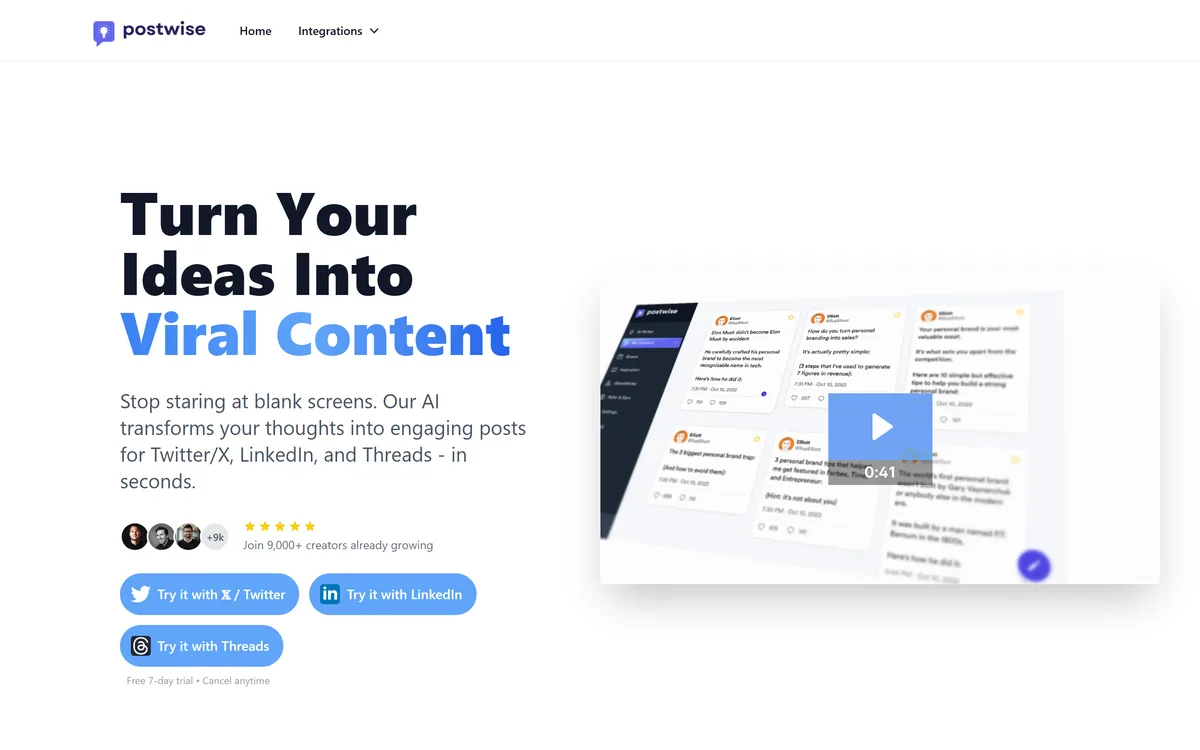
Postwise's homepage, captured 9 September 2026, showing the three-network posting positioning.
Postwise: Ideas Into Posts For Three Networks
Three networks from one dashboard — X, LinkedIn and Threads, each with content adapted to its format.
Batch creation and scheduling, which is the feature that actually keeps posting consistent.
Viral post repurposing and engagement tracking among the growth features.
9,000+ creators claimed, with a seven-day free trial and no card required to start.
XO Labs Ltd., with an affiliate program and comparison pages against eight named competitors.
Can An AI Write Posts That Actually Perform?
Postwise states that its AI has been trained on strong posts and engineered for engagement, and that you enter what you would like to say and it handles the rest.
The framing is honest about what it is doing, and it identifies the right bottleneck. Most people know what they want to say — the site's own line, you know exactly what you want to say, just not how to say it, is an accurate description of the problem.
There genuinely is craft to short-form writing. Where the hook goes, how long the first line is, whether to open with a claim or a question, when a line break does more than a sentence — these are learnable patterns and most people have not learned them.
A model trained on posts that performed can apply those patterns reliably, which is a real service and a modest one. It is formatting and structure rather than insight.
The limit is that structure amplifies a thought rather than supplying one. A well-shaped post about nothing performs worse than a badly formatted post containing something true, because readers are responding to the content — the same reason generated LinkedIn posts from tools like Phantomwriter succeed or fail on whether you had a view.
Structure amplifies a thought. It does not supply one, and a well-shaped post about nothing performs worse than an ugly post containing something true.
Why Viral Is The Wrong Target
The word viral appears throughout Postwise's marketing — viral content, viral post repurposing, viral-worthy posts.
It is worth being direct that optimising for virality is the least reliable strategy in social media, and not because the tooling is bad.
Virality is a distribution outcome determined by recommendation systems responding to early engagement, timing, what else was published that hour, and factors nobody outside those systems can observe. The same post published twice performs differently.
What is controllable is consistency, clarity and having a specific point of view. Those compound; virality does not, and a viral post that brings an audience with no reason to stay produces a follower count rather than a readership.
The healthier target is the one the site mentions almost in passing — building an audience systematically. That is a slower claim and a much more achievable one, and it is what batching and scheduling actually serve.
Scheduling Weeks In One Sitting
Postwise describes batch creating content in one session, scheduling it across platforms, and letting engagement grow while you focus on other things.
This is the most valuable feature in the product and it is described almost as an afterthought.
Daily posting fails for a structural reason: it requires a decision every day, and decisions are what get skipped when a day gets busy. The posts that never happen are always on the busy days, which are most of them.
Batching converts that into one decision a fortnight. An hour producing fourteen posts is a completely different commitment from fifteen minutes daily that keeps not happening, and it is the difference between a habit that survives and one that lasts three weeks.
The trade-off worth managing is topicality. A scheduled queue cannot respond to something that happened this morning, so the workable pattern is a scheduled base plus occasional live posts — which most people discover after a queue publishes something awkwardly timed.
Batch a fortnight at a time; daily decisions are what break the habit.
Keep a live slot for anything topical, since a queue cannot react.
Rewrite the per-platform versions rather than trusting automatic adaptation.
Target consistency rather than virality, which nobody controls.
Read your scheduled queue before it publishes, especially after news events.
Three Networks With Three Sets Of Rules
Postwise states that each platform gets content optimised for its unique audience and format across X, LinkedIn and Threads.
Those three are a well-chosen set because they are all text-first, which is what makes cross-posting plausible at all — a tool spanning TikTok and X would be attempting translation across media.
They still differ substantially. X rewards compression and a certain dryness; LinkedIn rewards a specific professional register that reads as try-hard elsewhere; Threads sits between them with conventions still settling.
The register mismatch is the most visible failure. A post written for LinkedIn's earnest tone posted verbatim on X gets mocked, and the reverse reads as flippant to a professional audience.
Automatic adaptation handles length and formatting well and register less well, so the practical advice is to treat the adapted versions as drafts. Two minutes rewriting the opening line for each network is usually the difference between a post that lands and one that is obviously repurposed.
If LinkedIn is where most of your effort goes, a specialist is worth comparing. Phantomwriter researches your audience and competitors before generating, which produces better angles at the cost of covering only one network — a narrower product doing more with what it covers.
What Posting Tools Cannot Do For You
It is worth being clear about the limits, because this category consistently oversells.
It cannot give you a reason to be followed. Attention goes to people with a specific point of view or genuine expertise, and consistently well-formatted posts from someone with neither produce consistent indifference.
It cannot do engagement. Replies, comments on other people's posts and conversations in messages are where audiences actually form, and publishing is the visible minority of the work.
It cannot prevent repetition. A system generating posts from your ideas will circle the same few points, and readers notice long before you do.
And it cannot fix the underlying position. Someone with nothing distinctive to say has a positioning problem rather than a content problem, which is the layer strategy tools such as Cleve address and no post generator can.
If your posting spans beyond text networks, the requirements change again. Products like Apaya cover seven channels including Instagram and Google Business, where the conventions and the media types differ enough that adaptation becomes translation rather than reformatting.
If your posting spans beyond text networks, the requirements change again. Products like Apaya cover seven channels including Instagram and Google Business, where the conventions and the media types differ enough that adaptation becomes translation rather than reformatting.
Building A Posting Habit That Survives
The pattern is always the same: three weeks of enthusiastic posting, a busy fortnight, and an account that has not updated since.
This sequence uses the tool for the part that actually breaks and keeps the part that matters human.
Collect ideas throughout the week rather than generating them at the keyboard.
Batch a fortnight of posts in one sitting, then schedule them.
Rewrite the opening line for each network yourself — register is where adaptation fails.
Keep one unscheduled slot a week for anything topical.
Read the queue before it publishes, particularly after anything happens in the news.
Spend as much time replying to other people as writing your own posts.
Is Postwise Worth It For Your Audience?
Batch your content when
Your posting stops every time a week gets busy.
You post to two or three of X, LinkedIn and Threads.
You have ideas but stall on turning them into finished posts.
Scheduling a fortnight in one sitting fits how you actually work.
You will edit the per-platform versions rather than posting them as generated.
Post manually when
Your posting is topical and a scheduled queue would be wrong by publication.
You are on networks this does not cover.
You would treat virality as the goal rather than consistency.
Your positioning is unclear, which no writing tool addresses.
Engagement rather than publishing is where your effort should go.
Postwise: Networks And Operator
Operating company
XO Labs Ltd.
Product type
AI social post writing and scheduling
Networks
X, LinkedIn and Threads
Positioning
Turn your ideas into viral content
Adaptation
Content optimised per platform's audience and format
Scheduling
Batch create and schedule across platforms from one dashboard
Growth features
Viral post repurposing and engagement tracking
Users
9,000+ creators claimed
Trial
Seven-day free trial, cancel anytime
Comparisons
Alternative pages published against Buffer, SocialPilot, Later, TweetDeck, Taplio, Hypefury and Tweet Hunter
What we could not confirm: pricing after the trial; which models generate the posts; how per-platform adaptation actually works beyond length and formatting; what viral post repurposing does mechanically; whether posting is direct or requires manual publishing; what engagement tracking measures; and where account credentials and post data are stored. We did not generate or schedule anything.
Editor's Verdict
3.6/5
The genuinely useful part of Postwise is the batching. Creating a fortnight of posts in one sitting and scheduling them is the mechanism that makes consistent posting survive a busy month, and consistency is what actually grows an audience. Covering X, LinkedIn and Threads from one dashboard with per-platform adaptation is sensible, since those three have genuinely different conventions. Where it loses ground is the framing — viral appears constantly, and optimising for virality is the least reliable strategy available, because the thing being optimised for is mostly outside anyone's control. AInexfinder Editor Score: 3.6/5.
Postwise pricing
AInexfinder does not list plan prices or billing details. For current pricing, plans, and trials, visit the official Postwise website.
Vendor pricing, credits, and billing policies change over time. Always confirm on the official site before you buy.
Frequently asked questions
What is Postwise?
Postwise turns an idea into posts for X, LinkedIn and Threads from one dashboard, with batch creation, cross-platform scheduling, viral post repurposing and engagement tracking. It states 9,000+ creators and is operated by XO Labs Ltd.
Can AI actually write posts that perform?
It can apply structure reliably, which is real and modest. Where the hook goes, how long the first line is, when a line break does more than a sentence — these are learnable patterns most people have not learned. It is formatting rather than insight.
Why is optimising for virality a mistake?
Because virality is a distribution outcome determined by recommendation systems, timing and what else was published that hour — factors nobody outside those systems can observe. The same post published twice performs differently.
What should I target instead?
Consistency, clarity and a specific point of view. Those compound; virality does not. A viral post bringing an audience with no reason to stay produces a follower count rather than a readership, which is a worse outcome dressed as a better one.
Which feature actually matters most?
Batching. Daily posting fails because it requires a decision every day, and decisions are what get skipped when a day gets busy — which is most days. An hour producing fourteen posts is a completely different commitment from fifteen minutes daily.
What is the downside of a scheduled queue?
It cannot react. Something happens in the morning and your queue publishes something written a fortnight ago that now reads badly. Keep one live slot a week, and read the queue before it publishes after anything happens in the news.
Does cross-posting between the three networks work?
Length and formatting adapt well; register does not. X rewards compression and dryness, LinkedIn rewards a professional tone that reads as try-hard elsewhere. Two minutes rewriting the opening line per network is usually the difference.
What can a posting tool not do?
Give you a reason to be followed, or do the engagement half. Attention goes to people with a specific point of view, and audiences form in replies and comments rather than in posts. Publishing is the visible minority of the work.
Will my posts start sounding the same?
Eventually, yes. A system generating from your ideas circles the same few points, and readers notice long before you do. Collecting ideas throughout the week rather than generating them at the keyboard is the main defence.
Who is Postwise not for?
Anyone whose posting is topical enough that a queue would be stale, anyone on networks it does not cover, and anyone whose real problem is positioning. Someone with nothing distinctive to say has a strategy problem no writing tool addresses.
Daniel reviews AI tools the slow way — by actually using them on real projects. His reviews cover what works, what breaks, and who each tool is genuinely a good fit for.
Daniel and the AInexfinder editorial team research Postwise using public product information, listing evidence, and (when available) hands-on checks. Scores reflect listing completeness and transparency — not paid placement.
Listings may include affiliate or sponsored placements, which are labeled when present. Editorial scores and cons are not sold. See our affiliate disclosure and review methodology.
Postiv packages LinkedIn strategy, drafting, carousel design, scheduling, analytics and comment replies into a single weekly ritual run by an assistant called Bob, working through the official LinkedIn API rather than a browser extension.
ViralBrain analyses LinkedIn creators you nominate as heroes, extracts the hooks, structures and calls to action behind their posts, and generates drafts in your own voice on a scheduled calendar. It publishes through LinkedIn's official API, offers an MCP server, and ships a large library of free single-purpose tools.
Velocity is a team of AI social-media agents for small businesses, agencies and multi-brand teams that research trends, draft on-brand captions and images, schedule and publish, and analyse results across Instagram, Facebook, YouTube, TikTok, LinkedIn, X and Bluesky.
Copy.ai has become an AI-native go-to-market platform: workflows and agents that run prospecting, lead processing, deal coaching, ABM, and CRM enrichment across Salesforce, HubSpot, Gong, Outreach, and 2,000+ integrations.