ViralBrain analyses LinkedIn creators you nominate as heroes, extracts the hooks, structures and calls to action behind their posts, and generates drafts in your own voice on a scheduled calendar. It publishes through LinkedIn's official API, offers an MCP server, and ships a large library of free single-purpose tools.
viralbrain.ai10 viewsAdded July 14, 20256K visitors
The honest problem with LinkedIn is that posting well is a learnable skill and almost nobody learns it, because the feedback loop is slow and the rules are unwritten.
ViralBrain's answer is to make the rules explicit. Pick creators whose posts land, let the tool pull apart what they are doing structurally, and write your own material into that shape.
That is a legitimate approach — formats are not private property — and it works better the more you understand what is actually being copied.
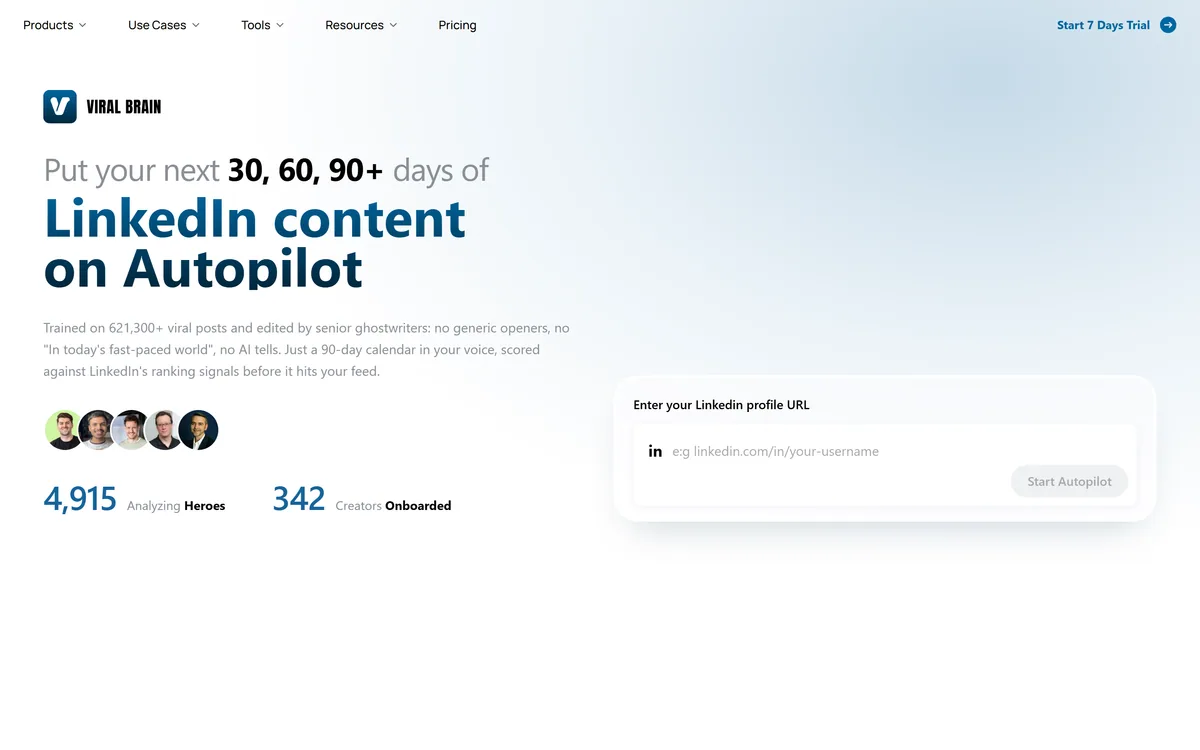
ViralBrain's homepage, captured 9 September 2026, showing the autopilot content calendar.
ViralBrain: LinkedIn Growth, Decoded
Hero analysis — nominate creators, and the tool extracts hooks, structures and tone from their recent posts.
Patterns, not words: you apply a structure that performed and write your own content into it.
Publishes via LinkedIn's official API on the top tier, rather than through a browser extension.
An MCP server for posting from Claude and other agent clients, plus 60 to 100-plus free single-purpose tools.
Two named founders who post publicly with it, and a company reachable at a humanoidz.ai address.
What Does Decoding Top Creators Actually Do?
ViralBrain describes itself as trained on hundreds of thousands of high-performing posts and states that it reverse-engineers the exact hooks, structures and calls to action, then rebuilds them for your topic.
The distinction that matters is between structure and substance, and it is worth being precise about it.
A structure is a shape: an opening line that withholds the point, three short paragraphs of build, a turn, a specific detail, a question at the end. That shape is a craft convention, not anyone's property, and studying it is what writers have always done.
Substance is the argument, the anecdote, the number, the thing only you know. Nothing in a pattern supplies that, and no tool can.
So the honest version of what this does is teach you form by example and leave the content to you. Used that way it is a genuine accelerant. Used the other way — same shape, borrowed insight, someone else's story rewritten — it produces the flat, familiar feed everyone complains about, and the tool cannot tell which you are doing.
A post's structure is a craft convention anyone can study. Its substance is the thing only you know. No pattern supplies the second.
Reading The Numbers On The Homepage
Several figures appear across the page and they measure different things, so it is worth separating them before they blur.
The recurring number in the thousands describes creators tracked and analysed. A separate, much smaller figure — in the hundreds — is the one the page attaches to creators using the product. Both appear near each other, and only the smaller one is about customers.
Two impression totals also appear, one describing what the training corpus covers and one describing what users have generated. They are not comparable and neither is dated.
The example post cards are worth reading carefully too: every one displays the same reaction, comment and repost counts, so those figures are placeholder styling rather than measured engagement.
None of this makes the product worse than it is. It does mean the mechanism deserves your attention and the headline arithmetic does not — which is the right way round to evaluate anything in this category, MaekerSuite and every other growth tool with a headline multiple included.
Heroes, Trending Posts And Pattern Reuse
The workflow runs in three moves the site names as decode, refine and post. You add heroes, the tool analyses their recent posts — stated as ten per hero on the free tier and twenty on a paid plan — and generation draws on both their structures and your own writing style.
Generation accepts an unusually wide set of starting points: a hero post, a YouTube video, an article, a Reddit thread, an image, a document, a voice note, a post you paste in, or nothing at all.
The voice note input is the most interesting of those and the least advertised. Talking through an idea produces different material from typing it, and the resulting post tends to carry the specifics that make writing worth reading.
A pattern banner then lets you apply a hero's structure, switch to another, or clear it and start from a blank shape — which is the right level of control, because it keeps the choice explicit rather than baked into every draft.
Trending topic discovery runs alongside, pulling from Reddit, X, Google and LinkedIn. Treat that as raw material rather than direction; commenting on whatever is trending is how a feed of interchangeable takes gets made — a trap that also catches Postwise users on other platforms.
Use voice notes as an input — spoken ideas carry specifics typing loses.
Apply a pattern deliberately, then clear it and compare.
Bring the substance yourself; the tool supplies the shape.
Read the free tools before paying for anything.
Check the API publishing tier if scheduling matters to you.
Founders Who Use Their Own Product
Two co-founders are named on the site with links to their LinkedIn profiles and their own impression totals, described as both using ViralBrain to grow on LinkedIn every day.
For a growth tool this is the single most useful signal available, and far more informative than any testimonial wall.
The reason is that LinkedIn is public. A founder claiming their tool grows an audience while posting rarely and getting no engagement is contradicted by the platform itself, in real time, at no cost to you.
Anyone evaluating this can therefore do something they cannot do with most software: open both profiles, read a month of posts, and judge whether the output reads like something you would want under your own name.
The customer testimonials on the page support this rather than replacing it — they name real people with follower counts and job titles, and those profiles are equally checkable. Verifiability, not volume, is what makes social proof worth anything here.
Publishing, MCP And The Compliance Question
ViralBrain states that it publishes through LinkedIn's official API rather than a browser extension, on a thirty-day calendar, with automatic posting available on its top tier and preview-and-copy on the lower ones.
That detail sounds procedural and is genuinely the most important compliance fact on the page.
Tools that automate LinkedIn through browser extensions operate by driving the interface as if it were you, which is the category of automation platforms move against periodically. When enforcement arrives it lands on the account, not the vendor.
Using the official API means the integration is sanctioned, rate-limited and revocable in the normal way. It also constrains what is possible, which is why extension-based tools can offer more and are worth less.
The MCP server is the forward-looking piece — posting to LinkedIn from an agent client rather than from the product's own interface. That is a sensible bet on where this workflow ends up, and a useful signal that the team is building for interoperability rather than lock-in. Video-first tools like Klap meet the same platform-terms question from the other side.
Growing On LinkedIn Without Sounding Copied
The failure mode with pattern tools is not that they do not work. It is that they work well enough to produce a feed of technically competent posts nobody remembers.
This sequence uses the mechanism for what it is good at and keeps the part that makes writing yours.
Pick heroes whose subject matter overlaps yours, not just their reach.
Read the extracted patterns before generating anything from them.
Bring one specific thing only you know to every post.
Record a voice note rather than typing when the idea is complex.
Rewrite the opening line yourself, every time.
Compare a month of output against the founders' own posts as a standard.
Key features of ViralBrain
Hero analysis of nominated LinkedIn creators
Pattern application from extracted post structures
Generation from video, article, Reddit, voice note, image or document
Post image generation across 12 styles
30-day content calendar with automatic publishing on the top tier
Publishing through LinkedIn's official API
A LinkedIn MCP server for agent clients
A large library of free single-purpose tools
Pros & cons
Pros
7
Extracts structure rather than text, which is the legitimate version of this idea
Pattern application is explicit and clearable rather than always on
Voice note input produces more specific material than typing
Publishes through LinkedIn's official API, which keeps the risk off your account
An MCP server signals interoperability rather than lock-in
Both founders post publicly with it, so the claim is checkable
The FAQ is unusually specific about tiers, limits and what each does
Cons
7
The headline creator figure describes posts analysed, not customers
Example post cards carry identical engagement counts, so they are placeholder
The four-times impressions claim has no stated methodology
Free tool counts differ between two places on the site
What we could not confirm: the basis for the four-times impression growth claim, which no methodology accompanies; how the creator counts on the page relate to one another, since the larger figure describes creators analysed and the smaller one creators using the product; whether the training corpus figures are current; what senior ghostwriters editing the output means operationally; the legal entity behind the humanoidz.ai contact address; and how LinkedIn's terms treat pattern-derived content. Plan prices are stated on the site and are not reproduced here. We did not connect a profile or publish a post.
Editor's Verdict
3.4/5
The mechanism here is sound and honestly explained: nominate creators whose posts work, let the tool extract the structure rather than the words, and write your own content into that shape. The FAQ is unusually specific for this category, publishing goes through LinkedIn's official API rather than a browser extension, and both founders post publicly using it. What holds the score down is the marketing around that mechanism — a headline creator count that describes posts analysed rather than customers, placeholder engagement figures on the example cards, and a four-times-reach promise with no method attached. AInexfinder Editor Score: 3.4/5.
ViralBrain pricing
AInexfinder does not list plan prices or billing details. For current pricing, plans, and trials, visit the official ViralBrain website.
Vendor pricing, credits, and billing policies change over time. Always confirm on the official site before you buy.
Frequently asked questions
What is ViralBrain?
A LinkedIn content platform that analyses creators you nominate as heroes, extracts the hooks and structures behind their posts, and generates drafts in your own voice on a scheduled calendar. It also ships a large set of free single-purpose LinkedIn tools.
What does it actually copy?
Structure, not substance. A pattern is the shape of a post — an opening that withholds the point, a build, a turn, a close. That is a craft convention rather than anyone's property. The argument, the anecdote and the number still have to be yours.
Is copying post patterns acceptable?
Studying form is what writers have always done, and formats are not owned. The line is substance: reusing someone's structure is craft, rewriting their insight or their story as your own is not, and no tool can tell which you are doing.
How many creators use it?
Read the page carefully — the large figure in the thousands describes creators tracked and analysed, while a much smaller figure in the hundreds is the one attached to creators using the product. Only the second is about customers.
Are the example post engagement numbers real?
Every example card on the page displays the same reaction, comment and repost counts, so treat those as placeholder styling rather than measured engagement. The named creators are real; the numbers beneath them are not data.
Why does publishing via the official API matter?
Because browser-extension automation drives the interface as if it were you, and when a platform acts against that category, the consequence lands on your account rather than the vendor's. A sanctioned API integration is the safer route.
What is the MCP server for?
Posting to LinkedIn from an agent client such as Claude rather than from ViralBrain's own interface. It is a sensible bet on where this workflow is heading, and a signal the team is building for interoperability.
Which input should I use?
Voice notes, more often than you would expect. Talking through an idea produces different material from typing it, and spoken thinking tends to keep the specifics that make a post worth reading rather than merely well-shaped.
How do I judge the output quality?
Read the founders' own LinkedIn profiles. Both are named on the site with links, and both state they post with it daily — so you can read a month of real output and decide whether it sounds like something you would sign.
Will it four-times my reach?
That claim appears on the site without a stated method, and reach depends far more on your network, subject and consistency than on any tool. The credible benefit is that structure and scheduling make consistency achievable.
Daniel reviews AI tools the slow way — by actually using them on real projects. His reviews cover what works, what breaks, and who each tool is genuinely a good fit for.
Daniel and the AInexfinder editorial team research ViralBrain using public product information, listing evidence, and (when available) hands-on checks. Scores reflect listing completeness and transparency — not paid placement.
Listings may include affiliate or sponsored placements, which are labeled when present. Editorial scores and cons are not sold. See our affiliate disclosure and review methodology.
Postiv packages LinkedIn strategy, drafting, carousel design, scheduling, analytics and comment replies into a single weekly ritual run by an assistant called Bob, working through the official LinkedIn API rather than a browser extension.
Velocity is a team of AI social-media agents for small businesses, agencies and multi-brand teams that research trends, draft on-brand captions and images, schedule and publish, and analyse results across Instagram, Facebook, YouTube, TikTok, LinkedIn, X and Bluesky.
Copy.ai has become an AI-native go-to-market platform: workflows and agents that run prospecting, lead processing, deal coaching, ABM, and CRM enrichment across Salesforce, HubSpot, Gong, Outreach, and 2,000+ integrations.
Writesonic has become an AI search growth platform — tracking whether your brand appears across 10 AI platforms, running optimisation and citation work through an Action Center, and reporting results against traffic and revenue.