
Copy.ai has become an AI-native go-to-market platform: workflows and agents that run prospecting, lead processing, deal coaching, ABM, and CRM enrichment across Salesforce, HubSpot, Gong, Outreach, and 2,000+ integrations.
FreemiumWriting & Content
LogicBalls is an AI writing and content platform whose central idea is verification before generation — it asks clarifying questions rather than assuming intent. It offers thousands of task-specific tools across writing, research, analysis and explanation, and claims 15M+ clarified generations.
Almost every disappointing AI output has the same cause. You asked for something, the model filled in a dozen unstated assumptions, and it filled them in differently from how you would have.
The usual fix is on you: write a better prompt, specify more, learn the incantations. That works and it puts the burden in the wrong place, because you often do not know which assumptions mattered until you see the wrong answer.
LogicBalls inverts that. Its stated design is to ask before it assumes — a clarifying question first, generation second.
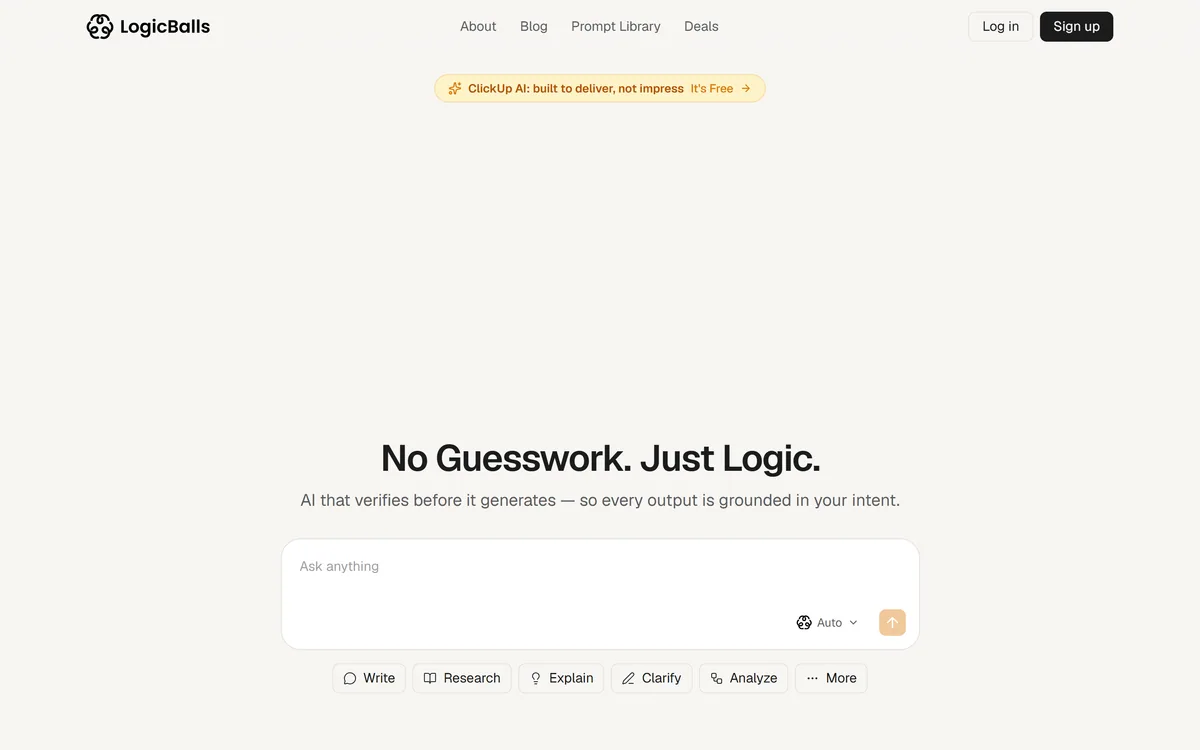
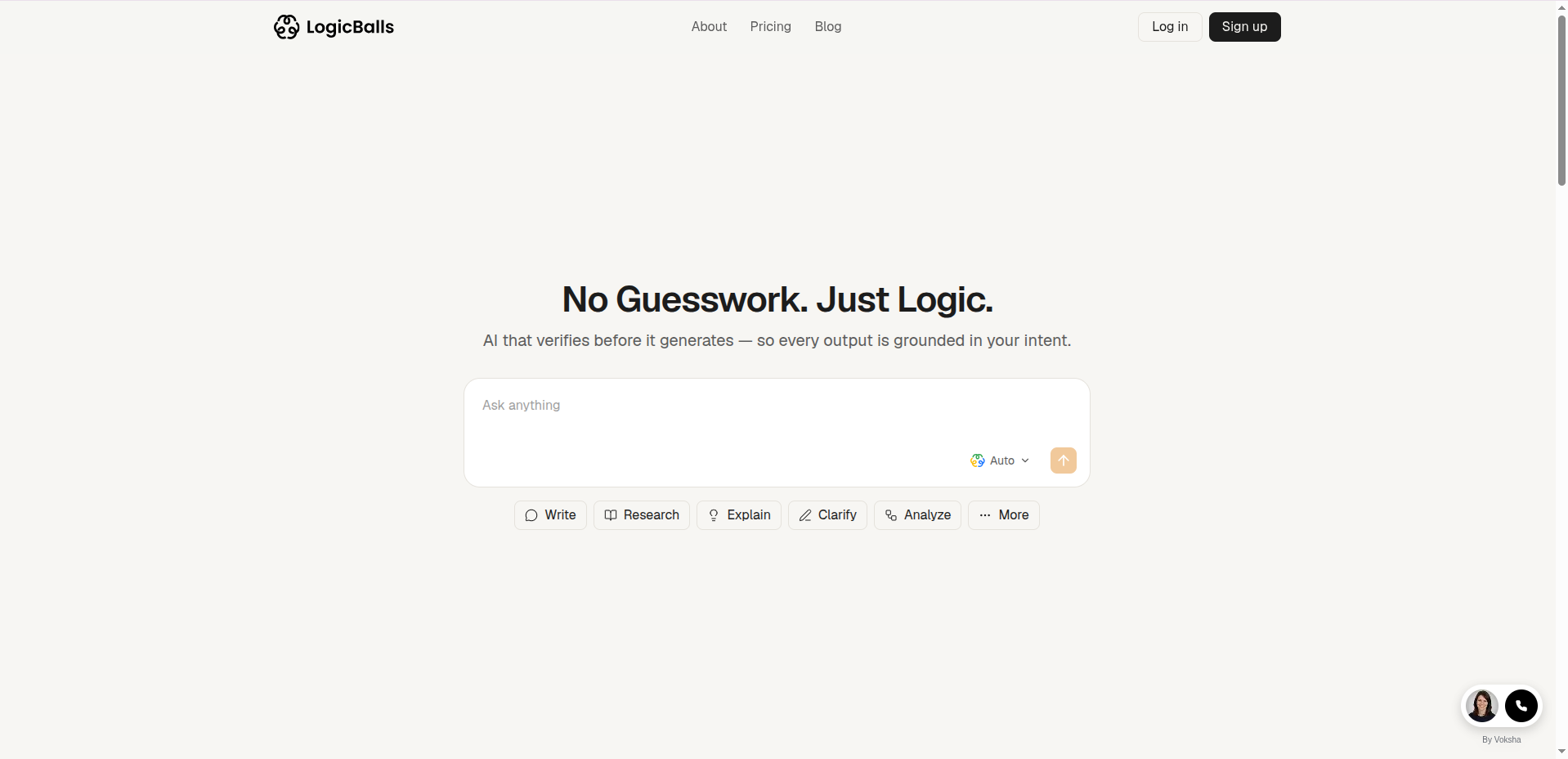
LogicBalls positions itself as AI that verifies before it generates, so every output is grounded in your intent, under the line no guesswork, just logic.
This is a better diagnosis of the problem than most products offer. The gap between what you asked for and what you wanted is where AI output fails, and it is rarely a model capability issue.
A single clarifying question often resolves it entirely. Who is this for, how long should it be, what should it not say — three questions that take ten seconds and change the output completely.
It also fixes an asymmetry in how people work. Experienced users front-load all that context automatically; everyone else types one line and is disappointed, and the difference between them is not intelligence but habit.
The risk is over-questioning. A system that interrogates you before every trivial request becomes exhausting fast, and the interesting engineering problem here is knowing when not to ask — which is exactly what a demo will not show you.
You often do not know which assumptions mattered until you see the wrong answer. That is why asking beats prompting harder.
The interface exposes Auto, Write, Research, Explain, Clarify and Analyze as distinct modes rather than a single undifferentiated prompt.
Naming the mode changes what the system optimises for, and those six tasks genuinely want different behaviour.
Research should be cautious, cite where it can and admit uncertainty. Write should be fluent and committed. Explain should adapt to what you already know. Those are contradictory objectives, and a single mode necessarily compromises between them.
The clearest example is confidence. You want a research answer to hedge where the evidence is thin and a piece of copy not to hedge at all, and a system that cannot tell which you are doing will get one of them wrong every time.
Auto exists for the case where you do not want to choose, which is most of the time. The honest test is whether Auto picks correctly often enough that the other five are rarely needed.
The site advertises 5,000+ smart tools across every need, with tiers offering access to 2,000+ or 5,000+ of them.
A tool count in the thousands is not a product specification, it is a marketing surface, and it is worth being clear about what generates such a number.
These catalogues are almost always the same underlying model wrapped in different prompt templates with different names. A cover letter generator, a product description generator and an email subject line generator are one system and three labels.
That is not deceptive and it is genuinely convenient — a pre-written prompt for a specific task saves you writing one, and a menu is easier to browse than a blank box.
But it means the count tells you nothing about quality. Five thousand templates over a weak model is worse than fifty over a strong one, which is why the tier structure — which names how many underlying models each level supports — is a more informative specification than the tool count.
The published figures are 15M+ clarified AI generations, 200K+ students, researchers and creators, and 5,000+ tools.
The most interesting of the three is the first, because of the word clarified. Counting generations that went through the clarification step is a claim about how the product is actually used, not just how many times a button was pressed.
Taken at face value it suggests the clarifying behaviour is not an optional mode people ignore, which would be the obvious failure — a good idea buried behind a setting nobody changes.
The 200K+ user figure describes a mid-sized consumer product, and naming students and researchers first tells you where the traffic comes from. That is a different audience from professional writers, with different expectations about depth.
The tier names — Free, Pro, Premium, Elite — with escalating model access is the specification a buyer should actually read. Which models each tier reaches determines output quality far more than how many templates it unlocks.
A platform that does thousands of things is by construction not the best at any of them, and knowing where that bites saves disappointment.
Domain depth is the first gap. A generalist tool writing product descriptions has no view of your catalogue, your brand rules or your regulatory constraints — which is exactly what dedicated systems such as Describely exist to hold.
Workflow integration is the second. Generalist platforms produce text you then copy somewhere else, and the copying is where volume work breaks down.
Governance is the third. Enforcing that certain claims are never made, or that a specific voice is always used, requires stored rules rather than per-request prompts, and template catalogues rarely provide that.
The place a generalist genuinely wins is variety at low volume — a person who needs twenty different kinds of writing a month and none of them at scale. That is a real and common situation, and it is who this is for.
The comparison worth making is against tools that do one writing job properly. Scribeist assumes longer-form structure; Cover Letter Copilot assumes a resume and a job description. Each knows something about its task that a general template cannot encode, and that knowledge is what a catalogue trades away for breadth.
The way people waste a platform like this is browsing the tool catalogue instead of finishing a task.
This sequence tests the thing that actually differentiates it and ignores the thing that does not.
| Product type | AI writing and content platform |
|---|---|
| Positioning | AI that asks before it assumes; no guesswork, just logic |
| Core design | Verification before generation, grounded in stated intent |
| Modes | Auto, Write, Research, Explain, Clarify, Analyze |
| Tools | 5,000+ smart tools across writing, research and analysis |
| Generations | 15M+ clarified AI generations claimed |
| Users | 200K+ students, researchers and creators |
| Tiers | Free, Pro, Premium and Elite, with escalating model access |
| Model access | From 3 free models up to 31 at the top tier, per the site |
| Extras | Prompt library, chat assistant, bookmarkable apps |
| Address | 415 Mission St, San Francisco, CA 94105 |
| Attribution | By Voksha, per the footer |
| Copyright | © 2026 LogicBalls |
Clarifying questions before generation
Six named modes including Research, Explain and Analyze
Thousands of task-specific tool templates
Access to multiple underlying models by tier
A chat assistant
A prompt library
Bookmarkable favourite apps
A published free tier
Writing tools differ by whether they hold domain context, enforce rules, or simply generate.
| Tool | What it holds | Breadth | Best for |
|---|---|---|---|
| LogicBalls | Your stated intent, per request | Very broad — thousands of templates | Varied writing at low volume |
| Describely | Your catalogue and content rules | Narrow — ecommerce copy | Product content at scale |
| Scribeist | Longer-form structure | Moderate | Article and content writing |
| WriteMail.ai | Email context | Narrow | Composing messages specifically |
| SEO.AI | Search intent and keywords | Narrow | Content aimed at search |
Adjacent products for writing that holds more context than a single request.
Last checked . Read from logicballs.com in a browser session on the date above, with the screenshot captured alongside.
What we could not confirm: which specific models each tier provides access to, which is the specification that determines output quality; how the clarification step decides when to ask and when not to; what a clarified generation is counted as; whether the 5,000+ tools are distinct systems or prompt templates over the same models, though the tier structure suggests the latter; and how content submitted for generation is retained. We did not generate anything.
The premise is genuinely good and slightly at odds with the product around it. Asking a clarifying question before generating addresses the actual reason AI output disappoints — the model guessed at what you meant and guessed wrong — and doing it by default rather than waiting for you to notice is the right instinct. What sits awkwardly beside that is a catalogue of thousands of tools, which is the opposite kind of design: breadth as a headline number rather than depth in a few things. Judge it on whether the clarifying questions are good ones, and ignore the count entirely. AInexfinder Editor Score: 3.5/5.
AInexfinder does not list plan prices or billing details. For current pricing, plans, and trials, visit the official LogicBalls website.
Visit official website for pricingVendor pricing, credits, and billing policies change over time. Always confirm on the official site before you buy.
Log in to write a review.
No reviews yet. Be the first to share your experience with LogicBalls.
Assigned reviewer
Daniel ReedSenior AI Tools Reviewer
Daniel reviews AI tools the slow way — by actually using them on real projects. His reviews cover what works, what breaks, and who each tool is genuinely a good fit for.
Daniel and the AInexfinder editorial team research LogicBalls using public product information, listing evidence, and (when available) hands-on checks. Scores reflect listing completeness and transparency — not paid placement.
Copy.ai has become an AI-native go-to-market platform: workflows and agents that run prospecting, lead processing, deal coaching, ABM, and CRM enrichment across Salesforce, HubSpot, Gong, Outreach, and 2,000+ integrations.

Writesonic has become an AI search growth platform — tracking whether your brand appears across 10 AI platforms, running optimisation and citation work through an Action Center, and reporting results against traffic and revenue.
Smartcat combines AI translation across 280+ languages with a CAT tool, translation memory, a marketplace of 500,000+ linguists, and AI agents for writing, auditing and maintaining content — integrated with Figma, Contentful, WordPress, Git and Salesforce.

Jasper has moved from AI copywriting to orchestrating marketing agents, with 100+ specialised agents, Content Pipelines, the Jasper IQ context hub, Jasper Studio for custom agents, and brand governance across everything a marketing team produces.
Spiral, a product from Every, uses stylometry to build a voice profile from your existing writing, then drafts tweets, blog posts, LinkedIn updates and newsletters in that voice. It adds shareable team styles, a knowledge base, and MCP and API access.
neuroflash is a German audience intelligence and AI content platform. Alongside its ChatFlash, ContentFlash and ImageFlash modules it runs Digital Twins — simulated respondents built on over a million real survey profiles — for testing copy before it ships.