
Copy.ai has become an AI-native go-to-market platform: workflows and agents that run prospecting, lead processing, deal coaching, ABM, and CRM enrichment across Salesforce, HubSpot, Gong, Outreach, and 2,000+ integrations.
FreemiumWriting & Content
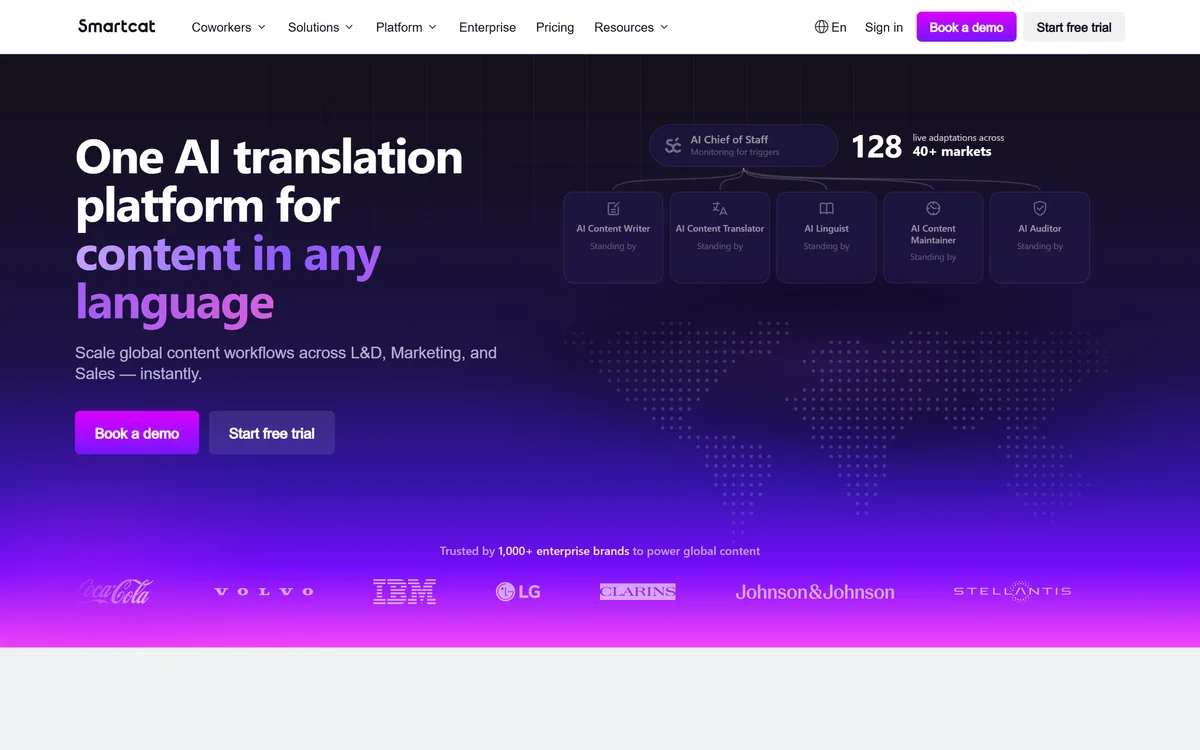
Smartcat combines AI translation across 280+ languages with a CAT tool, translation memory, a marketplace of 500,000+ linguists, and AI agents for writing, auditing and maintaining content — integrated with Figma, Contentful, WordPress, Git and Salesforce.
Smartcat translates content, but describing it as a translation tool undersells what it actually is. Machine translation is a commodity now — free, instant, and good enough for understanding a page.
What is not commoditised is publishing translated content responsibly at scale: keeping terminology consistent, routing work to a human when the stakes justify it, and getting the result back into the system it came from.
This review covers the CAT tooling and translation memory that make consistency possible, what the AI agents add, how the linguist marketplace fits, and where AI translation still cannot be trusted.
AI translation across 280+ languages
Advanced CAT tool with translation memory and glossaries
Marketplace of language professionals inside the same platform
AI Content Maintainer keeping translated content current as sources change
AI Auditor for consistency checks across a content body
Website, document, and video translation
Integrations spanning Figma, Contentful, WordPress, Git, Jira, and Salesforce
Payment automation for managing linguist work
Translation, dubbing, and captioning are different problems that get grouped together.
| Tool | Handles | Human review built in | Best fit |
|---|---|---|---|
| Smartcat | Text localisation at scale, 280+ languages | Yes — marketplace in-platform | Companies publishing content in many languages |
| ElevenLabs | Speech, dubbing, and voice | No | Translating spoken audio and video |
| Zeemo | Video captions and caption translation | No | Social video subtitling |
| Lokalise | Software string localisation | Via integrations | Product UI strings specifically |
| Claude | Ad-hoc translation of a document | No | One-off translation with no memory or workflow |
| Company | Smartcat Platform Inc., Wilmington, Delaware |
|---|---|
| Category | AI translation and localisation platform |
| Language coverage | 280+ languages |
| Linguist marketplace | Smartcat states 500,000+ language professionals |
| AI agents | AI Translation, Content Writer, Content Translator, Linguist, Content Maintainer, Auditor, Chief of Staff |
| Translation tooling | Advanced CAT tool with translation memory and glossaries |
| Content surfaces | Website Translator, document and video translation |
| Design and CMS | Figma, Contentful, WordPress and WPML, Drupal, Akeneo, Salsify, Lokalise |
| Developer and ops | Git, Bitbucket, Jira, Google Drive, Dropbox, Google Sheets |
| Business systems | Salesforce, Slack, Gmail, Google Docs |
| Named customers | Stanley Black & Decker, Smith+Nephew, Babbel, Wunderman Thompson, Kids2 |
| Compliance | Smartcat states SOC II compliance |
| Free trial | Yes |
The feature that matters most is the one nobody markets. Translation memory stores every segment you have translated before, so the same sentence is never translated twice and never translated differently.
For a company with a product, that consistency is the whole game. A term rendered three ways across a manual, a website, and a support article is not three translations — it is a support problem and, in regulated sectors, a compliance one.
Glossaries sit alongside it, pinning the terms you insist on. AI translation without either produces fluent output that drifts, which is worse than obviously wrong output because nobody catches it.
Machine translation is free. Translating the same term the same way for five years is what you actually pay for.
Smartcat exposes several named agents, which map to stages of a localisation workflow rather than to one general capability.
Of that list, Content Maintainer addresses the problem that quietly ruins most localisation programmes.
Translating a website once is a project with an end. Keeping twelve language versions current as the English source changes weekly is an unbounded commitment, and it is where localisation efforts usually decay into stale pages nobody has audited in two years.
Automating the detection of what has drifted out of date is more valuable than making the initial translation faster, because the initial translation was never the expensive part.
Smartcat states a marketplace of more than 500,000 language professionals, reachable inside the same platform that produced the AI draft.
That integration is the point. The usual pattern — machine translate, export, email an agency, wait, reimport — loses the translation memory, the glossary, and the version history at every handoff.
The judgement about when to involve a person is straightforward, and worth setting as policy rather than deciding case by case.
The integration list is unusually broad — Figma, Contentful, WordPress, Drupal, Akeneo, Salsify, Git, Bitbucket, Jira, Salesforce, Slack, Google Docs, Drive, Sheets, Gmail, Dropbox.
Figma is the one worth noticing. Catching localisation problems at the design stage, when German text is 30% longer than English and breaks the layout, is far cheaper than discovering it after the build.
Git and Bitbucket matter for product strings, where translation lives in a repository rather than a CMS. Together these determine whether translation happens where content is authored or in a separate system somebody has to remember to update.
Fluency is not accuracy, and this is the trap. Modern machine translation produces confident, grammatical output that can quietly reverse a meaning — and a reviewer who does not speak the target language cannot tell.
Quality varies enormously across the 280-language range. Major European and Asian language pairs are excellent; low-resource languages are substantially weaker, and the platform does not visibly flag which is which.
Cultural adaptation is beyond it. Idiom, humour, and things that are merely tone-deaf rather than incorrect need a person from that market.
And the platform is a genuine system, not an app. Translation memory, glossaries, workflows, and integrations all need configuring, so value arrives after setup rather than on day one.
Text is only one of the things that needs translating.
Last checked . Read from smartcat.com during this check, with the screenshot above captured at the same time.
Observations about machine translation fluency and low-resource language quality describe the technology generally, not Smartcat's implementation specifically.
Smartcat has an AInexfinder Editor Score of 4.4/5.
AInexfinder does not list plan prices or billing details. For current pricing, plans, and trials, visit the official Smartcat website.
Visit official website for pricingVendor pricing, credits, and billing policies change over time. Always confirm on the official site before you buy.
Log in to write a review.
No reviews yet. Be the first to share your experience with Smartcat.
Assigned reviewer
Daniel ReedSenior AI Tools Reviewer
Daniel reviews AI tools the slow way — by actually using them on real projects. His reviews cover what works, what breaks, and who each tool is genuinely a good fit for.
Daniel and the AInexfinder editorial team research Smartcat using public product information, listing evidence, and (when available) hands-on checks. Scores reflect listing completeness and transparency — not paid placement.
Copy.ai has become an AI-native go-to-market platform: workflows and agents that run prospecting, lead processing, deal coaching, ABM, and CRM enrichment across Salesforce, HubSpot, Gong, Outreach, and 2,000+ integrations.

Writesonic has become an AI search growth platform — tracking whether your brand appears across 10 AI platforms, running optimisation and citation work through an Action Center, and reporting results against traffic and revenue.
LogicBalls is an AI writing and content platform whose central idea is verification before generation — it asks clarifying questions rather than assuming intent. It offers thousands of task-specific tools across writing, research, analysis and explanation, and claims 15M+ clarified generations.

Jasper has moved from AI copywriting to orchestrating marketing agents, with 100+ specialised agents, Content Pipelines, the Jasper IQ context hub, Jasper Studio for custom agents, and brand governance across everything a marketing team produces.
Spiral, a product from Every, uses stylometry to build a voice profile from your existing writing, then drafts tweets, blog posts, LinkedIn updates and newsletters in that voice. It adds shareable team styles, a knowledge base, and MCP and API access.
neuroflash is a German audience intelligence and AI content platform. Alongside its ChatFlash, ContentFlash and ImageFlash modules it runs Digital Twins — simulated respondents built on over a million real survey profiles — for testing copy before it ships.