TTSReader turns text, PDFs, and EPUB files into speech in the browser, with voice and language selection, speed control, text highlighting, and MP3 export — the free tier runs on browser voices with no usage cap.
FreemiumVideo & Audio

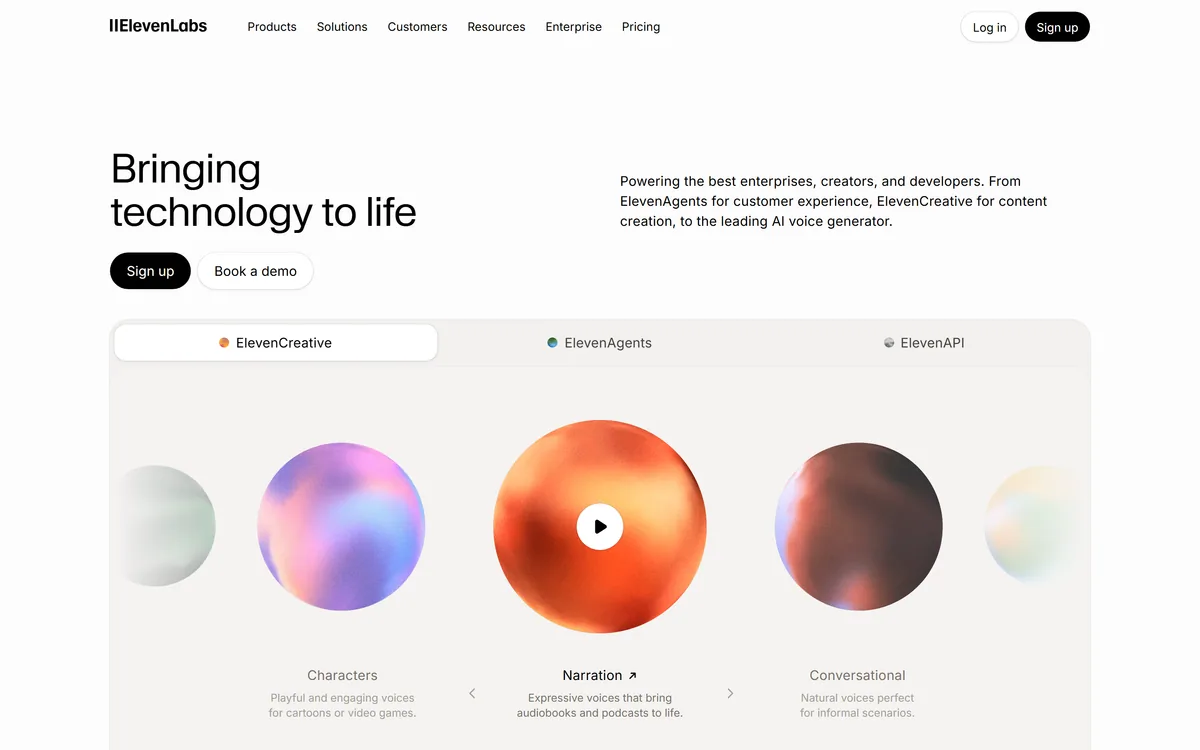
ElevenLabs is an AI audio platform covering text to speech, voice cloning, speech recognition, dubbing, music, and conversational voice agents, with a library of 5,000+ voices across more than 70 languages and an API behind every model.
ElevenLabs makes synthetic speech that does not sound synthetic. It began as a text-to-speech engine and has widened into an audio platform covering transcription, dubbing, sound effects, music, and real-time voice agents.
The voice quality is the reason it is talked about. Prosody, emphasis, and pacing land closer to a human read than most competitors manage, which is exactly what matters for audiobooks, ads, and characters.
This review walks through the model line-up, what each part is genuinely good at, the safeguards around voice cloning, and the constraints worth planning around before you build on it.
| Category | AI voice, audio, and conversational agent platform |
|---|---|
| Voice library | 5,000+ voices |
| Language coverage | 70+ languages across the platform |
| Speech models | Eleven v3, Eleven Multilingual v2, Eleven Flash |
| Transcription | Scribe v2, with vendor-stated accuracy around 98% |
| Other models | Dubbing v2, Music v2, sound effects, voice changer |
| Agent product | ElevenAgents, including an expressive conversational mode |
| Developer access | REST APIs and SDKs for text to speech, speech to text, and music |
| Free plan | Yes |
| Named customers | Twilio, Disney, Stripe, Meta, Zoom, IBM, Salesforce |
ElevenLabs ships several speech models rather than one, and choosing badly is the most common cause of disappointing output. The trade-off is expressiveness against latency.
Eleven v3 is the most expressive model, and the right pick when the read carries emotion — narration, characters, advertising. It is the model that makes people stop and check whether a clip was recorded.
Expressiveness costs time to generate, so it suits produced audio rather than anything answering in real time.
Flash trades some nuance for speed. It is the model behind responsive experiences — a voice agent answering a caller cannot pause to think, and a delay reads as a broken product.
For conversational work, Flash-class latency matters more than the last few percent of expressiveness.
Multilingual v2 covers the breadth case, where one voice needs to speak many languages consistently. It underpins the platform's 70+ language coverage across a library of more than 5,000 voices.
Cloning is the platform's headline capability and its biggest liability, and ElevenLabs treats it that way. You can build a voice from recorded audio and then have it read anything you write.
The controls are real: moderation, provenance tracking, and stated accountability for misuse. Cloning a voice you do not have permission to use is a policy violation, not a grey area, and the provenance layer exists so generated audio can be traced.
For legitimate work — an author narrating their own book, a brand keeping one voice across markets — this is the strongest offering available. Just budget time for consent and rights paperwork rather than treating it as a technical task alone.
Scribe v2 handles the opposite direction, turning audio into text. The vendor states accuracy around 98%, which lands it among the stronger options for clean recordings.
Real-world accuracy always depends on audio quality, overlapping speakers, and accents, so treat a headline figure as a ceiling rather than a guarantee. Budget review time for anything being published or quoted.
Having transcription in the same account as synthesis is more useful than it first sounds. Transcribe an existing recording, edit the text, and regenerate it in a cloned voice — corrections stop requiring the original speaker to book studio time again.
The honest comparison is not quality any more — it is control and turnaround. A script change at 11pm is a five-minute regeneration rather than a new session, and that flexibility is what usually decides the matter.
Human performers still win where interpretation carries the work: comedy timing, emotional range across a long arc, and anything where a director wants to shape a take in the room.
Many teams end up using both — synthesis for volume, iteration, and localisation, and a person for the flagship read that sets the tone.
Dubbing v2 translates and re-voices video, keeping a recognisable voice across languages — the practical answer for a channel that wants one library to work in several markets.
Music v2 generates original tracks, and the sound effects model produces short cues from a description. Together with a voice changer, these cover most of what a small production team would otherwise licence or record.
ElevenAgents is the conversational layer: an agent that listens, decides, and speaks back, with an expressive mode for delivery that is not flat. This is where ElevenLabs competes with contact-centre and support tooling rather than with audio apps.
Guardrails cover behavioural and compliance rules, which is the part that makes a voice agent deployable in a regulated setting rather than a demo. The named customer list — Twilio, Disney, Stripe, Meta, Zoom, IBM, Salesforce — skews toward exactly this kind of production use.
There is also an ElevenLabs for Government offering for public-sector requirements.
Every major capability is available through an API, with SDKs for common languages, so the web apps are a convenience rather than the product. Teams typically prototype in ElevenCreative and then move to the API.
That API-first shape is why ElevenLabs shows up inside other products so often. If you are building audio into an application rather than producing files by hand, this is the surface that matters.
Usage is metered by audio generated, and long-form work consumes quota quickly. An audiobook is a very different budgeting exercise from a handful of ad reads, and the free plan will not tell you much about either.
Quality is uneven across languages. English is excellent; less-resourced languages are noticeably weaker, so verify your specific language before committing to a localisation plan.
Expressive models are slower, non-English pronunciation of names and technical terms often needs manual correction, and voice cloning carries consent obligations that no feature toggle removes.
ElevenLabs is the default choice for AI audio quality, and the platform has grown well past its original single trick. Text to speech, transcription, dubbing, music, and voice agents now sit behind one API.
Pick it when the audio is the product — narration, characters, advertising, localisation, or a voice agent people will actually talk to. Be more cautious if your target language is poorly resourced, if long-form volume makes metering painful, or if you cannot document consent for a cloned voice.
Check elevenlabs.io for current plans and quota limits, and test your own language and script before you commit a production pipeline to it.
Text to speech across Eleven v3, Multilingual v2, and Flash models
Voice cloning with moderation and provenance tracking
Scribe v2 speech-to-text transcription
Dubbing v2 for translated, re-voiced video
Music v2 plus a generated sound effects model
ElevenAgents conversational voice agents with compliance guardrails
REST APIs and SDKs behind every model
ElevenLabs has an AInexfinder Editor Score of 4.7/5.
AInexfinder does not list plan prices or billing details. For current pricing, plans, and trials, visit the official ElevenLabs website.
Visit official website for pricingVendor pricing, credits, and billing policies change over time. Always confirm on the official site before you buy.
Log in to write a review.
No reviews yet. Be the first to share your experience with ElevenLabs.
Assigned reviewer
Daniel ReedSenior AI Tools Reviewer
Daniel reviews AI tools the slow way — by actually using them on real projects. His reviews cover what works, what breaks, and who each tool is genuinely a good fit for.
Daniel and the AInexfinder editorial team research ElevenLabs using public product information, listing evidence, and (when available) hands-on checks. Scores reflect listing completeness and transparency — not paid placement.
TTSReader turns text, PDFs, and EPUB files into speech in the browser, with voice and language selection, speed control, text highlighting, and MP3 export — the free tier runs on browser voices with no usage cap.
VMEG from PixRipple translates and dubs video into 170+ languages using 17,000+ voices, with voice cloning, lip-sync, subtitle generation, batch processing, and API and MCP access for automated localisation.
Respeecher is an enterprise voice cloning and text-to-speech platform used in film, television and games. Its credits include young Luke Skywalker in The Mandalorian and Viktor Vektor in Cyberpunk 2077, and it requires documented performer consent before a voice is used.
Phonely AI builds AI agents that handle phone calls, chat and SMS at scale. Its own model, Alma, is quoted at 182ms to first token against 490ms for GPT-4.1, with 1,000+ voices, 100+ languages and SOC 2, HIPAA and PCI compliance.

The workspace at www-flux3.com generates 5–20 second AI videos with native audio from text or a starting image, routing across FLUX 3, MiniMax H3, Seedance, Wan 3.0 and Kling 3.0 Pro, at 720p or 1080p with video extension.

Runway is an AI video platform built around generative world models — Gen-4.5, Aleph 2.0, and Act-Two for performance capture — split across Runway Creative for filmmakers, Runway Dev for builders, and Runway Robotics.