
TTSReader turns text, PDFs, and EPUB files into speech in the browser, with voice and language selection, speed control, text highlighting, and MP3 export — the free tier runs on browser voices with no usage cap.
FreemiumVideo & Audio
Phonely AI builds AI agents that handle phone calls, chat and SMS at scale. Its own model, Alma, is quoted at 182ms to first token against 490ms for GPT-4.1, with 1,000+ voices, 100+ languages and SOC 2, HIPAA and PCI compliance.
Text chat forgives a pause. You send a message, you look away, the reply arrives — a second either way is invisible. A phone call forgives nothing. Half a second of silence after you finish speaking and the person on the other end assumes the line dropped, starts talking again, or realises they are speaking to a machine.
That is why voice AI is a latency problem before it is an intelligence problem, and why Phonely leads with a number most platforms bury: 182 milliseconds to first token from its own model, Alma, against a quoted 490ms for GPT-4.1.
This review covers why that gap matters more than model quality, what turn-taking actually means on a call, why the compliance list determines who can deploy this at all, and how it compares with CloudTalk and support platforms like Forethought.
This is counterintuitive and it is the single most important thing to understand about voice agents.
In human conversation, the gap between one person stopping and the next starting is roughly 200 milliseconds. It is remarkably consistent across languages and cultures, and we are exquisitely sensitive to it. A longer gap reads as hesitation, confusion, or a bad connection — before any words arrive to be judged.
So a voice agent that responds in 490ms is not a slightly slower agent. It is one that sounds wrong on every single turn, no matter how good the answer is. A quoted 182ms sits inside the range a human would produce, which is the difference between a conversation and an interrogation of a machine.
This is why building a proprietary model makes sense here when it would not elsewhere. General-purpose models optimise for capability; a voice agent needs the first syllable out fast enough that the silence never registers, and that is a different engineering target.
The honest caveat: 182ms is Phonely's own published figure for its own model against a named competitor. Treat it as a claim to test on a real call rather than a benchmark result — and test it on a call with a bad mobile connection, not a studio one.
Human conversation leaves about 200ms between turns. Miss that window and your agent sounds broken before it has said anything.
Speed alone does not make a call natural. The harder problem is knowing when to speak.
Humans signal the end of a turn with intonation, pacing and grammar — and frequently pause mid-sentence while thinking without surrendering the floor. An agent that treats every silence as its cue interrupts constantly; one that waits too long leaves dead air.
"Natural turn-taking" as a named feature means the system is trying to model this rather than using a fixed silence threshold, and it is worth testing specifically. Read a sentence with a long thinking pause in the middle and see whether the agent jumps in.
The 1,000+ voices with cloning matter less than people assume. Voice quality is largely solved; a synthetic voice that sounds good is table stakes. Timing is where agents still give themselves away, and it is what you should evaluate on.
SOC 2, GDPR, CCPA, HIPAA and PCI. That combination is unusual and it explains the named target industries.
HIPAA is what allows healthcare deployments — appointment booking, reminders, triage calls all involve protected health information, and without it the entire sector is closed.
PCI is what allows any call where a payment card is mentioned. Insurance, utilities and e-commerce support calls routinely touch card data, and an agent that cannot handle it compliantly cannot take those calls.
This is the practical difference between a voice AI demo and a voice AI deployment. Building an agent that books appointments is a weekend; building one a hospital's compliance officer will approve is a different exercise, and the certifications are the evidence that work was done.
The stated audiences follow directly: healthcare, insurance, financial services, legal, real estate, automotive, hospitality, e-commerce and education — all sectors where calls carry regulated information.
An agent that answers questions is useful. An agent that completes the transaction is a different product.
Real-time appointment booking with zero human intervention means the call ends with a confirmed slot rather than a promise that someone will call back — which is the entire reason the customer rang. CRM updates in the same moment mean the record is current before the next person opens it.
The integration list supports exactly this: HubSpot, Salesforce, Google Calendar, Outlook, Airtable, Slack, Zapier and Meta. Conventional cloud telephony like CloudTalk routes the call to a person instead. These are the systems the outcome has to land in.
The supporting tooling is sensible rather than exciting. Agent Builder for conversation flows, Call History for records, AI Analytics for transcription and analysis, and A/B testing — which is the one experienced teams will use most, because a phrasing change on the opening line moves completion rates more than anything else you will do.
Voice agents fail publicly. A bad chatbot is an annoyance; a bad phone agent is a customer telling people about it.
| Company | Phonely Ltd. |
|---|---|
| Category | AI voice agents for phone, chat, SMS and API |
| Proprietary model | Alma |
| Quoted latency | 182ms to first token, against 490ms for GPT-4.1 (Phonely's own figure) |
| Voices | 1,000+ with voice cloning |
| Languages | 100+ |
| Conversation handling | Natural turn-taking |
| Scale | From a single conversation to over one million calls |
| Named features | Agent Builder, Call History, A/B Testing, AI Analytics |
| Actions | Real-time appointment booking and CRM updates without human intervention |
| Integrations | HubSpot, Salesforce, Google Calendar, Outlook, Airtable, Slack, Zapier, Meta, Google Chrome |
| Compliance | SOC 2, GDPR, CCPA, HIPAA, PCI |
| Named sectors | Healthcare, insurance, financial services, legal, real estate, hospitality, e-commerce, automotive, education |
AI agents handling phone, chat, SMS and API interactions
Alma, a proprietary model built for low-latency voice
1,000+ voices with voice cloning
Natural turn-taking rather than a fixed silence threshold
100+ language support
Agent Builder for conversation flows and workflows
Real-time appointment booking with no human intervention
Automatic CRM updates during the call
A/B testing across agent variants
AI analytics with call transcription and insight
Prebuilt integrations with HubSpot, Salesforce, Google Calendar and Outlook
These handle customer conversations from different directions and only one of them is built for the phone.
| Tool | Primary channel | Own model | Regulated deployment |
|---|---|---|---|
| Phonely AI | Phone, plus chat and SMS | Alma, built for low latency | SOC 2, HIPAA, PCI, GDPR, CCPA |
| CloudTalk | Contact centre telephony | No | Standard contact centre compliance |
| Forethought | Support tickets, plus voice | No | Enterprise support posture |
| Aloware | Sales calling and SMS | No | Sales-focused |
| Gappeo | Recruitment phone screening | No | Hiring-specific |
Telephony, support automation and specialised screening overlap around the same conversations.
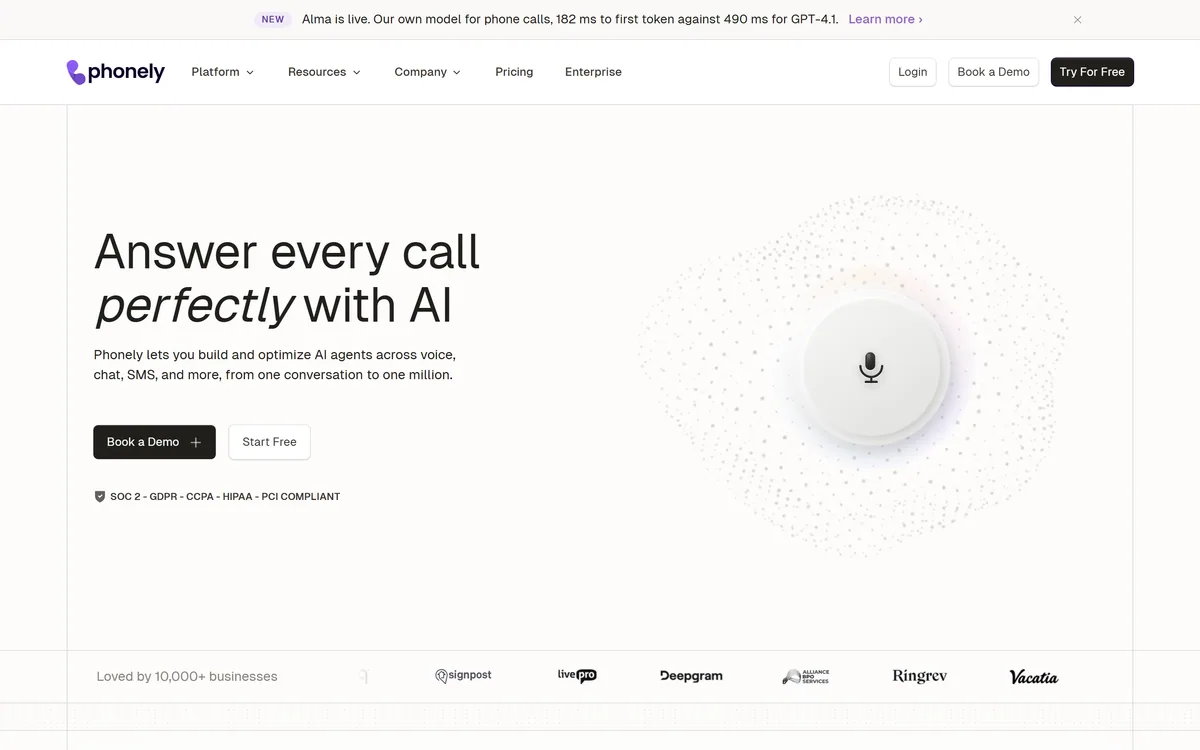
Last checked . Read from phonely.ai during this check, with the screenshot above captured at the same time.
The latency comparison is Phonely's own benchmark of its own model and has not been independently verified — test it on a real call over a poor connection. The observation about roughly 200ms turn gaps in human conversation reflects established conversation research, not a claim about this product. Disclosure requirements for AI callers differ by jurisdiction; take your own advice.
Phonely AI has an AInexfinder Editor Score of 4.2/5.
AInexfinder does not list plan prices or billing details. For current pricing, plans, and trials, visit the official Phonely AI website.
Visit official website for pricingVendor pricing, credits, and billing policies change over time. Always confirm on the official site before you buy.
Log in to write a review.
No reviews yet. Be the first to share your experience with Phonely AI.
Assigned reviewer
Daniel ReedSenior AI Tools Reviewer
Daniel reviews AI tools the slow way — by actually using them on real projects. His reviews cover what works, what breaks, and who each tool is genuinely a good fit for.
Daniel and the AInexfinder editorial team research Phonely AI using public product information, listing evidence, and (when available) hands-on checks. Scores reflect listing completeness and transparency — not paid placement.
TTSReader turns text, PDFs, and EPUB files into speech in the browser, with voice and language selection, speed control, text highlighting, and MP3 export — the free tier runs on browser voices with no usage cap.
VMEG from PixRipple translates and dubs video into 170+ languages using 17,000+ voices, with voice cloning, lip-sync, subtitle generation, batch processing, and API and MCP access for automated localisation.
Respeecher is an enterprise voice cloning and text-to-speech platform used in film, television and games. Its credits include young Luke Skywalker in The Mandalorian and Viktor Vektor in Cyberpunk 2077, and it requires documented performer consent before a voice is used.

ElevenLabs is an AI audio platform covering text to speech, voice cloning, speech recognition, dubbing, music, and conversational voice agents, with a library of 5,000+ voices across more than 70 languages and an API behind every model.

The workspace at www-flux3.com generates 5–20 second AI videos with native audio from text or a starting image, routing across FLUX 3, MiniMax H3, Seedance, Wan 3.0 and Kling 3.0 Pro, at 720p or 1080p with video extension.

Runway is an AI video platform built around generative world models — Gen-4.5, Aleph 2.0, and Act-Two for performance capture — split across Runway Creative for filmmakers, Runway Dev for builders, and Runway Robotics.