Retell AI is a voice-agent platform for automating phone calls, with a no-code studio and developer tools for building agents that handle receptionist, appointment-setting, lead-qualification, support, survey and collections calls, integrated with business systems.
Forethought
Verified
Forethought runs agentic AI across customer support: Discover finds knowledge gaps, Solve answers on chat, email and voice, Triage routes tickets, and QA scores every human-handled ticket. The company has been acquired by Zendesk.
4.2Editor Score
forethought.ai6 viewsAdded June 1, 20267K visitors
Most support AI is sold as one thing: a bot that deflects tickets. Forethought's structure is more interesting, because it splits the job into four agents that operate at different points in a support organisation — and only one of them talks to customers.
That split is worth understanding before any demo, because it determines where the value actually lands. Deflection is the headline; the knowledge-gap analysis and the automated quality scoring are the parts that change how a support team runs.
The other thing to weigh in 2026 is ownership: Forethought has been acquired by Zendesk. That changes the buying question from 'is this the best point solution?' to 'where does this sit in the Zendesk roadmap?', and it is the first thing to raise with a salesperson.
Ownership And Claims, Checked
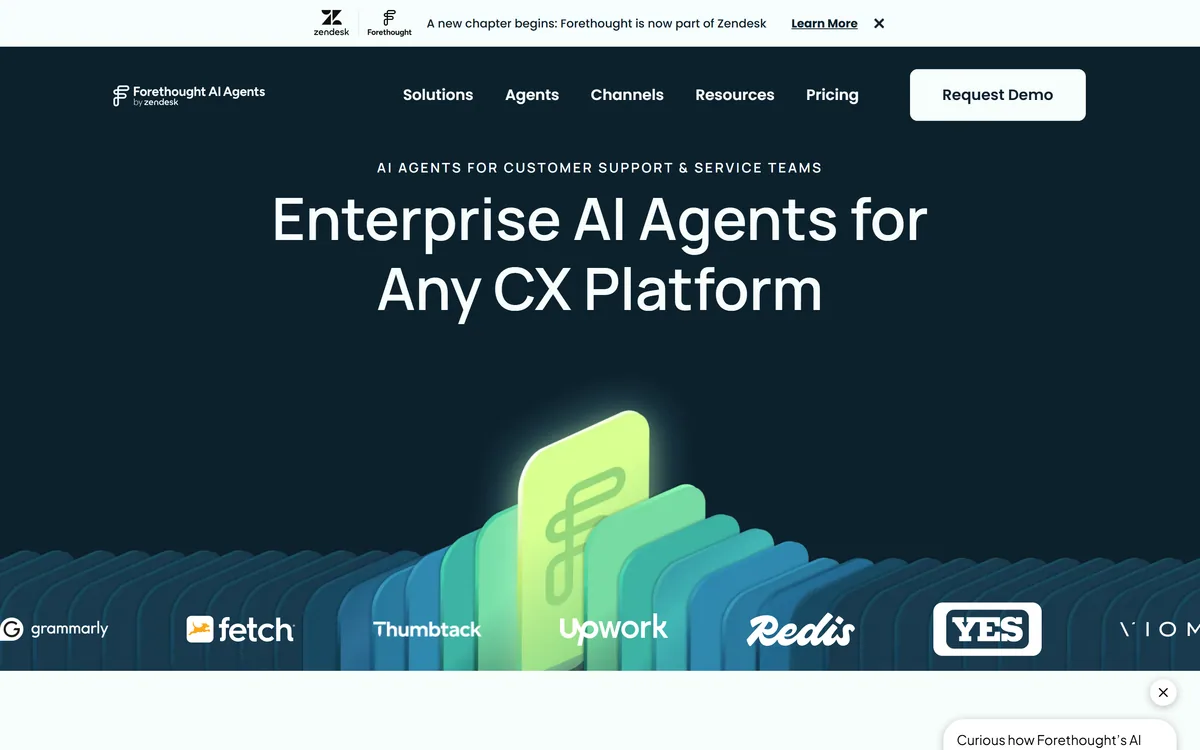
Last checked . Read from forethought.ai during this check, with the screenshot above captured at the same time. The acquisition is stated on the company's own site.
- Acquisition by Zendesk, announced on Forethought's own site
- Prior venture funding of $17 million, as reported on the site
- The named agents — Discover, Solve, Triage, QA and the Agentic AI Copilot — and what each does
- Solve channel coverage across chat, email, voice, Slack and headless API deployment
- QA described as scoring 100% of human agent tickets
- Named customers including Acorns, Grammarly, Fetch Rewards, Upwork, Redis, UPS, Corsair, WordPress, Cohere and Scale AI
- The 15x ROI, 55% first-response reduction and up-to-98% resolution figures are Forethought's own published claims and are described that way throughout this page
- Solutions, platform, company, resources, compliance and careers sections present in the site footer
- No plan prices published here, in line with this site's pricing policy
We have not independently verified the ROI, response-time or resolution figures. The observations about acquired point solutions describe a general pattern in enterprise software and are not a statement about Zendesk's intentions for this product.
Forethought, And The Zendesk Question
- Acquired by Zendesk. If you are evaluating it standalone in 2026, that is the first fact to weigh, not the feature list.
- Four separate agents, not one bot: Discover (knowledge gaps), Solve (answering), Triage (routing), QA (scoring human tickets).
- QA is the underrated one — it scores 100% of human-handled tickets, which no support team does manually.
- Omnichannel Solve covers chat, email, voice and a headless API, so it is not a chat widget.
- Headline metrics are the vendor's own. 15x ROI, 55% faster first response, up to 98% resolution — treat as marketing, not measurement.
Four Agents, Four Different Jobs
Naming them separately is not marketing tidiness — they solve genuinely different problems and you may only want two of them.
Deflection is what gets bought. Full-coverage QA is what actually changes how a support team is run.
Solve, The One Customers See
The omnichannel agent: chat, email, voice, and a headless deployment for teams building their own front end. It learns from past tickets and help-centre content rather than a hand-built decision tree.
The headless option is the detail worth noting. Most support AI assumes you want its widget; an API-only deployment means the AI can sit inside a product experience you already control.
Triage, The Quiet Saver
Classification and routing. Unglamorous, and often where the fastest real gain is — a misrouted ticket costs a full handling cycle before anyone starts helping, and large teams misroute constantly.
It also degrades gracefully. A routing suggestion that is wrong is a minor annoyance; a customer-facing answer that is wrong is a complaint.
Discover And QA, The Ones Aimed Inward
Discover reads support interactions to surface knowledge gaps — the questions customers keep asking that your documentation does not answer. That is a content backlog most teams know exists and never quantify.
QA scores 100% of human agent tickets. Traditional support QA samples perhaps 2% of tickets, because a human has to read each one. Moving from a 2% sample to full coverage is a different kind of visibility, not just more of the same — and it is the feature most likely to change management behaviour rather than cost.
Reading The Numbers On The Page
Forethought publishes 15x average ROI, a 55% average reduction in first response time, and up to 98% resolution rate. All three are the company's own figures, and this page repeats them as such rather than as findings.
"Up to" is doing heavy lifting in the resolution number. A 98% resolution rate on a narrow band of password resets and order-status queries is entirely plausible and tells you nothing about your own ticket mix. The only number that matters is what it resolves on your tickets, which is what a pilot measures and a case study does not.
ROI multiples in this category are also usually computed against fully-loaded agent cost at current volume, which quietly assumes headcount actually falls. Many teams instead absorb growth without hiring — a real benefit, but a different one from the arithmetic implies.
The customer list is more informative than the metrics. Acorns, Grammarly, Upwork, UPS, WordPress, Cohere and Scale AI are named — a spread that suggests it holds up at genuine volume.
What The Zendesk Acquisition Means For A Buyer
This is the part a feature comparison will miss, and it cuts both ways.
On the reassuring side, an acquired product has a large company behind its uptime, security posture and compliance paperwork. For an enterprise buyer that removes a real category of risk — the vendor disappearing mid-contract.
On the cautious side, acquired point solutions tend to be absorbed. Capabilities get folded into the parent's own suite, standalone roadmaps slow, and integrations with the acquirer's competitors rarely improve. If you run a helpdesk that is not Zendesk, ask directly how long non-Zendesk integrations will be supported and get the answer in the contract rather than on a call.
None of that means avoid it. It means the diligence question has changed, and anyone comparing Forethought against independent vendors on features alone is comparing the wrong thing.
Running A Pilot That Tells You Something
Support AI demos beautifully and disappoints specifically. The gap is always in your own ticket distribution.
- Pull your last thousand tickets and categorise them by hand before any demo, so you know what a realistic deflection ceiling looks like.
- Ask what resolution rate looks like on your worst category, not your best. The average hides everything.
- Start with Triage rather than Solve. Routing errors are cheap to be wrong about; customer answers are not.
- Run Discover early and treat its output as a documentation backlog — that value arrives whether or not you deploy the customer-facing agent.
- Turn QA on across everything before you change any process, so you have a baseline to compare against.
- Ask explicitly about the Zendesk roadmap and non-Zendesk helpdesk support, and get it written down.
- Measure your own resolution rate at 30 and 90 days rather than trusting the published figure.
Agents, Channels And Ownership
| Category | Agentic AI for customer support |
|---|---|
| Ownership | Acquired by Zendesk |
| Prior funding | $17 million raised before the acquisition |
| Named agents | Discover, Solve, Triage, QA, plus an Agentic AI Copilot |
| Solve channels | Chat, email, voice, Slack, and headless API |
| Copilot | Real-time guidance to human agents inside an existing helpdesk |
| QA coverage | Scores 100% of human agent tickets |
| Learns from | Past tickets and help-centre content |
| Named customers | Acorns, Grammarly, Fetch Rewards, Upwork, Redis, UPS, Corsair, WordPress, Cohere, Scale AI |
| Sectors served | SaaS, ecommerce, fintech, healthcare, education, mobile apps |
| Vendor metrics | 15x average ROI, 55% average first-response reduction, up to 98% resolution (company's own figures) |
Key features of Forethought
Solve — omnichannel AI agent across chat, email, voice and headless API
Triage — automated ticket classification and routing
Discover — surfaces knowledge gaps from support interactions
QA — scores 100% of human-handled tickets
Agentic AI Copilot — real-time guidance to agents inside an existing helpdesk
Learns from historical tickets and help-centre content
Slack integration alongside standard support channels
Enterprise security and compliance posture
Pros & cons
Pros
5- Splitting support into four agents targets four genuinely different problems
- QA at 100% coverage replaces a 2% manual sample — a change in kind, not degree
- Headless deployment means the AI can live inside your own product experience
- Triage delivers value with far less risk than customer-facing answers
- Named customers at real scale, which a feature list cannot substitute for
Cons
5- No longer an independent vendor — Zendesk ownership shapes the roadmap
- Non-Zendesk helpdesk integrations are the obvious long-term risk to ask about
- Published ROI and resolution figures are vendor claims with no independent verification
- Needs substantial historical tickets and documentation before it performs
- Low-volume teams will not recover the implementation overhead
Best For
- Zendesk customers wanting deeper support automation
- High-volume support organisations where misrouting is expensive
- Teams whose QA currently samples a tiny share of tickets
- Companies with years of tickets and a mature help centre
- Support leaders who need voice and email automation, not only chat
Forethought Beside Adjacent Platforms
These touch customer conversations from different directions — support automation, voice, and customer health.
| Tool | Core job | Customer-facing | Independent vendor |
|---|---|---|---|
| Forethought | Support deflection, routing and full-coverage QA | Yes, via Solve | No — owned by Zendesk |
| HubSpot AI | AI across CRM, marketing and service | Yes | Part of the HubSpot suite |
| Gainsight | Customer success and health scoring | Indirectly | Yes |
| Phonely AI | AI phone agents specifically | Yes, by voice | Yes |
| CloudTalk | Contact centre telephony with AI features | Yes, by voice | Yes |
Does This Suit Your Support Team?
Strong Case If
- You already run Zendesk, where the acquisition works in your favour
- Ticket volume is high enough that routing errors cost real money
- You have years of past tickets and a help centre for it to learn from
- Support QA currently samples a tiny fraction of tickets
- You need voice and email automation, not just a chat widget
Think Twice If
- Your helpdesk is a Zendesk competitor and long-term integration support matters
- Ticket volume is low, where automation overhead outweighs the saving
- Your queries are highly bespoke, which caps deflection regardless of vendor
- You have little historical ticket data or documentation to train on
- You would take the published ROI and resolution figures at face value
Other Tools Around The Support Desk
Deflection, voice, customer health and CRM overlap but are bought separately.
- HubSpot AI — AI across service and CRM if you want one suite rather than a specialist
- Gainsight — customer success and health, the layer above ticket handling
- Phonely AI — voice agents specifically, if the phone queue is the problem
- CloudTalk — contact centre telephony with AI features attached
- Anomaly AI — the reporting side — recurring support metrics with traceable numbers
Editor's Verdict
4.2/5Forethought has an AInexfinder Editor Score of 4.2/5.
Forethought pricing
AInexfinder does not list plan prices or billing details. For current pricing, plans, and trials, visit the official Forethought website.
Visit official website for pricingVendor pricing, credits, and billing policies change over time. Always confirm on the official site before you buy.
Frequently asked questions
Is Forethought still an independent company?
No. It has been acquired by Zendesk, and that is the first thing to weigh when evaluating it. It changes the question from whether it is the best point solution to where it sits in Zendesk's roadmap.
What are the four agents?
Discover surfaces knowledge gaps from support conversations. Solve answers customers across chat, email, voice and a headless API. Triage classifies and routes tickets. QA scores every human-handled ticket. Only Solve is customer-facing.
Which one should I deploy first?
Triage, usually. A wrong routing suggestion is a minor annoyance; a wrong customer answer is a complaint. Discover is the other low-risk starting point, since its output is a documentation backlog you benefit from either way.
Is the 98% resolution rate believable?
It is 'up to' 98%, which is Forethought's own figure, and the qualifier matters. A very high rate on password resets and order-status queries is plausible and says nothing about your ticket mix. Measure it on your own tickets in a pilot.
Why does QA scoring every ticket matter?
Because traditional support QA samples perhaps 2% of tickets — a human has to read each one. Full coverage is a different kind of visibility rather than more of the same, and it is the feature most likely to change how the team is managed.
What if we do not use Zendesk?
Ask directly how long integrations with competing helpdesks will be supported, and get the answer in the contract rather than on a call. Acquired point solutions commonly get folded into the parent suite, and cross-vendor integrations rarely improve afterwards.
How much historical data does it need?
It learns from past tickets and help-centre content, so a team with years of both will see far better results than one starting fresh. If your documentation is thin, Discover is worth running first simply to find out how thin.
Reviews
Log in to write a review.
User Reviews
No reviews yet. Be the first to share your experience with Forethought.
Reviewed by Daniel Reed
Assigned reviewer
Daniel ReedSenior AI Tools Reviewer
Daniel reviews AI tools the slow way — by actually using them on real projects. His reviews cover what works, what breaks, and who each tool is genuinely a good fit for.
Hands-on reviewsProduct testingAI software
Daniel and the AInexfinder editorial team research Forethought using public product information, listing evidence, and (when available) hands-on checks. Scores reflect listing completeness and transparency — not paid placement.
- Last verified
- Methodology
- How we review AI tools
- Sources used
- forethought.ai
- AInexfinder listing fields (features, pros/cons, description)
- Public vendor pages when available
- Editorial policy
- Listings may include affiliate or sponsored placements, which are labeled when present. Editorial scores and cons are not sold. See our affiliate disclosure and review methodology.
Related tools

Listomize is an Etsy SEO platform that generates titles, tags, and descriptions within Etsy's own limits, scores listings, optimises 100+ listings from a CSV, tracks competitors and trends, and auto-generates Pinterest pins.
FreemiumBusiness & Marketing

Lahjty (لهجتي) is an Arabic-first marketing platform for MENA campaigns. From one brief it produces dialect-aware ad copy, headlines, campaign images with Arabic text rendered in, dialect-aware voice, and SEO articles grounded in your own brand sources — with a Partner API and an MCP server for teams that want it inside their own workflow.
FreemiumBusiness & Marketing

MaxAEO is an answer engine optimisation platform from HIII PTE. LTD. It tracks how ChatGPT, Gemini, Claude, Perplexity, Copilot, Grok and Google's AI surfaces mention a brand, with sentiment, competitor benchmarking and citation tracing.
Mailjet is a Sinch-owned email platform handling both marketing campaigns and transactional sending from one account. It offers a collaborative drag-and-drop editor, an email API with SMTP relay, AI generation and segmentation, and EU-based data centres.
FreemiumBusiness & Marketing
Outranking is an AI SEO content platform that writes briefs and first drafts and optimises them with real-time scoring, grounding content in live SERP data through its Concepts feature, with keyword clustering, internal linking and content workflows.
FreemiumBusiness & Marketing
Explore More
Embed this listing on your site
Featured on AInexfinder