TTSReader turns text, PDFs, and EPUB files into speech in the browser, with voice and language selection, speed control, text highlighting, and MP3 export — the free tier runs on browser voices with no usage cap.
FreemiumVideo & Audio
CloudTalk is a business phone system for sales and support that puts human agents and AI voice agents on the same queues, integrations and numbers. It offers local numbers in 160+ countries, AI agents speaking 70+ languages, and states 40,000+ teams and over 1 billion calls.
Most companies buying AI for their phone lines end up with two phone systems. One where the people work, one where the agents do, and a handover between them that drops context, loses the caller's history and frequently drops the call.
That happens because the AI arrives as a separate product bolted alongside the existing system, with its own numbers, its own analytics and its own idea of who is in a queue.
CloudTalk's answer is to refuse the split. Human agents and AI agents share the queues, the integrations and the numbers — which turns the choice between them into a routing rule rather than an architecture.
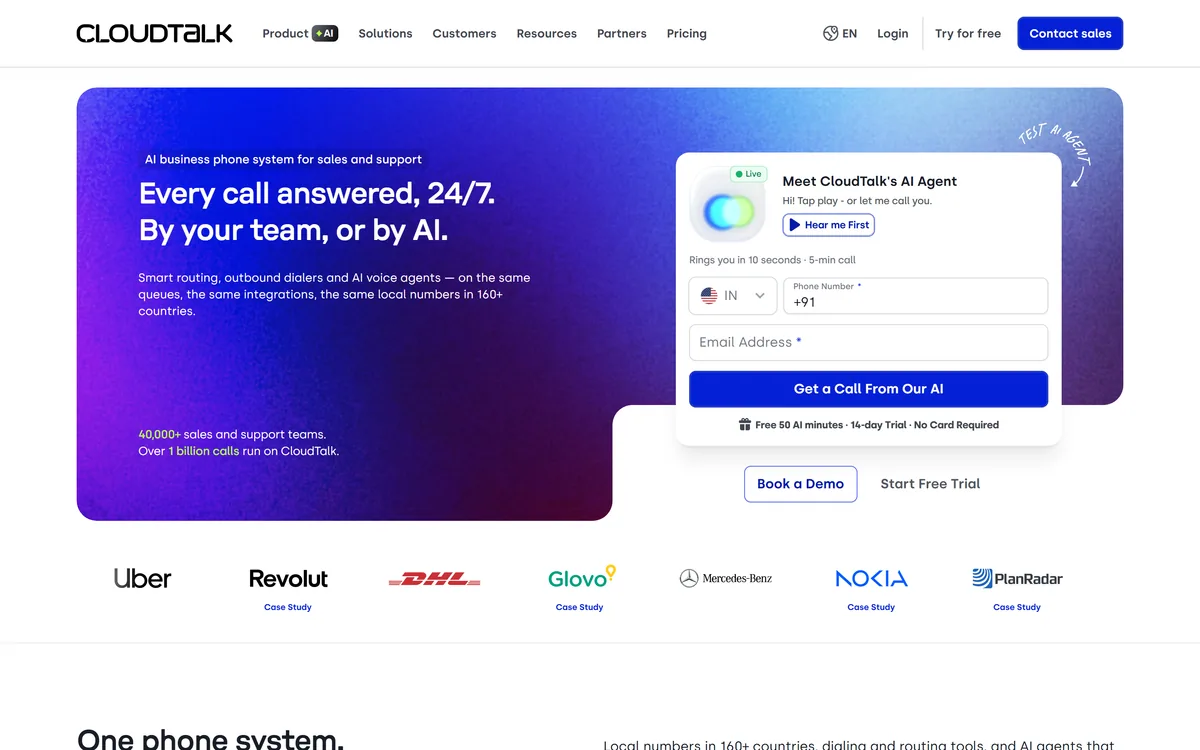
CloudTalk describes one phone system with two kinds of agent, where a number can point at your team, at an AI agent, or at both, with rotation between them and live handover from one to the other.
The reason this design matters is that the alternative fails at exactly the moment it is most needed. A caller who has explained their problem to an agent and is then transferred to a person has explained it to nobody unless the two systems share state.
Sharing the queue means the transfer carries the context, the caller's history and the recording, because there is only one record of the call. That is not an integration; it is the absence of one.
It also changes how coverage decisions get made. Instead of deciding whether to buy an AI product, you decide which gaps to cover — after-hours, weekends, overflow when the queue spikes, first-touch qualification, reminders nobody got to — and everything else keeps ringing your team.
The framing on the site is unusually restrained about this: cover the calls you cannot staff. That is a more honest pitch than replacing your support team, and it happens to describe the deployments that actually work.
The alternative arrangement is a CRM-native one. Aloware puts the whole system inside HubSpot or Salesforce instead, which is a different answer to the same question about where a call should live.
A caller who explained their problem to an agent and is then transferred has explained it to nobody, unless the two systems share one record of the call.
CloudTalk offers local numbers in more than 160 countries, with porting from any provider, and this is the part of the product that is genuinely hard to replicate.
Telephony numbering is not a software problem. Acquiring numbers in a country means regulatory registration, local entity requirements in some jurisdictions, carrier relationships and ongoing compliance — repeated 160 times, in 160 different regulatory environments.
That is years of unglamorous work, and it is why the number of platforms offering genuinely global local numbering is small while the number offering AI voice agents is enormous. One is a feature; the other is an operation.
The commercial value is straightforward. Answer rates for local numbers are materially higher than for international ones, and a company selling into a market without a number in it is calling from a number people decline.
Porting matters as much as provisioning. A business with established numbers on customer records and printed material cannot change them, so a platform that cannot take them over is a platform that cannot be adopted.
CloudTalk states that numbers can be rotated automatically so you do not get flagged as spam, and this is an operational feature that reveals real experience.
The problem it addresses is carrier-side reputation scoring. A single number placing hundreds of outbound calls a day looks, to a carrier's classifier, exactly like a nuisance caller — regardless of whether the calls are welcome, and regardless of what your business does.
Once a number is flagged, the damage is slow to undo and largely invisible from your side. Your dialer reports the calls as placed; the recipients' handsets display a warning label or do not ring at all, and connect rate falls without any obvious cause.
Rotation spreads volume so no single number crosses the threshold. It is a workaround for a system that cannot distinguish a legitimate business from a nuisance one, and it is what experienced outbound operations do by hand.
It is worth being clear that rotation is a mitigation rather than a licence. Carriers score behaviour, and a rotation strategy that exists to sustain call volumes recipients do not want is treating a symptom. The underlying question of whether people want the calls is not a technical one.
That distinction is worth holding when comparing against agent platforms. OpenMic.ai offers SIP trunking at enterprise tier rather than owning numbering itself, which is a lighter commitment on both sides.
CloudTalk states its AI agents speak 70+ languages and accents, which is a larger claim than a language count alone.
Accent is the harder half and the one that decides whether an agent works in practice. A model trained predominantly on one variety of a language handles a different regional accent poorly — and recognition failures in speech are far more frustrating than in text, because the caller has to repeat themselves rather than retype.
The specific failure is a loop: the agent mishears, the caller repeats more carefully, the agent mishears the more careful version differently, and the caller starts asking for a person. That is the worst outcome an automated line can produce.
Testing has to be done in the accent your callers actually have, not in the accent your team has. A platform that works perfectly for the person configuring it can fail for the customer base it serves, and nothing in the configuration reveals that.
The multilingual case is also where an AI agent's economics are strongest. Staffing a support line in eight languages is expensive and hard to schedule; covering the smaller languages with agents and the large ones with people is a genuinely sensible allocation.
Once calls are happening, capturing what was said in them is a separate purchase — a notetaker such as Wave covers the conversations a phone system only routes.
The deployments that work start narrow, and the ones that damage a brand start with the main inbound line.
The sequence below picks the calls where a poor experience costs least.
| Product type | AI business phone system for sales and support |
|---|---|
| Agent model | Human and AI agents on the same queues, integrations and numbers |
| Routing | By hours, queue depth or job type, with live handover between agent types |
| Local numbers | 160+ countries |
| Porting | Existing numbers from any provider |
| AI agent languages | 70+ languages and accents |
| Spam mitigation | Automatic number rotation |
| Named coverage gaps | After-hours and weekends, overflow, first-touch lead qualification, reminders, renewals, follow-ups, FAQs and status checks |
| Dialing tools | Outbound dialers and smart routing |
| Stated scale | 40,000+ sales and support teams, over 1 billion calls run |
| Stated availability | 99.999% platform availability |
| Trial | 14-day trial with 50 free AI minutes, no card required |
| Site sections | Product, AI, Solutions, Customers, Resources, Partners, Pricing |
Human and AI agents sharing queues, integrations and numbers
Live handover between an AI agent and a person mid-call
Local numbers in more than 160 countries, with porting from any provider
AI agents across 70+ languages and accents
Automatic number rotation to reduce spam flagging
Routing by hours, queue depth or job type
Outbound dialers and smart routing alongside inbound handling
A 14-day trial with 50 free AI minutes
Phone platforms differ on international reach and on whether AI is part of the system or bolted beside it.
| Tool | Geographic reach | AI position | Best for |
|---|---|---|---|
| CloudTalk | Local numbers in 160+ countries | Same queues and numbers as human agents | International sales and support operations |
| Aloware | US-focused, with managed carrier compliance | AloAi agents alongside a CRM dialer | HubSpot and Salesforce sales floors |
| OpenMic.ai | SIP trunking at enterprise tier | Agent platform rather than phone system | Building agents rather than running a floor |
| Vogent | Numbers by area code | Own models trained on phone calls | Agents that navigate business phone menus |
| Deepgram | Not applicable | The speech layer itself | Building the stack rather than buying it |
Last checked . Read from cloudtalk.io in a browser session, with the screenshot above captured alongside.
What we could not confirm: the operating company's legal name or headquarters; pricing and plan structure; which underlying models power the AI agents; whether the 70+ language figure covers recognition, synthesis or both; how the 99.999% availability is measured or whether it is audited; how the 1 billion call figure is counted; specific named customers, since case studies were listed without names on the page we read; and data residency for call recordings. We did not place a call, so nothing here reflects tested agent behaviour.
Phone systems, agent platforms and speech infrastructure are three different purchases.
CloudTalk's structural decision is the right one and the one most competitors avoid: AI agents and human agents sit on the same queues, the same integrations and the same numbers, so routing between them is a configuration rather than a migration. Most platforms sell an AI layer bolted beside a phone system, which means two sets of numbers, two sets of analytics and a handover that drops the call. Local numbers in 160+ countries is a genuine moat that takes years to build. It scores just below the top because 99.999% availability and the billion-call figure are vendor-stated and unaudited. AInexfinder Editor Score: 4.3/5.
AInexfinder does not list plan prices or billing details. For current pricing, plans, and trials, visit the official CloudTalk website.
Visit official website for pricingVendor pricing, credits, and billing policies change over time. Always confirm on the official site before you buy.
Log in to write a review.
No reviews yet. Be the first to share your experience with CloudTalk.
Assigned reviewer
Daniel ReedSenior AI Tools Reviewer
Daniel reviews AI tools the slow way — by actually using them on real projects. His reviews cover what works, what breaks, and who each tool is genuinely a good fit for.
Daniel and the AInexfinder editorial team research CloudTalk using public product information, listing evidence, and (when available) hands-on checks. Scores reflect listing completeness and transparency — not paid placement.
TTSReader turns text, PDFs, and EPUB files into speech in the browser, with voice and language selection, speed control, text highlighting, and MP3 export — the free tier runs on browser voices with no usage cap.
VMEG from PixRipple translates and dubs video into 170+ languages using 17,000+ voices, with voice cloning, lip-sync, subtitle generation, batch processing, and API and MCP access for automated localisation.
Respeecher is an enterprise voice cloning and text-to-speech platform used in film, television and games. Its credits include young Luke Skywalker in The Mandalorian and Viktor Vektor in Cyberpunk 2077, and it requires documented performer consent before a voice is used.

ElevenLabs is an AI audio platform covering text to speech, voice cloning, speech recognition, dubbing, music, and conversational voice agents, with a library of 5,000+ voices across more than 70 languages and an API behind every model.

The workspace at www-flux3.com generates 5–20 second AI videos with native audio from text or a starting image, routing across FLUX 3, MiniMax H3, Seedance, Wan 3.0 and Kling 3.0 Pro, at 720p or 1080p with video extension.

Runway is an AI video platform built around generative world models — Gen-4.5, Aleph 2.0, and Act-Two for performance capture — split across Runway Creative for filmmakers, Runway Dev for builders, and Runway Robotics.