TTSReader turns text, PDFs, and EPUB files into speech in the browser, with voice and language selection, speed control, text highlighting, and MP3 export — the free tier runs on browser voices with no usage cap.
FreemiumVideo & Audio
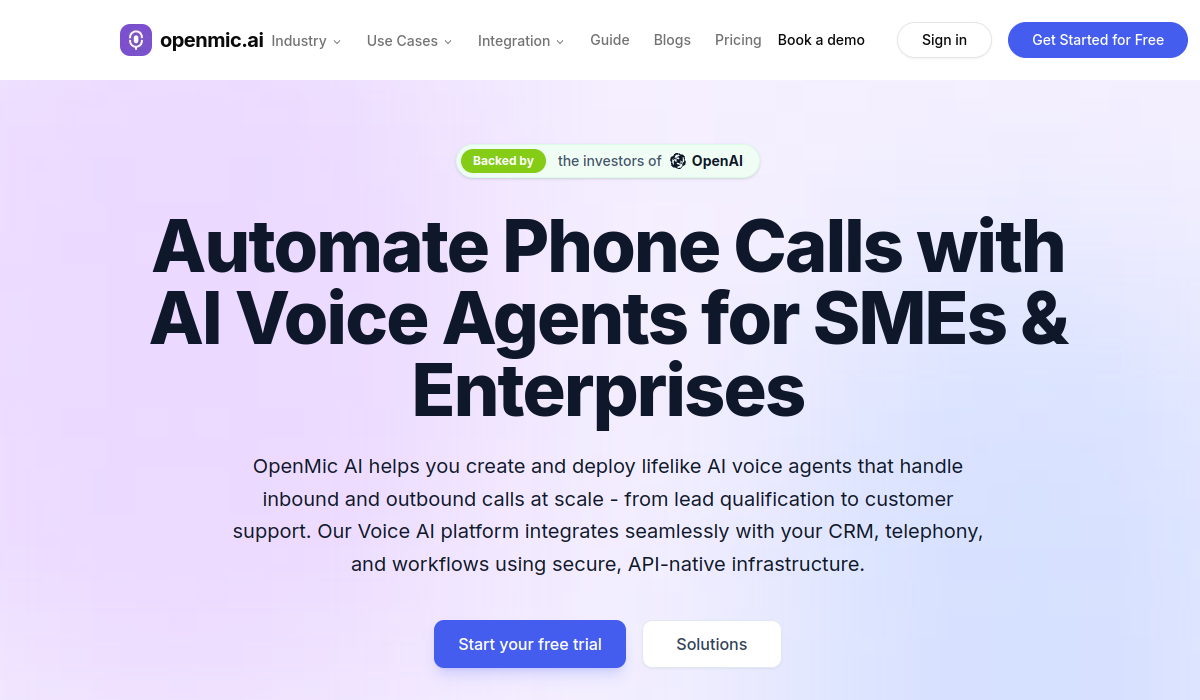
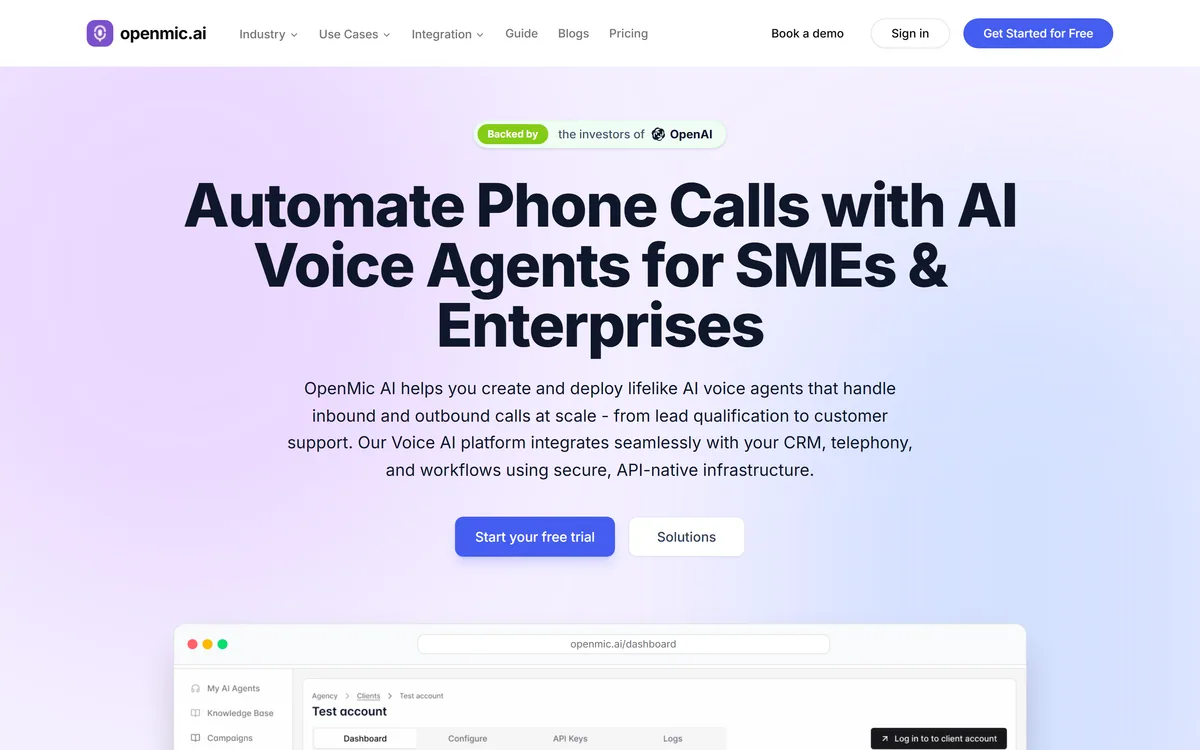
OpenMic.ai is an API-native platform for building AI voice agents that handle inbound and outbound phone calls — qualification, support, scheduling and routing. It claims sub-500ms latency, offers SDKs in six languages, and states SOC 2, HIPAA, PCI and GDPR compliance.
Voice is the hardest interface to get right, and the reason is that people notice delay in speech in a way they never notice it in text.
A chatbot that takes two seconds to respond is fine. A person on the phone who waits two seconds after you stop speaking has, in your gut, either not understood you or is not paying attention — and the conversation deteriorates from that moment.
That is why OpenMic's sub-500ms latency claim is the first thing to look at. Everything else a voice agent does is downstream of whether it feels like a conversation or like a machine.
| Product type | AI voice agent platform for inbound and outbound calls |
|---|---|
| Latency claim | Sub-500ms |
| Voice providers | ElevenLabs, Deepgram, Cartesia and others |
| Telephony | Works with existing phone systems; SIP trunk integration at enterprise tier |
| SDKs | cURL, Python, JavaScript, PHP, Go, Java |
| Named capabilities | 24/7 call handling, lead qualification, multilingual agents, appointment scheduling, intelligent routing and transfers, voice customisation, call analytics and transcription, overflow management, omnichannel across phone, SMS, email and chat |
| Builder | Visual workflow and flow designer, real-time analytics dashboard |
| Industries listed | Healthcare, debt collection, restaurant, retail, legal, education, car dealership, real estate, home services, coaching, salon, construction, AI receptionist |
| Use cases listed | Claims processing, customer loyalty, cart abandonment, product recommendation, appointment booking, voice surveys, lead qualification, invoice reminders, FAQ agent |
| Compliance | SOC 2, HIPAA, PCI, GDPR, with encryption and conversation logging |
| Integrations | Stated as 5,000+ business tools including CRMs, calendars, helpdesks and marketing automation |
| Stated scale | 10,000+ customers in over 120 countries |
OpenMic states sub-500ms latency, and it is worth knowing what that number is measuring and why it is so difficult.
The figure is the gap between you finishing a sentence and the agent starting to respond. Human conversation typically runs on gaps of around 200 milliseconds, and anything past roughly half a second registers as hesitation rather than as thought.
Achieving it is hard because several things must happen in that window: detect that you have stopped speaking, transcribe what you said, decide what to say, and synthesise speech. Each is fast individually and they compound, which is why most voice agents feel stilted.
The subtlest part is end-of-turn detection. Deciding whether a pause means you have finished or are thinking is a genuinely difficult judgement, and getting it wrong produces the two worst behaviours in a voice agent: interrupting you mid-sentence, and leaving dead air after you have finished.
Which is why the number should be tested rather than trusted. Latency measured in a lab differs from latency over a real phone network, and the honest test is a call from a mobile in a moving car, not from a broadband connection in an office.
Anyone building rather than deploying should look at the layer below. Deepgram sells the speech infrastructure directly, which is more work and more control.
Human conversation runs on gaps of around 200 milliseconds. Past half a second, a pause stops reading as thought and starts reading as not listening.
OpenMic names ElevenLabs, Deepgram and Cartesia among its voice providers, and disclosing the stack is more useful than it might appear.
It tells you the platform is an orchestration layer rather than a model company. That is the correct architecture for this problem — the best speech synthesis and recognition are built by specialists, and a voice agent platform's value is in the telephony, the state management and the tooling around them.
It also lets you reason about quality. If you already know how a particular synthesis provider sounds, you know roughly what your agent will sound like, which is far more informative than a vendor's own audio samples.
The practical benefit is switchability. A provider that raises prices, degrades, or is acquired can be swapped without rebuilding your agent, which is a genuine reduction in dependency risk.
The corresponding question, unanswered here, is who is on the language-model side. Voice providers are named; the model doing the reasoning is not, and that is the component that decides whether your agent says something it should not.
OpenMic lists thirteen industries — healthcare, debt collection, restaurant, retail, legal, education, car dealership, real estate, home services, coaching, salon, construction and AI receptionist — with nine named use cases alongside them.
This is a marketing structure rather than thirteen distinct products. The underlying platform is the same; the vertical pages exist because a dental practice searches for something different from a debt collector, and meeting each search with a page that names their situation converts far better than a generic one.
That is not a criticism — it is a sensible way to sell horizontal infrastructure. But it does mean you should not assume a vertical page implies domain-specific tuning, and the right question to a salesperson is what is actually different about the healthcare version beyond the copy.
Two of the thirteen deserve particular caution. Healthcare voice agents touch protected health information, which is why HIPAA compliance appears on the list, and the compliance obligation extends to how you configure the agent rather than only to the platform.
Debt collection is the sharper case. Collections calls are governed by specific regulation about disclosure, timing, frequency and conduct, and an automated dialler making those calls does not reduce the obligations — it multiplies the opportunities to breach them at scale. That vertical needs legal review before a pilot, not after.
The developer-first alternatives are worth a look here too — Vapi hands you more of the assembly, and Retell AI leans toward operating a fleet of agents once they are live.
The single most important design decision in a voice deployment is not what the agent says — it is when it stops and passes the call to a person.
Voice agents are strong on bounded, transactional calls: confirming an appointment, taking a booking, answering an FAQ, routing to the right department, qualifying an inbound lead. These have a defined shape and a clear success condition.
They are weak wherever the caller is distressed, confused, or has a problem that does not match a category. And those are precisely the calls where a bad experience is most expensive, because a frustrated customer talking to a machine that will not understand them is the story they tell everyone.
The failure mode to design against is the loop. An agent that cannot resolve the issue and cannot escalate is worse than a hold queue, because a hold queue at least implies a person is coming.
Practical rules that hold up: escalate on the second failed attempt at the same thing, escalate immediately on any detected distress, and always offer a route to a human without requiring the caller to guess the magic phrase. Intelligent routing and transfers are listed features here — the question is how aggressively you configure them.
For outbound programmes specifically, a platform such as Bland AI is built around calling at volume, which is a different design problem from answering well.
The reputational risk of voice is higher than for any other channel, because a bad call is remembered and repeated.
Start narrow, on calls where failure costs little.
AI voice agents for inbound and outbound telephone calls
Sub-500ms latency claimed for natural conversational timing
Lead qualification, appointment scheduling and intelligent call routing
Overflow handling for peak volume rather than full replacement
Visual workflow designer alongside an API-native architecture
SDKs in six languages plus SIP trunk integration at enterprise level
Call analytics, transcription and a real-time dashboard
Omnichannel reach across phone, SMS, email and chat
Voice platforms differ on how much they hand you versus how much they assemble for you.
| Tool | Emphasis | Who it is built for | Best for |
|---|---|---|---|
| OpenMic.ai | Vertical templates over an API-native platform | Businesses and developers alike | Deploying to a named industry use case quickly |
| Vapi | Developer-first voice infrastructure | Engineering teams | Building a voice product rather than deploying one |
| Retell AI | Voice agents with call operations tooling | Product and ops teams | Managing a running fleet of agents |
| Bland AI | Phone-calling agents at volume | Sales and support operations | Outbound calling programmes |
| Deepgram | The speech layer itself | Developers | Owning the stack rather than orchestrating it |
Last checked . Read from openmic.ai and its footer navigation, with the screenshot above captured in the same session.
What we could not confirm: the operating company's legal name, registration or location; which language models perform the reasoning, as only voice providers are named; pricing or how calls are metered; whether the latency figure is measured over real telephony or in ideal conditions; the basis for the 10,000+ customer and 120-country claims, with no customer named on the pages we read; the investor relationship the site references; and independent verification of any certification. We did not place a call, so nothing here reflects tested agent behaviour.
OpenMic is technically well specified for its category — sub-500ms latency, named voice providers, SIP trunking at enterprise, SDKs in six languages, and a compliance set covering SOC 2, HIPAA, PCI and GDPR. Those are the things that decide whether a voice agent is usable, and publishing them is more than most competitors do. The thirteen named industries are a distribution strategy rather than thirteen products, and the debt-collection vertical in particular carries regulatory obligations no platform can discharge for you. The score reflects the gap between what is published and what is verifiable, including a 10,000-customer claim with no named reference. AInexfinder Editor Score: 3.9/5.
AInexfinder does not list plan prices or billing details. For current pricing, plans, and trials, visit the official OpenMic.ai website.
Visit official website for pricingVendor pricing, credits, and billing policies change over time. Always confirm on the official site before you buy.
Log in to write a review.
No reviews yet. Be the first to share your experience with OpenMic.ai.
Assigned reviewer
Daniel ReedSenior AI Tools Reviewer
Daniel reviews AI tools the slow way — by actually using them on real projects. His reviews cover what works, what breaks, and who each tool is genuinely a good fit for.
Daniel and the AInexfinder editorial team research OpenMic.ai using public product information, listing evidence, and (when available) hands-on checks. Scores reflect listing completeness and transparency — not paid placement.
TTSReader turns text, PDFs, and EPUB files into speech in the browser, with voice and language selection, speed control, text highlighting, and MP3 export — the free tier runs on browser voices with no usage cap.
VMEG from PixRipple translates and dubs video into 170+ languages using 17,000+ voices, with voice cloning, lip-sync, subtitle generation, batch processing, and API and MCP access for automated localisation.
Respeecher is an enterprise voice cloning and text-to-speech platform used in film, television and games. Its credits include young Luke Skywalker in The Mandalorian and Viktor Vektor in Cyberpunk 2077, and it requires documented performer consent before a voice is used.

ElevenLabs is an AI audio platform covering text to speech, voice cloning, speech recognition, dubbing, music, and conversational voice agents, with a library of 5,000+ voices across more than 70 languages and an API behind every model.

The workspace at www-flux3.com generates 5–20 second AI videos with native audio from text or a starting image, routing across FLUX 3, MiniMax H3, Seedance, Wan 3.0 and Kling 3.0 Pro, at 720p or 1080p with video extension.

Runway is an AI video platform built around generative world models — Gen-4.5, Aleph 2.0, and Act-Two for performance capture — split across Runway Creative for filmmakers, Runway Dev for builders, and Runway Robotics.