
TTSReader turns text, PDFs, and EPUB files into speech in the browser, with voice and language selection, speed control, text highlighting, and MP3 export — the free tier runs on browser voices with no usage cap.
FreemiumVideo & Audio
Bland is an enterprise voice-AI platform for building, testing and running AI phone agents that hold human-sounding conversations inbound and outbound, on its own infrastructure and custom phone-tuned speech models, with scenario testing, 40+ languages and regulated-industry compliance.
A note on responsible use Bland's agents are built to sound human and can use per-language voice clones. Letting callers know they are speaking with an AI, and following the call-recording and disclosure laws in each region, is the caller's and deployer's responsibility, not an afterthought. We weigh the platform with that in mind.
AI that can hold a natural phone conversation has crossed a threshold, and the question for a business is no longer whether it works but whether you can deploy it safely and at scale. Bland is built squarely for that enterprise question.
It is a voice-AI platform for building, testing and running AI phone agents, inbound and outbound, on Bland's own infrastructure and custom speech models made for phone calls. It overlaps with the broader AI-agent market, where a sales agent like Artisan works outbound in a different channel, but Bland's focus is the live voice call.
This review covers how Bland builds and runs a phone agent, where AI calling makes sense and where care is essential, how its per-minute pricing works, and who it fits.
| What it is | An enterprise voice-AI phone-agent platform |
|---|---|
| Handles | Inbound and outbound calls at scale |
| Builder | Norm, a no-experience agent builder |
| Testing | Thousands of scenario tests before launch |
| Infrastructure | Its own, with phone-tuned speech models |
| Languages | 40+, with real-time translation in many |
| Compliance | SOC 2, HIPAA (BAA), PCI DSS, FedRAMP stated |
| Channels | Voice, SMS, iMessage and web chat |
Bland's core claim is sub-second, human-sounding phone conversations at scale, inbound and outbound. The quality of the voice and the latency are what separate a usable agent from the frustrating IVR systems everyone has hung up on, and Bland competes on both.
Crucially, it runs on its own infrastructure with custom speech models built specifically for phone calls, and states that no third party touches a call. For regulated buyers, that single-vendor, controlled-path design is a big part of the appeal.
The flip side of a convincingly human agent is a responsibility, which we flag plainly: callers should know they are talking to an AI, and recording and consent laws vary by region. A powerful tool here is also one to deploy carefully.
The flip side of a convincingly human agent is a responsibility: callers should know they are talking to an AI, and recording and consent laws vary by region.
Bland treats building and, importantly, testing an agent as a first-class workflow rather than an afterthought.
You build an agent with Norm, a no-experience builder you describe your goal to, and define conversation pathways with steps like warm transfer and identity verification. Before it goes live, you can run it against thousands of edge-case scenarios to see how it behaves.
That scenario testing is the standout, because an agent that handles the happy path but fails an edge case is a liability on a phone line. It is a more rigorous approach than a simple chat bot like Tidio Lyro needs, reflecting how much higher the stakes are on a live call.
Bland runs the whole stack, speech recognition, the language model, text-to-speech and telephony, on its own infrastructure, and lists heavy compliance credentials: SOC 2, HIPAA with a BAA, PCI DSS and FedRAMP, with data-residency options.
The transcription and call-intelligence side, scoring and searching calls, overlaps with speech tools like AssemblyAI, but Bland bundles it into the agent platform. The compliance depth is what makes it credible for healthcare, insurance and financial-services workloads.
Bland fits high-volume, repeatable phone work: appointment handling, qualification, status updates, routing, and support triage, the calls that are structured enough to script and too numerous to staff fully. Here the latency and scenario testing pay off.
It is strongest for regulated enterprises that cannot use a consumer-grade tool, precisely because of the compliance credentials and the controlled infrastructure. Several of Bland's customer stories cite large revenue or saving figures; those are customer-reported and worth treating as claims, not benchmarks.
Where care is essential is anything involving sensitive decisions or where a caller could be misled about who they are speaking to. The right deployments disclose the AI, keep a human escalation path, and respect the consent rules of each jurisdiction.
Bland uses per-minute pricing, with one rate stated to cover the language model, speech-to-text, text-to-speech and telephony rather than separate per-feature surcharges, plus a free trial and enterprise contracts shaped by volume, infrastructure and compliance. We do not publish rates; check the site.
The single-rate approach is buyer-friendly because it makes cost predictable per call, which matters when you are projecting a contact-centre-scale deployment. The value question is whether automated calls cost less than staffed ones at your volume, with quality held constant.
For enterprise rollouts, the real evaluation is a pilot, not a price list, since the economics depend on call length, resolution rate and how much human escalation you still need.
Because the stakes on a live phone line are high, trial Bland deliberately and with the guardrails in place from the start.
Human-sounding inbound and outbound phone agents
Norm no-experience agent builder
Scenario testing before launch
Conversation pathways and warm transfer
Own infrastructure and phone-tuned speech models
40+ languages with real-time translation
Call transcription, scoring and search
Enterprise compliance credentials
The useful comparison is with other agent and speech tools across channels.
| Tool | Tool | Channel | Best for |
|---|---|---|---|
| Bland | Voice phone agents | Human-sounding calls at scale | Regulated, high-volume calling |
| Artisan | Outbound sales agent | Pipeline and outreach | Sales automation |
| Tidio Lyro | Support chatbot | Text support deflection | Website chat |
| AssemblyAI | Speech-to-text API | Transcription and audio intel | Developers adding speech |
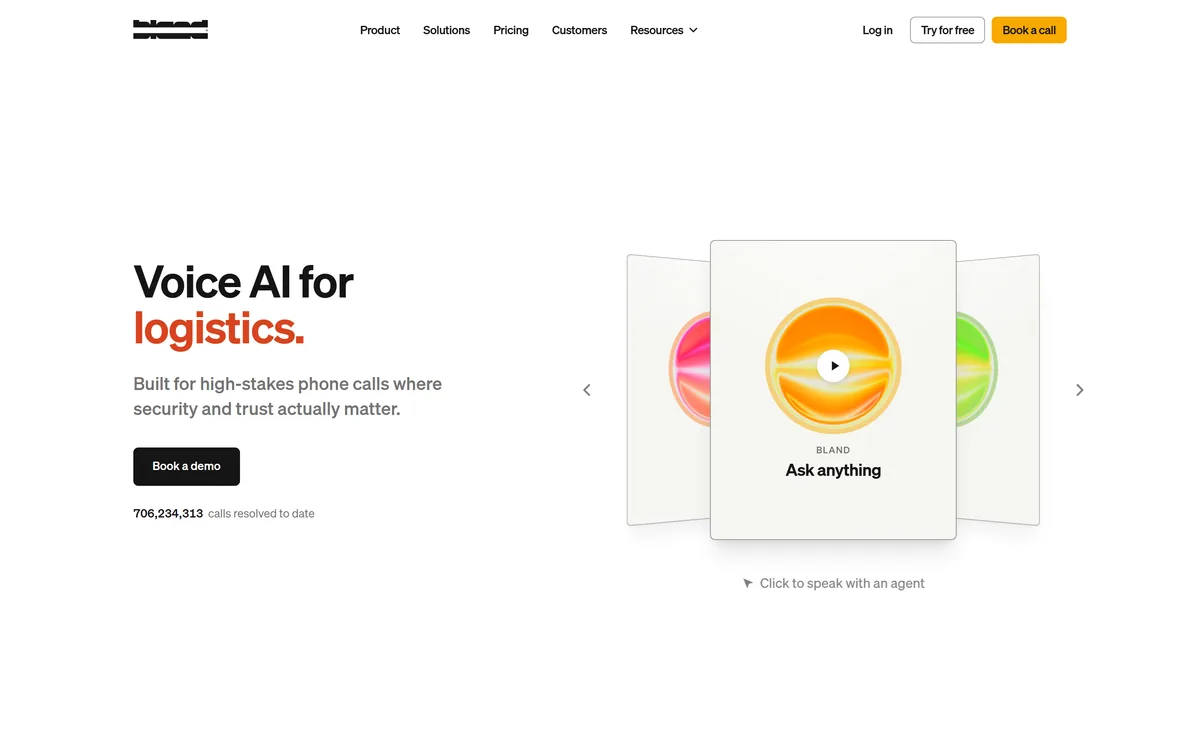
Last checked . Read from bland.ai during this check, with the screenshot above captured at the same time.
Bland's agents sound human and can use voice clones; disclosure to callers and compliance with recording and consent laws are the deployer's responsibility. Customer revenue and saving figures are customer-reported claims.
An outbound sales agent, a support chatbot and a speech API to weigh alongside Bland.
Bland earns 3.8 as a serious enterprise voice-AI platform: low-latency, human-sounding phone agents on its own infrastructure, with scenario testing that genuinely de-risks going live and compliance credentials for regulated work. The same realism that makes it powerful is why disclosure and consent must be handled properly, its customer ROI figures are self-reported, and small or low-volume operations will find it more than they need. AInexfinder Editor Score: 3.8/5.
AInexfinder does not list plan prices or billing details. For current pricing, plans, and trials, visit the official Bland AI website.
Visit official website for pricingVendor pricing, credits, and billing policies change over time. Always confirm on the official site before you buy.
Log in to write a review.
No reviews yet. Be the first to share your experience with Bland AI.
Assigned reviewer
Daniel ReedSenior AI Tools Reviewer
Daniel reviews AI tools the slow way — by actually using them on real projects. His reviews cover what works, what breaks, and who each tool is genuinely a good fit for.
Daniel and the AInexfinder editorial team research Bland AI using public product information, listing evidence, and (when available) hands-on checks. Scores reflect listing completeness and transparency — not paid placement.
TTSReader turns text, PDFs, and EPUB files into speech in the browser, with voice and language selection, speed control, text highlighting, and MP3 export — the free tier runs on browser voices with no usage cap.
VMEG from PixRipple translates and dubs video into 170+ languages using 17,000+ voices, with voice cloning, lip-sync, subtitle generation, batch processing, and API and MCP access for automated localisation.
Respeecher is an enterprise voice cloning and text-to-speech platform used in film, television and games. Its credits include young Luke Skywalker in The Mandalorian and Viktor Vektor in Cyberpunk 2077, and it requires documented performer consent before a voice is used.

ElevenLabs is an AI audio platform covering text to speech, voice cloning, speech recognition, dubbing, music, and conversational voice agents, with a library of 5,000+ voices across more than 70 languages and an API behind every model.

The workspace at www-flux3.com generates 5–20 second AI videos with native audio from text or a starting image, routing across FLUX 3, MiniMax H3, Seedance, Wan 3.0 and Kling 3.0 Pro, at 720p or 1080p with video extension.

Runway is an AI video platform built around generative world models — Gen-4.5, Aleph 2.0, and Act-Two for performance capture — split across Runway Creative for filmmakers, Runway Dev for builders, and Runway Robotics.