Lyro is Tidio's AI customer service agent, grounded in a business's own support content with configurable escalation rules, Smart Actions for order updates and lead qualification with MCP support, and a published average resolution rate of 67 percent.
tidio.com7 viewsAdded September 10, 202564K visitors
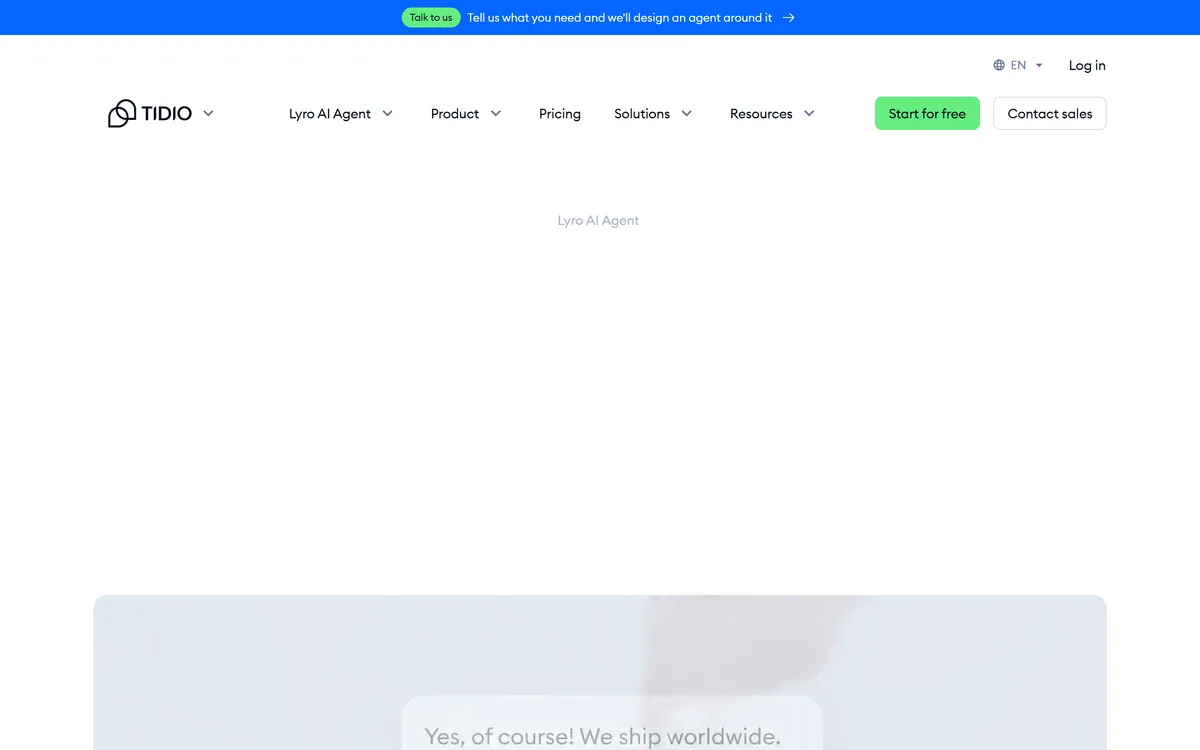
Tidio Lyro's page, captured 9 September 2026, showing its AI support agent positioning.
Tidio Lyro: What The Agent Handles
A published resolution rate: 67 percent on average, stated rather than implied.
Grounded in your content — answers built from your knowledge base and guidance, not general knowledge.
Smart Actions with MCP for order updates, lead qualification and product recommendations.
Configurable handoff rules, with real-time monitoring and the ability to step in.
No migration required — connects to Zendesk, Intercom, Salesforce and 20-plus platforms.
Tidio Lyro: An Agent Inside A Live Chat Product
Lyro is positioned as the AI agent customers want to talk to — resolving questions with AI that learns from your data and speaks like your best agents.
The context matters: this sits inside Tidio, an established live chat and helpdesk product, rather than arriving as a standalone agent looking for a queue to join.
That lineage produces a specific advantage. A support agent is only as good as its escape hatch, and a company that already built the live chat, the ticketing and the agent console has somewhere for a conversation to go when automation runs out.
Standalone agent products frequently have the harder half of the problem — the human handoff — as an integration rather than a native capability.
The stated positioning reinforces it: save on automation without switching platforms, no migration, connecting to your current stack. For most buyers that is the decisive practical point, because ripping out a working helpdesk to add automation is a project nobody wants to run.
A support agent is only as good as its escape hatch. Products built around an existing helpdesk have somewhere for a conversation to go when automation runs out.
Resolution Rate And How It Is Counted
The number stated is unusually specific: Lyro boosts your resolution rate to 67 percent on average, often higher.
Publishing an average rather than a best case is worth crediting, and it is also worth understanding precisely what such a figure measures.
Resolution rate is the share of conversations closed without a human. Its weakness across the whole category is that a conversation ending is not the same as a customer being helped — an abandoned chat and a solved problem both stop, and the naive metric counts them identically.
This is why resolution rates near 100 percent should be read as measurement artefacts rather than achievements.
Sixty-seven percent is credible precisely because it is modest. Roughly a third of a real support queue involves something unusual, emotional or genuinely complex, and any honest system escalates it. The number to ask a vendor for is satisfaction on resolved conversations alongside the rate, because those two together are the only pair that means anything. Enterprise platforms like Forethought report the same metric with the same caveats attached.
What Happens When The Agent Cannot Answer?
The escalation design is described as flexible handoff and escalation rules, with real-time conversation monitoring and the ability to jump in at any point — specifically to chat personally with high-value customers or discuss sensitive topics.
That framing is more sophisticated than a simple confidence threshold, and it reflects how support actually works.
Escalation is usually treated as a failure state: the agent could not cope, so a person takes over. But some conversations should never have gone to automation regardless of whether it could handle them — a complaint from your largest account, a bereavement, a legal threat, a safety issue.
Routing by customer value and topic rather than only by confidence is the difference between an automation policy and a support policy.
The other half is monitoring. Being able to watch conversations in real time and step in mid-exchange means automation is supervised rather than delegated, which is what makes support teams willing to trust it. The alert when a customer needs immediate human help is the mechanism that decides whether a frustrated customer waits two minutes or twenty, and that gap is where brand damage happens.
Ask for satisfaction on resolved conversations, not just the resolution rate.
Route by customer value and topic, not only by model confidence.
Load knowledge from real transcripts, not from your public FAQ page.
Test what it does when the knowledge base does not cover a question.
Review the escalated conversations weekly and add what was missing.
Training On Your Own Help Content
The grounding claim is the architectural centre of the product: Lyro works only with the content and guidance you provide — always on script, always on brand — with strong guardrails meaning every response is accurate and helpful.
The first half of that is a real and important design decision. The second half is stronger than any grounding can guarantee, and it is worth separating them.
Restricting an agent to your own content genuinely does reduce fabrication, because the model is summarising retrieved material rather than generating from general knowledge. That is the correct architecture for customer service, where a confidently invented refund policy is worse than no answer at all.
What it cannot do is make every response accurate. Retrieval can surface the wrong passage, your documentation can be out of date, and a plausible answer assembled from two unrelated articles reads exactly like a correct one.
The practical consequence is that quality tracks your knowledge base, which is the part most companies underestimate. An agent grounded in a neglected help centre will confidently repeat two-year-old policies. The strongest preparation is loading real support transcripts rather than the FAQ page, because transcripts contain the answers your team actually gives. General-purpose builders such as Voiceflow give more control over that logic at the cost of more configuration.
Where Automation Costs More Than It Saves
The onboard, develop, promote framing is the most useful idea on the page: add Lyro and get resolutions from day one, review conversations and add missing knowledge, then assign more complex tasks as it proves itself.
Treating an agent like a new hire is exactly right, and it inverts how most deployments go wrong.
The common failure is switching automation on across the entire queue on day one, discovering it handles the hard third badly, and concluding the category does not work. Nobody would give a new support hire every ticket type in week one, and the same logic applies.
Starting narrow, reviewing what it got wrong and widening its scope deliberately produces both better performance and a support team that trusts it.
The place automation genuinely costs more than it saves is worth naming plainly: a customer with an urgent problem, no visible route to a person, and a system confidently answering a question they did not ask. That customer does not file a complaint — they leave, and the resolution rate looks excellent while it happens. Smart Actions, now with MCP support, are what move the agent from answering to doing, and doing is where real resolution comes from. Multi-channel commerce tools like Spur apply the same principle across messaging apps rather than website chat.
Deploying Support Automation Carefully
The measure of a deployment is not what it automates. It is what happens to the customers it could not help.
This order protects them.
Load knowledge from real transcripts before touching the FAQ page.
Start on one narrow, high-volume question type.
Set escalation by customer value and topic as well as confidence.
Monitor live conversations for the first fortnight rather than reading reports.
Read every escalated conversation and add the knowledge that was missing.
Widen scope only after satisfaction on resolved conversations holds up.
Tidio Lyro: What It Does And Where It Stops
Category
AI customer service agent inside a live chat and helpdesk platform
Grounding
Answers built only from your provided content and guidance
Resolution rate
Stated as 67 percent on average, often higher
Escalation
Flexible handoff rules by confidence, customer value and topic
Monitoring
Real-time conversation view with the ability to intervene
Smart Actions
Order updates and lead qualification, described as now with MCP
Commerce
Product recommendations pulled directly from your store
Guidance
Configurable tone, style and escalation rules
Integrations
Zendesk, Intercom, Salesforce and a stated 20-plus platforms
Custom tier
Custom model training, priority SLA, SOC 2 and HIPAA compliance
Trial
50 free conversations, no credit card required
Company
Tidio, per the 2026 footer copyright
Key features of Tidio Lyro
AI agent grounded in your own support content
Configurable escalation and handoff rules
Real-time conversation monitoring and intervention
Smart Actions for order updates and lead qualification
MCP support for connected actions
Product recommendations from your store
Tone and style guidance configuration
Integration with major helpdesk platforms
Pros & cons
Pros
7
Publishes an average resolution rate rather than a best case
Sixty-seven percent is credible precisely because it is modest
Grounding in your own content is the right architecture for support
Escalation by customer value and topic beats a confidence threshold alone
Live monitoring makes automation supervised rather than delegated
Sits inside an established helpdesk, so the human handoff is native
No migration required, which removes the main practical objection
Cons
7
Every response accurate is stronger than grounding can guarantee
Quality tracks your knowledge base, which most companies underestimate
How resolution rate treats abandoned conversations is not defined
SOC 2 and HIPAA appear only on the custom tier
The site's framing of competitors making things up is a claim we did not test
Case study percentages carry no stated methodology
Low-volume teams will not recover the configuration effort
Best For
Ecommerce stores with repetitive pre-sales questions
Support teams already using Tidio or a connectable helpdesk
Salesken — analysing conversations rather than automating them
Tidio Lyro: Read From The Support Pages
Last checked . Read from tidio.com/ai-agent in a browser session on the date above, with the screenshot captured at the same time.
Positioned as an AI customer service agent that learns from your data
Stated as working only with the content and guidance you provide
Average resolution rate stated as 67 percent, described as often higher
Flexible handoff and escalation rules described, including by customer value and sensitive topic
Real-time conversation monitoring with the ability to intervene
An onboard, develop and promote framing describing the agent as a teammate
Smart Actions described for order updates and lead qualification, stated as now with MCP
Product recommendations described as pulled directly from your store
Integration stated with Zendesk, Intercom, Salesforce and 20-plus platforms without migration
A custom tier listing custom model training, priority SLA, and SOC 2 and HIPAA compliance
A trial of 50 free conversations with no credit card required
Named customer testimonials with roles and companies, plus a 2026 Tidio footer copyright with privacy policy and terms
What we could not confirm: how resolution rate is defined, and whether abandoned conversations count as resolved; satisfaction scores on resolved conversations; how the 97 percent response-time figure in the case study was measured; which capabilities require which plan tier, since SOC 2 and HIPAA appear only under the custom offering; and pricing. We did not deploy an agent or run a conversation.
Editor's Verdict
4.1/5
Lyro publishes an average resolution rate of 67 percent, and that single decision tells you more than any feature list. A vendor claiming to resolve everything is describing a demo; a vendor stating two thirds is describing deployments, and two thirds of a support queue handled is a serious result. Grounding responses in the customer's own content is the right architectural choice for reducing fabrication, though the site's phrasing runs slightly ahead of what grounding can guarantee. The onboard-develop-promote framing is the most useful mental model in the category. AInexfinder Editor Score: 4.1/5.
Tidio Lyro pricing
AInexfinder does not list plan prices or billing details. For current pricing, plans, and trials, visit the official Tidio Lyro website.
Vendor pricing, credits, and billing policies change over time. Always confirm on the official site before you buy.
Frequently asked questions
What is Lyro?
Tidio's AI customer service agent. It answers using only the content and guidance you provide, escalates to a person under rules you set, and can take actions like updating an order through connected systems.
What does a 67 percent resolution rate mean?
That roughly two thirds of conversations close without a human on average. Publishing an average rather than a best case is credible — and modest, because a real support queue always contains a complex third.
Why be sceptical of very high resolution rates?
Because an abandoned chat and a solved problem both end, and a naive metric counts them the same way. Rates near 100 percent usually describe measurement rather than achievement.
What should I ask alongside the resolution rate?
Satisfaction on resolved conversations. The two numbers together mean something; either one alone can be improved by making it harder for customers to reach a person.
Does grounding stop it making things up?
It substantially reduces fabrication, because the agent summarises your retrieved material rather than generating from general knowledge. It cannot guarantee accuracy — retrieval can surface the wrong passage, and stale documentation is repeated confidently.
What should I load as knowledge?
Real support transcripts before your public FAQ. Transcripts contain the answers your team actually gives, including the phrasing and the exceptions that never made it into published documentation.
How should escalation be configured?
By customer value and topic as well as confidence. Some conversations should never go to automation regardless of whether it could cope — a complaint from your largest account, a bereavement, a safety issue.
What is the onboard, develop, promote idea?
Treating the agent like a new hire: start narrow, review what it got wrong, add missing knowledge, then widen its scope. Nobody gives a new support hire every ticket type in week one.
What are Smart Actions?
The agent doing something in another system rather than describing it — updating an order, qualifying a lead — now with MCP support. Doing is where resolution comes from; explaining how to check an order is deflection.
When does automation cost more than it saves?
When a customer with an urgent problem sees no route to a person and gets a confident answer to a question they did not ask. They do not complain, they leave — and the resolution rate looks excellent meanwhile.
Daniel reviews AI tools the slow way — by actually using them on real projects. His reviews cover what works, what breaks, and who each tool is genuinely a good fit for.
Daniel and the AInexfinder editorial team research Tidio Lyro using public product information, listing evidence, and (when available) hands-on checks. Scores reflect listing completeness and transparency — not paid placement.
Listings may include affiliate or sponsored placements, which are labeled when present. Editorial scores and cons are not sold. See our affiliate disclosure and review methodology.
Voiceflow is an enterprise conversational AI platform where CX teams design agent workflows visually, prototype them in place, and deploy one agent across web, app, WhatsApp, SMS and voice. It states 500-millisecond voice latency, 300,000 messages per minute and more than 10,000 live agents in production.
Wonderchat is a platform for building AI customer-service and sales agents from your own content and data. Agents answer with citations from approved sources, hand off to sales and capture leads in the conversation, while a QA agent flags weak answers for fixing.
Chatling deploys AI support agents across five channels — web, WhatsApp, Instagram, Telegram and Messenger — into one unified inbox. It auto-syncs your website, docs and help centre, replies in 80+ languages, and hands off to your team with full context.
Spur is a multi-channel AI agent for commerce marketing and support, unifying WhatsApp, Instagram, Facebook and website chat in one inbox, automating comment-to-DM flows and bulk campaigns, and integrating with external systems to update orders and book meetings.