Voiceflow is an enterprise conversational AI platform where CX teams design agent workflows visually, prototype them in place, and deploy one agent across web, app, WhatsApp, SMS and voice. It states 500-millisecond voice latency, 300,000 messages per minute and more than 10,000 live agents in production.
voiceflow.com7 viewsAdded September 11, 2025387K visitors
The people who know what customers actually ask work in support. The people who can wire an agent into an order system work in engineering. Almost every disappointing customer-facing bot is a consequence of that gap.
Voiceflow's answer is a canvas: conversation designers build and test the flow, engineers own the integrations, and the two work on the same artefact.
The platform's own testimonials give the strategy away — most are from conversation designers and UX leads rather than developers, which tells you exactly who it is built for.
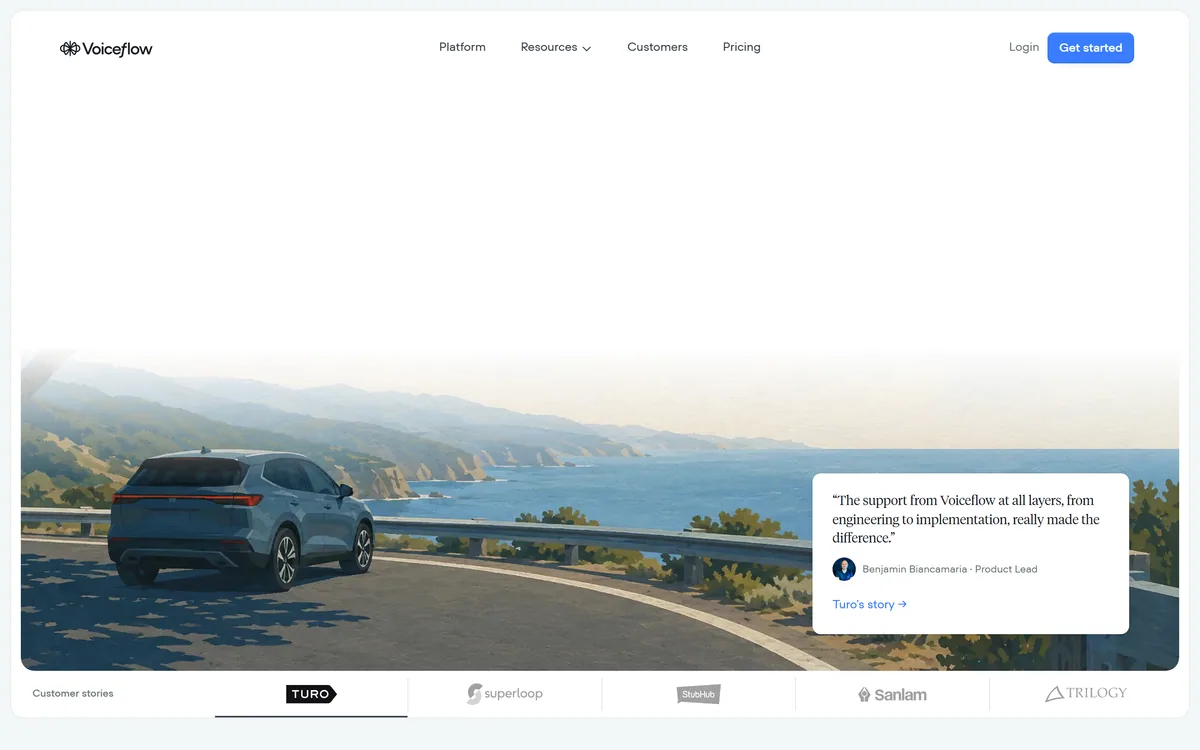
Voiceflow's homepage, captured 9 September 2026, showing the omnichannel agent demonstration.
Voiceflow: Designing Agents Visually
A visual canvas for conversation design, with prototyping in place rather than after a build.
One agent, every channel — web, app, WhatsApp, SMS and voice from the same definition.
Stated performance: 500-millisecond voice latency, 300,000 messages per minute, 10,000-plus live agents.
Build, launch, iterate with agents described as staying compatible as you scale, without rebuilds.
4,000-plus customers and 200,000-plus users with a 4.8 out of 5 rating displayed.
Why Build Conversational Agents On A Canvas?
Voiceflow positions itself as helping CX teams own every customer interaction, with a build-launch-iterate cycle and integrated prototyping, and describes making everything accessible to designers and non-designers alike.
The case for a visual builder is not that code is hard. It is that conversation is a design discipline with its own failure modes, and the person who understands them is usually not an engineer.
A conversation fails in ways a function does not. It fails when a customer asks something adjacent to what you anticipated, when they change their mind halfway, when the agent answers correctly but in a tone that makes an annoyed person angrier.
Those are all design problems. Seeing the whole flow laid out — every branch, every dead end, every place a person can get stuck — is how you find them, and a flow diagram surfaces them in a way a codebase does not.
Prototyping in place is the second half. Being able to talk to a half-built agent while designing it collapses the loop between an idea and knowing whether it works, which is the same argument that makes design tools better than specification documents.
A conversation fails when a customer asks something adjacent to what you anticipated. Seeing every branch laid out is how you find that.
What A Canvas Cannot Solve
One of the platform's own testimonials is more revealing than any feature description: an engineering leader describing moving from a workflow designed in Voiceflow to one their team owned and could refactor themselves.
That is a graduation path, and the fact that it is quoted approvingly is a good sign about the company's honesty rather than a criticism of the product.
The pattern it describes is real across every visual builder. A canvas is excellent for defining behaviour and mapping conversation, and it becomes constraining once the logic gets genuinely complex — dozens of branches, state that persists across sessions, conditions that interact.
Voiceflow addresses part of this by including a code editor and functions alongside the visual layer, which several of its technical testimonials mention specifically. That hybrid is the right design, because it means the escape hatch exists before you need it.
The question to ask in an evaluation is where your logic sits on that spectrum, and whether the handoff to engineering is a supported path or a rewrite. A platform quoting an engineer who took that path is at least not pretending it does not happen. The destination of that path usually looks like Vocode — a library your own engineers own outright.
Five Hundred Millisecond Voice Latency
The three performance figures on the page are 500 milliseconds latency for voice, 300,000 messages per minute, and more than 10,000 live agents in production.
The voice latency number is the one with real meaning, and understanding why requires knowing what half a second represents in conversation.
Human turn-taking runs on gaps of roughly 200 milliseconds. At 500 the pause is noticeable but tolerable — it reads as a person thinking rather than as a system failing. Beyond about a second, callers start speaking again because they assume the line dropped.
So 500 milliseconds is inside the range where voice works and outside the range where it feels effortless, which is an honest number rather than an aspirational one. Every platform in this space is fighting the same physics: speech recognition, model inference and speech synthesis chained together.
What the figure does not cover is your integrations. An agent that checks an order status is waiting on your order system, and a slow internal API adds its latency to everything the platform achieves — which is why testing against real backends matters more than the headline, and why turn-taking specialists like Tavus treat the problem as a model rather than a metric.
Test latency against your real backends, not the demo.
Design the escalation path before the happy path.
Ask where your logic outgrows the canvas and what the handoff looks like.
Read containment claims as ticket-type specific, not general.
Build one channel properly before enabling the rest.
Build, Launch, Iterate Without Rebuilds
The lifecycle framing includes a specific promise: agents that stay compatible as you scale, with no rebuilds required, powered by what Voiceflow calls its Agentic Context Engine.
No rebuilds is a stronger claim than it sounds, and it addresses the most expensive failure in this category.
The pattern it refers to is familiar. A team builds an agent on a platform's current architecture, the platform shifts to a new model of how agents work, and the existing agent has to be rebuilt from scratch to get any of the improvements. Two years of accumulated conversation design becomes migration work.
Promising compatibility across that kind of change is a commitment to keeping the definition portable while the runtime underneath moves — which is worth a great deal if it holds, and impossible to verify from a homepage.
The Agentic Context Engine itself is the least specified thing on the page. Context management is genuinely the hard problem in conversational agents — what to remember, what to retrieve, what to forget — so it is the right thing to be building, and the name currently carries more weight than the description.
One Agent Across Every Channel
The omnichannel demonstration runs the same conversation across web chat, WhatsApp, SMS and voice, with the site describing one agent running across all of them at once.
This is the most operationally significant feature and the least visible in a feature comparison.
The alternative is what most organisations actually have: a website chatbot, a WhatsApp flow someone built separately, an IVR that predates both, and three different answers to the same question. Every policy change means three edits and one forgotten channel.
One definition across channels means the answer changes once. That is a governance benefit rather than a technical one, and it compounds over years.
The design caveat is that channels are not interchangeable. A message thread tolerates long answers and links; a voice call cannot read out a URL; SMS has hard length limits. An agent authored once still needs channel-appropriate rendering, and the demo showing identical text everywhere is a demo rather than a design recommendation. Knowing what customers actually ask across those channels is a separate discipline, and where Thematic reads the same conversations as data.
Designing An Agent That Survives Scale
Conversational agents are easy to launch and hard to keep good. The version that ships is the best it will ever be unless someone owns it.
This sequence front-loads the decisions that determine whether it degrades.
Read a hundred real customer messages before designing anything.
Design the escalation path to a human first, and test it under frustration.
Prototype on the canvas and talk to the agent while it is half built.
Launch on one channel, with channel-appropriate wording.
Instrument what the agent could not answer, not just what it resolved.
Review that failure list weekly and let it drive the next iteration.
Voiceflow: Platform And Performance
Positioning
Enterprise conversational AI platform for CX teams, from resolution to ROI
Design surface
Visual workflow canvas with integrated prototyping
Developer surface
Code editor, functions and API capabilities alongside the canvas
Channels
Web, app, WhatsApp, SMS and voice from one agent
Voice latency
Stated at 500 milliseconds
Throughput
Stated at 300,000 messages per minute
Deployment scale
More than 10,000 live agents in production, as stated
Underlying system
Described as the Agentic Context Engine
Lifecycle
Build, launch and iterate, with agents stated to stay compatible without rebuilds
Other features
NLU modelling, separate workspaces and collaborative design, per customer quotes
Adoption
4,000-plus customers and 200,000-plus users, with a 4.8 out of 5 rating displayed
Case study
A customer states AI support live in three months; another states 59% of 7,000 central support tickets solved completely by AI
Key features of Voiceflow
Visual canvas for conversation workflow design
Integrated prototyping while designing
Code editor and functions alongside the visual layer
One agent across web, app, WhatsApp, SMS and voice
NLU modelling and intent handling
Separate workspaces for collaborative design
API integration capabilities
Publishing to a chosen deployment platform
Pros & cons
Pros
7
Puts conversation design in the hands of the people who understand customers
Prototyping in place collapses the loop between idea and evidence
A code editor and functions mean the escape hatch exists before you need it
One definition across five channels is a real governance win
500 milliseconds is an honest voice latency figure rather than an aspirational one
Quotes an engineer describing graduating off the canvas, which is candid
Testimonials come from named practitioners with checkable job titles
Cons
7
A canvas becomes constraining once logic gets genuinely complex
The Agentic Context Engine is named more precisely than it is described
Latency figures exclude your own integrations, which usually dominate
The 59 percent containment figure is not broken down by ticket type
No-rebuild compatibility is impossible to verify before committing
Channels need channel-appropriate wording the demo does not show
Our capture stopped before the footer, so company details went unread
Best For
CX and support teams building customer-facing agents
Conversation designers who need a canvas and a prototype
Companies serving customers across chat, messaging and phone
Organisations whose channels currently contradict each other
Teams that want designers and engineers on the same artefact
Voiceflow Against Other Agent Platforms
Conversational platforms differ by who builds the agent and on what surface.
Last checked . Read from voiceflow.com in a browser session on the date above, with the screenshot captured at the same time.
Positioned as an enterprise conversational AI platform helping CX teams own every interaction from resolution to ROI
Lifecycle described as build, launch and iterate, with agents stated to stay compatible as you scale without rebuilds
Described as powered by Voiceflow's Agentic Context Engine
Voice latency stated at 500 milliseconds
Throughput stated at 300,000 messages per minute
More than 10,000 live agents in production stated
Omnichannel described as one agent running across web, app, WhatsApp, SMS and voice at once
The same demonstration conversation shown rendered in web chat, WhatsApp, SMS and voice
A customer story states AI support live in three months
A customer quote states 59% of 7,000 central support tickets solved completely by AI
Customer quotes reference NLU modelling, integrated prototyping, separate workspaces, a code editor and functions
Displayed as trusted by 4,000-plus customers with a 4.8 out of 5 rating and 200,000-plus users
What we could not confirm: our capture ended inside repeating omnichannel demonstration panels before the site footer, so we read nothing below that point and make no claim in either direction about what is published there. We also could not confirm what the Agentic Context Engine does technically; whether 500 milliseconds is measured end to end or excludes integrations; how the 59 percent containment figure breaks down by ticket type; what compatibility without rebuilds covers contractually; and pricing, which sits on a separate page. We did not build or deploy an agent.
Editor's Verdict
4.2/5
Voiceflow's insight is that building a conversational agent is a design problem before it is an engineering one, and that the people who understand what customers ask are rarely the people who can write the integration. A visual canvas with prototyping in place puts those people in charge of the conversation, which is why the platform's own testimonials come from conversation designers rather than developers. Omnichannel from one definition is the operationally valuable part. The claims to test are latency and containment, because both depend on your integrations rather than the platform. AInexfinder Editor Score: 4.2/5.
Voiceflow pricing
AInexfinder does not list plan prices or billing details. For current pricing, plans, and trials, visit the official Voiceflow website.
Vendor pricing, credits, and billing policies change over time. Always confirm on the official site before you buy.
Frequently asked questions
What is Voiceflow?
An enterprise conversational AI platform where teams design agent workflows on a visual canvas, prototype them in place, and deploy a single agent across web, app, WhatsApp, SMS and voice channels.
Why use a visual builder instead of code?
Because conversation is a design discipline and the person who understands what customers ask is usually not an engineer. Seeing every branch and dead end laid out surfaces failure modes a codebase hides.
Is 500 milliseconds fast enough for voice?
It is inside the range where voice conversation works. Human turn-taking runs on gaps around 200 milliseconds, so half a second reads as thinking rather than failure. Past about a second, callers start talking again assuming the line dropped.
Does that latency include our systems?
Almost certainly not, and this is the number to test yourself. An agent checking an order status waits on your order system, and a slow internal API adds its own delay to whatever the platform achieves.
What happens when the logic gets complex?
A canvas becomes constraining, which is true of every visual builder. Voiceflow includes a code editor and functions for that reason, and its own testimonials include an engineer describing taking a designed workflow and refactoring it themselves.
What does omnichannel actually buy us?
One place to change an answer. The alternative is a website bot, a separately built WhatsApp flow and an older IVR giving three different answers, where every policy change means three edits and one forgotten channel.
Do channels need different design?
Yes. A chat thread tolerates long answers and links, a voice call cannot read out a URL, and SMS has hard length limits. One agent definition still needs channel-appropriate rendering rather than identical text everywhere.
How should I read the 59 percent figure?
As encouraging and incomplete. Containment is only meaningful per ticket type — password resets and billing disputes are not comparable — so ask which categories the number covers before projecting it onto your own queue.
What is the Agentic Context Engine?
The name Voiceflow gives its underlying system. Context management — what an agent remembers, retrieves and forgets — is genuinely the hard problem here, so it is the right thing to build; the description on the page is thinner than the name suggests.
What should we design first?
The escalation path, before the happy path. Whether a failing agent is a minor inconvenience or the reason someone stops being a customer is decided entirely by how well it hands over to a person with context attached.
Daniel reviews AI tools the slow way — by actually using them on real projects. His reviews cover what works, what breaks, and who each tool is genuinely a good fit for.
Daniel and the AInexfinder editorial team research Voiceflow using public product information, listing evidence, and (when available) hands-on checks. Scores reflect listing completeness and transparency — not paid placement.
Listings may include affiliate or sponsored placements, which are labeled when present. Editorial scores and cons are not sold. See our affiliate disclosure and review methodology.
Wonderchat is a platform for building AI customer-service and sales agents from your own content and data. Agents answer with citations from approved sources, hand off to sales and capture leads in the conversation, while a QA agent flags weak answers for fixing.
Chatling deploys AI support agents across five channels — web, WhatsApp, Instagram, Telegram and Messenger — into one unified inbox. It auto-syncs your website, docs and help centre, replies in 80+ languages, and hands off to your team with full context.
Spur is a multi-channel AI agent for commerce marketing and support, unifying WhatsApp, Instagram, Facebook and website chat in one inbox, automating comment-to-DM flows and bulk campaigns, and integrating with external systems to update orders and book meetings.