
Runway is an AI video platform built around generative world models — Gen-4.5, Aleph 2.0, and Act-Two for performance capture — split across Runway Creative for filmmakers, Runway Dev for builders, and Runway Robotics.
FreemiumVideo & Audio
Tavus is an AI research lab building what it calls PALs — real-time conversational video agents that see, hear and respond with emotional context. It ships three named models for rendering, perception and turn-taking, and offers them through a developer API, a no-code PAL Maker and managed enterprise deployments.
Most conversational AI companies sell an interface over someone else's model. Tavus describes itself as a research lab and publishes the models it built, which changes what you are evaluating.
The product is a PAL: an agent with a rendered face that holds a real-time conversation, reads what it sees and hears, and decides for itself when to speak and when to wait.
That last capability is the one worth paying attention to, because it is where almost every conversational agent falls apart and where the least marketing attention usually goes.
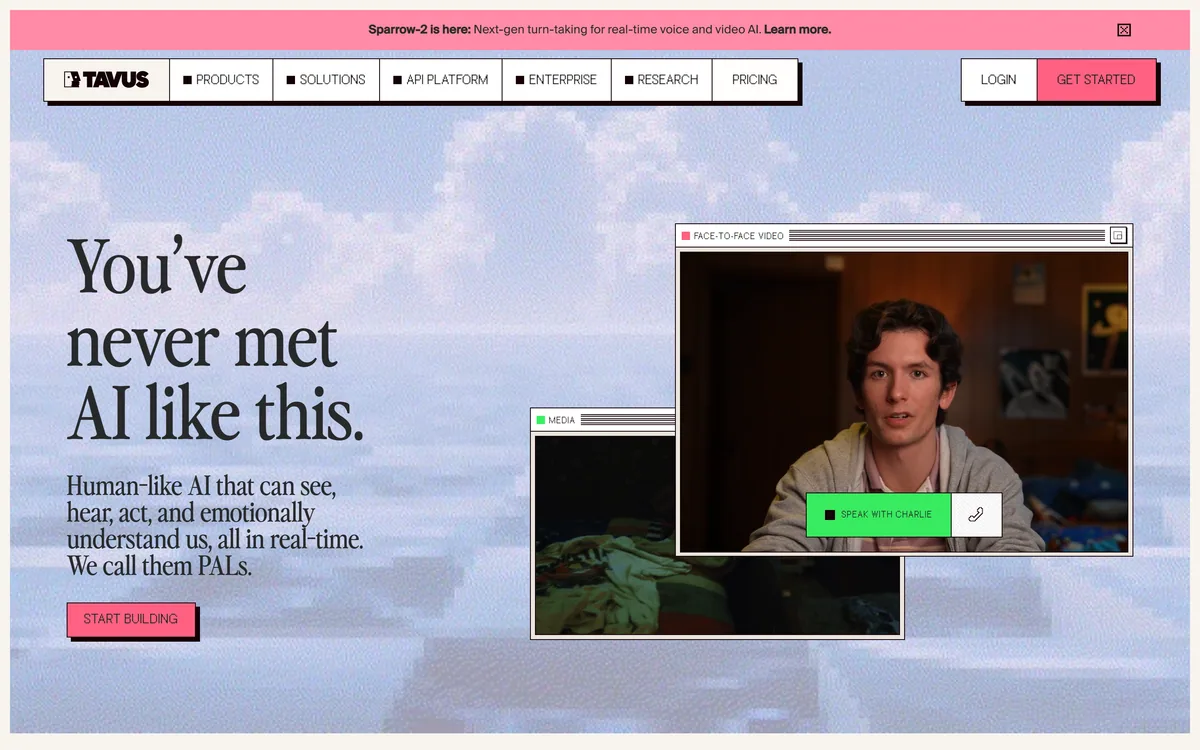
Tavus describes a PAL as a new type of application that can see, hear, act and understand like a coworker or friend, and positions it as whatever the moment calls for — a teammate, an onboarding guide, a customer expert or a companion.
Strip the framing and the technical claim is specific: a rendered human face in a real-time conversation, with a perception model reading the other side of the call.
Video adds two things voice cannot. The first is that the agent can see — an error light, a cracked part, a document held to the camera — which turns a support conversation from description into observation.
The second is presence. People behave differently talking to a face than to a voice, and for roleplay, onboarding and intake that difference is the product rather than decoration.
The cost is equally specific. Video is heavier, harder to render convincingly in real time, and lands in the uncanny valley when it fails — where a voice agent that stumbles merely sounds like a bad phone line, which is why Vocode and other voice-only stacks remain the safer default for pure telephony.
Video lets the agent see the error light rather than ask you to describe it. That is a different product, not a prettier one.
The Developer API brings together perception, understanding, voice and rendering as building blocks for real-time PAL conversations. This is the route for teams embedding agents inside their own product.
PAL Maker is the no-code path: describe what you want in a sentence, or talk to Charlie — described as the kid inside the machine — and deploy to a website or app in a few clicks.
Enterprise Solutions are bespoke and fully managed, with Tavus designing, building and tuning the agent around a specific workflow and running it in production with integrations and service guarantees.
Those are three genuinely different companies wearing one brand, and the honest read is that they suit different maturity levels rather than different budgets.
The pattern worth noticing is that no-code entry points and managed enterprise delivery usually appear at the same time for a reason: the self-serve product proves the category and the managed one earns the revenue.
Sparrow-2 is described as a real-time conversational understanding model built for natural flow in noisy, multi-speaker environments, modelling semantics, prosody, speaker identity, backchannels, interruptions, background speech, noise and unclear audio to determine when to listen, wait, speak or continue.
That sentence is doing more work than any other on the site, and it deserves unpacking.
Every unbearable conversational agent fails in one of two ways: it interrupts you mid-sentence because you paused for breath, or it leaves a two-second gap after everything you say. Both come from treating silence as the only signal.
Real turn-taking is not a silence threshold. Humans use falling intonation, syntactic completeness, gaze and the difference between a thinking pause and a finished thought — which is why prosody and semantics appear in that model description rather than just voice activity detection.
Backchannels are the detail that gives it away as a serious attempt. Recognising that mm-hm means keep going rather than my turn now is exactly the distinction cheap systems get wrong, and getting it right is most of what makes a conversation feel unremarkable in the good sense.
Tavus lists five applications: roleplay and L&D agents, HR onboarding, go-to-market agents, customer support and patient intake.
They are not equally strong, and the difference is worth naming.
Roleplay is the best fit on the list. Practice conversations need a patient partner more than a knowledgeable one, mistakes carry no consequence, and a face makes the rehearsal transfer — the same logic behind dedicated tools like Hyperbound for sales practice and Praktika for language.
Intake and onboarding are strong for a different reason: both are structured interviews where the agent asks and the human answers, which is the easiest conversational shape to get right.
Support and go-to-market are the harder cases, because both have an adversarial edge. A frustrated customer or a sceptical buyer will test the agent deliberately, and the escalation path matters more than the conversation quality. That is a deployment design problem rather than a model problem, and the site treats it as neither.
The homepage states that Tavus powers 100,000+ developers and the world's most forward-thinking companies, which is a number worth reading carefully rather than dismissing.
Developer counts are among the least standardised metrics in software. The figure could mean accounts created, API keys issued, developers who shipped something, or any combination.
That is not a criticism unique to Tavus — practically every developer platform reports the same way — but it does mean the number cannot be compared against a competitor's without knowing both definitions.
What is more informative is the shape of the surrounding evidence. Named models with published research pages, an llms.txt file, a trust centre and separate supplemental terms for a specific product are the artefacts of a company with real deployments rather than a demo.
The claim we would want and do not have is retention: how many of those developers are still building six months later. In a category where the demo is much easier than the deployment, that is the number that would actually settle the question.
A video agent demo is compelling in a way that skips past the questions a deployment has to answer. That is the risk with this category rather than any weakness in the technology.
This sequence tests the things that decide whether a PAL survives contact with real users.
| Self-description | An AI research lab pioneering human computing |
|---|---|
| Founded | 2020, per its own site |
| Product name | PALs — real-time conversational video agents |
| Claimed reach | Powering 100,000+ developers per the homepage |
| Rendering model | Phoenix-4.5, gaussian-diffusion based, real-time |
| Perception model | Raven-1, multi-modal, reads expression, tone, gaze and context |
| Turn-taking model | Sparrow-2, for flow in noisy multi-speaker environments |
| Developer route | API platform covering perception, understanding, voice and rendering |
| No-code route | PAL Maker, from a single sentence or a conversation with Charlie |
| Enterprise route | Bespoke, fully managed deployments with service guarantees |
| Use cases listed | L&D roleplay, HR onboarding, GTM agents, customer support, patient intake |
| Accessibility | The site states it is AudioEye enabled and being optimised for accessibility |
Real-time conversational video agents (PALs)
Phoenix-4.5 rendering with expression and emotion
Raven-1 perception across expression, tone, gaze and context
Sparrow-2 turn-taking for noisy, multi-speaker settings
Developer API covering the full conversation stack
PAL Maker for no-code creation and deployment
Managed enterprise deployments with service guarantees
Published research pages on turn-taking, rendering and LLM thinking
Conversational agents differ most in modality and in how much you build.
| Tool | Modality | Models named | Best for |
|---|---|---|---|
| Tavus | Real-time video with perception | Phoenix, Raven, Sparrow | Face-to-face agents at scale |
| Vocode | Voice over telephony | None — you choose providers | Engineers building phone agents |
| Voiceflow | Chat and voice, visually designed | Not named | CX teams designing flows |
| Hyperbound | Voice roleplay for sales | Not named | Practice with scoring |
| Praktika | Avatar tutors for language | Not named | Conversational learning |
Other approaches to agents that talk, across voice, chat and video.
Last checked . Read from tavus.io in a browser session on the date above, including the full footer. The screenshot was captured at the same time.
What we could not confirm: what 100,000+ developers counts — registrations, active builders or paying customers; how the three models perform against alternatives, since no independent benchmark is cited on the homepage; latency figures for real-time rendering; whether the model versions named are the ones served by default; and pricing, which sits behind a separate page we did not reproduce. We did not build or deploy a PAL, and the five use cases are drawn from the site's own descriptions rather than from customers we spoke to.
Tavus is unusual among conversational AI companies in that it publishes its research and names its models rather than describing a black box. Phoenix renders the face, Raven perceives, Sparrow decides when to speak — and that last one is the hardest problem in the category, which most vendors quietly route around. The product line runs from a one-sentence no-code builder to bespoke managed deployments. The open question is not capability but fit: video agents are compelling in a demo and only sometimes the right answer for a real workflow. AInexfinder Editor Score: 4.3/5.
AInexfinder does not list plan prices or billing details. For current pricing, plans, and trials, visit the official Tavus website.
Visit official website for pricingVendor pricing, credits, and billing policies change over time. Always confirm on the official site before you buy.
Log in to write a review.
No reviews yet. Be the first to share your experience with Tavus.
Assigned reviewer
Daniel ReedSenior AI Tools Reviewer
Daniel reviews AI tools the slow way — by actually using them on real projects. His reviews cover what works, what breaks, and who each tool is genuinely a good fit for.
Daniel and the AInexfinder editorial team research Tavus using public product information, listing evidence, and (when available) hands-on checks. Scores reflect listing completeness and transparency — not paid placement.
Runway is an AI video platform built around generative world models — Gen-4.5, Aleph 2.0, and Act-Two for performance capture — split across Runway Creative for filmmakers, Runway Dev for builders, and Runway Robotics.
LipSync.video generates lip-synchronised video from a face and an audio track. It offers two model tiers, accepts uploaded video, uploaded or recorded audio, or a typed script with generated speech, and provides over 300 prebuilt avatars. Credits can be earned through daily actions as well as bought.
Viggle animates characters from a still image driven by motion from a video, built on its Joint Space-Time model — described as a physics-native world model that generates characters, motion and scenes together in shared 4D space. It offers a Meme Maker, the PINOC motion-capture tool, games and an API, and states 50 million users.
BeatViz.ai turns music into video through three tools — Chat, Workflow and Editor. Chat 2.0 is positioned as an AI music video director, and the site names the models it draws on, including Veo, Sora, Kling, Seedance, Nano Banana and GPT Image 2.
Argil is an AI video platform built around three surfaces: a Playground for generating images and video model by model, a Director that takes an idea to a finished video, and Templates that turn a repeated video format into a reusable recipe with variables.

The workspace at www-flux3.com generates 5–20 second AI videos with native audio from text or a starting image, routing across FLUX 3, MiniMax H3, Seedance, Wan 3.0 and Kling 3.0 Pro, at 720p or 1080p with video extension.