

Runway is an AI video platform built around generative world models — Gen-4.5, Aleph 2.0, and Act-Two for performance capture — split across Runway Creative for filmmakers, Runway Dev for builders, and Runway Robotics.
FreemiumVideo & Audio
Viggle animates characters from a still image driven by motion from a video, built on its Joint Space-Time model — described as a physics-native world model that generates characters, motion and scenes together in shared 4D space. It offers a Meme Maker, the PINOC motion-capture tool, games and an API, and states 50 million users.
Viggle became widely known for one thing: putting a recognisable person into a video of someone else's dance. That made it a meme engine, and the reputation stuck.
The technology underneath is doing something more interesting than that use suggests, and the company's own positioning has moved accordingly — toward world models and physical intelligence rather than internet novelty.
Both readings are true, and a useful review has to hold them together. There is a real capability here with genuine applications in animation and game development, and there is a consumer product whose most popular use raises a question the site does not address.
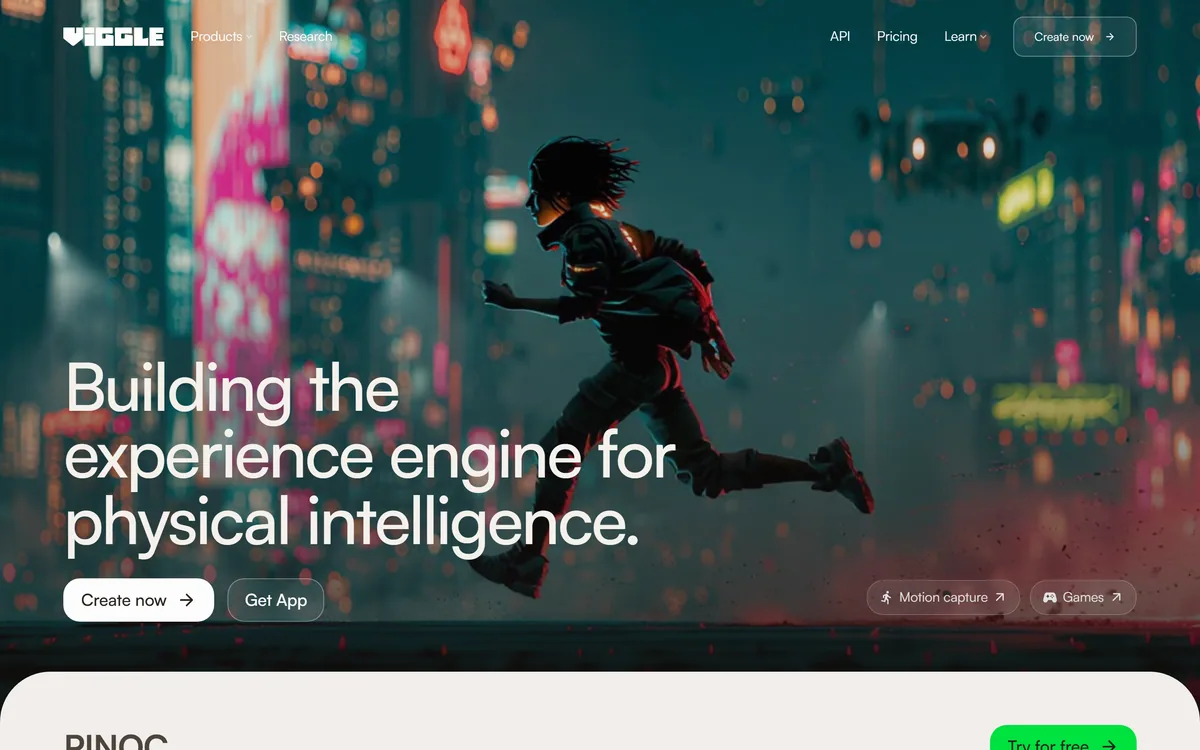
Viggle names its technology the Joint Space-Time model, describing it as a physics-native world model that generates characters, motion and scenes together in a shared 4D space.
Stripped of the branding, the claim is about representation. Most generative video — Runway ML and Luma Dream Machine among them — works in two dimensions plus time: it produces frames that look plausible in sequence, and consistency between them is something the model has to maintain rather than something the representation guarantees.
A model reasoning in space and time together represents the scene as having depth and persistence — a character occupies a position that continues to exist between frames rather than being redrawn each time.
If that works, it explains why character animation is the natural application. Moving a character through a motion requires knowing that limbs have length, that a body cannot pass through itself, and that a foot planted on the ground stays there. Those are physical facts, and a model with a physical representation can respect them where a frame-based one has to approximate them.
The honest caveat is that no benchmarks, comparisons or technical papers are linked from the pages we read, so the architectural claim cannot be verified from outside. Judge it on output rather than on the description — which, for this category, you can do in a few minutes.
Frame-based video keeps a character consistent by trying. A model with a spatial representation keeps it consistent because the character is somewhere.
Alongside the consumer tools sits PINOC, described as turning a phone video clip into production-ready motion in minutes. This is the most commercially significant thing Viggle does.
Motion capture has traditionally required a studio, which is why game teams reach for asset tools such as Sprite Flow instead, a suit, a calibrated camera array and a technician — which is why small game studios and independent animators either license generic animation libraries or animate by hand.
Deriving usable motion from a phone recording removes that barrier entirely. An animator can act out a movement themselves and get it into an engine, which changes what a small team can produce.
The realistic expectation is that this will not match a professional volume for precision work — fine hand articulation and facial capture are where studio systems still earn their cost. For body motion in a game, an indie animation or a previsualisation, phone-derived capture is plausibly good enough, and good enough at that price is a different category of tool.
Viggle's best-known use is placing a recognisable person's image into a video of someone else's performance. That deserves direct treatment.
The site publishes Terms of Service, Community Rules and a Privacy Policy, so rules exist. What we did not find on the pages we read is a plain statement about using other people's likenesses — which is the first thing a user of this specific capability needs to know.
The legal position is clearer than the silence suggests. A person's likeness is protected independently of copyright in many jurisdictions, through personality and publicity rights. Using someone's face in generated video without permission can be actionable regardless of whether the result is flattering, funny or clearly unreal, and several jurisdictions have introduced legislation aimed specifically at synthetic media.
There is a second layer that catches people out. Placing a character into a copyrighted performance — a music video, a film clip, a broadcast — involves the rights in that footage as well as the person's likeness. A meme that circulates widely is exactly the one that gets noticed.
The practical guidance is short. Use your own likeness, or one you have written permission for. Do not use a public figure's image because it is easy to obtain; availability is not permission. And read the Community Rules before your first project rather than after a takedown.
Viggle exposes its technology through several products: a Meme Maker web app, PINOC for motion capture, a games platform and an API.
That spread tells you the company is treating the model as infrastructure and the consumer apps as demonstrations of it — which is a reasonable strategy, since the meme use built enormous awareness at essentially no marketing cost.
The API is the part that matters for anyone building. It means the capability can sit inside a game, an animation pipeline or another product rather than requiring people to visit Viggle's own app.
The gap is documentation. No output resolutions, clip length limits, generation times or rate limits appear on the pages we read, and those are the specifications that determine whether an API is usable for a given purpose.
The games platform is the most speculative of the four and the hardest to assess from outside. It suggests the company sees interactive experiences rather than clip generation as the destination, which is consistent with the world-model framing but not yet something a buyer can evaluate.
This is a category where a few minutes of hands-on use tells you more than any specification would, because the failure modes are immediately visible.
The bar is step four. Character consistency across a full clip is what separates a usable animation tool from a novelty.
Being direct about the gaps is necessary here, because they are wide enough to affect a decision.
There is no pricing on the pages we read. No output format, resolution or length limits. No stated commercial licence terms for generated video. No funding or company detail beyond a copyright line. No consent policy for likenesses, as covered above.
For a consumer trying the Meme Maker, most of that is tolerable — the cost of finding out is a few minutes.
For anyone considering it for commercial animation or game work, those absences are the decision. You cannot budget without pricing, you cannot plan a pipeline without format specifications, and you cannot ship a commercial project without knowing the licence terms for the output.
The site does publish Terms of Service, Community Rules and a Privacy Policy, and those are where such terms would live. Read them before committing to anything beyond experimentation, and ask directly for the specifications the marketing pages omit.
Four terms that explain what Viggle is claiming and how to judge it.
| Product type | Spatial generative AI for character animation and motion |
|---|---|
| Core capability | Placing a character into a motion or scene taken from other footage |
| Named model | Joint Space-Time (JST) model, described as a physics-native world model |
| Model claim | Generates characters, motion and scenes together in a shared 4D space |
| Products | Meme Maker web app, PINOC motion capture, games platform, developer API |
| PINOC claim | Turns a phone video clip into production-ready motion in minutes |
| Stated reach | Used by 50 million people worldwide |
| Languages | English and Simplified Chinese site options |
| Published policies | Terms of Service, Community Rules, Privacy Policy |
| Pricing model | Not disclosed on the pages we read |
Character animation from a still image driven by motion from a video
Joint Space-Time world model generating character, motion and scene together
PINOC motion capture derived from an ordinary phone video clip
Meme Maker web application for quick character swaps
Games platform built on the same underlying engine
Developer API for embedding motion capabilities elsewhere
Web-based access with no specialist hardware required
English and Simplified Chinese interfaces
These tools generate motion in very different ways. What you are animating decides which approach fits.
| Tool | Approach | Best at | Main gap |
|---|---|---|---|
| Viggle | Motion transfer via a space-time world model | Putting a character into an existing movement, and phone-based motion capture | No published specifications, pricing or licence terms |
| Runway ML | Text and image to video generation | Original footage from a description | Less control over a specific motion |
| Luma Dream Machine | Generative video from text and images | Cinematic motion and camera movement | Not built for character motion transfer |
| LipSync.video | Lip synchronisation specifically | Matching mouth movement to audio | Faces only, not full-body motion |
| Sprite Flow | Game asset and sprite generation | 2D game art rather than motion | Different medium entirely |
Motion transfer, generation and lip-sync are three different problems that all produce video.
Last checked . Read from viggle.ai, including the footer, with the screenshot above captured in the same session.
What we could not confirm: no consent or likeness policy is stated on the pages we read, which is the most material gap given the product's best-known use; no pricing appears anywhere; no output formats, resolutions, clip length limits, generation times or API rate limits are published; no commercial licence terms for generated video are stated; no funding, legal entity name or headquarters is given beyond a copyright line; and no benchmarks or technical papers support the world-model claim.
Viggle scores fairly because the underlying idea is more ambitious than the meme output suggests: a model that generates character, motion and scene together in shared space and time is a different technical bet from frame-by-frame video generation, and turning a phone clip into usable motion capture has real value for game and animation work. Fifty million users is genuine reach. It loses ground because the site publishes almost nothing a builder needs — no output limits, no pricing, no licence terms — and because a tool whose most popular use is placing recognisable people into new scenes says nothing about likeness consent where a user would see it. AInexfinder Editor Score: 3.7/5.
AInexfinder does not list plan prices or billing details. For current pricing, plans, and trials, visit the official Viggle AI website.
Visit official website for pricingVendor pricing, credits, and billing policies change over time. Always confirm on the official site before you buy.
Log in to write a review.
No reviews yet. Be the first to share your experience with Viggle AI.
Assigned reviewer
Daniel ReedSenior AI Tools Reviewer
Daniel reviews AI tools the slow way — by actually using them on real projects. His reviews cover what works, what breaks, and who each tool is genuinely a good fit for.
Daniel and the AInexfinder editorial team research Viggle AI using public product information, listing evidence, and (when available) hands-on checks. Scores reflect listing completeness and transparency — not paid placement.
Runway is an AI video platform built around generative world models — Gen-4.5, Aleph 2.0, and Act-Two for performance capture — split across Runway Creative for filmmakers, Runway Dev for builders, and Runway Robotics.
LipSync.video generates lip-synchronised video from a face and an audio track. It offers two model tiers, accepts uploaded video, uploaded or recorded audio, or a typed script with generated speech, and provides over 300 prebuilt avatars. Credits can be earned through daily actions as well as bought.
BeatViz.ai turns music into video through three tools — Chat, Workflow and Editor. Chat 2.0 is positioned as an AI music video director, and the site names the models it draws on, including Veo, Sora, Kling, Seedance, Nano Banana and GPT Image 2.
Argil is an AI video platform built around three surfaces: a Playground for generating images and video model by model, a Director that takes an idea to a finished video, and Templates that turn a repeated video format into a reusable recipe with variables.

The workspace at www-flux3.com generates 5–20 second AI videos with native audio from text or a starting image, routing across FLUX 3, MiniMax H3, Seedance, Wan 3.0 and Kling 3.0 Pro, at 720p or 1080p with video extension.

Descript is a video and audio editor that works by editing a transcript — delete a sentence and the footage goes with it — plus Studio Sound, Eye Contact, filler-word removal, AI voices, avatars, and the Underlord assistant.