

HubSpot AI is branded Breeze — an assistant plus a set of agents for prospecting, content, customer service, campaigns, nurture, and revenue, all running on live CRM data, with an Agent Builder for custom ones.
FreemiumBusiness & Marketing
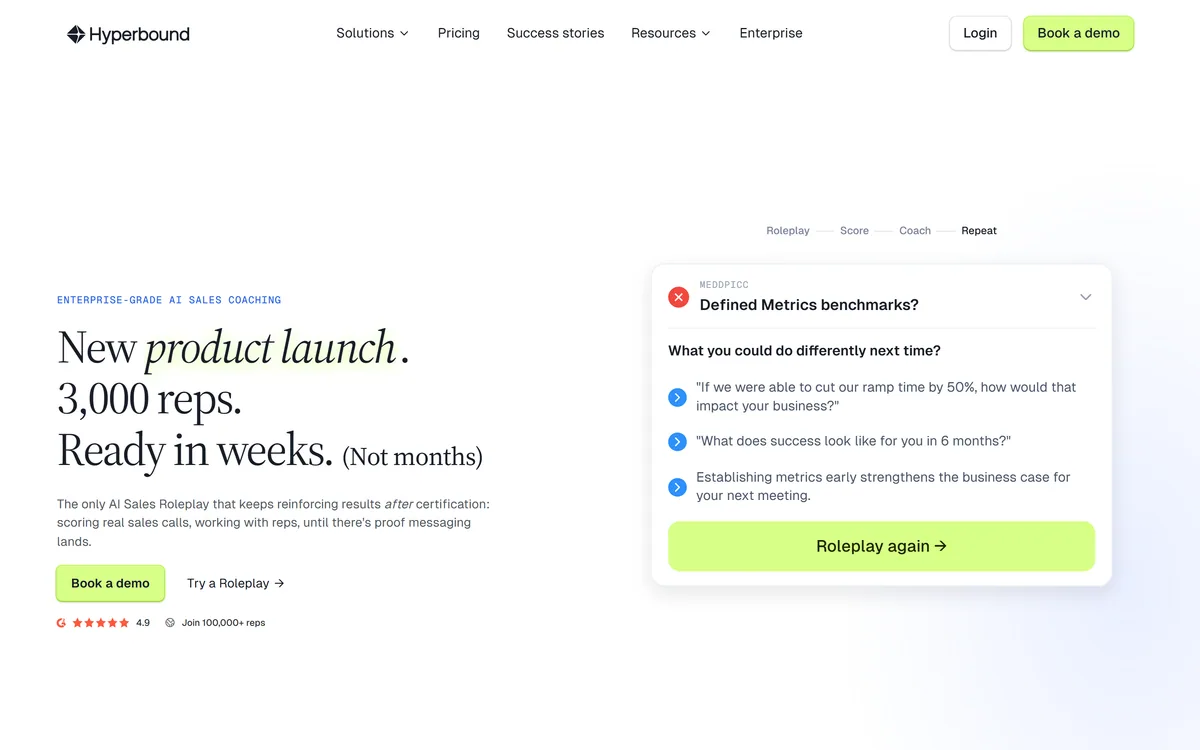
Hyperbound is an enterprise AI sales roleplay and coaching platform. Reps practise against buyer personas built from a company's own methodology and historical deals, and the system then scores real sales calls to check whether the messaging actually lands. Operated by IntelligentSystems Corp.
Every sales organisation runs the same cycle. New messaging arrives, reps are trained, everyone certifies, and within a month the calls sound exactly like they did before.
The reason is not that the training was bad. It is that nothing checked. Certification measures whether a rep could say the words once in a room; it says nothing about whether they say them under pressure to a buyer who is not cooperating.
Hyperbound's design targets that specific failure — the gap between the practice room and the pipeline — by scoring the real calls too.
Hyperbound describes roleplays built from your sales methodology, historical deals and top-performing reps, with a scored loop of practise, perform and activate.
The case for roleplay at all is strong and predates AI. Sales is a performance skill, performance skills improve with repetition against feedback, and reps get almost no repetition — a rep runs perhaps four discovery calls a week, all of them live, all of them with revenue attached.
What AI changes is the supply. A rep can run twenty roleplays in an afternoon, which is more discovery practice than a normal quarter provides, and none of it costs a real opportunity.
Building the persona from your own historical deals is the part that separates this from generic training. A simulated buyer who raises the objections your buyers actually raise is a fundamentally different exercise from one improvising a plausible enterprise CTO.
The honest limit is that repetition builds fluency, and fluency is necessary rather than sufficient. A rep who can deliver the discovery framework smoothly has removed one obstacle; whether they can read a room and abandon the framework when it is not working is not something a roleplay teaches.
A rep runs perhaps four discovery calls a week, all of them live, all of them with revenue attached. That is not enough repetition to get good at anything.
Simulated buyers differ from real ones in ways that matter, and knowing them prevents over-reading a roleplay score.
They are engaged. A real prospect is doing something else, joined late, and has already decided this call is a favour to a colleague. An AI buyer participates fully, which removes the single most common condition a rep actually faces.
They are coherent. Real buying committees contradict themselves, have a shadow decision-maker who never joined, and change what they want between calls for reasons nobody explains.
They also cannot be genuinely rude, bored or dismissive at the level real people manage, and handling that is a large part of the job. A roleplay that is uncomfortable is still substantially more comfortable than a bad call.
This is why the real-call scoring half matters more than the roleplay half. Practice builds the motion; only recordings of actual conversations show whether it survives — which is the same argument call platforms such as Aloware and CloudTalk make about their own recording features.
Hyperbound states it is the only AI sales roleplay that keeps reinforcing results after certification, scoring real sales calls and working with reps until there is proof messaging lands.
The word proof is doing a lot of work there, and it is the right thing to be claiming. Sales enablement has historically been unable to demonstrate that anything it did changed what happened on calls.
Scoring real conversations against the same rubric used in practice closes the measurement gap. You can see whether the framework a rep certified on appears in their live calls, or whether it evaporated the moment revenue was at stake.
That produces uncomfortable findings, which is a sign it is working. The usual discovery is that adoption is bimodal — a few reps changed everything, most changed nothing, and the average conceals both.
The caution is about what a rubric can see. Automated scoring recognises whether questions were asked and topics covered; it is much weaker at whether the conversation was any good, and a rep who mechanically recites every required question can score well while conducting an interrogation.
The third piece is described as agents turning what happens across calls, deals and roleplays into automated coaching, insights and actions delivered where you already work.
The argument for connecting these is genuine. A coaching suggestion is far more useful when it knows this rep's last six calls and the state of the deal, rather than being a generic reminder about discovery.
Delivered where you already work is the operationally important half. Coaching that requires opening a separate platform gets read on the day it launches and never again, which is why most enablement content is unopened.
What deserves scepticism is the volume. Automated coaching that arrives after every call becomes noise within a fortnight, and the difference between useful and ignored is entirely about restraint.
The question worth asking in an evaluation is how the system decides *not* to send something. A coaching agent that speaks only when it has something specific is worth ten that comment on everything.
Practice tools have a boundary, and mistaking a structural problem for a skill problem is an expensive error.
It cannot fix a product nobody wants. If calls are failing because the offer does not match the market, better discovery questions will produce better-articulated rejections at exactly the same rate.
It cannot fix targeting. Reps talking to the wrong accounts will improve at talking to the wrong accounts, which is why pipeline quality is usually the higher-leverage intervention — the problem tools like Kronologic and attribution platforms such as Cometly address from opposite ends.
It cannot fix a compensation plan that rewards behaviour the training discourages. Reps respond to how they are paid faster than to any enablement programme, and no roleplay outscores a quarterly quota.
And it cannot fix a hiring problem. Coaching moves a middling rep meaningfully and does not turn the wrong hire into the right one, which is a harder conversation than any software purchase.
Enablement rollouts fail the same way: mandated for everyone at once, completed grudgingly, and abandoned when the quarter gets tight.
This sequence proves the loop on a small group before it becomes a mandate.
| Operating company | IntelligentSystems Corp., per the footer |
|---|---|
| Product type | AI sales roleplay and coaching |
| Positioning | Enterprise-grade AI sales coaching |
| Core loop | Roleplay, score, coach, repeat |
| Persona sources | Your sales methodology, historical deals and top-performing reps |
| Beyond practice | Scoring of real sales calls after certification |
| Agents | Automated coaching and actions across calls, deals and roleplays |
| Frameworks | MEDDPICC referenced in the interface |
| Scale claims | 3,000 reps ready in weeks, 100,000+ reps joined, a displayed 4.9 rating |
| Named customers | Nivoda and JumpCloud case studies |
| Industries | B2B SaaS, sales trainers and agencies, call centres, banking and financial advisers |
| Meeting recorder | A Hyperbound recorder joins live calls, per the interface shown |
AI sales roleplay against custom buyer personas
Personas built from your methodology and historical deals
Real sales call scoring after certification
Automated coaching agents across calls, deals and roleplays
A meeting recorder that joins live calls
MEDDPICC and methodology-aligned scoring
Deal-aware coaching suggestions
Published customer case studies
Revenue tooling divides by whether it trains the rep, books the meeting, or measures the spend.
| Tool | What it improves | Where it operates | Best for |
|---|---|---|---|
| Hyperbound | How reps run conversations | Practice plus real call scoring | Large floors rolling out new messaging |
| Kronologic | How many meetings happen at all | Outreach and calendars | Renewals and cross-sell nobody chases |
| Aloware | The calling infrastructure itself | Phone system | Teams whose volume is outbound dialling |
| Cometly | Which spend produced revenue | Attribution | Marketing budget decisions |
| Bolto | Hiring and employment records | HR stack | Getting the reps in the door |
Adjacent products across the parts of a revenue motion this does not touch.
Last checked . Read from hyperbound.ai in a browser session on the date above, with the screenshot captured alongside.
What we could not confirm: pricing, which routes through a demo request; how real-call scoring is derived and whether the rubric is customisable; which models drive the simulated buyers; where call recordings are processed and retained, which matters because they contain customer conversations; whether the 4.9 rating comes from a named review platform; and what the 3,000 reps in weeks claim refers to specifically. We did not run a roleplay, so nothing here reflects tested simulation quality.
Sales training has always had the same hole in it: reps certify, everyone declares victory, and nobody checks whether the new messaging survives contact with a real buyer three weeks later. Hyperbound's argument is that roleplay alone is theatre unless it is tied to what happens on actual calls, and the product is built around closing that loop — practise, then score real conversations, then coach against the gap. That is the correct design. The limitation is inherent to the category: a simulated buyer is agreeable in ways real ones are not, so scores measure fluency more reliably than they measure persuasion. AInexfinder Editor Score: 4.1/5.
AInexfinder does not list plan prices or billing details. For current pricing, plans, and trials, visit the official Hyperbound website.
Visit official website for pricingVendor pricing, credits, and billing policies change over time. Always confirm on the official site before you buy.
Log in to write a review.
No reviews yet. Be the first to share your experience with Hyperbound.
Assigned reviewer
Daniel ReedSenior AI Tools Reviewer
Daniel reviews AI tools the slow way — by actually using them on real projects. His reviews cover what works, what breaks, and who each tool is genuinely a good fit for.
Daniel and the AInexfinder editorial team research Hyperbound using public product information, listing evidence, and (when available) hands-on checks. Scores reflect listing completeness and transparency — not paid placement.
HubSpot AI is branded Breeze — an assistant plus a set of agents for prospecting, content, customer service, campaigns, nurture, and revenue, all running on live CRM data, with an Agent Builder for custom ones.
Clay is go-to-market data infrastructure built around waterfall enrichment: instead of one provider, it queries a marketplace of more than 200 in sequence until a field is filled. Claygent AI agents research companies and people, and the results push into a CRM, ad platforms or a native sequencer.
Trellus is an AI dialer that works inside Salesloft, Outreach and HubSpot, offering parallel dialling of up to five lines, real-time call guidance, conversational analytics, voice agents for practice and inbound, and a LinkedIn tool, aimed at multiplying sales conversations.
AutogenAI is an enterprise platform for writing proposals, bids and grant applications. It covers the workflow from qualifying an opportunity through drafting, research, review and compliance, using custom language engines built on each customer's own tone of voice and content library.
Aviso is an agentic revenue intelligence platform for go-to-market teams. It covers forecasting, pipeline inspection, conversation and relationship intelligence, coaching, sales engagement and customer success, with more than 30 prebuilt agentic workflows and a no-code studio for building new agents.
Ironclad is an AI contract lifecycle management platform covering create, review, sign, store, analyze and fulfill. Jurist is its agentic AI contract partner for legal review, Ironclad AI runs behind every workflow stage, and 20+ integrations connect it to Salesforce, Word, Slack, DocuSign and SAP.