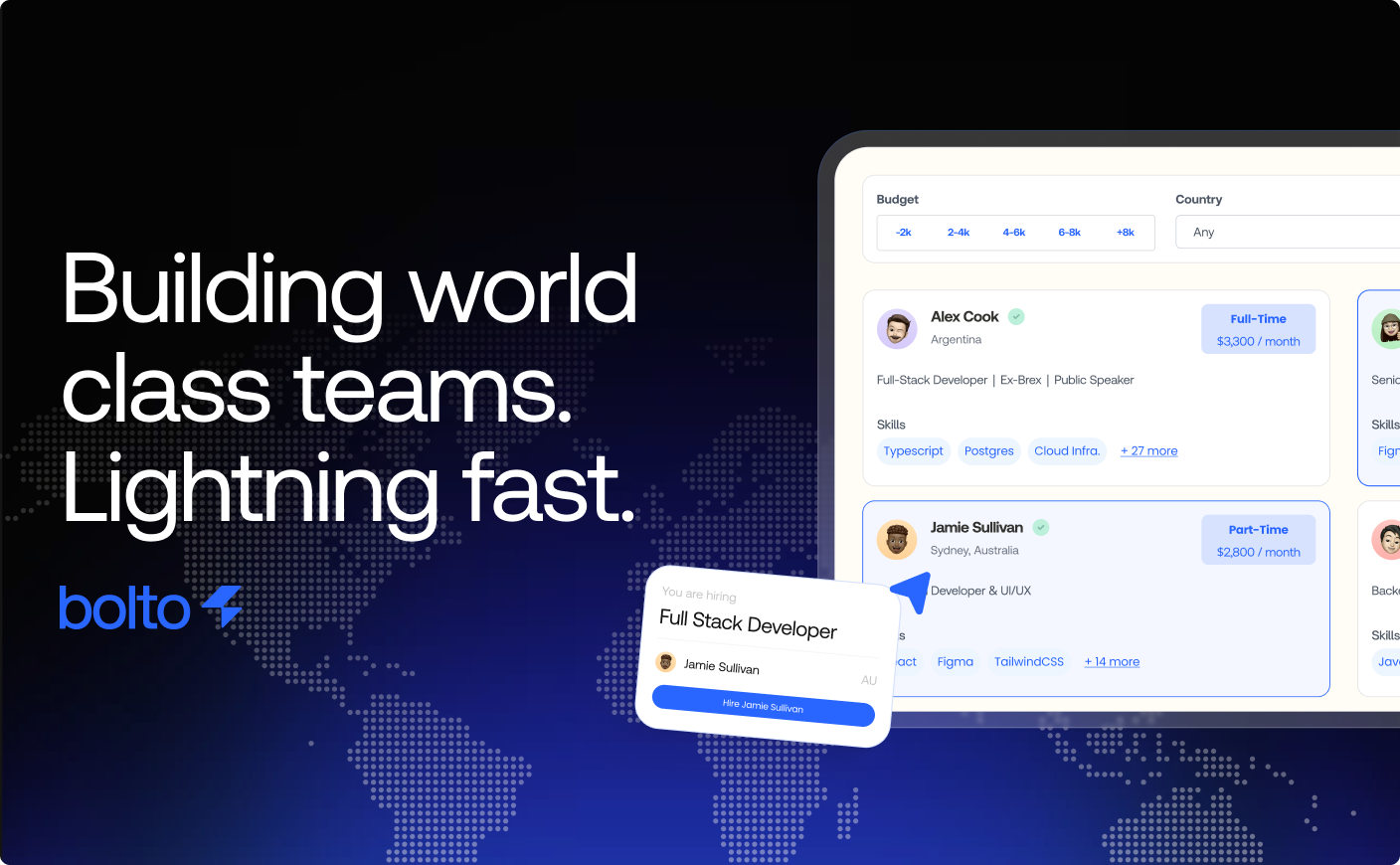
Bolto consolidates recruiting, payroll and global HR into a single platform and automates compliance tasks with AI. Operated by Bolto LLC, it announced a $12M Series A and runs a candidate newsletter delivering engineering resumes to subscribers.
Every growing company ends up with the same three systems: something for hiring, something for paying people, and something for the records in between. They are bought at different times by different people and integrated afterwards, badly.
The consequence is not merely inconvenience. The same employee exists three times, with three start dates, three classifications and three sets of details, and reconciling them is somebody's recurring afternoon.
Bolto's answer is one platform holding all three, with AI handling the compliance tasks that fall between them. Whether that is worth a migration depends almost entirely on how much your current arrangement is costing you.
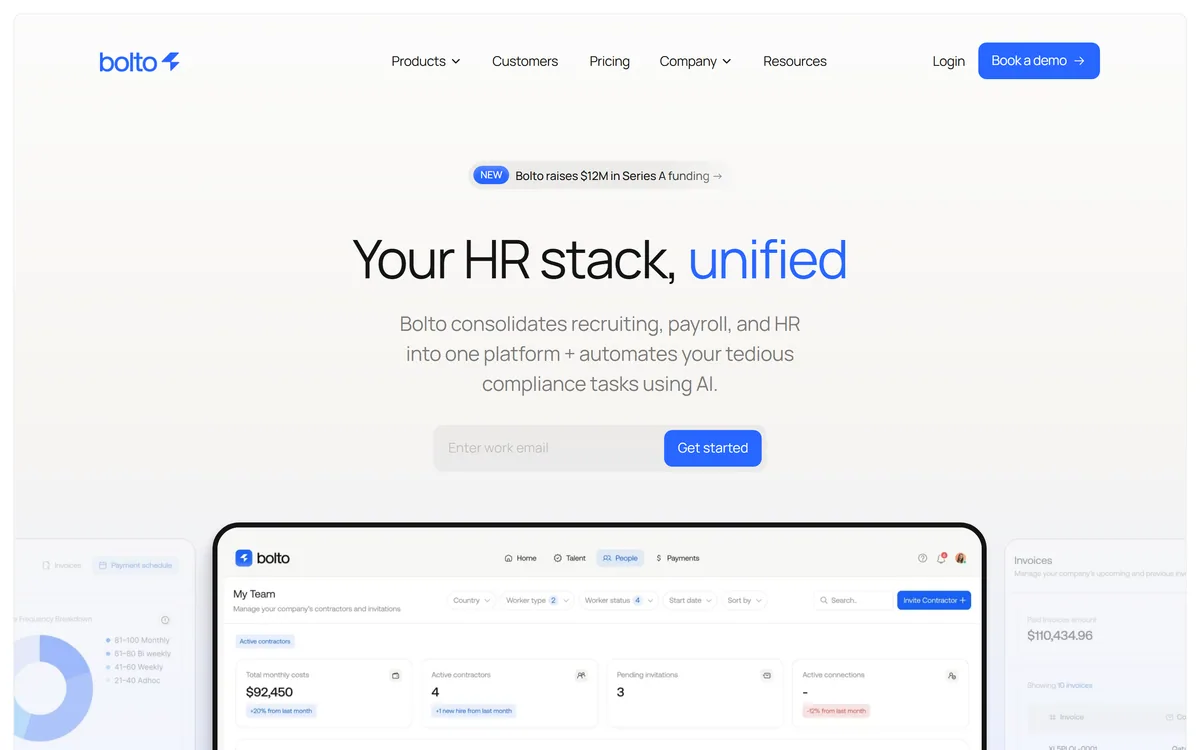
Bolto's homepage, captured 9 September 2026, showing the consolidated HR stack positioning.
Bolto: Recruiting, Payroll And HR Together
Three systems in one — recruiting, payroll and global HR on a single platform rather than three integrated products.
Compliance automation is the real pitch, covering the tedious tasks that create risk when they are done inconsistently.
Operated by Bolto LLC, with a $12M Series A announced on the site.
Contracts and global HR alongside the core three, aimed at teams hiring across borders.
A candidate newsletter delivering five engineering resumes fortnightly, which is an unusual sourcing channel to build.
Bolto: Products And Funding
Operating company
Bolto LLC
Product type
Unified recruiting, payroll and HR platform
Positioning
Your HR stack, unified
Products
Recruiting, Payroll, Global HR
Automation
Compliance tasks automated using AI
Also covers
Contracts and compliance alongside hiring and payment
Funding
$12M Series A announced on the site
Newsletter
Five open-to-work software engineering resumes delivered fortnightly
Bolto states that it consolidates recruiting, payroll and HR into one platform and automates tedious compliance tasks using AI.
The convenience argument is obvious and the weakest one. Fewer logins, one interface, less switching — all true, and none of it justifies moving payroll, which is the highest-risk system a company runs.
The compliance argument is much stronger. The same employee record existing in three systems means three places where a classification, a jurisdiction or a start date can be wrong, and the systems will not agree with each other about which is right.
That matters because employment compliance is largely about consistency. A contractor classified one way in the hiring system and another in payroll is not a data quality issue — it is an exposure, and it is invisible until somebody asks.
One record removes the class of problem rather than reconciling it. That is the argument worth evaluating, and it is a structural one rather than a feature comparison — which is also why it only pays off if you genuinely move all three.
A contractor classified one way in hiring and another in payroll is not a data quality issue. It is an exposure, and it is invisible until somebody asks.
Compliance Automation Is The Real Pitch
Bolto's framing is automating tedious compliance tasks with AI, and the word tedious is doing precise work there.
Employment compliance is rarely difficult in the sense of requiring judgement. It is difficult in the sense of being voluminous, jurisdiction-specific, changeable, and unforgiving of small errors — which is a description of exactly the work software should absorb.
The failure mode in small companies is consistent. Compliance tasks are done by whoever has time, using last year's version of a form, and nobody notices until an audit, a dispute or an acquisition puts it under scrutiny.
Automating across a single employee record means the rules apply to the same data every time, which removes the inconsistency that produces most of the exposure. That is more valuable than any individual automated task.
The caution is that automating compliance does not transfer responsibility. The employer remains liable for classifications, filings and obligations regardless of which system produced them, and a platform that gets a jurisdiction wrong is a problem you own.
A $12M Series A And What It Signals
Bolto announces a $12M Series A on its homepage, and for a company holding payroll that number is relevant in a way it would not be for most software.
A Series A at that size describes a company that has raised institutional money and has runway to build, which is genuinely reassuring compared with an unfunded startup. It also describes a company early enough that its long-term shape is unsettled.
That matters more here than in most categories because of what payroll is. Payroll must run on the same day every month regardless of what is happening at the vendor, and a company still finding its market is a company that might change direction, get acquired, or reprioritise.
The right way to weigh this is not to avoid young vendors but to ask the boring questions. What happens to payroll continuity in an acquisition, what the data export looks like, and how long a transition period the contract provides.
Announcing funding on the homepage is also a signal about audience. It is aimed at buyers who read that as credibility — which is startups and growing technology companies rather than established businesses, and that is consistent with everything else about the positioning.
Weigh consolidation on compliance consistency, not on having fewer logins.
Ask what happens to payroll continuity if the vendor is acquired.
Confirm the data export format before migrating any employee record.
Run payroll in parallel for two cycles rather than switching outright.
Remember that automating compliance does not transfer liability for it.
The Candidate Newsletter Is An Unusual Move
Bolto runs a newsletter delivering five open-to-work engineering resumes to subscribers every two weeks, described on the site as helping subscribers find undiscovered talent.
That is a genuinely unusual thing for an HR platform to build, and it reveals something about the strategy. Most recruiting software helps you manage candidates you already found; supplying candidates is a different business with different economics.
The reason it works as a distribution channel is that the audience is exactly the buyer. A hiring manager who subscribes for free resumes is a hiring manager who might buy recruiting software, and the newsletter costs a fraction of what acquiring that person through advertising would.
For the candidates in it, the value is being seen by companies actively looking, which is a better position than an application in a queue. Whether that is a good trade depends on consent and how their information is used, which the site does not describe.
The stated subscriber number is modest, which is honest rather than concerning at this stage. A newsletter with a specific, useful premise growing slowly is a more credible sourcing channel than a large list with no engagement.
What Bolto Does Not Replace
Consolidating recruiting, payroll and HR still leaves several systems standing, and knowing which ones matters before you describe this as a single platform internally.
Accounting is the obvious one. Payroll is usually the largest expense a company has and the messiest thing to account for, but the ledger itself is a separate discipline — which is why tools like Puzzle exist alongside HR platforms rather than inside them. Consolidating employment records does nothing for your close.
Tax obligations are the second. Employment tax and business tax overlap at payroll and diverge everywhere else, and a platform handling payroll filings is not handling your company's own position. That remains a separate problem, addressed by separate products such as Instead.
Contract review is the third, and it is the one people conflate most often. Bolto generates and holds employment contracts, which is document handling. Deciding whether a clause is acceptable is legal judgement, and dedicated review tools such as LegalOn exist because generating a document and assessing one are different jobs with different failure modes.
The useful mental model is that Bolto consolidates the employee record. Everything downstream of that record — money, tax, legal risk — still lives where it lived, and a consolidation pitch that seems to promise otherwise is worth reading twice.
Replacing An HR Stack Without Breaking Payroll
Payroll is the one system where a failed migration is not an inconvenience — people do not get paid, and that is a trust event you do not recover from quickly.
The sequence below moves the low-risk pieces first and treats payroll as the last step rather than the first.
Move recruiting first, since a hiring pipeline in a new system is recoverable and payroll is not.
Migrate HR records second, and reconcile them against your existing system field by field rather than by count.
Run payroll in parallel for two full cycles, comparing every figure before switching anything off.
Verify tax filings and classifications specifically, since those are where inconsistency produces exposure.
Confirm the export format works by actually exporting, not by reading that export exists.
Keep the old system readable for a full year, because questions about last year's payroll arrive next year.
Key features of Bolto
Recruiting, payroll and global HR on a single platform
Compliance task automation using AI
Contract handling alongside hiring and payment
A single employee record across all three functions
A fortnightly newsletter of open-to-work engineering candidates
A published Terms of Service and Privacy Policy
Pros & cons
Pros
6
Consolidation removes the class of problem where three systems disagree about one employee
Compliance consistency is a structural argument rather than a feature comparison
Automating voluminous, jurisdiction-specific work is exactly what software should absorb
A named operating company and disclosed funding rather than an anonymous startup
The candidate newsletter is an unusual and well-aimed distribution channel
Contracts sitting with hiring and payroll keeps employment documents in one place
Cons
6
Payroll migration is the highest-risk system change a company can make
A Series A company is early to be holding something that must run every month
Which countries global HR and payroll actually cover is not stated
Automating compliance does not transfer liability, which remains the employer's
No customer is named on the pages we read
Pricing, location and data export terms are all unpublished
Best For
Growing companies whose three HR systems already disagree
Teams hiring across borders where classification consistency matters
Businesses where compliance is done by whoever has time
Companies consolidating deliberately rather than adding another tool
Startups comfortable with a Series A vendor holding employment records
Bolto Against Other HR Platforms
Business operations tools differ by which records they hold and how much risk a migration carries.
The systems a growing company runs on divide by which records they own and how painful they are to replace.
Puzzle — the accounting equivalent — the ledger rather than the employee record
Ema — automating within HR, IT and finance systems you keep
Wobo — the candidate's side of the same hiring market
Instead — tax obligations, which sit next to payroll compliance
LegalOn — the contracts an HR platform generates but does not review
Is Bolto Right For Your Company?
A sensible consolidation for HR when
Recruiting, payroll and HR are three systems that disagree with each other.
Compliance tasks are done by whoever has time, using whatever version they have.
You hire across borders and classification consistency is a live concern.
You are growing fast enough that the current arrangement is already straining.
You have capacity to run payroll in parallel for two cycles.
Keep your providers when
Your payroll works and nobody is complaining, which is a high bar to beat.
You need long-term vendor stability guarantees a Series A company cannot give.
You would migrate payroll first rather than last.
Your problem is accounting rather than employment records.
You want automation inside the systems you already have rather than a replacement.
Bolto: What The Site Publishes
Last checked . Read from bolto.com in a browser session, with the screenshot above captured alongside.
Operating company confirmed in the footer as Bolto LLC
Positioned as your HR stack, unified
Products confirmed as Recruiting, Payroll and Global HR
Stated as consolidating recruiting, payroll and HR into one platform
Compliance task automation using AI stated on the site
Contracts and compliance named alongside recruiting and payroll
A $12M Series A announced on the homepage
A newsletter confirmed, delivering five open-to-work software engineering resumes every two weeks
Footer sections confirmed for Products, Resources including Customers, Blog, Careers and Newsletter, and Company including Contact, Terms of Service and Privacy Policy
Social links confirmed for LinkedIn and X
What we could not confirm: the company's location or headquarters; pricing and plan structure; which countries payroll and global HR actually cover, which is the central question for a global product; which underlying models perform compliance automation; whether any customer is named, since the Customers page was not read; how employee data is exported if you leave; and what continuity commitments exist around payroll. We did not use the platform, so nothing here reflects tested performance.
Editor's Verdict
3.9/5
Bolto's argument is consolidation, and the strongest version of it is compliance rather than convenience. Recruiting, payroll and HR being three systems is annoying; the same employee data existing in three systems with different rules about employment classification, tax and jurisdiction is where companies actually get into trouble. Automating those tasks across a single record is a better answer than integrating three products that each hold a partial truth. It scores mid-table because a payroll migration is genuinely risky, and because a $12M Series A means a young company holding something you cannot afford to have go wrong. AInexfinder Editor Score: 3.9/5.
Bolto pricing
AInexfinder does not list plan prices or billing details. For current pricing, plans, and trials, visit the official Bolto website.
Vendor pricing, credits, and billing policies change over time. Always confirm on the official site before you buy.
Frequently asked questions
What is Bolto?
Bolto is a platform from Bolto LLC that consolidates recruiting, payroll and global HR into one system and automates compliance tasks using AI. It also covers contracts, announced a $12M Series A on its site, and runs a newsletter delivering five open-to-work engineering resumes fortnightly.
Why consolidate three HR systems?
The convenience argument — fewer logins — is the weak one and does not justify moving payroll. The strong argument is compliance consistency: the same employee existing in three systems means three places a classification, jurisdiction or start date can be wrong, and the systems will not agree about which is right.
Why does classification consistency matter?
Because employment compliance is largely about consistency. A contractor classified one way in the hiring system and another in payroll is not a data quality issue but an exposure — and it is invisible until an audit, a dispute or an acquisition puts it under scrutiny.
Does automating compliance remove my liability?
No. The employer remains responsible for classifications, filings and obligations regardless of which system produced them. A platform that gets a jurisdiction wrong creates a problem you own, which is why automation here reduces effort and inconsistency rather than transferring responsibility.
Is a Series A company safe to run payroll on?
It depends on your risk appetite, and the question is worth asking directly rather than avoiding. Payroll must run on the same day every month regardless of what is happening at the vendor, and a company still finding its market may change direction. Ask about continuity in an acquisition and about data export.
How should I migrate without breaking payroll?
Move recruiting first, since a hiring pipeline in a new system is recoverable and payroll is not. Migrate HR records second, reconciling field by field rather than by count. Run payroll in parallel for two full cycles, comparing every figure. Keep the old system readable for a year.
Which countries does Bolto's global HR cover?
Not stated on the pages we read, and it is the central question for anything described as global. Employment law, payroll mechanics and compliance obligations differ entirely by jurisdiction, and a platform's usefulness to you is decided by whether your specific countries are among them.
What is the candidate newsletter for?
Distribution. Five open-to-work engineering resumes delivered fortnightly attracts exactly the audience that buys recruiting software, at a fraction of what advertising to hiring managers would cost. It is an unusual thing for an HR platform to build and a well-aimed one.
Is Bolto an alternative to my accounting system?
No — different records entirely. Bolto holds employment data; an accounting platform holds the ledger. They touch at payroll, which is both the largest expense in most companies and the messiest thing to account for, but consolidating one does nothing for the other.
What should I ask before signing?
What happens to payroll continuity if the company is acquired, what the data export actually produces, how long a transition period the contract provides, and which specific countries are supported. All four are boring questions, and all four are the ones that matter when something goes wrong.
Daniel reviews AI tools the slow way — by actually using them on real projects. His reviews cover what works, what breaks, and who each tool is genuinely a good fit for.
Daniel and the AInexfinder editorial team research Bolto using public product information, listing evidence, and (when available) hands-on checks. Scores reflect listing completeness and transparency — not paid placement.
Listings may include affiliate or sponsored placements, which are labeled when present. Editorial scores and cons are not sold. See our affiliate disclosure and review methodology.
Listomize is an Etsy SEO platform that generates titles, tags, and descriptions within Etsy's own limits, scores listings, optimises 100+ listings from a CSV, tracks competitors and trends, and auto-generates Pinterest pins.
Lahjty (لهجتي) is an Arabic-first marketing platform for MENA campaigns. From one brief it produces dialect-aware ad copy, headlines, campaign images with Arabic text rendered in, dialect-aware voice, and SEO articles grounded in your own brand sources — with a Partner API and an MCP server for teams that want it inside their own workflow.
MaxAEO is an answer engine optimisation platform from HIII PTE. LTD. It tracks how ChatGPT, Gemini, Claude, Perplexity, Copilot, Grok and Google's AI surfaces mention a brand, with sentiment, competitor benchmarking and citation tracing.
Mailjet is a Sinch-owned email platform handling both marketing campaigns and transactional sending from one account. It offers a collaborative drag-and-drop editor, an email API with SMTP relay, AI generation and segmentation, and EU-based data centres.
Outranking is an AI SEO content platform that writes briefs and first drafts and optimises them with real-time scoring, grounding content in live SERP data through its Concepts feature, with keyword clustering, internal linking and content workflows.
PitchBud is a press outreach tool that drafts a release with Claude Sonnet, publishes it to a newsroom URL with NewsArticle schema and RSS, matches relevant journalists by their recent work, and drafts personal pitches you review and send yourself.