MentoMind is a white-label digital learning platform from Innotrail Inc. of Warrington, Pennsylvania. Tutoring companies and test-prep centres deliver Digital SAT, ACT, HSPT, PSSA and AP courses under their own domain and branding, with expert-written question banks.
mentomind.ai8 viewsAdded September 2, 202512K visitors
There are two ways to sell education software, and the difference decides everything about the product.
You can sell to the student, which means competing on brand, spending on acquisition, and losing the customer the moment the exam is over. Or you can sell to the tutoring business that already has the students, and let it put its own name on the front.
MentoMind takes the second route, and it is a better fit for this market than it first appears — because a tutoring centre's real asset is its relationship with local families, and its real weakness is that it cannot build software.
The White-Label Case In Five Lines
Sold to tutoring businesses, not students — the platform runs under your domain, logo and brand colours.
Operated by Innotrail Inc. of Warrington, Pennsylvania, with named leadership behind the content.
Substantial question banks: 3,500+ SAT questions with 11 adaptive tests, 1,000+ ACT, 1,000+ HSPT, 2,000+ PSSA and 6,800+ across AP maths and statistics.
Content written by test-prep experts, with the site stating explicitly that questions are not AI-generated.
Business tooling included — payment collection, package management, parent reporting and real-time activity tracking.
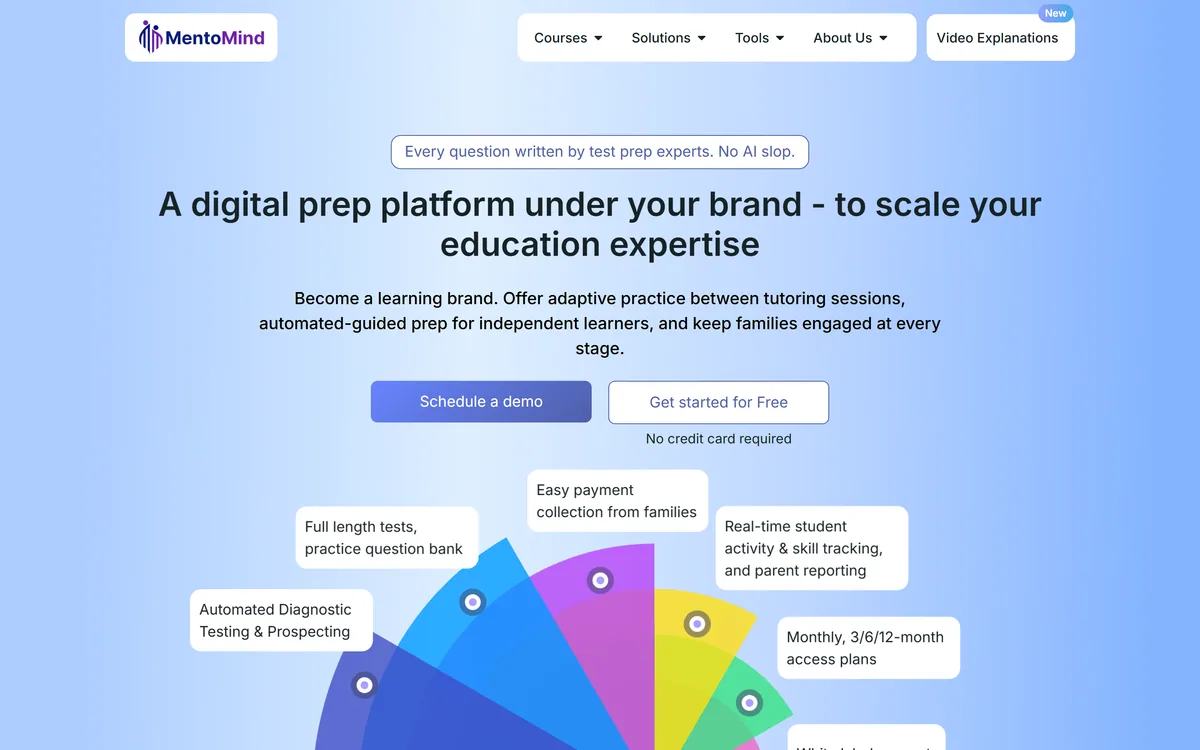
MentoMind's homepage, captured 9 September 2026, showing the white-label test-prep platform positioning.
MentoMind: Platform And Content
Operating company
Innotrail Inc.
Location
Warrington, Pennsylvania, USA
Product type
White-label digital learning and test-prep platform
Branding
Custom domain, logo and brand colours
SAT
3,500+ questions, 11 adaptive tests
ACT
1,000+ questions, 4 full-length tests
HSPT
1,000+ questions, 2 full-length tests
PSSA
2,000+ questions, 2 full-length tests, grades 3-8
AP courses
Precalculus, Calculus AB, Calculus BC and Statistics — 6,800+ questions and 20 full-length tests combined
Content policy
Written by test-prep experts; stated on the site as not AI-generated
Instructor tools
On-screen annotation, auto-graded exercises, problem set creation, PDF-to-question-bank conversion
Diagnostics, adaptive assignments by topic, skill mapping, 24/7 guided assistance with step hints
Leadership named
Chris McKenna and Patrick Kennedy
Footer sections
Courses, Tools (TutorHub, Think10x.ai), Resources, About, Social
Why Does White-Label Change The Business Model?
MentoMind is white-label: a tutoring company runs it on its own domain, with its own logo and brand colours, and to a parent it looks like the centre's own platform.
That solves a problem tutoring businesses have and rarely articulate. Their competitive position rests on being trusted locally — the centre that got the neighbour's daughter into her university — and every time they send a family to a third-party product, they hand some of that relationship away.
It also fixes an economic problem. Building practice software is enormously expensive and completely outside a tutoring centre's competence, but a centre without any looks dated next to one that has it. White-label lets them compete on infrastructure they could never build.
For the vendor the logic is equally sound. One tutoring company brings hundreds of students who never had to be acquired individually, which is a far cheaper distribution model than consumer marketing in one of the most expensive advertising categories there is.
The trade the tutoring business accepts is dependency. The platform their brand now sits on belongs to someone else, and a pricing change, an outage or a shutdown becomes their problem in front of their own families. That is a real risk and it is the standard cost of not building software yourself.
The contrast is with student-facing products. Quizlet and Khanmigo compete for the learner directly, which means paying to acquire every one of them.
A tutoring centre's asset is its relationship with local families. Every time it sends them to a third-party product, it hands part of that away.
What The Question Banks Actually Contain
The counts are specific, which is more useful than a round number: 3,500+ SAT questions with 11 adaptive tests, 1,000+ ACT with 4 full-length tests, 1,000+ HSPT with 2 full-length tests, 2,000+ PSSA across grades 3-8 with 2 full-length tests, and 6,800+ questions with 20 full-length tests across AP Precalculus, Calculus AB, Calculus BC and Statistics.
The adaptive SAT tests are the notable item. The SAT is now digital and adaptive — the second module's difficulty depends on performance in the first — and practice that does not replicate that behaviour is practising a different exam.
Full-length tests matter more than question counts for a reason people underestimate. Standardised testing is substantially an endurance problem, and a student who can answer any individual question can still lose thirty points in the final section through fatigue. Only full-length practice reveals that.
The PSSA coverage across grades 3-8 is a different business entirely from college admissions, and its presence suggests the platform is being sold to maths tutoring franchises as much as to test-prep centres.
What no external party can assess is whether the questions are good — whether difficulty is calibrated to the real exam, whether the wrong answers represent the mistakes students actually make. That is the whole product, and it is unauditable from outside.
No AI Slop Is A Positioning Choice
MentoMind states that all practice content is written by test-prep experts, using the phrase no AI slop, and names Chris McKenna and Patrick Kennedy in its leadership.
Positioning against generated content is unusual in 2026 and, for this specific product, correct. Standardised test questions are a genuinely hard writing task, and the difficulty is in the wrong answers rather than the right one.
A well-constructed multiple-choice question has distractors that each correspond to a specific error a student makes — a sign flip, a misread of the question, a common algebraic slip. Get those right and a wrong answer tells the tutor exactly what the student misunderstood. Get them wrong and the question is a coin toss with extra steps.
Generated questions are frequently plausible and subtly miscalibrated in precisely that way. They look like SAT questions and do not behave like them, and a student practising on them builds confidence in the wrong places.
The corresponding limitation is scale. Expert-written content is expensive and slow, which is why the counts are in the thousands rather than the hundreds of thousands, and why coverage does not extend to every exam. That is a reasonable trade for this subject and it is a trade.
That is the opposite bet from generators like Quizgecko, which turn your own material into questions quickly. For open revision that trade is fine; for a calibrated exam it is not.
Weight full-length adaptive tests above raw question counts.
Check that SAT practice replicates the digital adaptive format, not the old paper one.
Judge sample questions on the wrong answers, not the right one.
Confirm what happens to your students' data if you stop being a customer.
Ask how often content is revised when an exam board changes the test.
What A Tutoring Business Actually Needs From Software
MentoMind's non-academic features are the ones that decide whether a centre adopts it: payment collection, package management, student skill mapping, parent reporting and real-time activity tracking.
Parent reporting is the most commercially important item on that list, and it is worth being direct about why. The person paying is not the student, and what they are buying is reassurance as much as instruction.
A parent who can see that their child completed four practice sets this week renews. A parent who hears nothing between invoices starts wondering what they are paying for, and that wondering is where churn comes from in tutoring.
Payment collection and package management address the other half of a small centre's overhead. These businesses are frequently run by teachers rather than administrators, and chasing payments is the work they are worst at and most resent.
The instructor-side tooling — on-screen annotation, auto-graded exercises, problem set creation, PDF-to-question-bank conversion — is what makes the platform usable during a session rather than only between them. PDF conversion in particular matters, because every established tutor has a folder of material they have refined over years and will not abandon.
Note how little of this a study app needs. A tool such as NoteGPT answers to the student alone, and never has to reassure the person paying.
Evaluating A White-Label Platform
The evaluation questions for infrastructure you will put your own brand on are different from the ones for software you use privately.
Content quality is the first, and the only way to assess it is to have someone who knows the exam read actual questions.
Have your most experienced tutor review twenty questions per subject, judging the distractors rather than the correct answers.
Take a full-length adaptive SAT test yourself and confirm the module difficulty actually adapts.
Convert one of your own PDFs into a question bank and check how much cleanup it needs.
Send a parent report to a colleague and ask whether it would reassure them as a paying customer.
Establish in writing what happens to your students' accounts and history if you leave.
Confirm how quickly content is updated when a testing board changes the exam, since that is when a stale platform becomes a liability in front of families.
Key features of MentoMind
White-label delivery under your own domain, logo and brand colours
Digital SAT preparation with 11 adaptive full-length tests
ACT, HSPT and PSSA question banks with full-length tests
AP Precalculus, Calculus AB, Calculus BC and Statistics coverage
Expert-written questions, stated as not AI-generated
Diagnostics, skill mapping and adaptive assignments by topic and subtopic
Instructor annotation, auto-grading and PDF-to-question-bank conversion
Payment collection, package management and parent reporting
Pros & cons
Pros
7
White-label keeps the family relationship with the tutoring business, which is its real asset
Adaptive SAT tests replicate the format of the actual digital exam
Full-length tests address the endurance problem question banks alone cannot
Refusing generated questions is the right call where distractor quality is the product
Named operating company, location and leadership rather than an anonymous site
Parent reporting targets retention, which is where tutoring businesses lose money
PDF conversion lets tutors keep material they have refined over years
Cons
6
Question quality is the entire product and cannot be audited from outside
Coverage is limited to US standardised tests and AP maths and statistics
Expert-written content scales slowly, which caps breadth
Your brand sits on infrastructure you do not control
Pricing and licence structure are not published
What happens to student history if you leave is not stated
Best For
Tutoring centres and test-prep businesses wanting their own platform
LearnFast AI — another study tool aimed directly at learners
Is MentoMind Right For Your Business?
Right for your centre when
You run a tutoring centre and want a platform families see as yours.
Your subjects are Digital SAT, ACT, HSPT, PSSA or AP maths and statistics.
Parent reporting and retention are as much your problem as instruction is.
Payment chasing and package admin are consuming teaching time.
You have your own material in PDFs that you want to keep using.
Not your platform when
You are a student looking for a study app, which is not who this is sold to.
Your subjects fall outside the covered exams, where the question banks do not help.
You are outside the US testing system entirely.
You are unwilling to put your brand on infrastructure you do not control.
You cannot get an experienced tutor to assess content quality before committing.
MentoMind: Reading The Course Pages
Last checked . Read from mentomind.ai, its course pages and footer navigation, with the screenshot above captured in the same session.
Operating company confirmed as Innotrail Inc., located in Warrington, Pennsylvania
Positioned as a white-label digital learning platform for tutoring companies, institutions and test-prep businesses
White-label customisation confirmed for domain, logo and brand colours
SAT coverage confirmed as 3,500+ questions with 11 adaptive tests
ACT coverage confirmed as 1,000+ questions with 4 full-length tests
HSPT coverage confirmed as 1,000+ questions with 2 full-length tests
PSSA coverage confirmed as 2,000+ questions with 2 full-length tests, grades 3-8
AP coverage confirmed for Precalculus, Calculus AB, Calculus BC and Statistics, with 6,800+ questions and 20 full-length tests combined
Content stated on the site as written by test-prep experts, with the phrase no AI slop
Leadership named on the site as Chris McKenna and Patrick Kennedy
Instructor tools confirmed including on-screen annotation, auto-graded exercises, problem set creation and PDF-to-question-bank conversion
Business tools confirmed including payment collection, package management, parent reporting and real-time activity tracking
Student features confirmed including diagnostics, adaptive assignments by topic and subtopic, skill mapping and 24/7 guided assistance with step hints
Footer sections confirmed for Courses, Tools including TutorHub and Think10x.ai, Resources, About and social links
What we could not confirm: pricing or how the white-label licence is structured; how question difficulty is calibrated against the real exams; how quickly content is revised when a testing board changes a test; what happens to student accounts and history if a customer leaves; how many tutoring businesses use the platform; whether any AI is used in the guided assistance despite questions being expert-written; and any independent score-improvement evidence. We did not use the platform, so nothing here reflects tested content quality.
Editor's Verdict
4.0/5
MentoMind is not a study app, and reading it as one gets the product wrong. It is infrastructure sold to tutoring businesses: your domain, your logo, your colours, with the question banks, adaptive tests, analytics, payment collection and parent reporting underneath. That is a well-chosen position, because a tutoring centre's asset is its relationship with families and its liability is building software. The explicit refusal to generate practice questions — content written by test-prep experts, stated as no AI slop — is the right call for standardised testing, where a subtly wrong question teaches the wrong thing. It scores where it does because everything depends on question quality nobody outside can audit. AInexfinder Editor Score: 4.0/5.
MentoMind pricing
AInexfinder does not list plan prices or billing details. For current pricing, plans, and trials, visit the official MentoMind website.
Vendor pricing, credits, and billing policies change over time. Always confirm on the official site before you buy.
Frequently asked questions
What is MentoMind?
MentoMind is a white-label digital learning platform from Innotrail Inc. of Warrington, Pennsylvania. Tutoring companies, test-prep centres and institutions run it under their own domain and branding, delivering Digital SAT, ACT, HSPT, PSSA and AP courses with expert-written question banks and business tooling underneath.
Is MentoMind for students or for businesses?
For businesses. It is sold to tutoring companies who then present it to families as their own platform. A student cannot meaningfully buy it, and the features that matter most — payment collection, package management, parent reporting — only make sense from the operator's side.
Why does white-label matter for a tutoring centre?
Because the centre's competitive asset is being trusted locally, and every time it sends a family to a third-party product it hands part of that relationship away. White-label also lets a small centre compete on infrastructure it could never afford to build — at the cost of depending on someone else's platform.
How large are the question banks?
3,500+ SAT questions with 11 adaptive tests, 1,000+ ACT with 4 full-length tests, 1,000+ HSPT with 2, 2,000+ PSSA across grades 3-8 with 2, and 6,800+ across AP Precalculus, Calculus AB, Calculus BC and Statistics with 20 full-length tests. Full-length tests matter more than raw counts, because testing is partly an endurance problem.
Are the questions AI-generated?
The site states they are written by test-prep experts and uses the phrase no AI slop. For standardised testing that is the right call: the difficulty in a good multiple-choice question is the wrong answers, each of which should match a specific mistake students make. Generated questions look right and are frequently miscalibrated in exactly that way.
Do the SAT tests match the current digital format?
The site states 11 adaptive tests, which matters because the SAT is now digital and adaptive — the second module's difficulty depends on performance in the first. Practice that does not replicate that is practising a different exam. Take a full-length test yourself during evaluation and confirm the adaptation actually happens.
Can I bring my own material into MentoMind?
Yes — PDF-to-question-bank conversion is a listed capability, alongside question generation and problem set creation. That matters more than it sounds, because every established tutor has a folder of material refined over years and will not adopt a platform that asks them to abandon it.
What business features does it include?
Payment collection, package management, parent reporting and real-time activity tracking. Parent reporting is the commercially important one: the person paying is not the student, and a parent who can see four completed practice sets this week renews, while one who hears nothing between invoices starts wondering what they are paying for.
What should I check before signing up?
Have your most experienced tutor review twenty questions per subject, judging the distractors rather than the correct answers — that is the only way to assess content quality. Then establish in writing what happens to your students' accounts and history if you leave, and how quickly content is revised when a testing board changes an exam.
Does MentoMind cover exams outside the US?
Not from what we could read. Coverage is SAT, ACT, HSPT, PSSA and AP maths and statistics, which is squarely the US system. A tutoring business working to other national curricula would find the question banks irrelevant, though the white-label platform tooling would in principle still apply.
Daniel reviews AI tools the slow way — by actually using them on real projects. His reviews cover what works, what breaks, and who each tool is genuinely a good fit for.
Daniel and the AInexfinder editorial team research MentoMind using public product information, listing evidence, and (when available) hands-on checks. Scores reflect listing completeness and transparency — not paid placement.
Listings may include affiliate or sponsored placements, which are labeled when present. Editorial scores and cons are not sold. See our affiliate disclosure and review methodology.
LUCA is a K-12 reading intervention platform that analyses student reading at the phoneme level rather than the word level, identifying skill gaps in real time. It reports a 17.4 words-per-minute average fluency gain and 763,000+ grapheme-phoneme mappings, delivered through SoundScout, StoryGen and Assessment Intelligence.
RemNote combines outlining, handwriting, PDF annotation and spaced-repetition flashcards in one document, generating cards, quizzes and summaries from PDFs, slides, lecture transcripts and video, with an exam scheduler that works backwards from a date you set.
Question AI is a homework-helper app that scans a question and returns step-by-step answers across school subjects, plus AI writing, search, translation and summarizing. Its study uses are legitimate; using it to hand in answers or graded work crosses academic-integrity lines, which we weigh honestly.
Gizmo is a mobile-first study app that turns your notes, PDFs, slides and YouTube videos into AI-generated quizzes and flashcards, built around active recall so revision becomes a habit rather than a chore.
StudyFetch turns course material — PDFs, slides, lecture recordings, YouTube videos, photographed notes — into flashcards, quizzes, summaries and an AI tutor called Spark.E that answers only from your uploaded content.
ThetaWise is a STEM study tool covering maths, science and engineering with step-by-step solutions, a Tutor Mode that guides through hints, generated animated video lessons, practice quizzes, flashcards and Desmos graphing, stating 765,781 students.