LearnFast AI solves maths, physics and science problems from typed text, an uploaded image or a photograph, returning step-by-step working. It also generates study guides, summaries and quizzes from uploaded PDFs, and gives every visitor a free daily allowance before requiring an account.
learnfast.ai8 viewsAdded December 26, 20254K visitors
A maths problem you cannot start is a specific kind of stuck. You are not missing effort or motivation; you are missing one step, and without it the next forty minutes produce nothing at all.
That is the moment this category exists for, and the honest case for it is strong. A student at eleven at night with nobody to ask has historically had two options: give up, or copy from someone. Tools such as Mathos AI exist because that is a genuinely bad pair of options. A tool that shows the working is better than both.
It is also, in the same motion, the fastest possible way to complete an assignment without learning anything. Both of those are true of the same product used by two different students, and any review that only tells you one of them is not being useful. This one covers what LearnFast AI does, where a worked solution genuinely teaches, and how to tell which of the two you are doing.
A Solver First, A Tutor Second
Maths and physics are the core, with the homepage positioning it explicitly as a solver rather than as a general study assistant.
Three input methods: type the problem, upload an image, or attach a file — the camera route being the one students actually use.
Step-by-step working, not just answers, which is the difference between a tool that can teach and one that only finishes homework.
A free daily quota for every visitor, with more unlocked by creating an account — unusually generous for the category.
Broader coverage in the navigation across science, language and humanities study, plus study guides, quizzes and summaries from uploaded PDFs.
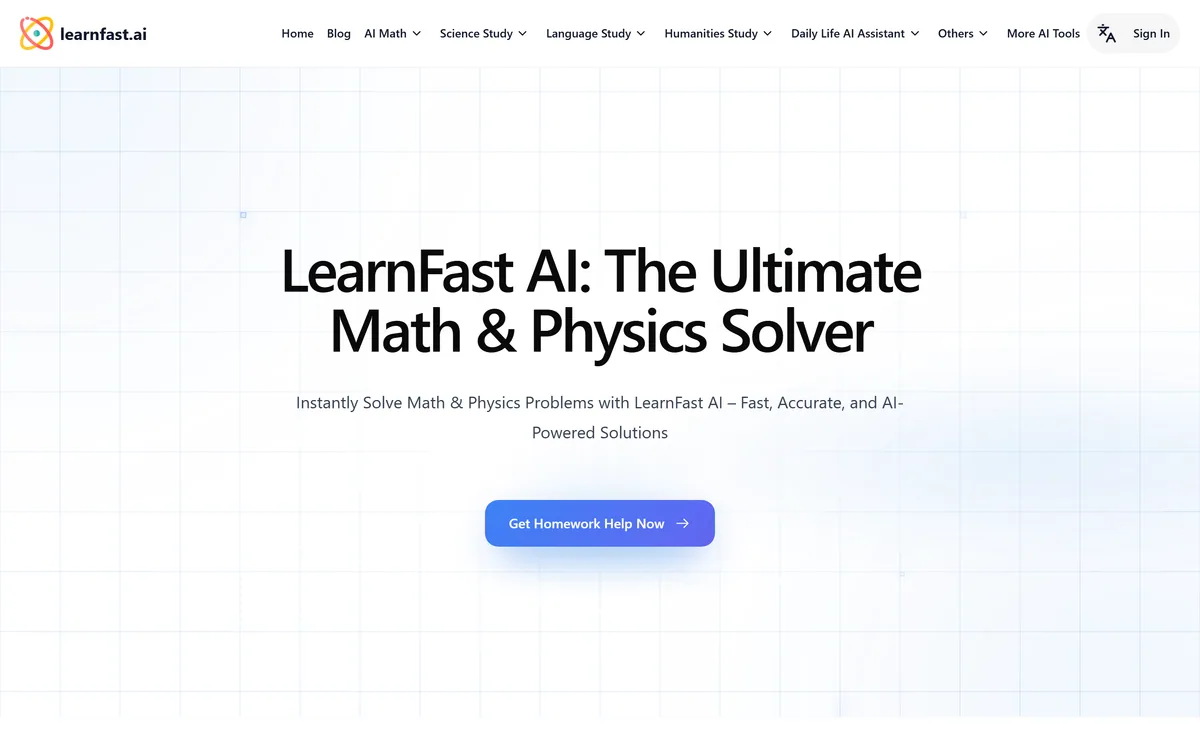
LearnFast AI's homepage, captured 9 September 2026. The site organises itself by subject in the navigation, with maths and physics leading.
The Camera Is The Feature Students Actually Use
The site supports typed input, image upload and file attachment, and offers a camera route for physics problems specifically.
Photography is the interaction that matters, and the reason is friction rather than novelty. Typing a maths problem requires transcribing notation — fractions, exponents, integrals, subscripts — into a text field that was not designed for it. That transcription is slow, error-prone, and frequently harder than the problem.
Pointing a camera at the page removes all of it. It also removes the one useful side effect of transcription, which is that re-reading a problem carefully is often enough to see the way in. That is a genuine trade rather than a pure gain.
The technical caveat is worth knowing before you rely on it. Recognising handwritten mathematics is considerably harder than recognising printed text, and a misread symbol produces a confidently worked solution to a problem you did not ask. Photograph printed problems where you can, write clearly where you cannot, and always check that the restated problem matches the one on your page before reading the answer.
The first thing to check in any solver's output is not the answer. It is whether it read the question correctly.
Maths Answers Are Checkable, Which Changes Everything
There is a reason maths and physics are the best subjects for this technology, and it is not that models are especially good at them.
It is that the output can be verified — and that a symbolic engine such as Symbolab computes the steps rather than predicting them. Differentiate a result and see whether you get back what you started with. Substitute the solution into the original equation. Check the units on a physics answer — if you asked for a velocity and the working produces something in joules, the error announces itself.
No equivalent check exists for an essay about a poem. A confidently wrong literary analysis reads exactly like a correct one, which is why the same technology is far more dangerous in humanities work than in a maths exercise.
This is the single most useful habit to build with any solver: verify the answer independently before accepting it. It takes thirty seconds, it catches the errors these tools do make, and it is itself a form of practice.
Where A Step-By-Step Answer Helps And Where It Hurts
The distinction that decides whether this tool helps you is not what it does. It is when you reach for it.
Used after a genuine attempt, a worked solution is one of the more effective study aids available. You have already loaded the problem into your head, you have a specific point of failure, and the solution resolves exactly that. What you learn is durable because it attached to a question you were actually holding.
Used instead of an attempt, the same output teaches nothing measurable. You will follow the steps, each will seem reasonable, and you will experience a strong sense of understanding that does not survive contact with a similar problem a week later. Psychologists have a name for this — fluency mistaken for learning — and it is the specific failure mode of every worked-example tool.
The practical rule is a timer, and it is the discipline a Socratic tutor such as Khanmigo builds in by refusing to answer at all. Ten minutes of genuine effort before you photograph anything. If you get it, you have learned it; if you do not, the solution lands on a prepared mind. That single discipline is the difference between the two students described at the top of this review.
A second rule matters almost as much: after reading the solution, close it and redo the problem from a blank page. If you cannot, you did not learn it — you read it.
Attempt first for ten minutes, always, before opening the solver.
Read the restated problem and confirm it matches yours before reading a single step.
Verify the answer independently — substitute back, differentiate, or check the units.
Close the solution and redo the problem from blank. This is the actual test of whether you learned it.
Ask a follow-up question about the step you did not understand, rather than accepting the whole solution.
The Integrity Question Nobody Should Skip
The site presents itself as homework help, and its call to action invites you to get homework help now. That framing deserves a direct response rather than a polite silence.
Using a solver to produce work you submit as your own breaches the assessment rules of essentially every school, college and university. That is not a claim about this tool specifically — it is true of every solver, and of a general assistant used the same way. The tool is not the transgression; submitting its output as your own is.
It is worth being clear about the practical stakes rather than moralising. The immediate consequence is an academic penalty. The larger one is that assessments exist to tell you whether you can do something, and a passed assessment you could not have passed is information you have destroyed about yourself — which surfaces later, in an exam hall or a job, at a much worse moment.
The legitimate uses are numerous and real: checking your own completed work, getting unstuck on one step, revising a topic from months ago, generating extra practice problems, and understanding a method your textbook explains badly. None of those involve submitting anything.
Parents and teachers should know the camera route exists and that it is fast. The productive response is not prohibition, which does not work, but changing what gets assessed — working shown in class, problems explained aloud, questions that ask why rather than what.
Using It So It Teaches You Something
The free daily quota makes this easy to trial without an account. The sequence below is how to use it as a study aid rather than as an answer service.
The bar is the final step. If you cannot reproduce the method on a fresh problem, the session taught you nothing regardless of how clear it felt at the time.
Set a timer for ten minutes and attempt the problem properly. Write down where exactly you get stuck.
Photograph the problem, and read the restated version first to confirm it was recognised correctly.
Read only up to the step you were stuck at, then stop and try to finish it yourself.
If you finish it, you are done — that is the ideal outcome and it is more common than people expect.
If not, read the rest, then verify the answer independently by substitution or by checking units.
Close everything and redo the problem from a blank page. Then find a similar one and do that too — reproducing the method on a fresh problem is the only real test.
What LearnFast AI Gives Away Free
Every visitor gets a free daily allowance without creating an account, with more unlocked by registering. That is genuinely generous positioning in a category where most tools gate the first answer behind a signup.
For a student, the practical implication is that you should never pay for this before establishing whether the working is reliable on your specific syllabus. A tool that is excellent at calculus can be mediocre at statistics, and the free quota is enough to find out.
Beyond the free tier the site references account-based access to further features. What is not published anywhere we could find is a clear statement of what a paid tier adds — whether it is quota, subjects, tutoring depth or something else.
We do not publish amounts, and in this case there is little to publish. The advice is straightforward: use the daily quota for a fortnight on real coursework, and only then consider whether more of it is worth buying.
Which Students LearnFast AI Suits
Helpful when
You are genuinely stuck on one step after a real attempt, and there is nobody to ask.
You want to check work you have already completed before submitting it.
You are revising a topic from earlier in the year and need the method refreshed quickly.
You need extra practice problems on a specific technique.
Your textbook explains a method badly and you want it presented a second way.
Harmful when
You would use it to produce work you then submit as your own, which breaches essentially every institution's assessment rules.
You have not attempted the problem — a worked solution read cold produces a feeling of understanding that does not survive a week.
You are working in a humanities subject where the answer cannot be independently verified and a confident error reads exactly like a correct answer.
You are preparing for an exam where the skill being assessed is doing this unaided, and practice under those conditions is the whole point.
You need certainty about correctness for high-stakes work, since no reliability data is published anywhere on the site.
LearnFast AI: The Site’s Own Claims
Primary subjects
Mathematics and physics, positioned as the core
Wider coverage
Science study, language study, humanities study and general assistant tools
Input methods
Typed text, image upload, file attachment, and a camera route for physics
Output
Step-by-step worked solutions rather than answers alone
Study tools
Study guide generation from uploaded PDFs or topics, plus summaries and quizzes
Interaction
Follow-up questions and interactive quizzes described as reinforcing the topic
Free access
A daily quota available to all visitors, with more unlocked on an account
Interface languages
A language switcher is present in the site navigation
Model disclosed
No underlying AI model or provider is named on the site
Company details
Not established — the site returned a 403 to our automated fetch, so its footer could not be read
Key features of LearnFast AI
Step-by-step solutions for mathematics and physics problems rather than bare answers
Camera input, so a problem can be photographed instead of transcribed
Image upload and file attachment alongside typed entry
Study guide generation from an uploaded PDF or a named topic
Automatic quiz and summary generation for revision
Follow-up questions and interactive quizzes to reinforce a topic
Coverage beyond maths across science, language and humanities study
A free daily quota available without creating an account
Pros & cons
Pros
6
A genuinely useful free daily quota that needs no account and no payment details
Camera input removes the transcription friction that makes typed maths input painful
Worked steps rather than answers alone, which is what makes learning from it possible
Maths and physics are the right domain, because the answer can be independently verified
Multiple input routes suit different problem types and devices
Study guide and quiz generation extends it beyond one-off problem solving
Cons
6
No AI model or provider is named, so there is no way to assess what produces the working
No accuracy or reliability data is published for the solutions
The homework-help framing never addresses the academic-integrity question it raises
Nothing in the design encourages attempting a problem before requesting the answer
Handwritten notation is harder to recognise than print, and a misread symbol yields a confident answer to the wrong question
We could not read the site footer, privacy policy or terms — it returned a 403 to our automated fetch, so its published company details remain unestablished
Best For
Students stuck on one step of a maths or physics problem after a real attempt
Checking completed work before submitting it
Refreshing a method from earlier in the course
Generating extra practice on a specific technique
Anyone who wants a second explanation when a textbook is unclear
LearnFast AI Against The Homework Helpers
These tools differ far more in method than in subject coverage, and method determines whether a student learns anything.
Tool
Approach
Strongest at
Main risk
LearnFast AI
Photograph or type a problem, receive worked steps
Speed and a free daily quota with no account required
Choose on method. A solver, a symbolic engine and a Socratic tutor produce very different learning outcomes from the same problem.
Mathos AI — deeper specialisation in mathematics, if that is the only subject you need
Symbolab — computes rather than predicts, which makes its working more dependable
Khanmigo — deliberately withholds the answer, which is the better tool if learning is the goal
StudyFetch — turns your own lecture notes and slides into revision material
Quizgecko — generates practice questions, which is what you need after the method has landed
What A Blocked Fetch Left Unverified
Last checked . The site returned a 403 to our automated fetch, so facts here are read from the captured screenshot above and from the site's own indexed feature pages.
Homepage headline confirmed from the captured screenshot as positioning the product as a mathematics and physics solver
Navigation confirmed from the screenshot as covering AI Math, Science Study, Language Study, Humanities Study, Daily Life AI Assistant, Others and More AI Tools, alongside a blog and a language switcher
Call to action on the homepage confirmed as inviting the visitor to get homework help
Step-by-step solutions described on the site's feature pages rather than answers alone
Input methods described across the feature pages as typed text, image upload and file attachment, with a camera route for physics problems
Study guide generation from uploaded PDFs or a topic, producing quizzes and summaries, described on a dedicated feature page
A free daily quota available to all visitors, with further access on a registered account, described across the site
What we could not confirm: the site blocked our automated fetch with a 403 response, so we could not read the footer, the privacy policy or the terms; no underlying AI model or provider is named by the vendor, and third-party directories that name one are not the vendor speaking; no accuracy or reliability data is published for the worked solutions; and what a paid tier adds over the free daily quota is not clearly stated anywhere we could reach.
Editor's Verdict
3.4/5
LearnFast AI scores modestly because it does the narrow thing competently and gives it away generously — photograph a problem, get worked steps, with a free daily quota that requires no account and no payment details. Maths and physics are also the right domain for this, because an answer can be checked rather than merely believed. It loses ground because the site names no model or company, publishes nothing about how reliable the working actually is, and frames itself around homework help without ever addressing the academic-integrity question that framing raises — and because a tool that hands over finished steps is, for a student who is being assessed, as easy to misuse as it is to learn from. AInexfinder Editor Score: 3.4/5.
LearnFast AI pricing
AInexfinder does not list plan prices or billing details. For current pricing, plans, and trials, visit the official LearnFast AI website.
Vendor pricing, credits, and billing policies change over time. Always confirm on the official site before you buy.
Frequently asked questions
What does LearnFast AI do?
It solves mathematics, physics and science problems from typed text, an uploaded image or a photograph, returning step-by-step working rather than only an answer. It also generates study guides, summaries and quizzes from uploaded PDFs or a named topic, and covers language and humanities study in its wider navigation.
Is LearnFast AI free?
There is a free daily quota available to every visitor without creating an account, with more unlocked by registering. What a paid tier adds is not clearly stated anywhere we could reach. Use the daily quota on real coursework for a fortnight before considering payment — a tool strong on calculus can be mediocre on statistics.
Is using LearnFast AI cheating?
Using it to produce work you submit as your own breaches essentially every institution's assessment rules — that is true of any solver, not this one specifically. Checking your own completed work, getting unstuck on a single step, revising an old topic or generating extra practice are all legitimate. The tool is not the problem; submitting its output as your own is.
How accurate are LearnFast AI's solutions?
The site publishes no accuracy or reliability data, and names no underlying model, so there is no basis for a figure. What makes maths and physics the right domain for this is that you can check the result yourself: substitute the answer back, differentiate the result, or check that the units make sense. Do that every time.
Can it read handwritten problems from a photo?
Image and camera input are supported, but recognising handwritten mathematics is considerably harder than reading print, and a misread symbol produces a confidently worked solution to a different problem. Photograph printed problems where you can, write clearly where you cannot, and always confirm the restated problem matches yours before reading the working.
Will using a solver actually help me learn?
It depends entirely on when you open it. After a genuine ten-minute attempt, a worked solution lands on a prepared mind and teaches durably. Opened instead of an attempt, it produces a strong sense of understanding that does not survive a similar problem a week later. Close the solution afterwards and redo the problem from blank — that is the only real test.
How does LearnFast AI compare with Khanmigo?
They have opposite designs. Khanmigo deliberately withholds the answer and pushes you toward it with questions, which is slower and better for learning. LearnFast AI gives you the worked solution immediately, which is faster and better when you are genuinely stuck at eleven at night. If you are studying for an exam, the Socratic approach is the one that prepares you for it.
Daniel reviews AI tools the slow way — by actually using them on real projects. His reviews cover what works, what breaks, and who each tool is genuinely a good fit for.
Daniel and the AInexfinder editorial team research LearnFast AI using public product information, listing evidence, and (when available) hands-on checks. Scores reflect listing completeness and transparency — not paid placement.
Listings may include affiliate or sponsored placements, which are labeled when present. Editorial scores and cons are not sold. See our affiliate disclosure and review methodology.
LUCA is a K-12 reading intervention platform that analyses student reading at the phoneme level rather than the word level, identifying skill gaps in real time. It reports a 17.4 words-per-minute average fluency gain and 763,000+ grapheme-phoneme mappings, delivered through SoundScout, StoryGen and Assessment Intelligence.
RemNote combines outlining, handwriting, PDF annotation and spaced-repetition flashcards in one document, generating cards, quizzes and summaries from PDFs, slides, lecture transcripts and video, with an exam scheduler that works backwards from a date you set.
Question AI is a homework-helper app that scans a question and returns step-by-step answers across school subjects, plus AI writing, search, translation and summarizing. Its study uses are legitimate; using it to hand in answers or graded work crosses academic-integrity lines, which we weigh honestly.
Gizmo is a mobile-first study app that turns your notes, PDFs, slides and YouTube videos into AI-generated quizzes and flashcards, built around active recall so revision becomes a habit rather than a chore.
StudyFetch turns course material — PDFs, slides, lecture recordings, YouTube videos, photographed notes — into flashcards, quizzes, summaries and an AI tutor called Spark.E that answers only from your uploaded content.
ThetaWise is a STEM study tool covering maths, science and engineering with step-by-step solutions, a Tutor Mode that guides through hints, generated animated video lessons, practice quizzes, flashcards and Desmos graphing, stating 765,781 students.