RemNote combines outlining, handwriting, PDF annotation and spaced-repetition flashcards in one document, generating cards, quizzes and summaries from PDFs, slides, lecture transcripts and video, with an exam scheduler that works backwards from a date you set.
remnote.com9 viewsAdded February 26, 202691K visitors
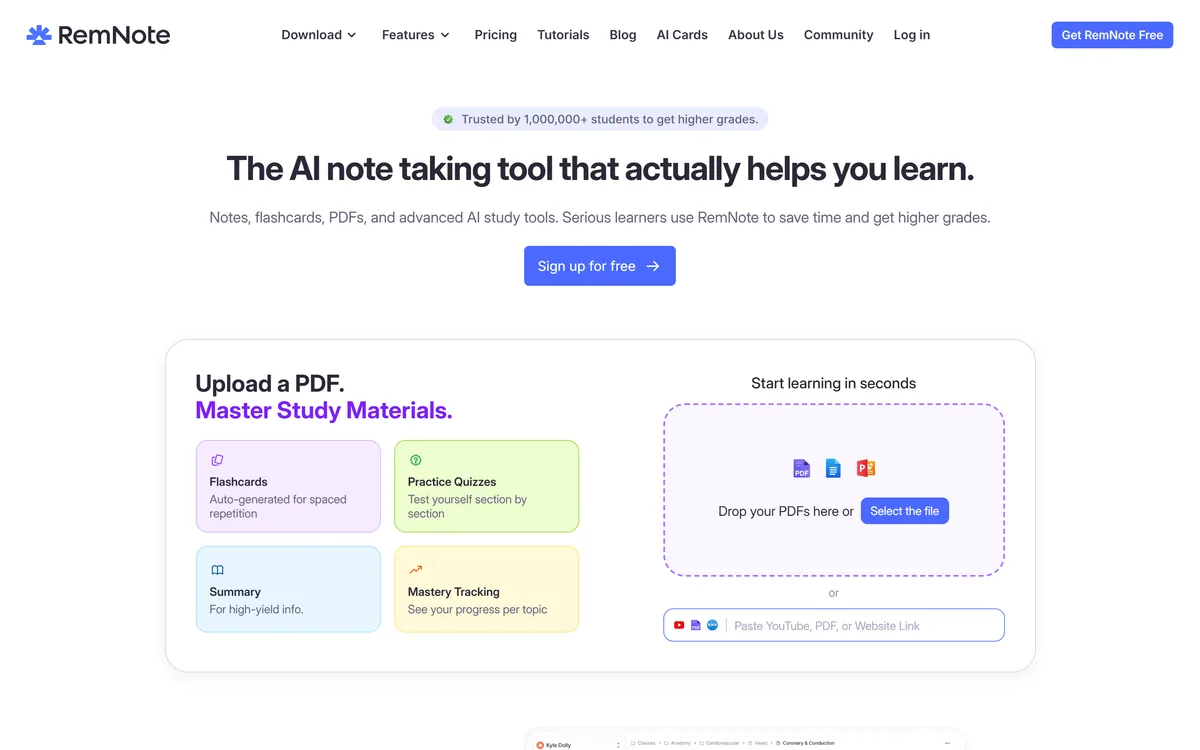
RemNote's homepage, captured 9 September 2026, showing its notes-and-flashcards positioning.
RemNote: Notes That Become Flashcards
The positioning is stated as the AI note-taking tool that actually helps you learn, with notes, flashcards, PDFs and study tools in one place and a stated million-plus students.
The word in that sentence doing the real work is one — one tool rather than several.
The conventional student stack is a note app, a separate flashcard app and a PDF reader, and the friction between them is not trivial. Converting lecture notes into cards means reading your own notes, deciding what matters, and retyping it somewhere else.
That transfer step is where study systems die. Almost everyone who has used a serious flashcard programme has a backlog of lectures they meant to turn into cards and never did.
The site's own testimonial from a medical student names exactly this — the greatest hassle being conversion, and the value being creating cards without breaking flow. That is the correct description of the problem and the correct description of the fix.
Almost everyone who has used a serious flashcard programme has a backlog of lectures they meant to turn into cards and never did.
Writing A Card That Is Worth Reviewing
A flashcard system is only as good as the cards in it, and most people write bad ones without realising, then conclude the method does not work.
The dominant mistake is the compound card: a question whose answer is four facts. You recall three, get it partly wrong, and the system cannot tell which part failed — so it reschedules the whole thing and you keep re-learning the three you knew.
The rule is one fact per card, which feels tediously granular and is the difference between a deck that works and one you abandon.
The second mistake is context-free cards. A card asking what a term means, written without the surrounding material, becomes meaningless six weeks later when you have forgotten which lecture it came from. Cards living inside your notes largely solve this, because the context is one click away.
The card types offered — image occlusion, question and answer, fill in the blank, lists and clusters — matter for the same reason. Different material needs different formats, and image occlusion in particular is what makes anatomy and diagram-heavy subjects learnable at all. Knowledge tools like Recall apply the same resurfacing principle to reading rather than to study.
Why Does Spaced Repetition Work?
The FAQ describes it accurately: a science-backed memory technique that reminds you of concepts right before you are about to forget them.
It is worth being specific about why, because understanding the mechanism changes how you use it.
Two separate effects are operating. The spacing effect means review distributed over time produces far better retention than the same total time spent at once — a fact known since the nineteenth century and replicated ever since. The testing effect means retrieving an answer strengthens the memory more than re-reading it does.
Flashcards on a schedule combine both, which is why the method outperforms almost everything students do instead.
The awkward corollary is that it feels worse. Rereading notes is comfortable and produces a strong sense of familiarity that students reliably mistake for knowledge. Retrieval is uncomfortable, exposes what you do not know, and works better — which is precisely why most people prefer the method that fails them. A system that schedules the reviews removes the need to make that choice daily, and that removal is most of its value.
One fact per card — compound cards are why decks get abandoned.
Write cards as you take notes, not in a session afterwards.
Use image occlusion for anything spatial or diagrammatic.
Set the exam date so the schedule works backwards from it.
Review generated cards before trusting them; that review is the learning.
Turning A PDF Into A Study Deck
The AI tools are extensive and specific: cards, quizzes and summaries generated from PDFs, PowerPoint, YouTube and plain text, plus lecture transcripts, with mastery tracking per topic and an explanation attached to every card.
This is the feature students will use most and the one that needs the most honest treatment.
The convenience is real. Turning a 60-page lecture PDF into a deck in seconds removes hours of work, and for material you must cover but do not need to understand deeply — a required module outside your field — that is a straightforwardly good trade.
The cost is the generation effect. Deciding what deserves a card is not preparation for learning; it is a large part of the learning itself. You are forced to distinguish the central claim from the supporting detail, and that judgement is precisely what an exam tests.
Outsourcing it produces a deck that covers the material and a student who has not yet engaged with it. The practical resolution is to treat generated cards as a first draft: read every one, delete the trivial, split the compound, and fix the ones that miss the point. That review recovers most of the benefit at a fraction of the time. Tools like StudyFetch make the same trade with the same caveat.
Notes And Cards In One Document
The wider product is a knowledge base rather than a study app: outlining, handwritten notes on a tablet with conversion to text, PDF and slide annotation, references and tags, tables and databases, instant search, offline mode and a lecture recorder.
The stated ambition is a knowledge base for life, scaling from studies into a career.
That ambition is where tools of this kind usually overreach, and it is worth separating the parts. As a student system this is coherent: everything relating to one course lives together, and the flashcards are attached to the material that explains them.
As a lifelong knowledge base the proposition is weaker, not because the features are missing but because spaced repetition rarely survives graduation. The forcing function is the exam, and without one most people stop reviewing within a month.
The genuinely valuable long-term feature is the connected note structure — references, tags and search over material you wrote yourself. Offline mode deserves a mention too, since it is unglamorous and disproportionately important for anyone studying on a commute or in a building where the signal fails. The comparison pages in the footer name the alternatives directly, which is a confident thing for a vendor to do. NoteGPT covers the capture side without the review system underneath.
Studying For An Exam With A Schedule
The exam scheduler is the feature that converts a good method into an actual plan, by working backwards from a date.
This sequence uses it properly.
Set the exam date first, so the schedule has something to work backwards from.
Write cards while taking notes rather than in a separate later session.
Split every compound card into single facts before it enters the queue.
Generate from PDFs for breadth, then edit every card it produced.
Do the daily queue even when it is short — the interval is the mechanism.
Use image occlusion for every diagram rather than describing it in text.
RemNote: Features And Community
Category
Note-taking with integrated spaced-repetition flashcards
Adoption
Stated as over 1,000,000 students
Note formats
Outlining, handwritten notes with text conversion, PDF and slide annotation
Card types
Image occlusion, question and answer, fill in the blank, lists and clusters
Scheduling
Spaced repetition with an exam scheduler working backwards from your date
AI generation
Cards, quizzes and summaries from PDFs, slides, video and text
AI support
A tutor chat over your notes, and an explanation attached to each card
Tracking
Mastery tracking shown per topic
Organisation
Folders, references, tags, tables, databases and instant search
Availability
Desktop, iOS and Android, with offline mode and sync
Turbo AI — another route from source material to study aids
RemNote: Read From The Study Pages
Last checked . Read from remnote.com in a browser session on the date above, with the screenshot captured at the same time.
Positioned as an AI note-taking tool for learning, trusted by a stated 1,000,000-plus students
PDF upload producing flashcards, practice quizzes, summaries and mastery tracking
Note formats listed as typed outlining, handwritten notes with text conversion, and PDF and slide annotation
Card types listed as image occlusion, question and answer, fill in the blank, lists and clusters
An exam scheduler described as telling you what to study each day from a set exam date
Spaced repetition described as resurfacing cards at the optimal time for retention
An AI tutor chat over your notes, with an explanation attached to every card
AI generation tools listed for PDF, PowerPoint, YouTube and text into cards, quizzes or summaries
Tables, databases, references, tags and instant search offered for organisation
Offline mode and sync across desktop, iOS and Android
Named testimonials from students at identified universities, one describing card creation without breaking flow
Footer showing RemNote Inc. with a 2026 copyright, terms, privacy, a privacy hub and direct comparison pages
What we could not confirm: how the million-student figure is counted; which spaced repetition algorithm is used or how intervals are calculated; the quality of AI-generated cards across subjects; what the free tier includes relative to paid tiers; and pricing. Testimonials are vendor-selected. We did not create an account or build a deck.
Editor's Verdict
4.2/5
RemNote's structural idea is right: flashcards and notes belong in the same document, because writing a card while you take a note is when you actually decide what matters. Spaced repetition is one of the most robustly supported findings in learning research, and building the schedule backwards from an exam date is the sensible application of it. The one real tension is that generating cards automatically from a PDF removes the step where most of the learning happens — and the site's own strongest testimonial describes writing cards while studying, not skipping it. AInexfinder Editor Score: 4.2/5.
RemNote pricing
AInexfinder does not list plan prices or billing details. For current pricing, plans, and trials, visit the official RemNote website.
Vendor pricing, credits, and billing policies change over time. Always confirm on the official site before you buy.
Frequently asked questions
What does RemNote do differently?
Flashcards live inside your notes rather than in a separate app. That removes the transfer step — reading your own notes, deciding what matters and retyping it elsewhere — which is where most study systems break down.
Why does spaced repetition work?
Two effects combine. Spacing means review distributed over time beats the same time spent at once, and testing means retrieving an answer strengthens memory more than re-reading it. Cards on a schedule use both.
Why does effective study feel worse?
Because rereading is comfortable and produces familiarity that students mistake for knowledge, while retrieval is uncomfortable and exposes gaps. A scheduled queue removes the daily choice between the two.
Should I let AI generate my cards?
For material you must cover but need not master deeply, yes. Otherwise treat them as a first draft — deciding what deserves a card is a large part of the learning, and outsourcing it produces a deck you have not engaged with.
What makes a good flashcard?
One fact per card. Compound cards — where the answer is four things — are the main reason decks get abandoned, because getting one part wrong reschedules everything and you keep relearning what you knew.
What is image occlusion and who needs it?
Covering parts of a diagram so you have to recall what is hidden. It is essential for anatomy, chemistry and anything spatial, and it is absent from most general-purpose flashcard tools.
How does the exam scheduler work?
You set your exam date and it tells you what to study each day, working backwards from it. That converts spaced repetition from a good principle into an actual plan with a finish line.
Is it useful after graduation?
The notes, references and search remain valuable. The review habit usually does not — the exam is the forcing function, and without one most people stop working the queue within a month.
Can I use it offline?
Yes. Offline mode with sync is offered across desktop, iOS and Android, which matters disproportionately for anyone studying on a commute or in a building where the signal fails.
Is there a free version?
The FAQ states a free plan covering note-taking, flashcards, spaced repetition and PDF annotation, with paid tiers for advanced AI tools and backups. We do not publish plan prices — check the vendor's pricing page.
Daniel reviews AI tools the slow way — by actually using them on real projects. His reviews cover what works, what breaks, and who each tool is genuinely a good fit for.
Daniel and the AInexfinder editorial team research RemNote using public product information, listing evidence, and (when available) hands-on checks. Scores reflect listing completeness and transparency — not paid placement.
Listings may include affiliate or sponsored placements, which are labeled when present. Editorial scores and cons are not sold. See our affiliate disclosure and review methodology.
LUCA is a K-12 reading intervention platform that analyses student reading at the phoneme level rather than the word level, identifying skill gaps in real time. It reports a 17.4 words-per-minute average fluency gain and 763,000+ grapheme-phoneme mappings, delivered through SoundScout, StoryGen and Assessment Intelligence.
Gizmo is a mobile-first study app that turns your notes, PDFs, slides and YouTube videos into AI-generated quizzes and flashcards, built around active recall so revision becomes a habit rather than a chore.
Question AI is a homework-helper app that scans a question and returns step-by-step answers across school subjects, plus AI writing, search, translation and summarizing. Its study uses are legitimate; using it to hand in answers or graded work crosses academic-integrity lines, which we weigh honestly.
StudyFetch turns course material — PDFs, slides, lecture recordings, YouTube videos, photographed notes — into flashcards, quizzes, summaries and an AI tutor called Spark.E that answers only from your uploaded content.
ThetaWise is a STEM study tool covering maths, science and engineering with step-by-step solutions, a Tutor Mode that guides through hints, generated animated video lessons, practice quizzes, flashcards and Desmos graphing, stating 765,781 students.
Wolfram|Alpha is a computational knowledge engine that computes verified, expert-level answers across maths, science, data and everyday topics using Wolfram's algorithms and curated knowledgebase, with step-by-step solutions, Pro features and an API.