Turbo AI, formerly TurboLearn and operated by Turbolearn LLC, turns lectures, PDFs, Word documents, YouTube videos and recordings into notes, flashcards, quizzes and podcasts. It includes an AI Notetaker that records lectures live, and states over 10 million learners.
Every student faces the same impossible choice in a lecture: listen properly, or write properly. Doing both means doing neither well, and the notes you take while trying to follow an argument are reliably worse than the argument was.
That is a genuine problem with a technological answer, and it is the one thing in this category where AI clearly helps rather than arguably helps.
Turbo AI — which was TurboLearn until recently — builds around exactly that, then adds the study tools that turn a recording into something you might actually remember.
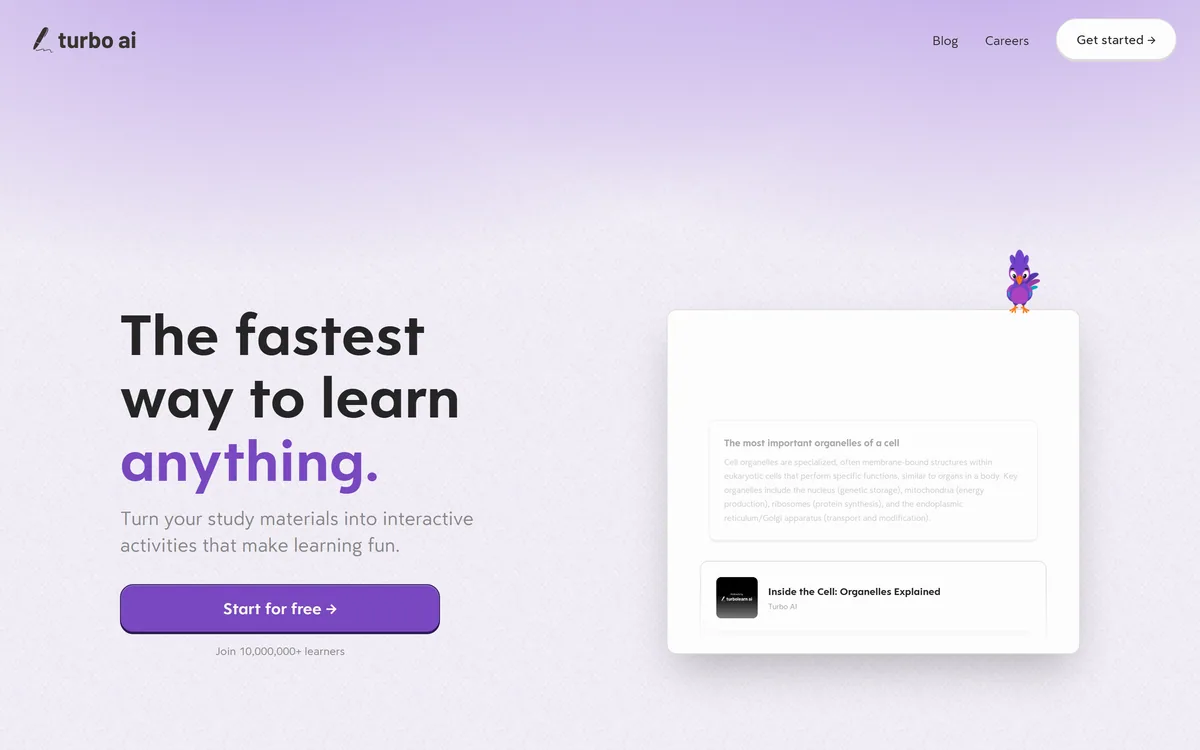
Turbo AI's homepage, captured 9 September 2026, showing the product under its post-rebrand name.
Turbo AI, Formerly Turbolearn
TurboLearn is now Turbo AI, at turbo.ai, operated by Turbolearn LLC — features and accounts stated as carried across.
The AI Notetaker records lectures live and generates notes, which is the feature that solves an actual problem.
Flashcards and quizzes are the retention half, and the part with real evidence behind it.
Inputs include PDFs, Word documents, YouTube videos and audio recordings, plus your own notes.
Over 10 million learners stated, with web, mobile and tablet apps syncing automatically.
What Changed When Turbolearn Became Turbo AI?
The product is now Turbo AI at turbo.ai, having previously been branded TurboLearn, and the operating company remains Turbolearn LLC. The site states that existing features and user accounts were maintained through the change.
For an existing user the practical impact is small, which is how a rebrand should go. Accounts, material and workflow carried across, and the old domain redirects.
For everyone else the impact is on findability. Tutorials, reviews, class recommendations and study-group references written before the change all use the old name, and someone searching for what a classmate mentioned finds material describing a product under a name the site no longer uses.
What a rebrand does not tell you is why. A name change can accompany a repositioning, a change of scope, or nothing at all beyond a shorter domain, and the site does not explain which applies here.
The narrowing of the name is mildly informative. TurboLearn described what it did; Turbo AI describes a category. Names usually get broader when a product intends to, which is worth noticing without over-reading.
Renames are common enough in this category to be worth a habit. NoteGPT covers similar ground under a stable name, and the practical cost of a change is always the same: your existing knowledge quietly stops matching the interface.
Names usually get broader when a product intends to. TurboLearn described what it did; Turbo AI describes a category.
The Notetaker Is The Feature Students Use
The AI Notetaker records lectures and generates notes from them, and it is the most defensible thing in the product.
The reason is that it removes an effort that teaches you nothing. Transcribing what a lecturer said is not learning — it is stenography — and the mental capacity it consumes is exactly the capacity you needed for following the argument.
A student freed from writing can listen, question, and notice when they did not understand something, which is when they can still ask. That is a genuine improvement in what a lecture accomplishes rather than a shortcut around it.
The important discipline is what you do with the output. Generated notes read as complete, which produces the comfortable feeling of having covered the material — and that feeling is precisely the failure mode, because reviewing something you did not process leaves very little behind.
The version that works is generated notes as a safety net rather than a substitute: listen actively, write your own brief notes on what confused you, and use the generated version to fill gaps rather than to replace the attention.
Which Half Of This Actually Helps You Learn
Turbo AI's features split neatly into two groups, and only one of them has evidence behind it.
The summarising group — notes, study guides, podcast generation — reduces effort. That is genuinely useful for triage, deciding what deserves your attention, and catching up on something you missed. It is not how anyone learns anything.
The testing group — flashcards and quizzes — increases effort, deliberately. Retrieval practice is the most consistently supported finding in the study literature, it reliably beats re-reading and highlighting, and it is unpopular precisely because it feels like failing.
That is the whole distinction, and it explains why AI study tools produce such mixed results. A student who uses the summaries and skips the quizzes has bought a faster way to feel prepared, which is worse than useless before an exam.
The podcast feature is the most interesting of the summarising group, because listening while walking or commuting uses time that was not available for studying. Passive review is weak, and weak review in time you were not using is still a gain.
That is the same split Recall is built around, applied to reading rather than lectures — and the reason both products live or die on whether anyone answers the quiz.
Use the Notetaker to listen better, not to skip listening.
Do the quizzes — the summaries are triage and the testing is the learning.
Add your own harder questions, since generated ones favour definition recall.
Use the podcast output for time you could not otherwise study in.
Note what confused you during a lecture; a generated summary will not.
Ten Million Learners And What That Means
Turbo AI states over 10 million learners and displays names including Google, Harvard, MIT, Goldman Sachs, McKinsey, Yale, Deloitte, Duke, Northwestern and UT Austin.
The user figure is vendor-stated with no definition. Ten million registered accounts, ten million people who once uploaded a PDF, and ten million active students are three very different numbers, and only the third would tell you anything.
The institution logos need reading more carefully still. A student at Harvard using a study app does not mean Harvard uses it, endorses it or has assessed it — it means a person with a Harvard email address signed up, which is true of essentially every consumer product with any traction.
That is a general pattern worth recognising rather than a criticism of this vendor specifically. Logo walls on consumer AI products almost always mean users work or study there, and the visual grammar borrows the credibility of an institutional endorsement that was never given.
The figure that would actually be informative — how many students still use it after a semester — is the one nobody publishes, because retention in study apps is notoriously poor. Judge this on whether it works for you across one module, which is a test you can run.
Studying From A Recorded Lecture Properly
The tool changes what is possible in a lecture; it does not change what learning requires afterwards.
The sequence below uses the summarising half for triage and the testing half for the actual work.
For standardised exams none of this substitutes for calibrated questions, which is the argument a platform like MentoMind makes when it refuses to generate them at all.
Record the lecture and listen actively rather than transcribing, writing only what confused you.
Review the generated notes the same day, while you still remember the shape of the argument.
Generate flashcards and a quiz immediately, rather than saving them for revision week.
Add three of your own harder questions per topic, aimed at applying the idea rather than recalling it.
Test yourself before re-reading anything, since the discomfort of retrieval is the mechanism.
After a fortnight, check whether you can explain the topic without the notes open — the only real measure.
Key features of Turbo AI
AI Notetaker that records live lectures and generates notes
Note generation and editing from uploaded material
Flashcards and quizzes produced from your own sources
Podcast generation for listening rather than reading
Pre-made study guides
Collaborative document editing
Input from PDFs, Word documents, YouTube and audio recordings
Web, mobile and tablet apps with automatic sync
Pros & cons
Pros
6
The Notetaker removes transcription effort that teaches nothing, freeing attention for the argument
Flashcards and quizzes are the retention half, with real evidence behind them
Podcast output uses commuting time that was not available for study
Broad input support covering the formats course material actually arrives in
Accounts and features stated as carried through the rebrand
A named operating company in Turbolearn LLC
Cons
6
Summaries produce the feeling of having covered material without the retention
Generated questions favour definition recall over application
The 10 million learners figure is undefined and unaudited
University and company logos indicate individual users, not institutional endorsement
Older references and tutorials still use the TurboLearn name
No pricing, model disclosure or recording retention policy published
Best For
Students who cannot listen and take notes at the same time
Coursework spread across PDFs, slides and recordings
Anyone who knows flashcards work and never makes them
Learners with commuting time to fill with audio review
Study groups using collaborative document editing
Turbo AI Beside Other Study Apps
Study tools divide by whether they remove effort that teaches you nothing, or effort that does.
PDF, Word documents, YouTube videos, audio and lecture recordings, your own notes
Stated users
Over 10 million learners
Platforms
Web, mobile app and tablet, with automatic sync
Footer sections
Privacy, Terms, Blog, Careers
Is Turbo AI Your Study Tool?
A real help for revision when
You attend live lectures and cannot listen and write at the same time.
Your material is spread across PDFs, slides, recordings and YouTube.
You know retrieval practice works and never make the flashcards.
You have commuting or walking time that podcast output could use.
You will do the quizzes rather than only reading the summaries.
Learn another way when
You would read summaries instead of engaging with the material.
Your exam rewards application, where generated recall questions are not enough alone.
Your institution restricts recording lectures, which is worth checking.
You need calibrated standardised-test practice, where question quality decides everything.
You have no live lectures, which removes the strongest feature.
Other Learning Apps
Study tools differ on where the material comes from and whether the app makes you work.
NoteGPT — a wider toolbox for material that is already recorded
Quizlet — the established home of spaced repetition and shared decks
Recall — the same retention idea applied to general reading
MentoMind — for standardised exams, with expert-written questions
Gemini Notebook — when you need cited answers from your sources rather than summaries
Confirming The Turbolearn Rename
Last checked . Read from turbo.ai, reached via a redirect from turbolearn.ai, with the screenshot above captured in the same session.
turbolearn.ai returns a 301 permanent redirect to turbo.ai
Product branded on the current site as Turbo AI
Operating company stated as Turbolearn LLC
Site states the product was previously branded TurboLearn and that existing features and user accounts were maintained through the rebrand
Described as converting lectures, PDFs, YouTube videos and your own notes into interactive study activities
Note generation and editing confirmed
Flashcards and quizzes confirmed
Podcast generation confirmed
AI Notetaker confirmed as recording lectures and generating notes
Pre-made study guides and collaborative document editing confirmed
Supported inputs confirmed as PDF, Word documents, YouTube videos and audio or lecture recordings
Over 10 million learners stated on the site
Organisation names displayed on the site including Google, Harvard University, MIT, Goldman Sachs, McKinsey, Yale University, Deloitte, Duke University, Northwestern University and UT Austin
Platform availability confirmed as web, mobile app and tablet with automatic synchronisation
Footer sections confirmed for Privacy, Terms, Blog and Careers
What we could not confirm: the date of the rebrand or the reason for it; pricing and plan structure; which underlying models generate notes, questions and audio; how many languages are supported; how uploaded lecture recordings are retained or deleted; what the displayed organisation names actually signify, since no relationship is described; and any retention or outcome data. We did not use the product, so nothing here reflects tested output quality.
Editor's Verdict
3.7/5
Turbo AI's strongest feature is the one that requires the least trust: the AI Notetaker, which records a lecture and produces notes from it. That solves a real and specific problem — you cannot listen properly and write properly at the same time, and students have been choosing badly between the two forever. The flashcards and quizzes are the half that actually builds retention. It scores where it does because summarising a lecture is not the same as learning it, and the ten-million-learner figure and university logos are marketing rather than evidence of anything about the product. AInexfinder Editor Score: 3.7/5.
Turbo AI pricing
AInexfinder does not list plan prices or billing details. For current pricing, plans, and trials, visit the official Turbo AI website.
Vendor pricing, credits, and billing policies change over time. Always confirm on the official site before you buy.
Frequently asked questions
Is TurboLearn now called Turbo AI?
Yes. The product is branded Turbo AI at turbo.ai, with turbolearn.ai redirecting there, and the operating company remains Turbolearn LLC. The site states that existing features and user accounts were maintained through the change, so the practical impact on an existing user is small.
What is Turbo AI?
A study platform that turns lectures, PDFs, Word documents, YouTube videos and recordings into notes, flashcards, quizzes, study guides and podcasts. Its AI Notetaker records lectures live and generates notes from them, and it runs on web, mobile and tablet with automatic sync.
What is the best feature?
The AI Notetaker, because it removes an effort that teaches you nothing. Transcribing a lecture is stenography, and the mental capacity it consumes is exactly what you needed for following the argument. A student freed from writing can listen, question, and notice what they did not understand while they can still ask.
Do the summaries actually help me learn?
They help you triage, not learn. Summarising reduces effort, which is useful for deciding what deserves attention or catching up on a missed session. Learning requires increased effort — which is what the flashcards and quizzes provide. A student who uses the summaries and skips the quizzes has bought a faster way to feel prepared.
Why do flashcards work better than re-reading?
Because retrieval strengthens memory in a way recognition does not. Pulling something out of your head is harder than reading it again, and the difficulty is the mechanism. It is also why the technique is unpopular: it feels like failing, where re-reading feels productive and leaves far less behind.
Is the podcast feature useful?
More than it looks. Passive listening is weak review, but it uses commuting or walking time that was not otherwise available for studying — and weak review in found time beats no review. It is the one summarising feature whose value is about when you use it rather than how well it works.
Should I trust the 10 million learners figure?
Treat it as a claim about scale. It is vendor-stated with no definition — registered accounts, people who once uploaded a PDF, and active students are three very different numbers. The figure that would be informative, how many still use it after a semester, is the one nobody in this category publishes.
Does Harvard or MIT endorse Turbo AI?
No. Displayed institution names on a consumer study app mean students there signed up, which is true of essentially every product with any traction. The visual grammar of a logo wall borrows the credibility of an institutional endorsement that was never given — worth recognising as a general pattern rather than a specific criticism.
Can I record my lectures legally?
Check your institution's policy before assuming. Many universities require a lecturer's permission, some restrict recording entirely, and rules differ between departments. That is worth resolving first, because the Notetaker is the strongest feature here and it does not work if you are not permitted to use it.
How should I actually study with it?
Record and listen actively, writing only what confused you. Review the generated notes the same day while you remember the argument's shape. Generate flashcards and a quiz immediately rather than in revision week, add three harder questions of your own per topic, and test before re-reading anything.
Daniel reviews AI tools the slow way — by actually using them on real projects. His reviews cover what works, what breaks, and who each tool is genuinely a good fit for.
Daniel and the AInexfinder editorial team research Turbo AI using public product information, listing evidence, and (when available) hands-on checks. Scores reflect listing completeness and transparency — not paid placement.
Listings may include affiliate or sponsored placements, which are labeled when present. Editorial scores and cons are not sold. See our affiliate disclosure and review methodology.
LUCA is a K-12 reading intervention platform that analyses student reading at the phoneme level rather than the word level, identifying skill gaps in real time. It reports a 17.4 words-per-minute average fluency gain and 763,000+ grapheme-phoneme mappings, delivered through SoundScout, StoryGen and Assessment Intelligence.
Question AI is a homework-helper app that scans a question and returns step-by-step answers across school subjects, plus AI writing, search, translation and summarizing. Its study uses are legitimate; using it to hand in answers or graded work crosses academic-integrity lines, which we weigh honestly.
Gizmo is a mobile-first study app that turns your notes, PDFs, slides and YouTube videos into AI-generated quizzes and flashcards, built around active recall so revision becomes a habit rather than a chore.
RemNote combines outlining, handwriting, PDF annotation and spaced-repetition flashcards in one document, generating cards, quizzes and summaries from PDFs, slides, lecture transcripts and video, with an exam scheduler that works backwards from a date you set.
StudyFetch turns course material — PDFs, slides, lecture recordings, YouTube videos, photographed notes — into flashcards, quizzes, summaries and an AI tutor called Spark.E that answers only from your uploaded content.
ThetaWise is a STEM study tool covering maths, science and engineering with step-by-step solutions, a Tutor Mode that guides through hints, generated animated video lessons, practice quizzes, flashcards and Desmos graphing, stating 765,781 students.