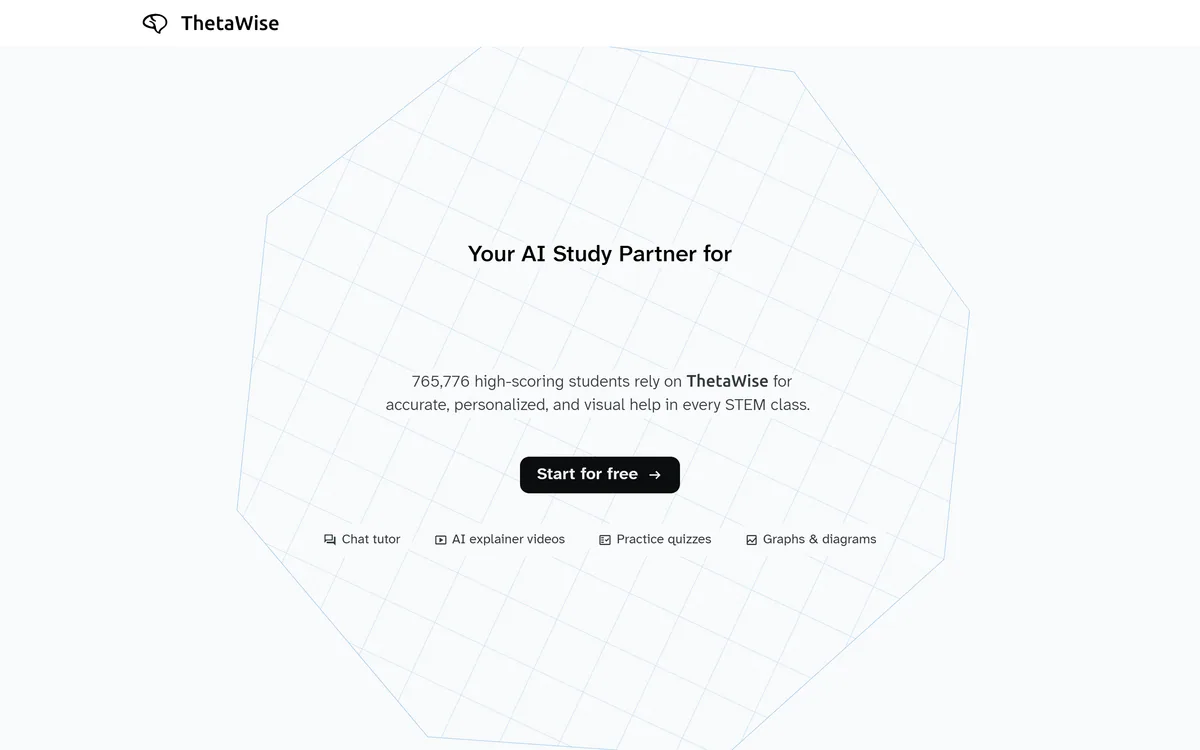
ThetaWise is a STEM study tool covering maths, science and engineering with step-by-step solutions, a Tutor Mode that guides through hints, generated animated video lessons, practice quizzes, flashcards and Desmos graphing, stating 765,781 students.
thetawise.ai7 viewsAdded February 7, 2026164K visitors
ThetaWise's homepage, captured 9 September 2026, showing its STEM tutoring positioning.
ThetaWise: What Students Get
Tutor Mode — hints and questions rather than the answer, which is the mode that teaches.
Answer Directly mode also offered, alongside a custom response behaviour.
Generated video lessons with visuals and narration on any topic you name.
Practice quizzes and flashcards built from your own course material.
Desmos graphing, photo and document input, and a maths notation editor.
ThetaWise: Tutor Mode Versus Answer Directly
The response behaviour options are stated plainly: Tutor me, Answer Directly, or Custom — with Tutor Mode described as guiding you with hints and questions so it actually sticks.
That single design decision is the most important thing on the site, and offering both modes openly is more honest than the alternative.
The pedagogy behind Tutor Mode is well established. A worked solution handed to a student produces the sensation of understanding without the substance of it, because recognising a correct method is far easier than producing one. The student closes the tab confident and fails the same question on an exam.
A hint that prompts the next step forces retrieval, and retrieval is what builds the ability to do it alone.
Answer Directly exists because students want answers, and pretending otherwise would make the product unusable rather than more ethical. The site does not hide that mode or dress it up, and the choice sits with the student — which is where responsibility genuinely lies, though the design of a default matters more than vendors like to admit.
A worked solution produces the sensation of understanding without the substance. Recognising a correct method is far easier than producing one — and only one of those is examined.
Where Homework Help Becomes Homework Doing
The line is not where most people assume, and it is worth drawing carefully rather than moralising about it.
Getting a concept explained is unambiguously legitimate. So is checking your answer, seeing a worked example of a different problem of the same type, or asking why a method applies here and not there. All of that is what a tutor, a teaching assistant or a patient friend has always done.
Submitting a solution you did not produce as your own work is a different act, and no framing changes what it is.
The awkward middle is submitted homework that is graded — where getting the answer from any source misrepresents what you can do, even though the same act would be fine on a practice problem. Institutions differ on this and their rules are the ones that apply.
The practical advice for a student is simpler than the ethics: whatever you get help with, you will sit the exam alone. A tool that always answers directly is optimising for the assignment and against the exam, which is why Tutor Mode is the mode worth defaulting to even when the other one is faster. General maths tools like MathGPT face exactly the same tension.
Why Is Maths Harder For Language Models?
The claim on the site is that ThetaWise is the most accurate AI for maths, science and engineering, and understanding why this is a genuine specialism explains why the claim is plausible even where the evidence is thin.
Language models predict likely text, and mathematics is unforgiving of likely. A sentence that is nearly right is usually fine; an equation that is nearly right is wrong, and the error propagates through every subsequent line.
Multi-step problems compound this. A ten-step derivation with 95 percent reliability per step succeeds barely 60 percent of the time, and the failure is often invisible because the working looks entirely plausible.
This is why general assistants have such an uneven record on maths: the prose explaining the method is excellent and the arithmetic in the middle is occasionally fabricated.
The specialist approaches that help are known — routing calculation to a symbolic engine rather than generating it, verifying answers by substitution, and constraining output to formal notation. The Desmos integration for graphs suggests some of that thinking, since a plotted function is computed rather than described. What the site does not do is explain its method, so the accuracy claim rests on assertion and testimonials rather than on anything examinable.
Default to Tutor Mode, even when Answer Directly is faster.
Check every numeric result yourself — the working can look plausible and be wrong.
Use the graphing view to sanity-check an answer visually.
Upload your own course material so practice matches your syllabus.
Know your institution's rules before submitting anything.
Generated Video Lessons On Any Topic
The most distinctive feature is video: turn any topic into a full animated video lesson from a prompt, complete with visuals and narration, including a video explaining a specific homework problem.
For mathematics this is a better idea than it might sound elsewhere.
Much of STEM is genuinely spatial and temporal. A rotation, a limit approaching a value, a vector field, a titration curve — these are processes, and a static equation describes a process without showing it. Animation communicates them in a way text cannot, which is why the best mathematics education channels are video rather than blog posts.
Generating one on demand for the specific thing you do not understand is a real capability, and no textbook can do it.
The caution is that a wrong animation is more persuasive than wrong text, because visual explanations feel authoritative and are harder to check. A student who cannot yet tell a correct derivation from an incorrect one is also unable to tell a correct animation from a misleading one — and the video gives no signal either way. Documents and images can be added to the lesson request, which is the right feature for matching a teacher's specific notation. Tools like Mathos AI concentrate on the solving side without the video layer.
Accuracy Claims That Name No Source
Four claims on the homepage deserve to be listed together: the most accurate AI for STEM, proven to be the most reliable tool, ranked as the best AI for learning with a link to the proof, and 95 percent of users seeing improved scores.
We could not verify any of them from the pages we read, and that is worth stating rather than glossing.
None of this suggests the product is inaccurate. The testimonials are unusually specific and read as genuine — a PhD student describing other tools failing, a maths major describing consistency, a user reporting an exam score rising substantially. Volume of that kind of detail is weak evidence but not no evidence.
The problem is the shape of the claims. Most accurate requires a comparison set and a test; 95 percent of users seeing improved scores requires a measurement of scores across users, which almost certainly means a self-reported survey.
Both are presented in the register of findings rather than marketing. A vendor confident enough to claim a ranking usually has something to point at, and the honest position for a reader is to treat these as unverified and judge the product on your own subject and your own problems. The stated 765,781 students is precise enough to be a real count of something, though what it counts is not defined. Broad tutoring platforms such as Khanmigo are more explicit about their pedagogical basis.
Studying With An AI Without Outsourcing It
The risk is not that a student learns nothing. It is that they feel they learned something and find out in an exam hall that they did not.
This order keeps the learning where it counts.
Set Tutor Mode as your default and leave it there.
Attempt every problem yourself before asking anything about it.
Ask for a hint, not a solution, and take the next step alone.
Khanmigo — Socratic tutoring across the curriculum
RemNote — spaced repetition for what you have learned
StudyFetch — study sets from your own course material
ThetaWise: Read From The Tutor Pages
Last checked . Read from thetawise.ai in a browser session on the date above, with the screenshot captured at the same time.
Positioned as an AI study partner for every STEM class
Three response behaviours offered: Tutor me, Answer Directly and Custom
Tutor Mode described as guiding with hints and questions so it sticks
A maths solver accepting typed, uploaded or photographed problems
Generated animated video lessons offered from a prompt, including for a specific homework problem
Practice quizzes with graded attempts, hints and instant feedback
Flashcards generated from course material
Graph visualisation described through a Desmos integration
Input options including documents, images, draw-pad sketches, tables and maths notation
Reach stated as 765,781 students in two separate places
Claims displayed as most accurate AI for STEM, ranked best for learning, and 95 percent of users seeing improved scores
A parents' FAQ entry present, with footer links to privacy policy, terms of service and community channels
What we could not confirm: any of the accuracy or ranking claims, since we did not follow the linked proof; how the 95 percent improved-scores figure was measured, though it most likely reflects self-report; whether calculation is routed to a symbolic engine; what the 765,781 figure counts; and pricing. Testimonials are vendor-selected. We did not create an account or solve a problem.
Editor's Verdict
3.8/5
ThetaWise has built the thing that makes this category defensible: a Tutor Mode that guides with hints and questions rather than handing over the answer, described on its own site as making it actually stick. That is the correct design, and it sits beside an Answer Directly mode that does the opposite — which is honest, and puts the academic integrity question squarely where it belongs, with the student. The accuracy claims are the weak part: most accurate, ranked best, proven most reliable, and 95 percent of users seeing improved scores, none with a source we could follow. AInexfinder Editor Score: 3.8/5.
Thetawise pricing
AInexfinder does not list plan prices or billing details. For current pricing, plans, and trials, visit the official Thetawise website.
Vendor pricing, credits, and billing policies change over time. Always confirm on the official site before you buy.
Frequently asked questions
What is Tutor Mode?
A response behaviour that guides with hints and questions instead of giving the answer. The site's own framing is that it makes the material stick, which is the correct pedagogical claim.
Why does a worked solution teach less than a hint?
Because recognising a correct method is far easier than producing one. A handed-over solution produces the sensation of understanding, and the student closes the tab confident and fails the same question later.
Where is the line on academic integrity?
Getting a concept explained, checking your answer or seeing a worked example of a different problem is legitimate. Submitting a solution you did not produce as your own work is not, whatever mode produced it.
Why is mathematics hard for these systems?
Because a nearly right sentence is fine and a nearly right equation is wrong. A ten-step derivation with 95 percent per-step reliability succeeds barely 60 percent of the time, and the working still looks plausible.
Should I trust the accuracy claims?
Treat them as unverified. Most accurate for STEM, ranked best for learning and 95 percent seeing improved scores all appear without a source we could follow, and the last almost certainly reflects self-report.
Are the generated video lessons useful?
For genuinely spatial or temporal concepts — a rotation, a limit, a vector field — yes, because those are processes an equation describes without showing. Just remember a wrong animation is harder to catch than wrong text.
How do I check whether an answer is right?
Independently. Plot the function, substitute the result back, check the units. The working can be entirely plausible and wrong, and a student who cannot yet spot that is the one most at risk.
Can I use my own course material?
Yes — documents and photos can be added so practice problems match your teacher's notation and style, which is the single most useful thing you can do to make generated practice relevant.
Should parents let a child use it?
The site has a dedicated FAQ entry for this. The practical answer is that Tutor Mode is the mode to insist on, because Answer Directly optimises for the assignment and against the exam.
What is the single best way to use it?
Attempt the problem yourself first, ask for a hint rather than a solution, take the next step alone, and verify the final result independently. That sequence is the whole difference between studying and outsourcing.
Daniel reviews AI tools the slow way — by actually using them on real projects. His reviews cover what works, what breaks, and who each tool is genuinely a good fit for.
Daniel and the AInexfinder editorial team research Thetawise using public product information, listing evidence, and (when available) hands-on checks. Scores reflect listing completeness and transparency — not paid placement.
Listings may include affiliate or sponsored placements, which are labeled when present. Editorial scores and cons are not sold. See our affiliate disclosure and review methodology.
LUCA is a K-12 reading intervention platform that analyses student reading at the phoneme level rather than the word level, identifying skill gaps in real time. It reports a 17.4 words-per-minute average fluency gain and 763,000+ grapheme-phoneme mappings, delivered through SoundScout, StoryGen and Assessment Intelligence.
RemNote combines outlining, handwriting, PDF annotation and spaced-repetition flashcards in one document, generating cards, quizzes and summaries from PDFs, slides, lecture transcripts and video, with an exam scheduler that works backwards from a date you set.
Question AI is a homework-helper app that scans a question and returns step-by-step answers across school subjects, plus AI writing, search, translation and summarizing. Its study uses are legitimate; using it to hand in answers or graded work crosses academic-integrity lines, which we weigh honestly.
Gizmo is a mobile-first study app that turns your notes, PDFs, slides and YouTube videos into AI-generated quizzes and flashcards, built around active recall so revision becomes a habit rather than a chore.
StudyFetch turns course material — PDFs, slides, lecture recordings, YouTube videos, photographed notes — into flashcards, quizzes, summaries and an AI tutor called Spark.E that answers only from your uploaded content.
Wolfram|Alpha is a computational knowledge engine that computes verified, expert-level answers across maths, science, data and everyday topics using Wolfram's algorithms and curated knowledgebase, with step-by-step solutions, Pro features and an API.