Mathos AI solves mathematics problems from a photo, a PDF or typed input and returns numbered step-by-step reasoning. It adds a graphing calculator, a shared whiteboard, quiz and flashcard generation, and animated solution videos, covering high school through undergraduate level.
Maths help has a structural problem that no other subject has quite so sharply. A student stuck on question fourteen at eleven at night has no one to ask, and the answer alone is useless to them — they need to know why.
That gap is why this category exists and why it is so crowded. It is also why most of it is unhelpful: producing the answer is easy, and producing understanding is a different discipline entirely.
Mathos is worth reviewing because several of its choices point at understanding rather than at answers. This review covers what photo input actually changes, why the animated videos are more than a gimmick, how to read reliability claims about maths AI, and the honest question of whether any of this helps or simply completes the homework.
Every tool in this category can produce the answer. Whether it produces understanding is the whole question.
Coverage, Features And Backing
Category
AI mathematics tutoring and problem solving
Input methods
Photograph, PDF upload, and typed entry
Output
Numbered step-by-step solutions with reasoning
Level covered
High school through advanced undergraduate
Topics stated
Algebra, calculus including integration and area between curves, optimisation, trigonometry, geometry, and applied physics and engineering problems
Video solutions
Animated solution videos with editable components, first frame stated in 5 to 10 seconds
Vendor states millions of students across 100+ countries
Backing and recognition
Y Combinator Winter 2024, cofounders named in Forbes 30 Under 30 (2024), iF Design Award 2026, SXSW EDU 2025 finalist
Charging model
Free tier with basic solving, Pro mode above it, a 3-day trial, and cancellation at any time; no prices published here
Photo Input Removes The Barrier That Mattered
Accepting a photograph of a problem sounds like convenience. For mathematics specifically it is closer to essential.
The reason is notation. Typing a definite integral, a matrix, a summation with bounds, or anything with nested fractions into a text box requires either LaTeX or a symbol picker, and both are barriers precisely at the moment a student is already frustrated.
A student stuck on a problem in a textbook wants to point their phone at it. Anything more than that adds friction to an interaction that was already reluctant, and reluctant users abandon tools quickly.
Tools grounded in your own uploaded course material, like StudyFetch, take a different route to the same goal. PDF support extends the same principle to problem sets and past papers, which is how most homework actually arrives now.
The thing to test is recognition accuracy rather than solving accuracy, because they fail differently and the first failure is invisible. A misread exponent produces a confidently correct solution to a different problem, and a student without the ability to spot that will not spot it.
That is the specific reason a student should always check that the problem shown back to them matches the one on the page — a habit worth building on the first use rather than the twentieth.
A misread exponent does not produce an error. It produces a flawless solution to a problem nobody asked, which is much harder for a struggling student to notice.
The Animated Videos Are The Interesting Part
Generating an animated video of the solution, with the first frame in five to ten seconds and editable components afterwards, is the feature that separates this from the rest of the category.
The pedagogical case is real. Mathematics is frequently a sequential and visual subject, and a static list of steps loses the sense of transformation — of a term moving, an expression collapsing, a curve taking shape. Watching an equation change is closer to how a teacher explains at a whiteboard than reading the same steps as text.
For geometry, calculus and anything involving graphs, that difference is substantial rather than cosmetic. Seeing area accumulate under a curve as bounds move communicates the idea of integration far better than a paragraph does.
The editability is the more thoughtful detail. It suggests the videos are meant as objects a teacher can adapt, not only as answers a student consumes — which points at classroom use rather than at homework completion.
The generation speed matters for a practical reason: a student's patience at eleven at night is short, and a tool that takes two minutes to render loses to one that starts immediately.
The whiteboard sits alongside this and does something subtly different. Working with a student rather than presenting a finished solution is much closer to what a tutor does, and it is the design that most distinguishes a study tool from an answer machine.
How To Read Reliability Claims About Maths AI
Every tool in this space implies near-perfect accuracy, and the honest position is more nuanced than either the marketing or the scepticism.
Mathematics has been a well-documented weakness of language models, though the picture has changed substantially — modern systems paired with symbolic computation handle routine problems very reliably, and the remaining failures are concentrated rather than random.
What matters for a student is where the failures cluster. Arithmetic and standard procedures are now largely solid. Problems requiring insight — choosing a substitution, spotting the trick, recognising which theorem applies — are less reliable. Multi-step word problems, where interpreting the question is the hard part, are the least reliable of all.
A general model such as ChatGPT carries the same caveat without the step-by-step framing. The site quotes a user describing it as fully reliable for maths. That is a testimonial rather than a measurement, and no tool in this category should be taken as infallible on that basis.
The practical implication for a student is simple and worth stating: a solution that arrives with visible reasoning is checkable, and one that arrives as a number is not. That is the strongest argument for step-by-step tools over answer engines — not that they are more accurate, but that their errors are catchable.
For anything that matters — coursework, revision for an exam — verifying against a textbook answer or an independent method is a habit worth keeping.
Photograph the problem and immediately check the tool transcribed it correctly.
Attempt the problem yourself first, then compare — this is what turns it into learning.
Read the steps for the one you did not understand rather than skipping to the answer.
Use the quiz generator on the same topic to test whether the understanding stuck.
Verify anything that counts towards a grade against a second source.
What Students Actually Pay For
This site does not publish plan prices. Mathos's structure is a conventional student-software ladder and the shape is worth knowing.
There is a free tier with basic problem solving, a Pro mode with expanded features, and a short trial of the paid features, with the vendor stating no lock-in and cancellation at any time.
In this category the meter is almost always problems solved per day or per month, with the richer outputs — video generation especially — either capped separately or reserved for the paid tier. Video generation is materially more expensive to run than text, so expect it to be the feature that pushes you to upgrade.
That has an implication worth naming for the actual buyer, who is frequently a parent rather than the student. The cheapest version of this tool answers questions; the paid version explains them. Since explanation is the entire educational value, the free tier can be the version least likely to help.
One point specific to student software: usage is intensely seasonal. Demand collapses over holidays and spikes before exams, so a monthly subscription that can be paused or cancelled easily is worth more here than in most categories — and the vendor stating cancellation at any time is a genuine point in its favour.
For schools and institutions, ask whether any classroom or site arrangement exists, since individual subscriptions across a class are rarely the sensible route.
Does It Teach, Or Does It Do The Homework?
This is the honest question about the entire category, and it deserves a straight answer: it does both, and which one depends almost entirely on the student.
A student who attempts a problem, gets stuck, reads the steps, understands where they went wrong and tries the next one unaided has used a tutor. That is genuinely valuable and it is the interaction the whiteboard, quizzes and flashcards are designed to support.
A student who photographs twenty problems, copies twenty answers and submits them has learned nothing and will discover this in an exam hall. No feature prevents that, and no tool ever will.
The distinction is not detectable by the software, which is why the honest framing is about how it is used rather than what it does.
Two structural points are worth making to parents and teachers reading this. First, tools that show reasoning are meaningfully better than tools that show answers, because the reasoning is at least available to be learned from. Second, the inclusion of quiz and flashcard generation matters, because those are retrieval-practice features, of the kind QuizRise specialises in — testing yourself is among the most evidenced ways to actually retain material, and a tool that pushes toward it is designed for learning rather than completion.
The reasonable expectation is that this replaces the textbook's answer section, which students always used anyway, with something that explains itself.
Genuinely helps: attempt first, then read the steps for what you got wrong
Genuinely helps: quiz and flashcard generation, which is retrieval practice
Genuinely helps: the whiteboard, which works with you rather than at you
Does not help: photographing a problem set and copying the answers
Never detectable by the software — the difference is entirely in the student
What Mathos Does For A Student
Mathos AI is a mathematics tutoring tool that solves problems from a photograph, a PDF or typed input and explains the solution in numbered steps rather than returning only an answer.
Coverage runs from high school to advanced undergraduate — algebra, calculus, optimisation, trigonometry, geometry and applied problems in physics and engineering.
Animated solution videos are the distinctive feature, generated with the first frame in five to ten seconds and editable afterwards.
The surrounding tools are genuinely study tools: a graphing calculator, a whiteboard for working alongside the explanation, plus quiz and flashcard generation.
Y Combinator W24, with cofounders named in Forbes 30 Under 30, a 2026 iF Design Award and SXSW EDU finalist recognition. Free tier plus a Pro mode with a short trial.
Will This Actually Help The Student?
Good For A Student If
They attempt problems first and use it to understand what went wrong
The subject is visual — geometry, calculus, graphing — where the videos earn their place
They need help at hours when no teacher or tutor is available
Notation is the barrier, and photographing a problem removes it
They will use the quiz and flashcard tools rather than only the solver
It Will Not Help If
The pattern is photograph, copy, submit — no tool changes that outcome
The maths is beyond advanced undergraduate level
They will not check that the problem was transcribed correctly
Understanding rather than completion is graded and they use it to skip the work
They need a human to identify why a specific misconception keeps recurring
Key features of Mathos AI
Problem solving from photographs, PDFs or typed input
Numbered step-by-step solutions with reasoning
Animated solution videos with editable components
Graphing calculator
Collaborative whiteboard for working alongside the explanation
Quiz generation for retrieval practice
Flashcard creation
Coverage from high school to advanced undergraduate
Web, iOS and Android applications
Multiple interface languages
Pros & cons
Pros
6
Photo input removes the notation barrier that defeats most maths text boxes
Animated videos suit a subject that is sequential and visual in a way text is not
Editable videos point at classroom use rather than only homework completion
Quiz and flashcard generation are retrieval-practice features, which is evidence-led design
The whiteboard works alongside a student rather than presenting a finished answer
Y Combinator backing and design recognition suggest a product being built deliberately
Cons
6
A misread problem produces a confident solution to the wrong question
Reliability claims rest on testimonials rather than published measurement
Failures cluster on word problems and insight-based questions, which are the hard ones anyway
Video generation is likely to sit behind the paid tier, and it is the main educational feature
Coverage stops at advanced undergraduate level
Nothing prevents a student photographing a problem set and copying the answers
Best For
High school and undergraduate students studying outside class hours
Students who understand better from watching a process than reading steps
Anyone whose barrier is entering mathematical notation
Teachers producing worked examples they can adapt
Parents supporting maths homework they cannot explain themselves
Mathos Beside Other Study Tools
Only some of these do mathematics; the rest handle the surrounding study workflow.
Maths help is one part of a study workflow that also involves notes, revision and testing yourself.
StudyFetch — tutoring grounded in your own uploaded lecture material
Khanmigo — deliberately withholds answers and prompts you toward them instead
Turbolearn AI — turns lecture notes into flashcards and revision material
QuizRise — quiz generation for retrieval practice on any material
Claude — the general model for explaining a concept in a different way
Checked Against Mathos's Pages
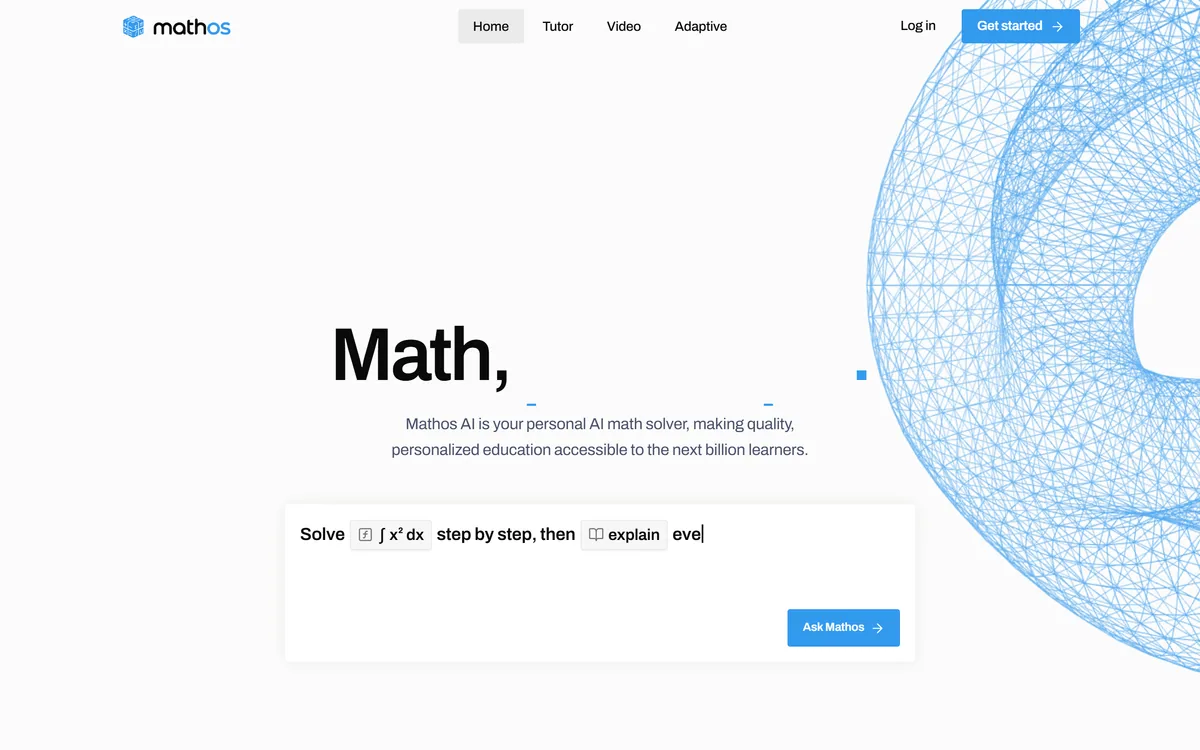
Last checked . Read from mathos.ai during this check, with the screenshot above captured at the same time.
Problem solving from photographs and PDFs stated on site, alongside typed input
Step-by-step solutions with numbered steps and detailed reasoning stated on site
Animated solution videos with editable components described, with the first frame stated at 5 to 10 seconds
Graphing calculator, whiteboard, quiz generation and flashcard creation all named on site
Topics stated including algebra, calculus, optimisation, trigonometry, geometry and applied physics and engineering problems
Levels described as high school through advanced undergraduate
Web application plus iOS and Android apps
Interface elements indicating multiple language support including Spanish and Japanese
Vendor states millions of students and active users across 100+ countries
Y Combinator Winter 2024 batch, Forbes 30 Under 30 cofounder recognition in 2024, an iF Design Award in 2026 and SXSW EDU 2025 finalist status cited on site
Free tier with basic solving, Pro mode, a 3-day trial and cancellation at any time; no plan prices published here, in line with this site's pricing policy
Reliability claims on the site are user testimonials rather than measurements, and no maths AI should be treated as infallible — failures cluster on multi-step word problems and problems needing insight rather than procedure. User and country figures are the vendor's own. Check any work that counts towards a grade against a second source, and confirm the tool transcribed the problem correctly before trusting the solution.
Editor's Verdict
3.9/5
Mathos AI has an AInexfinder Editor Score of 3.9/5.
Mathos AI pricing
AInexfinder does not list plan prices or billing details. For current pricing, plans, and trials, visit the official Mathos AI website.
Vendor pricing, credits, and billing policies change over time. Always confirm on the official site before you buy.
Frequently asked questions
Can Mathos AI solve a problem from a photo?
Yes — photographs and PDFs are both accepted alongside typed input. That matters more in maths than elsewhere, because entering notation like integrals, matrices and nested fractions is itself a barrier for a student who is already stuck.
Is Mathos AI free?
There is a free tier with basic problem solving, a Pro mode above it and a three-day trial, with cancellation stated as available at any time. Expect video generation to sit on the paid tier, since it is materially more expensive to run than text.
How accurate is AI at solving maths problems?
Routine arithmetic and standard procedures are now handled very reliably. Failures cluster on multi-step word problems and questions requiring insight — choosing a substitution or spotting which theorem applies. Check anything that counts towards a grade against a second source.
What level of maths does Mathos cover?
High school through advanced undergraduate, spanning algebra, calculus, optimisation, trigonometry and geometry, plus applied problems in physics and engineering. Beyond that level it is outside the stated scope.
Does using an AI maths solver count as cheating?
It depends entirely on how it is used, and your institution's policy is the authority. Attempting a problem and then reading the steps to see where you went wrong is studying; photographing a problem set and copying answers is not. No feature distinguishes the two.
Why are the animated videos useful?
Because mathematics is sequential and often visual, and a static list of steps loses the sense of transformation. Watching area accumulate under a curve communicates integration far better than a paragraph, which is why the videos are more than presentation.
Mathos vs Khanmigo — which is better for learning?
Khanmigo deliberately withholds the answer and prompts you toward it, which is stronger pedagogy if a student will engage with it. Mathos gives the worked solution with steps and video, which is more useful when someone is genuinely stuck and has nobody to ask.
Daniel reviews AI tools the slow way — by actually using them on real projects. His reviews cover what works, what breaks, and who each tool is genuinely a good fit for.
Daniel and the AInexfinder editorial team research Mathos AI using public product information, listing evidence, and (when available) hands-on checks. Scores reflect listing completeness and transparency — not paid placement.
Listings may include affiliate or sponsored placements, which are labeled when present. Editorial scores and cons are not sold. See our affiliate disclosure and review methodology.
LUCA is a K-12 reading intervention platform that analyses student reading at the phoneme level rather than the word level, identifying skill gaps in real time. It reports a 17.4 words-per-minute average fluency gain and 763,000+ grapheme-phoneme mappings, delivered through SoundScout, StoryGen and Assessment Intelligence.
RemNote combines outlining, handwriting, PDF annotation and spaced-repetition flashcards in one document, generating cards, quizzes and summaries from PDFs, slides, lecture transcripts and video, with an exam scheduler that works backwards from a date you set.
Question AI is a homework-helper app that scans a question and returns step-by-step answers across school subjects, plus AI writing, search, translation and summarizing. Its study uses are legitimate; using it to hand in answers or graded work crosses academic-integrity lines, which we weigh honestly.
Gizmo is a mobile-first study app that turns your notes, PDFs, slides and YouTube videos into AI-generated quizzes and flashcards, built around active recall so revision becomes a habit rather than a chore.
StudyFetch turns course material — PDFs, slides, lecture recordings, YouTube videos, photographed notes — into flashcards, quizzes, summaries and an AI tutor called Spark.E that answers only from your uploaded content.
ThetaWise is a STEM study tool covering maths, science and engineering with step-by-step solutions, a Tutor Mode that guides through hints, generated animated video lessons, practice quizzes, flashcards and Desmos graphing, stating 765,781 students.